

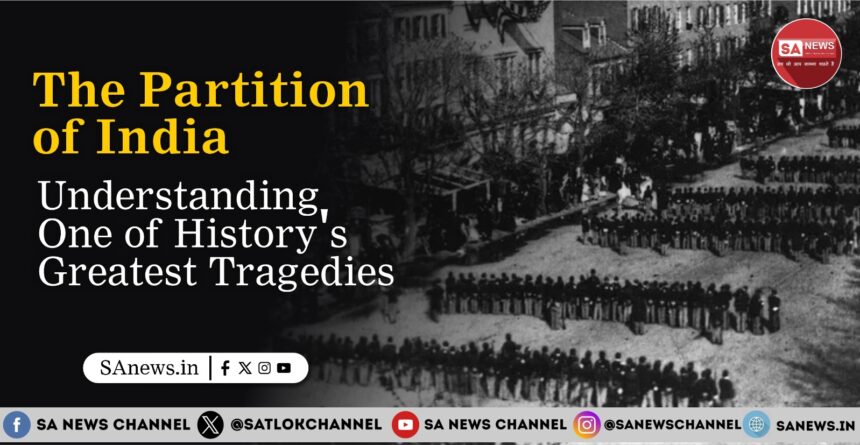
Partition of India 1947: When India gained independence in 1947, it should have been a moment of pure celebration. Instead, it became one of the darkest chapters in modern history. The British did not just leave, they split the country in two, creating India and Pakistan. What followed was catastrophic: roughly 15 million people were forced from their homes, and somewhere between one and two million were killed in horrific communal violence.
- How Did We Get Here?
- Why Did Partition Happen?
- The Two-Nation Theory
- The Last Attempt to Keep India Together
- Britain’s Rush to Leave
- When Violence Spiralled Out of Control
- Drawing the Border: A Catastrophic Mistake
- Where It Was Worst: Punjab and Bengal
- The Great Migration
- The Human Cost
- The Immediate Aftermath
- Why It Still Matters Today
- Common Myths vs. Reality
- Why You Should Care
- Frequently Asked Questions
- Who was responsible for partition?
- What was the Radcliffe Line?
- How many people died?
- Why was it so violent?
- Did Gandhi support partition?
- When History Breaks, Meaning Must Be Rebuilt
This was not some ancient religious conflict finally boiling over. It was a political disaster, largely made worse by how the British handled their exit. Let us look at what really happened, and why it still matters today.
How Did We Get Here?
The British Set the Stage
To understand why India was partitioned, we need to go back further than 1947. The British did not accidentally stumble into dividing India. They had been laying the groundwork for decades.
After taking direct control of India in 1857, the British realised that a unified India might eventually kick them out. So they adopted a strategy of divide and rule. They started categorising people rigidly by religion in the census and gave different religious groups separate voting systems.
The Morley-Minto Reforms of 1909 were particularly damaging. They created separate electorates for Muslims, meaning Muslim politicians could only be elected by Muslim voters, and Hindu politicians by Hindu voters. This made religion the defining factor in politics, turning what had been more fluid identities into hard, competing camps.
Two Communities Drift Apart
By the early 1900s, the damage was showing. The Indian National Congress was officially secular, but many Muslims saw it as dominated by upper-caste Hindus. Meanwhile, the All India Muslim League, founded in 1906, started claiming to speak for all of India’s Muslims.
These were not natural divisions. They were manufactured by a political system that made people compete along religious lines.
Why Did Partition Happen?
The Two-Nation Theory
Muhammad Ali Jinnah, leader of the Muslim League, developed what he called the Two-Nation Theory. His argument was straightforward but explosive: Hindus and Muslims were not just different religious groups. They were completely separate nations with different cultures and values. In a unified India, he argued, Muslims would always be a minority and therefore always vulnerable.
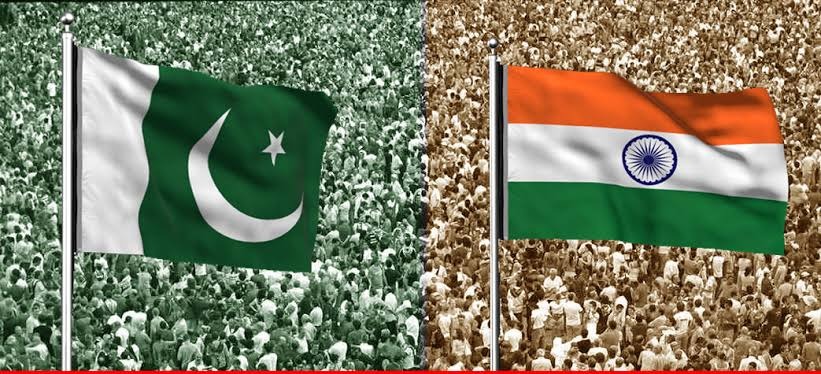
By 1940, the Muslim League was formally demanding separate Muslim-majority states in northwestern and eastern India. Pakistan was no longer just an idea. It was a political demand backed by mass support.
The Last Attempt to Keep India Together
In 1946, the British Cabinet Mission tried one last time to avoid partition. They proposed a creative solution. India would stay united but with a very weak central government. Different groups of provinces would have significant autonomy, giving Muslim-majority areas protection without splitting the country.
At first, both the Congress and the Muslim League accepted this plan. But then Jawaharlal Nehru, who would become India’s first Prime Minister, publicly suggested that Congress might change the arrangement once in power. Jinnah felt betrayed and pulled out. That was essentially the end. Partition became inevitable.
Britain’s Rush to Leave
After World War II, Britain was broke and exhausted. The new Labour government wanted out of India quickly. They sent Lord Mountbatten as the final Viceroy with orders to wrap things up.
Then Mountbatten made a stunning decision. He moved the independence date from June 1948 to August 1947. This meant dividing an entire subcontinent, with all its complexity, in just 72 days. It was administrative madness, and it cost countless lives.
When Violence Spiralled Out of Control
On August 16, 1946, the Muslim League called for “Direct Action” to demand Pakistan. In Calcutta, this turned into days of horrific killing. The violence spread to other regions, and suddenly the abstract political debate about partition had become a bloody reality on the streets.
Drawing the Border: A Catastrophic Mistake
Perhaps nothing symbolises the disaster of partition better than how the actual border was drawn.
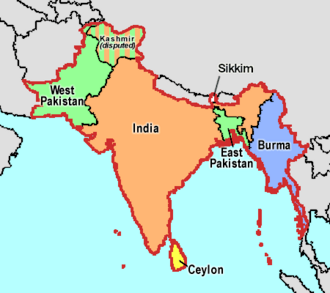
The job went to Sir Cyril Radcliffe, a British lawyer who had never even been to India before. He had five weeks to divide Punjab and Bengal based on which areas had Muslim or non-Muslim majorities.
Radcliffe worked with outdated maps and almost no understanding of how people actually lived. The line he drew cut through villages, split irrigation systems, divided industrial areas, and in some cases literally ran through people’s homes.
Here is the really shocking part. Radcliffe finished drawing the border on August 12, 1947. But Mountbatten did not publish it until August 17, two days after independence. Millions of people celebrated independence not knowing which country they were now in. When the announcement finally came, chaos erupted.
Where It Was Worst: Punjab and Bengal
Punjab: Unimaginable Horror
Punjab saw the worst violence. The region had a mixed population of Muslims, Hindus, and Sikhs living together. The new border split right through Sikh areas, leaving many of their holiest sites in Pakistan.
What happened next was ethnic cleansing on both sides. In West Punjab, which became part of Pakistan, Hindus and Sikhs were systematically driven out or killed. In East Punjab, India, the same happened to Muslims.
The stories are haunting. Trains would arrive in Lahore or Amritsar filled with nothing but corpses. They became known as “ghost trains”. The agricultural canal colonies that had been thriving communities became mass graves.
Bengal: A Slower Tragedy
Bengal was divided into West Bengal, India, and East Pakistan, which later became Bangladesh. The violence here was initially less intense, partly because Mahatma Gandhi personally went to Calcutta to try to maintain peace.
But the division still caused enormous suffering. Calcutta, the major industrial centre, went to India, leaving East Pakistan economically crippled from the start. This set the stage for the tensions that would eventually lead to the Bangladesh independence war in 1971.
The Great Migration
What happened next was the largest mass migration in human history. About 15 million people crossed the new borders, going in both directions.
Picture this. Refugee columns sometimes stretched for 50 miles, people walking with whatever they could carry. These columns were often attacked by armed mobs. Massive refugee camps sprang up. The Purana Qila fort in Delhi sheltered thousands of Muslims waiting to leave for Pakistan.
Also Read : A Complete History from Prehistoric Times to Early Empires
This was not just people moving. Entire communities were uprooted. Business owners, skilled workers, farmers, all suddenly displaced. The economic impact was devastating for both new countries.
The Human Cost
The death toll estimates range from one to two million people. But numbers do not capture what actually happened.
Violence Against Women
Women suffered especially. An estimated 75,000 to 100,000 women were abducted, raped, or forced to convert.
In a particularly horrifying aspect, many families killed their own women, daughters and wives, to prevent them from being captured by the “other” community. This was considered protecting honour.
After partition, both governments tried to recover and return abducted women. But many of these women, having been forced into new families or fearing rejection, did not want to return. The recovery operations often created new trauma.
Neighbours Killing Neighbours
This was not like a conventional war between armies. Neighbours turned on neighbours. People who had lived side by side for generations suddenly became enemies. When the British government collapsed, it created a vacuum where old grievances and disputes over land and property got settled through violence, all justified with religious rhetoric.
The Immediate Aftermath
India and Pakistan were born into crisis.
The entire government had to be divided. Civil servants, police officers, military units, all split along religious lines. They even divided office supplies and library books.
In October 1947, just weeks after independence, war broke out over Kashmir. Tribal fighters backed by Pakistan invaded, and Kashmir’s ruler chose to join India. The partition had already become an armed conflict.
Then, on January 30, 1948, Mahatma Gandhi was assassinated by a Hindu nationalist who blamed him for “appeasing” Muslims and enabling partition. Even the man who had opposed partition most strongly became its victim.
Why It Still Matters Today
The partition did not end in 1947. We are still living with its consequences.
The Nuclear Threat: The insecurity created by partition has led both India and Pakistan to develop nuclear weapons. South Asia is now one of the most dangerous nuclear flashpoints in the world.
Bangladesh: In 1971, East Pakistan broke away to become Bangladesh after a brutal war. The Two-Nation Theory, that Muslims and Hindus could not live together, was essentially disproven when Muslims from East and West Pakistan could not stay united.
Minority Issues: The treatment of Muslims in India and Hindus in Pakistan remains a contentious political issue in both countries, with debates often referencing partition.
Divided Families: The border between India and Pakistan is so militarised you can see it from space, because of the floodlights. Families split by partition often cannot visit each other because of visa restrictions and political tensions.
Also Read: From Colonies to Superpower: The American History
Common Myths vs. Reality
Myth: “It was a peaceful transfer of power.”
Reality: This is British propaganda. It was one of the bloodiest events in modern history.
Myth: “Partition was inevitable.”
Reality: Until late 1946, it could have been avoided. Specific political failures made it happen.
Myth: “It was purely a religious war.”
Reality: While religion was the rallying cry, much of the violence was driven by desires for land, loot, and settling personal scores.
Myth: “Jinnah wanted an Islamic theocracy.”
Reality: In his August 11 speech, Jinnah envisioned a secular Pakistan. The religious character came later.
Why You Should Care
The partition of India is not just history. It is a living memory in South Asia. It explains Kashmir. It explains India Pakistan tensions. It explains identity struggles among South Asian diaspora communities worldwide.
It is also a warning. It shows what happens when politicians play with communal identities for short-term gain. It shows what happens when colonial powers draw borders without caring about the people who live there. And it shows how quickly civilisation can collapse when institutions fail.
Frequently Asked Questions
Who was responsible for partition?
Blame is shared. The British rushed the timeline and used divide and rule tactics for decades. Jinnah and the Muslim League pushed for a separate state. The Congress leadership eventually accepted it to secure a strong central government for India.
What was the Radcliffe Line?
The border drawn by Sir Cyril Radcliffe that divided Punjab and Bengal between India and Pakistan. It was announced on August 17, 1947.
How many people died?
We do not have exact numbers, but historians estimate between one and two million.
Why was it so violent?
The British left a power vacuum. The rushed timeline, just 72 days, meant there was no proper planning. Security forces were inadequate. Years of inflammatory political rhetoric had poisoned relations between communities.
Did Gandhi support partition?
No. Gandhi called it the “vivisection” of India and opposed it until the end. But the Congress leadership sidelined him in the final negotiations.
The partition of India reminds us that the lines on maps represent real lives. When those lines are drawn carelessly or in haste, the human cost can be staggering. Seventy-five years later, South Asia is still trying to heal from those wounds.
When History Breaks, Meaning Must Be Rebuilt
The Partition of India exposes how quickly politics can fracture societies and how fragile human order becomes when fear replaces wisdom. Beyond borders and numbers lies a deeper question: what anchors human life when institutions fail? History records the collapse, but it also invites reflection on purpose, ethics, and our connection to something higher than power and identity.
In moments of collective trauma, spiritual inquiry often begins, not as escape, but as orientation. For readers drawn to that search, books like “Gyan Ganga” and “Way of Living” by Saint Rampal Ji Maharaj offer a reflective path toward inner clarity, authentic worship, and disciplined compassion. They do not rewrite history. They ask how we live wisely within it.