

NCERT Class 8 Social Science Textbook Controversy: There are very few chances that you have usually seen people sitting in protests because of school textbooks. However, in February 2026, a Class 8 Social Science textbook published by NCERT unexpectedly became the center of a national controversy.
A discussion that initially seemed to be about a classroom chapter on the judiciary soon expanded into a national debate involving the Supreme Court, the Ministry of Education, and education policymakers.
The key issue centered on a chapter discussing the role of the judiciary in a democratic system. The chapter aimed to educate students about courts and highlight their importance in safeguarding people’s rights; however, some critics felt that the chapter presented the judicial system in a negative light.
Within days of the controversy emerging in late February 2026, the issue reached the Supreme Court of India. As criticism intensified, NCERT eventually decided to withdraw the textbook from circulation.
This incident has sparked a wider debate about how sensitive institutions should be represented in school textbooks.
What the Textbook Was Trying to Explain
The book titled Exploring Society: India and Beyond – Part II was introduced for Class 8 students as part of the revised NCERT Social Science curriculum in 2026. It aimed to help middle-school students understand Indian society, governance structures, and democratic institutions.
One chapter focused on the judiciary and attempted to explain how courts interpret laws, resolve disputes, and uphold the Constitution of India.
The chapter covered concepts such as:
- the structure and hierarchy of courts in India
- the principle of judicial independence
- the role of courts in protecting citizens’ rights
Its primary aim was to introduce students to the functioning of the justice system in a democracy. However, the chapter also mentioned issues such as delays in the justice delivery system, case backlogs, and references to corruption within parts of the judiciary. These references were intended to illustrate challenges within the system, but they quickly became the most controversial parts of the chapter.
Some critics felt that such sensitive topics were introduced to students without sufficient context or balance.
How the Controversy Began
The controversy began around 24–25 February 2026 when portions of the chapter started circulating on social media and news platforms.
Many commentators argued that the way the judiciary was discussed might create a negative perception among young students. Questions were also raised about the editorial review process before the textbook was published. Since NCERT textbooks are widely used in schools across India, the issue quickly attracted national attention.
For many observers, the debate was not just about a single chapter but about how educational materials should approach discussions about public institutions.
Supreme Court’s Intervention
The issue escalated on 26 February 2026, when concerns about the judiciary chapter reached the Supreme Court of India. The controversy intensified when the Court took note of the issue and expressed concern over the portrayal of the judiciary in the textbook. During the proceedings, the bench emphasized the responsibility of educational institutions and textbook authors when discussing constitutional institutions. The Court stressed that educational content discussing institutions like the judiciary should remain balanced and carefully contextualized.
Following these developments, steps were taken to halt the circulation of the textbook while the matter was reviewed.
NCERT’s Response and Apology
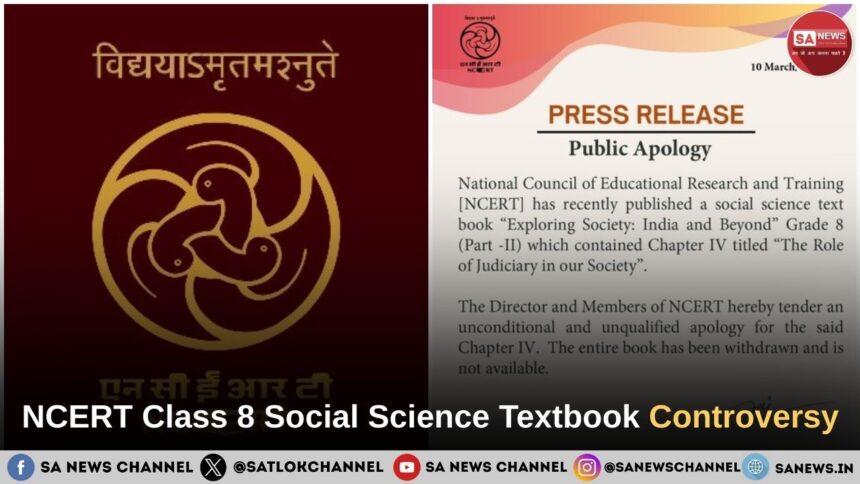
As the controversy grew, NCERT announced on 10 March 2026 that it would withdraw the Class 8 Social Science textbook from circulation.
The council issued an “unconditional and unqualified apology” for the controversy created by the chapter. In its statement, NCERT explained that the withdrawal was intended to prevent confusion among students and teachers.
It also assured the public that the content of the chapter would be reviewed and revised before any future publication. According to officials, subject experts and academic reviewers would reassess the chapter to ensure that it remained educationally accurate while presenting institutions responsibly.
Debate Within the Academic Community
The controversy has triggered widespread debate among educators, scholars, and policy experts. Many academics argue that school education should encourage students to think critically about democratic institutions.
According to this view, discussing challenges such as delays in justice or institutional reforms can help students better understand how democracy functions. However, others argue that school textbooks must be particularly careful when discussing sensitive institutional issues. They believe that young students may lack the background knowledge needed to interpret complex debates about governance and institutional accountability. Therefore, many experts have suggested that complex institutional issues should be explained in simplified and balanced ways for school audiences.
What the Controversy Means for Education Policy
Although the curriculum attempt has now been halted, the NCERT Class 8 Social Science textbook controversy highlights the importance of strong editorial and review processes in educational publishing.
Textbooks play a crucial role in shaping students’ understanding of democratic institutions and governance structures. This incident may encourage policymakers to examine more closely how school textbooks are reviewed and approved before publication. The education ministry may also consider developing clearer guidelines on how institutions such as the judiciary, legislature, and executive should be discussed in school curricula. At the same time, the controversy highlights an ongoing tension between encouraging open discussion and maintaining institutional sensitivity in education.
Conclusion
The NCERT Class 8 Social Science textbook controversy demonstrates how even a single chapter in a school textbook can spark a nationwide debate.
Although the textbook has now been withdrawn and an apology issued, the questions raised by the controversy continue to remain relevant.
- What role should schools play in explaining public institutions?
- How can textbooks encourage critical understanding without misrepresentation?
- What balance should exist between discussion and institutional respect?
As NCERT reviews and revises the textbook, the answers to these questions may influence how future generations learn about the institutions that sustain India’s democracy.
A Spiritual Perspective on Justice and Ethics
Discussions about institutions like the judiciary also remind society of the importance of moral values and ethical awareness. Spiritual leaders have often emphasized that justice begins with individual integrity, awareness, and righteousness. The teachings of Sant Rampal Maharaj frequently highlight the importance of truth, fairness, and moral conduct in building a balanced society. According to his discourses, a just society is sustained not only through laws and courts but also through individuals who follow ethical principles and spiritual understanding. His teachings encourage people to reflect on the deeper meaning of justice, responsibility, and social harmony.
Readers interested in exploring this perspective further can learn more through the spiritual knowledge shared by Sant Rampal Maharaj on the official website www.jagatgururampalji.org or the Saint Rampal Ji Maharaj YouTube channel, which is dedicated to sharing his spiritual teachings and discourses.