

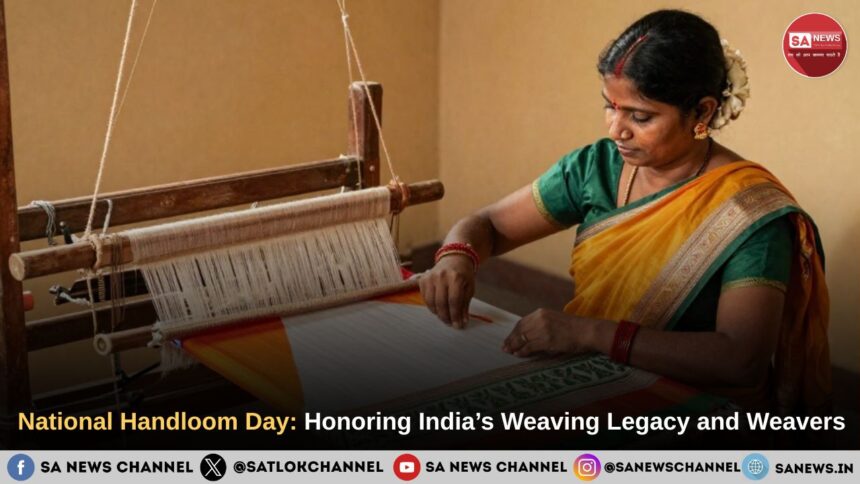
National Handloom Day 2026: India observes National Handloom Day every year on 7 th August to celebrate the country’s weaving legacy and pay tribute to millions of artisans who have contributed to the art. It is an excellent opportunity to appreciate India’s weaving legacy and promote the purchase of handwoven products.
- National Handloom Day 2026: Key Highlights
- National Handloom Day Significance
- India’s Handloom Weaving Legacy
- Handloom Art and Sustainable Development
- Government’s Initiatives for Handloom Weavers
- Challenges Facing Handloom Weaving in India
- Why We Should Support Handloom Weaving?
- Celebrations of National Handloom Day in India
- Economic Importance of Handloom Weaving in India
India’s handloom industry is one of the most promising sectors in the country. Handloom products are produced using traditional weaving techniques. National Handloom Day is observed nationwide to create awareness about the art of handlooms and its importance.
National Handloom Day 2026: Key Highlights
1. National Handloom Day: Know the Significance, History and Role of Handlooms in India’s Swadeshi Movement
2. India’s Rich Handloom Heritage: Exploring Centuries-Old Weaving Traditions and Craftsmanship
3. Sustainable Handloom: How Traditional Indian Weaving Promotes Eco-Friendly Living
4. Empowering India’s Handloom Weavers: Key Government Schemes, Support and Development Initiatives
5. Technology Meets Tradition: How Digital Innovation Is Transforming India’s Handloom Industry
6. India’s Handloom Industry Under Pressure: Key Challenges Threatening Traditional Weaving
7. Support Handloom, Support Sustainability: Preserving India’s Craft and Empowering Artisans
8. National Handloom Day in India: Celebrating Weavers, Crafts and the Nation’s Textile Heritage
9. India’s Handloom Economy: How Traditional Weaving Drives Jobs, Exports and Allied Industries
10. India’s Handloom Revolution: Empowering Artisans, Supporting Women and Strengthening the Economy
National Handloom Day Significance
India observes National Handloom Day on 7 th August nationwide to commemorate the beginning of the Swadeshi Movement in 1905. The Swadeshi Movement encouraged people to boycott foreign goods and promoted the use of indigenous products.
India’s handloom industry has been playing a significant role in the freedom struggle of the country. National Handloom Day was declared as India’s National Handloom Day in 2015 to acknowledge the art’s significance.
India’s Handloom Weaving Legacy
India has one of the most prominent weaving legacies in the world. Different states have their own weaving legacy, motifs, and patterns. Weaving traditions are embedded in the lives of millions of Indians, and the art has been passed down through generations.
India’s famed handloom products include Banarasi, Bandhani, Pochampally, Chanderi, Kanchipuram, and Assam Muga silk Handloom weaving has been an integral part of Indian history and culture for centuries. In addition to being an art form, handloom weaving has been a source of livelihood for millions of Indians for centuries.
Handloom Art and Sustainable Development
Handloom weaving art has made significant progress towards sustainable development. Handloom products are in demand worldwide because of their eco-friendliness. Handwoven products have a lesser carbon footprint compared to other textile products. Handloom weaving has been an excellent choice for individuals looking to embrace a sustainable lifestyle.
Handloom weaving products are unique and use traditional weaving methods to produce high-quality products. Products are durable and preferred by individuals looking to minimize their impact on the environment. Handloom weaving has been an essential part of India’s handcrafted legacy.
Government’s Initiatives for Handloom Weavers
The government takes care of handloom weaving art through various initiatives. Some of the government’s initiatives include providing financial assistance to handloom weavers, skill development programs, marketing assistance to weavers, promotion of GI-tagged handloom products, and social security schemes for handloom workers.
The government also promotes handloom weaving clusters and creates awareness about handloom weaving art. Handloom weaving has great potential in India, and the government makes all efforts to ensure that the art thrives in the country.
Technology and Handloom Weaving
Handloom weaving has gone through various phases of development, and currently, it is in the era of digital weaving. Handloom weaving has embraced digital technology, allowing artisans to sell their products online. In addition, digital weaving has created an online marketplace, enabling artisans to sell their products locally and internationally.
Digital weaving has helped weavers overcome challenges such as lack of proper marketing and middlemen. Social media has also played a significant role in promoting handloom weaving products and creating brand value for handloom weaving art. Handloom weaving has experienced a tremendous upsurge due to the adoption of digital weaving technology.
Challenges Facing Handloom Weaving in India
Handloom weaving faces numerous challenges hindering its growth and development in India. Some of the challenges facing handloom weaving include competition with machine-made products, rising raw material costs, lack of modern technology, and lack of interest in learning the art.
Other challenges associated with handloom weaving include inadequate marketing and branding strategies and unpredictable income for handloom weavers. Experts recommend that India’s handloom weaving art requires proper policy support, financial assistance, marketing and branding strategies, design and skill development, and better market linkages.
Why We Should Support Handloom Weaving?
Handloom weaving products are unique and use traditional weaving techniques. Handloom weaving requires a lot of skills, and every product that comes from handloom weaving represents the weavers’ hard work and dedication. Handlooms are not only an art form but also promote sustainable development.
Handloom weaving products support sustainable development in various ways. First, they promote sustainable livelihood by providing employment to millions of Indians. Handloom weaving products also help conserve India’s rich weaving legacy. Handloom weaving products are made using traditional weaving techniques that are eco-friendly.
Handloom weaving products are handcrafted, and, therefore, unique. These products are made using natural fibers that have a lesser carbon footprint compared to other textile products. Handloom weaving products promote sustainable development while conserving India’s weaving legacy.
Handloom weaving products are in great demand worldwide because of their unique designs and eco-friendliness. These products have enormous potential in promoting sustainable development while providing sustainable livelihood to millions of Indians.
Celebrations of National Handloom Day in India
National Handloom Day is widely celebrated across India with great enthusiasm and energy. Government and private organizations hold various programs and events to mark this day. Handloom fairs and melas are also organized across the country to mark the day. Handloom exhibitions, fairs, and melas are also held in different states to mark the day.
Handloom fairs and exhibitions mark the day, and cultural events are also held to mark the day. National Handloom Day is also marked by felicitating handloom weavers for their exceptional contribution to the art of handloom weaving. People all over the country are encouraged to wear handloom products on this day.
Economic Importance of Handloom Weaving in India
Handloom weaving holds great economic importance in India. Handloom weaving plays a significant role in India’s economy, as it creates employment for millions of Indians. Handloom weaving also contributes significantly to India’s foreign exchange earnings.
Handloom weaving also promotes the growth of ancillary industries such as the spinning and dyeing industry, embroidery, handicrafts, and textile printing. Handloom weaving has great potential in India, and its economic importance cannot be underestimated.
The Future of Handloom in India: Empowering Artisans, Driving the Economy and Building a Sustainable Future
Handloom weaving has the potential to provide sustainable livelihood to millions of people in India. Handloom weaving promotes female empowerment by providing employment to many women. Handloom weaving products are in great demand worldwide, and, therefore, there is great potential for India to become a superpower in the handcrafted industry. Handloom weaving products have the potential to contribute immensely to India’s economy.