

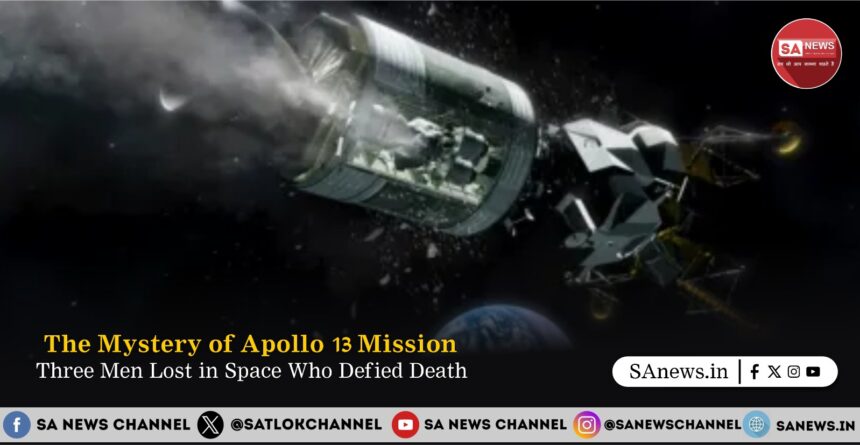
Imagine you are trapped in a tin can hurtling through the vacuum of space, 200,000 miles from home. Your oxygen is leaking into the void. Your spacecraft is crippled. The temperature inside plummets below freezing. You have no way to call for help except a radio, and even if Earth can hear you, they cannot reach you. You are alone in the most hostile environment humans have ever encountered, and every breath might be your last.
- The Road to the Moon: Understanding Apollo 13’s Mission
- The Crew: Three Men Chosen for Glory, Tested by Catastrophe
- Jim Lovell: The Veteran Commander
- Jack Swigert: The Last-Minute Replacement
- Fred Haise: The Lunar Module Specialist
- Launch and Early Mission: Everything According to Plan
- The Explosion: When Everything Changed in an Instant
- Understanding What Went Wrong: The Anatomy of a Disaster
- The Desperate Fight for Survival: Aquarius Becomes a Lifeboat
- The Carbon Dioxide Crisis: A Race Against Suffocation
- Survival in the Deep Freeze
- A Record Nobody Wanted: Farthest From Earth
- The World Watches and Prays
- The Final Challenge: Re-entry
- The Aftermath: Lessons Written in Survival
- The Eternal Quest: From Space Exploration to Spiritual Enlightenment
This was not science fiction. This was the terrifying reality facing three American astronauts on April 13, 1970, when an explosion ripped through their spacecraft, transforming a routine mission to the Moon into the most dramatic rescue operation in human history.
The words crackled across 200,000 miles of empty space: “Houston, we’ve had a problem.” Those seven words marked the beginning of a six-day ordeal that would test the absolute limits of human ingenuity, courage, and determination. Against impossible odds, with the entire world watching and praying, three men fought their way back from the edge of the abyss.
This is the complete story of Apollo 13, how a “successful failure” became one of humanity’s finest hours.
The Road to the Moon: Understanding Apollo 13’s Mission
To understand what went wrong, you first need to understand what Apollo 13 was supposed to accomplish.
By April 1970, the Apollo program was hitting its stride. Neil Armstrong and Buzz Aldrin had walked on the Moon during Apollo 11 in July 1969, achieving President John F. Kennedy’s goal of landing Americans on the lunar surface before the decade ended. Apollo 12 followed in November 1969 with a precision landing near the Surveyor 3 spacecraft, proving NASA could target specific locations.
Apollo 13 was designed to be the third Moon landing. The mission’s primary objective was to explore the Fra Mauro highlands, a hilly region formed by debris from the impact that created the Mare Imbrium basin. Scientists believed this area contained some of the Moon’s oldest exposed rock, potentially offering insights into the early history of our solar system.
The mission plan called for Commander Jim Lovell and Lunar Module Pilot Fred Haise to spend 33.5 hours on the lunar surface, conducting two moonwalks totalling about nine hours. They would collect geological samples, take photographs, and deploy scientific instruments including a seismometer to detect moonquakes and a device to measure the solar wind.
Meanwhile, Command Module Pilot Jack Swigert would orbit the Moon in the Command Service Module “Odyssey,” conducting observations and waiting to retrieve his crewmates after their exploration.
The mission was expected to last approximately 10 days from launch to splashdown. Instead, it would become a desperate race against time, equipment failure, and the unforgiving laws of physics.
The Crew: Three Men Chosen for Glory, Tested by Catastrophe
Jim Lovell: The Veteran Commander
At 42 years old, James Arthur Lovell Jr. was NASA’s most seasoned space traveller. A 1952 graduate of the United States Naval Academy, Lovell had served as a naval aviator and test pilot before joining NASA’s second astronaut group in 1962.
By the time Apollo 13 launched, Lovell had accumulated 572 hours in space, more than any other NASA astronaut. He had flown on Gemini 7 (1965), Gemini 12 (1966), and Apollo 8 (1968), the first mission to orbit the Moon. His experience, particularly his circumlunar flight on Apollo 8, made him the ideal commander for this complex mission.
Lovell had been scheduled to command Apollo 14, but when Alan Shepard’s crew needed additional training time, Lovell’s crew was moved up to Apollo 13. He would have become the fifth person to walk on the Moon. Instead, he would face the fight of his life.
Jack Swigert: The Last-Minute Replacement
John Leonard “Jack” Swigert Jr., 38, brought impressive credentials to the mission despite being a spaceflight rookie. He held a Bachelor of Science in mechanical engineering from the University of Colorado and a Master of Science in aerospace science from Rensselaer Polytechnic Institute. An Air Force veteran and engineering test pilot, Swigert had also served in various Air National Guard units.
But Swigert was not supposed to be on Apollo 13 at all.
The original command module pilot was Ken Mattingly, who had trained extensively with Lovell and Haise. Just 72 hours before launch, NASA flight surgeon Dr. Charles Berry discovered that Mattingly had been exposed to German measles (rubella) through the children of backup crew member Charlie Duke. Blood tests showed Mattingly had no immunity to the disease.
Dr. Berry recommended replacing Mattingly with his backup, Jack Swigert, to avoid the possibility of Mattingly becoming ill during the mission, a potentially catastrophic scenario if symptoms appeared during critical lunar operations. Despite Lovell’s protests that his crew was ready and that Mattingly probably would not get sick, NASA management made the decision to swap pilots.
Swigert had to rapidly integrate with a crew he had trained with only as a backup. He had just 72 hours to prepare for his first spaceflight. This last-minute change would prove both challenging and fortunate. Swigert’s cool-headed professionalism during the crisis would be instrumental in the crew’s survival.
Fred Haise: The Lunar Module Specialist
Fred Wallace Haise Jr., 36, was also making his first spaceflight. Born in Biloxi, Mississippi, Haise had studied engineering and served as a Marine Corps fighter pilot before becoming a research pilot and test pilot for NASA at Lewis Field, now Glenn Research Center.
As Lunar Module Pilot, Haise had spent countless hours training in simulators, learning every system of the spacecraft he and Lovell would fly to the Moon’s surface. His deep technical knowledge of the Lunar Module “Aquarius” would become critical, though not in the way anyone expected.
| Astronaut | Role | Age | Experience |
| Jim Lovell | Commander | 42 | 572 hours in space across three missions; Apollo 8 lunar orbit veteran |
| Jack Swigert | Command Module Pilot | 38 | First spaceflight; selected 72 hours before launch as replacement for Ken Mattingly |
| Fred Haise | Lunar Module Pilot | 36 | First spaceflight; expert in Lunar Module systems |
Launch and Early Mission: Everything According to Plan
On April 11, 1970, at 2:13 p.m. Eastern Standard Time (1:13 p.m. Central Standard Time), the massive Saturn V rocket lifted Apollo 13 from Launch Complex 39A at Kennedy Space Center in Florida. The launch appeared flawless to spectators, but there was an early anomaly.
The centre engine of the second stage shut down two minutes early, causing the remaining four engines to burn longer to compensate. This was concerning but not catastrophic. The spacecraft still achieved orbit successfully. Analysis later revealed that vibrations called “pogo oscillations” had triggered the premature shutdown, but the automatic systems compensated correctly.
After orbiting Earth to check all systems, the third stage engine fired again, sending Apollo 13 on its trajectory toward the Moon, a manoeuvre called trans-lunar injection. Everything proceeded normally for the next two days.
The crew conducted a live television broadcast showing viewers inside the spacecraft. Because this was NASA’s third lunar landing attempt, public interest had waned significantly. The major television networks declined to carry the broadcast live, a stark contrast to the worldwide attention commanded by Apollo 11 just nine months earlier.
Also Read: Srinivasa Ramanujan: The Man Who Knew Infinity | Biography & Legacy
Nobody realised they would soon be watching one of the most gripping survival dramas in human history.
The Explosion: When Everything Changed in an Instant
At 55 hours, 54 minutes, and 53 seconds into the mission, 9:08 p.m. Eastern Standard Time on April 13, 1970, Jack Swigert performed a routine procedure: stirring the oxygen tanks.
The spacecraft’s oxygen was stored in cryogenic tanks, extremely cold liquid oxygen, in the Service Module, which was attached to the Command Module. These tanks had fans inside to stir the oxygen, preventing it from stratifying into layers of different densities and ensuring accurate quantity readings.
Swigert flipped the switches to activate the stirring fans in both oxygen tanks.
Seconds later, the crew heard a loud bang. The spacecraft shuddered. Warning lights illuminated. Alarms sounded. Swigert looked at the instrument panel and saw that one oxygen tank’s pressure reading had dropped to zero. Then he noticed the second tank’s pressure was also falling rapidly.
At 9:08 p.m., Swigert radioed Mission Control: “Okay, Houston, we’ve had a problem here.”
Capsule communicator Jack Lousma responded: “This is Houston. Say again, please.”
Jim Lovell, now fully aware that something catastrophic had occurred, repeated: “Houston, we’ve had a problem. We’ve had a Main B Bus Undervolt.”
The crew initially thought a meteorite had struck the spacecraft, a rare but known risk of space travel. When Lovell looked out the window, he saw something far more terrifying: a cloud of gas venting into space. Their oxygen, the very air they needed to breathe, was escaping into the void.
Understanding What Went Wrong: The Anatomy of a Disaster
The explosion that crippled Apollo 13 was years in the making, the result of design changes, oversights, and warning signs that went unheeded.
In 1965, during the development of the Command Service Module, NASA made what seemed like a minor modification: increasing the voltage supplied to the heaters inside the oxygen tanks from 28 volts DC to 65 volts DC. This change was made to be compatible with ground support equipment at Kennedy Space Center.
However, the thermostatic switches that controlled these heaters, devices designed to prevent overheating, were not upgraded to handle the higher voltage. This seemingly small oversight created a ticking time bomb.
During the months before launch, the oxygen tank that would later explode was installed and filled for testing. After the test, workers attempted to drain the tank, but a malfunction prevented complete drainage. To empty the tank, technicians turned on the heaters to boil off the remaining oxygen.
Because the thermostatic switches could not handle 65 volts, they likely welded shut when they attempted to open, leaving the heaters running continuously. For eight hours, temperatures inside the tank reached approximately 1,000°F, far above the rated temperature of the Teflon insulation surrounding the electrical wiring.
This extreme heat severely damaged the Teflon insulation, exposing bare wires. But the damage was not visible from outside, and temperature sensors that might have detected the problem were located too far from the heaters to register the dangerous conditions. The tank appeared normal in all subsequent tests.
For months, Apollo 13 carried a bomb in its Service Module, damaged wiring inside an oxygen tank filled with pure oxygen, one of the most combustible environments imaginable.
When Swigert activated the stirring fans on April 13, the damaged wiring sparked. In the pure oxygen environment, the spark caused an immediate, violent combustion. The explosion ruptured the tank, and the escaping oxygen damaged the second tank’s plumbing, causing it to leak as well.
Within hours, Apollo 13 lost both oxygen tanks, which meant losing three critical systems:
- Breathing oxygen for the crew
- Water production through the fuel cells
- Electrical power because the fuel cells could no longer function
The Command Service Module “Odyssey” was dying. The Moon landing was impossible. Even returning to Earth was suddenly in doubt.
The Desperate Fight for Survival: Aquarius Becomes a Lifeboat
Mission Control immediately recognised the severity of the situation. Within hours, oxygen pressure in the second tank would drop to zero. The fuel cells would shut down. The Command Module would be completely dead with no power, no air, and no water.
The crew had only one option: shut down the Command Module to conserve its battery power for re-entry, and move into the Lunar Module “Aquarius.”
This presented an enormous problem. The Lunar Module was designed to support two people for approximately 45 hours during lunar operations. Now it would need to support three people for at least 90 hours during the long journey back to Earth.
| Challenge | Original Design | Crisis Requirement | Solution Implemented |
| Crew Size | 2 people | 3 people | Extreme rationing of all resources |
| Mission Duration | 45 hours | 90+ hours | Power down all non-essential systems |
| Water Supply | Adequate for 2 people/45 hours | Must sustain 3 people/90+ hours | Reduce consumption to 6 oz per person per day |
| Power Budget | Sufficient for lunar landing | Must reach Earth with reserve | Shutdown of guidance computer, heaters, instruments |
| CO₂ Removal | Round lithium hydroxide canisters | Needed additional square canisters from CM | Improvised adapter using duct tape and materials |
The crew executed the shutdown procedures for the Command Module, carefully preserving battery power that would be absolutely critical for re-entry. They transferred to Aquarius, the spacecraft that was supposed to land them on the Moon but would now serve as their lifeboat.
The Carbon Dioxide Crisis: A Race Against Suffocation
Approximately 36 hours after moving into Aquarius, a new life-threatening problem emerged: carbon dioxide buildup.
Human breathing produces carbon dioxide (CO₂). In Earth’s atmosphere, this is not a problem because plants absorb CO₂ and produce oxygen. But in a sealed spacecraft, CO₂ accumulates rapidly and becomes toxic at high concentrations, causing headaches, dizziness, impaired judgement, unconsciousness, and eventually death.
Spacecraft use lithium hydroxide canisters to scrub CO₂ from the air through chemical absorption. The Lunar Module carried enough lithium hydroxide canisters to support two people for 45 hours. With three people aboard for four days, the canisters were exhausted far ahead of schedule.
The Command Module had plenty of spare lithium hydroxide canisters, but they were square. The Lunar Module’s environmental system was designed for round canisters. The shapes were completely incompatible.
As CO₂ levels climbed toward dangerous concentrations, engineers at Mission Control faced a seemingly impossible challenge: make a square peg fit in a round hole using only materials available on the spacecraft.
They had cardboard, plastic bags from space suit packaging, the covers of procedure manuals, duct tape, and a few other miscellaneous items. From these limited materials, engineers designed an adapter that could connect the square Command Module canisters to the round receptacles in the Lunar Module.
Also Read: Henrietta Lacks: The Woman Whose Cells Changed the Future of Medicine
Mission Control radioed up detailed instructions. The crew followed them precisely, constructing the makeshift adapter and installing it. They turned on the system and waited.
It worked. CO₂ levels began dropping to safe ranges.
This improvised solution, created under desperate time pressure with materials never intended for this purpose, saved three lives. It remains one of the most celebrated examples of engineering creativity under pressure.
Survival in the Deep Freeze
As the crew rationed power to extend Aquarius’s life support, the cabin became brutally cold. With most heaters shut down, temperatures dropped to approximately 38 to 40°F (3 to 4°C).
This might not sound extreme, but remember that the crew could not simply put on warmer clothes. They wore lightweight flight suits designed for a temperature-controlled environment. They were also dehydrated from strict water rationing, just 6 ounces per person per day, about one-fifth of normal intake, which made them more susceptible to cold.
The cold was relentless and inescapable. Condensation formed on the walls and equipment as the crew’s breath froze. They could not sleep properly, and exhaustion compounded their misery. Fred Haise’s condition deteriorated significantly, though the kidney infection he developed would not be diagnosed until after splashdown.
Every moment was a test of endurance: cold, dehydration, exhaustion, recycled air, the constant noise of Aquarius’s systems, and above all, the gnawing uncertainty of whether they would survive.
A Record Nobody Wanted: Farthest From Earth
As Apollo 13 swung around the far side of the Moon on its free-return trajectory back to Earth, the crew achieved a record that still stands today.
At 00:33 UTC on April 15, 1970, Apollo 13 reached its farthest point from Earth: 400,171 kilometres (248,655 miles) from our planet.
This remains the greatest distance from Earth ever achieved by human beings. No subsequent mission has taken people farther into space. Since the final Apollo mission in December 1972, no humans have even left low Earth orbit.
The record represents humanity’s deepest venture into the cosmos, achieved not in triumph, but during a desperate struggle for survival.
The World Watches and Prays
As news of the crisis spread, Apollo 13 became far more than an American space mission. It became a human story that transcended politics, nationality, and ideology.
In the midst of the Cold War, Soviet Premier Aleksey N. Kosygin sent a remarkable message: the Soviet government had ordered all citizens and military personnel to use any means necessary to assist the Apollo 13 crew. Soviet tracking stations monitored the spacecraft and stood ready to help with communications or recovery if needed.
Pope Paul VI led a congregation of 10,000 people at the Vatican in prayers for the astronauts’ safe return. In India, 100,000 people gathered at a religious festival to pray for three American astronauts they had never met.
On April 14, the United States Senate passed a resolution urging American businesses to pause at 9:00 p.m. local time to allow employees to pray for the crew’s safe return.
At Mission Control in Houston, hundreds of engineers, flight controllers, and support personnel worked around the clock. They ran countless simulations, tested procedures, and double-checked calculations. Flight Director Gene Kranz established one absolute rule: “Failure is not an option.”
The networks that had declined to broadcast Apollo 13’s routine television broadcast before the explosion now provided continuous coverage. Three men lost in space had captured the attention and hearts of the entire world.
The Final Challenge: Re-entry
On April 17, after four days in the frozen, damp Lunar Module, the crew faced their final test: re-entry.
They had to reactivate the Command Module “Odyssey,” which had been completely shut down for days. The condensation that had formed throughout the spacecraft raised serious concerns. Would the electrical systems work after being exposed to moisture in freezing temperatures?
The crew carefully executed the reactivation checklist, rationing power from the limited batteries. One by one, systems came back online. Everything worked.
They jettisoned the Service Module, which had housed the exploded oxygen tanks. For the first time, they saw the extent of the damage. An entire panel had been blown away, exposing the interior structure. It was a miracle the Command Module had not been destroyed.
Next, they separated from Aquarius, the Lunar Module that had kept them alive. As it drifted away, Lovell said a silent farewell to the spacecraft that had become their home and salvation.
The Command Module Odyssey entered Earth’s atmosphere at approximately 25,000 miles per hour, protected by its heat shield. Radio contact was lost during the normal communications blackout caused by the superheated plasma surrounding the spacecraft during re-entry.
The blackout typically lasted three minutes. Four minutes passed. Five minutes. Mission Control grew tense. Had something gone wrong in the final moments?
Then, at six minutes, the cameras caught sight of three parachutes deploying above the Command Module. Cheers erupted in Mission Control. Around the world, people cried with relief and joy.
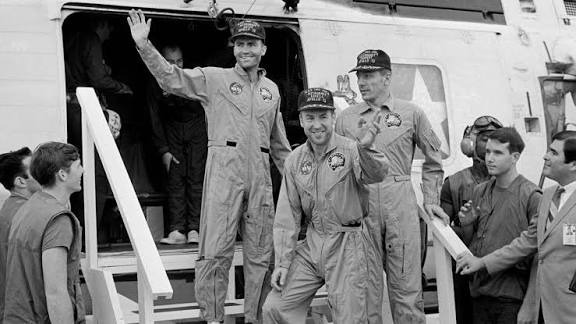
At 1:07 p.m. Eastern Standard Time on April 17, 1970, Apollo 13 splashed down in the Pacific Ocean, 600 miles southeast of American Samoa. The recovery ship USS Iwo Jima retrieved the crew within 45 minutes.
All three astronauts had survived.
The Aftermath: Lessons Written in Survival
The crew had collectively lost significant weight due to dehydration and stress. Fred Haise’s urinary tract infection, likely caused by extreme dehydration, required immediate treatment and kept him in sick bay aboard the USS Iwo Jima.
Despite their ordeal, all three astronauts made full recoveries. President Richard Nixon awarded them the Presidential Medal of Freedom on April 18, just one day after their return.
A comprehensive investigation by the Apollo 13 Accident Review Board identified the exact sequence of events that led to the explosion. NASA implemented immediate design changes:
- Third oxygen tank: Future Apollo spacecraft included an isolated backup oxygen tank that could not be affected by damage to the first two tanks
- Emergency battery power: Additional battery systems were installed to provide backup power
- Combustible materials: Teflon and other potentially flammable materials were eliminated or minimised inside oxygen systems
- Voltage verification: All electrical components were verified for proper voltage ratings and compatibility
These changes were incorporated into Apollo 14, which successfully landed on the Moon at Fra Mauro in February 1971, the original destination of Apollo 13.
Jim Lovell never returned to space; Apollo 13 was his fourth and final mission. Jack Swigert was later elected to Congress from Colorado but died of cancer before taking office. Fred Haise flew the Space Shuttle Enterprise during approach and landing tests but never flew another space mission.
Ken Mattingly, the astronaut replaced due to measles exposure, never contracted the disease. He later flew on Apollo 16 and commanded two Space Shuttle missions, enjoying a distinguished career that vindicated his initial selection for Apollo 13.
The Eternal Quest: From Space Exploration to Spiritual Enlightenment
The mystery of Apollo 13 reminds us of humanity’s incredible resilience and our perpetual quest to explore the unknown. Just as Lovell, Swigert, and Haise reached the farthest point any human has traveled from Earth, 248,655 miles into the cosmic void, each of us carries within ourselves an eternal quest for meaning and purpose.
The astronauts faced the vastness of space and the fragility of human existence. Their survival was not merely about technology; it was about the human spirit’s refusal to surrender. This same spirit drives our search for spiritual enlightenment and connection with the Divine.
If the mysteries of the cosmos inspire such wonder, imagine the mysteries of the soul awaiting discovery. True wisdom, Satgyan, guides us through life’s challenges just as Mission Control guided Apollo 13 home. To understand life’s ultimate purpose and the path to true salvation, explore the spiritual teachings in “Gyan Ganga“ and “Way of Living” by Saint Rampal Ji Maharaj, books that illuminate the soul’s journey back to its eternal home.
For more inspiring stories of human achievement and spiritual wisdom, continue exploring our articles at sanews.in.