


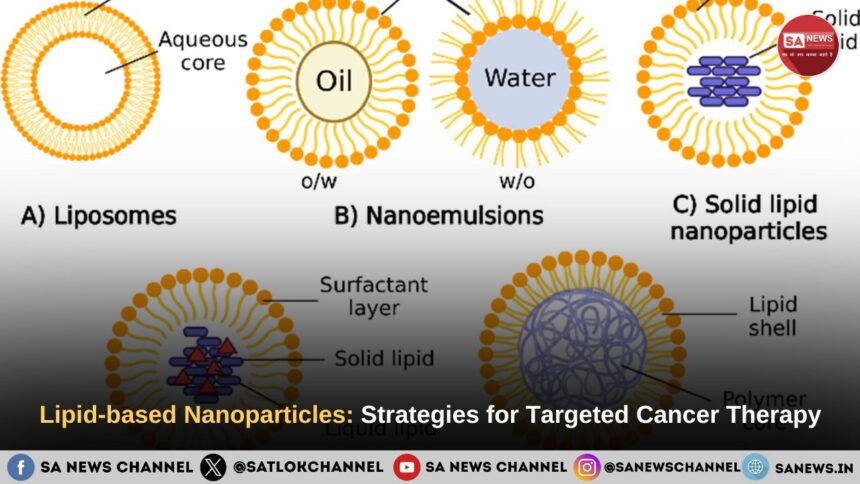
Lipid-based nanoparticles (LBNPs) are used in targeted cancer therapy through passive and active targeting strategies to deliver drugs more effectively and with fewer side effects. Passive targeting relies on the enhanced permeability and retention (EPR) effect, where LBNPs preferentially accumulate in tumors due to their leaky blood vessels. Active targeting involves modifying the nanoparticle surface with ligands, such as antibodies or folic acid, to bind specifically to receptors on cancer cells. Other strategies include encapsulating drugs with specific properties, using pH-sensitive formulations for targeted release, and employing external triggers like heat or ultrasound to release the drug on-demand.
This article provides a comprehensive review of LBNP’s for cancer treatment. The objectives of this review are to:
- Describe the limitations of conventional chemotherapy, such as non-specificity, serious adverse effects and drug resistance, and underline the need to develop a new generation of targeted therapies.
- Explore how nanotechnology is being used to treat cancer, particularly in the context of LBNP, which significantly enhances the effectiveness and safety of anticancer drugs.
- Discuss the types of LBNPs according to their biocompatibility, ability to incorporate hydrophilic and hydrophobic drugs, and biodegradability, which can lead to improved therapeutic efficacy while reducing toxicity.
- Highlight the applications of LBNPs in cancer treatment, including their use in combination therapy, and discuss recent advances in LBNP technology, such as novel surface coatings and improved synthesis methods.
- To provide a comprehensive summary of the current status of LBNP in cancer therapy, including prospects, challenges, and future directions, to guide the design of better-oriented anticancer therapies.
The organization of the article is as follows. Section 2 describes the characterization of LBNP; Section 3 discusses the classification of LBNP; Section 4 summarizes LBNP synthesis; Section 5 discusses the interactions with LBNP and emphasizes strategies for targeting cancer cells; Section 6 describes data from current clinical trials; Section 7 discusses challenges and future perspectives; and Section 8 presents findings regarding LBNPs, a new generation of promising drug delivery systems for cancer therapy, which offers major advantages over conventional chemotherapy methods.
How do lipid nanoparticles work?
Lipid-based nanoparticles are tiny fat-based particles that encapsulate a drug. They travel through the body, specifically recognizing the surface of tumor cells and releasing the drug there.Experts say this technique can provide effective treatment without harming normal cells.
Researchers say these tiny particles made of lipids behave similarly to naturally occurring fats in the body, allowing them to travel easily through the bloodstream. They are designed to identify cancer cells and release the drug at that location. Experts believe this technique could significantly reduce damage to healthy cells.
Several preliminary studies indicate that the use of lipid-based nanoparticles significantly increases drug efficacy while reducing side effects. According to the research teams, this technology could be particularly promising for patients with tumors located in difficult-to-reach areas of the body.
Future Directions and Expectations
The medical community believes that if clinical trials yield positive results, lipid-based nanoparticles could revolutionize mainstream cancer treatment. This strategy could provide patients with less painful, more effective treatments and has the potential to provide targeted treatments. Experts consider it a strong pillar of the future of cancer treatment. In the future, researchers hope to further advance this technology to develop personalized cancer therapy—that is, tailored to each patient’s tumor type. Different nanoparticles and medicines can be prepared according to the body’s response.
The spiritual meaning of these strategies in the context of the wisdom of Sant Rampal Ji Maharaj
Sant Rampal Ji Maharaj’s message lays great emphasis on “True Knowledge” (Gyan Ganga) and “Sat Bhakti”, where one devotes one’s life to the path of morality, devotion and dharma.Scientific research takes time, examination and improvements are needed. Sant Rampal Ji Maharaj also advises his followers to have courage, faith and stay within limits. In the teachings of Sant Rampal Ji Maharaj, liberation from diseases is possible through “satbhakti” — Sant Rampal Ji Maharaj has benefited followers from serious diseases like cancer through devotion.
FAQs
What are lipid-based nanoparticles?
Ans: These are very small particles made of fat-like substances (lipids) that help deliver drugs safely into the body.
How do they work in cancer treatment?
Ans: They help deliver the drug to cancer cells, increasing its effectiveness and reducing damage to healthy cells.
Can these nanoparticles directly target tumors?
Ans: Yes, they can be designed to accumulate in high concentrations around tumors and release the drug there.