

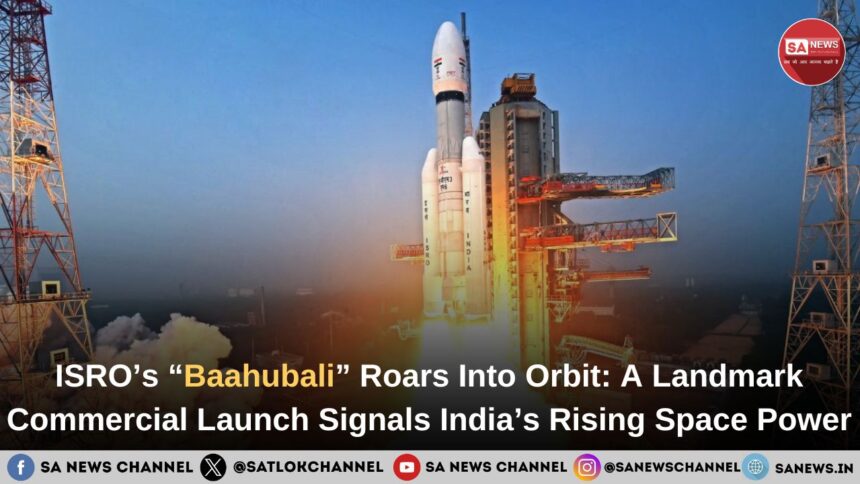
In a moment that underscores India’s growing heft in the global space economy, the Indian Space Research Organisation (ISRO) on December 24, 2025, successfully launched its heavy-lift LVM3-M6 rocket, aptly nicknamed “Baahubali,” from the second launch pad at the Satish Dhawan Space Centre, Sriharikota, Andhra Pradesh. The lift-off took place at 8:55 AM IST, following a 90-second delay implemented as a precautionary measure to avoid potential collisions with space debris—a detail that reflects ISRO’s increasing focus on mission safety and space situational awareness.
- Precision Launch, Powerful Payload: The Big Picture
- Inside the Rocket: Engineering Excellence on Display
- A Satellite With Global Ambitions
- Strategic Milestones: From Gaganyaan to Global Markets
- Industry Participation and a Clean Post-Launch Record
- Reactions and Economic Impact
- The Road Ahead: A Reliable Launch Provider Emerges
Precision Launch, Powerful Payload: The Big Picture
Standing 43.5 meters tall and weighing a massive 640 tonnes, the LVM3-M6 carried the BlueBird Block-2 communication satellite for US-based AST SpaceMobileinto low Earth orbit (LEO).
The target altitude was approximately 520
kilometers, and the satellite was placed at an actual altitude of 518.9 kilometers, achieving an accuracy of less than 1.5 kilometers—a feat hailed by experts as a testament to ISRO’s enhanced precision and reliability.
Weighing 6,100 kilograms, BlueBird Block-2 is the heaviest payload ever deployed by ISRO into LEO, surpassing the previous record of 4,400 kilograms set during the LVM3-M5 mission on November 2, 2025. The entire mission—from launch to satellite separation—lasted about 15 minutes, proceeding exactly as per the flight plan.
Inside the Rocket: Engineering Excellence on Display
The LVM3-M6 is a three-stage launch vehicle, comprising two S200 solid propellant strap-on boosters, an L110 liquid core stage, and a C25 cryogenic upper stage.
This mission showcased several technological upgrades, which contributed directly to the rocket’s high degree of accuracy and operational robustness.
Notably, this launch marked the quickest turnaround for consecutive LVM3 missions, taking place just 52 days after the previous flight—a clear indicator of ISRO’s growing operational efficiency and readiness for back-to-back heavy-lift missions.
A Satellite With Global Ambitions
The BlueBird Block-2 satellite has no ordinary payload. It features the world’s largest communications array in LEO, spanning a staggering 223 square meters.
Designed to deliver direct-to-smartphone 4G and 5G broadband connectivity, the system eliminates the need for ground-based towers, enabling global mobile coverage, even in remote and underserved regions.
In the competitive space-based broadband sector, BlueBird Block-2 positions AST SpaceMobile as a direct challenger to services such as SpaceX’s Starlink.
For India, the successful deployment reinforces its credentials as a preferred launch partner for cutting-edge commercial missions.
Strategic Milestones: From Gaganyaan to Global Markets
ISRO Chairman V Narayanan described the mission as a standout achievement on multiple fronts. He noted that the flawless performance of LVM3-M6 significantly boosts confidence for the upcoming Gaganyaan human spaceflight program, while also strengthening India’s footprint in the global LEO communications market.
With this mission, ISRO marked its 434th satellite deployment for 34 countries over 45 years, and its 101st orbital success overall.
It was also ISRO’s first dedicated commercial launch for a US customer, executed through its commercial arm, NewSpace India Limited (NSIL)—a milestone moment in India’s commercial space journey.
Industry Participation and a Clean Post-Launch Record
Indian private industry played a critical role in the mission’s success. Companies such as Ananth Technologies supplied avionics systems, electronics, and precision subsystems, reflecting the growing public-private synergy in India’s space ecosystem.
As of December 26, 2025, no anomalies have been reported post-launch, and the satellite has been confirmed to be politically operating in its intended orbit. This comes despite challenges earlier in 2025, when ISRO faced two PSLV rocket failures in the first half of the year.
Crucially, the LVM3 series has maintained a 100% success rate, including landmark missions like Chandrayaan-2, Chandrayaan-, and OneWeb deployments totaling 72 satellites.
Reactions and Economic Impact
Prime Minister Narendra Modi congratulated the ISRO team, calling the launch a significant stride in India’s space sector. He emphasized that the mission enhances heavy-lift capabilities, supports self-reliance under the Aatmanirbhar Bharat initiative, and reflects sustained efforts to expand commercial launch services and deepen global partnerships.
Union Minister Jitendra Singh echoed these sentiments, praising India’s growing prowess in space technology under Modi’s leadership.
From an economic standpoint, India has deployed at least 234 US satellites as of late December 2025, generating nearly $143 million in foreign exchange revenue since 2015—a figure that underlines the commercial viability of India’s space program.
The Road Ahead: A Reliable Launch Provider Emerges
With eight prior flawless launches and now a ninth consecutive success, LVM3’s pedigree stands firmly established. The Baahubali launch not only reinforces ISRO’s image as a reliable launch provider but also positions India competitively in the international commercial space arena.
In the larger narrative—yaani badi tasveer—this mission signals that India’s space ambitions are no longer just aspirational; they are decisively operational and globally relevant.