

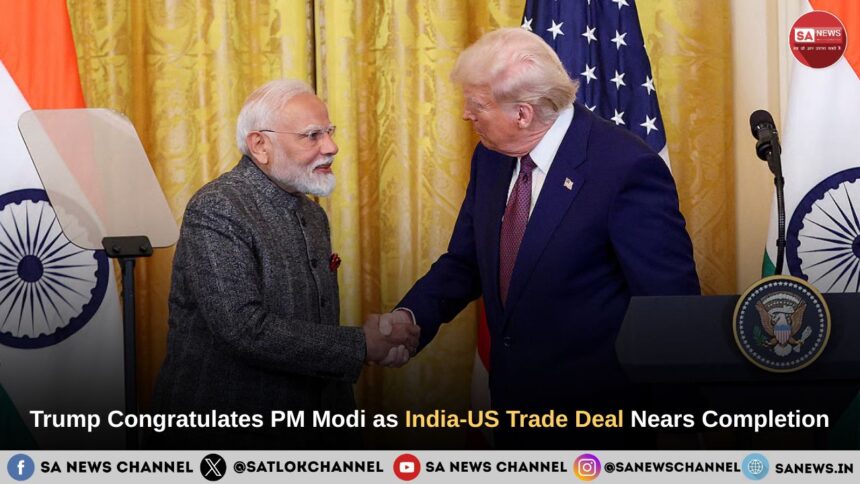
A major diplomatic and economic moment is unfolding as U.S. President Donald Trump congratulated Prime Minister Narendra Modi on what the White House described as a “historic” and “decisive” election victory following the BJP’s landmark sweep in West Bengal. The message came as U.S. officials confirmed that India and the United States are “very, very close” to signing a major trade deal, with only a final hurdle left to clear.
- Trump’s Message: Why the Congratulation Matters
- Why Bengal Matters Strategically
- India-US Trade Deal: “Very, Very Close”
- What the Trade Deal Could Change
- Why the Timing Is Important
- Challenges Before Final Signing
- India’s Diplomatic Advantage
- Power, Partnership and Righteous Conduct
- FAQs on Trump’s Modi Message and India-US Trade Deal
The timing is politically significant. BJP’s first major victory in West Bengal has strengthened Modi’s national standing, while the near-final trade deal could reshape tariffs, supply chains, investment flows and the India-US strategic partnership for the next decade.
Trump’s Message: Why the Congratulation Matters
A Political Signal From Washington
President Trump’s congratulatory message is more than a routine diplomatic courtesy. According to a White House spokesperson, Trump congratulated PM Modi on a “historic” and “decisive” election victory after the BJP’s breakthrough in West Bengal. The message specifically comes after the BJP secured its first-ever win in the state, ending years of Trinamool Congress dominance.
In diplomacy, timing matters. The congratulation came just as India and the U.S. are approaching the final phase of a trade agreement. By publicly praising Modi’s political success, Washington is signaling continuity, confidence and readiness to move forward with deeper engagement.
Bengal Win Becomes a Global Talking Point
West Bengal has long been one of India’s most politically significant states. The BJP’s win there is not only a state-level event; it is being read internationally as a shift in India’s internal political balance. Official Election Commission data showed the BJP winning 207 seats in the 294-member West Bengal Assembly, while the Trinamool Congress was reduced to 80 seats.
For Washington, a stronger BJP position in Bengal may reinforce the view that Modi remains the dominant political figure in India. This could make the U.S. more confident about closing long-term agreements with New Delhi.
Also Read: Know Everything About Free Trade Agreement Between India & Australia
Why Bengal Matters Strategically
Eastern India Enters BJP’s Power Map
Bengal gives the BJP a major eastern foothold. The state borders Bangladesh, connects to India’s Northeast, sits near critical trade corridors and has deep cultural, economic and security importance. A BJP government in Bengal could align more closely with the central government on infrastructure, border management, ports, logistics, industrial corridors and regional connectivity.
This matters for the India-US partnership because Washington increasingly sees India as a central Indo-Pacific partner. Eastern India’s infrastructure and connectivity can support wider strategic goals, including trade diversification, supply-chain resilience and engagement with Southeast Asia.
Political Stability and Policy Execution
Foreign governments and investors often watch state elections carefully because Indian states control land, labour, electricity, logistics, industry approvals and implementation of many economic policies. A strong state mandate can speed up decision-making if the state and central governments are aligned.
The BJP’s Bengal victory may therefore be seen by U.S. business circles as a potential opening for investment in manufacturing, ports, energy, digital infrastructure and logistics. However, actual outcomes will depend on governance, social stability and policy clarity.
India-US Trade Deal: “Very, Very Close”
Final Hurdle Remains
U.S. Deputy Secretary of State Christopher Landau said India and the United States are “very, very close” to signing a trade deal and need to get over “that last hurdle.” His comments came after months of negotiations between the two sides.
This language suggests that the broad framework is already in place, but one or more sensitive issues remain unresolved. These could include tariffs, agricultural access, digital trade, pharmaceuticals, energy imports, industrial goods, market access or standards.
Earlier Framework Set the Direction
The two countries had already released an interim trade framework in February 2026. That framework aimed to lower tariffs, reshape energy ties and deepen economic cooperation, while continuing negotiations toward a broader bilateral trade agreement.
Reuters also reported in April that trade talks in Washington were “constructive,” with both sides working toward a balanced, mutually beneficial and forward-looking agreement and a target of $500 billion in bilateral trade by 2030.
This makes the current “very, very close” statement highly significant. It indicates that the trade talks have moved beyond general intent and are now in the closing stage.
What the Trade Deal Could Change
Tariffs and Market Access
A landmark trade deal could reduce tariff friction and improve market access for both sides. For Indian exporters, lower U.S. tariffs could help sectors such as textiles, engineering goods, pharmaceuticals, auto components, gems and jewellery, technology services and specialty manufacturing. For American businesses, better access to India’s large consumer market could benefit agriculture, energy, aircraft, machinery, medical devices, digital services and high-value manufacturing.
However, both countries have sensitive sectors. India must protect farmers, small manufacturers and domestic policy space. The U.S. wants stronger access and lower trade barriers. The final agreement will need to balance economic ambition with domestic political realities.
Supply Chain Diversification
The deal also has a strategic purpose. The U.S. and India both want to reduce overdependence on concentrated supply chains. India wants to become a major manufacturing hub, while the U.S. wants trusted partners in critical sectors.
A trade agreement could support cooperation in semiconductors, clean energy, defence manufacturing, electronics, pharmaceuticals, critical minerals, artificial intelligence, logistics and digital infrastructure. In this sense, the deal is not only about exports and imports; it is about long-term strategic alignment.
Also Read: India–US Interim Trade Deal 2026: What It Means for Trade, Business, and Farmers
Why the Timing Is Important
Politics and Trade Moving Together
Trump’s congratulatory message and the near-complete trade deal are happening at the same time. This creates a diplomatic moment where political goodwill and economic negotiation reinforce each other. Modi’s stronger domestic position after BJP’s Bengal win may help India negotiate with confidence. Trump can present the trade deal as a major achievement with one of America’s most important Asian partners.
Both leaders have political incentives to close the deal. Modi can show that India’s global influence is rising. Trump can show that his trade policy is producing major bilateral outcomes.
Strategic Partnership for the Decade Ahead
The India-US relationship is no longer limited to trade. It includes defence cooperation, technology, Indo-Pacific security, clean energy, space, artificial intelligence, education, investment, critical minerals and counterterrorism. A trade deal would add economic depth to this already broad partnership.
If successfully signed and implemented, the agreement could become one of the defining pillars of India-US relations in the 2026–2030 period.
Challenges Before Final Signing
Domestic Industry Concerns
Even when leaders agree, domestic industries may object. Indian farmers, dairy groups, small manufacturers and certain protected sectors may worry about U.S. competition. American labour groups, agriculture lobbies and manufacturing interests may also push for stronger terms.
This is why Landau’s “last hurdle” comment matters. The final obstacle may be politically sensitive, not merely technical.
Implementation Will Be Harder Than Announcement
Signing a trade deal is only the first step. Implementation requires customs changes, tariff notifications, dispute mechanisms, standards alignment, regulatory cooperation and monitoring. If either side feels the other is not delivering, tensions could return.
A good deal must therefore be clear, phased and enforceable.
India’s Diplomatic Advantage
A Stronger Hand After State Wins
BJP’s Bengal win gives Modi additional political momentum. It reinforces his image as a leader capable of expanding into difficult political territory. This can strengthen India’s bargaining position internationally because foreign governments prefer dealing with leaders who appear politically secure.
Balancing Strategic Autonomy
India will still try to preserve strategic autonomy. Even as it deepens ties with the U.S., New Delhi will continue to manage relations with Europe, Russia, the Gulf, Japan, ASEAN and the Global South. The trade deal must therefore support India’s national interest without making India appear dependent on Washington.
Power, Partnership and Righteous Conduct
This geopolitical pivot shows how political power and international agreements can shape the destiny of nations. But real progress depends not only on victory speeches or trade numbers; it depends on truthful conduct and welfare-oriented leadership. The teachings of Sant Rampal Ji Maharaj and Sat Gyaan emphasize truth, humility, compassion, righteous conduct and true worship according to holy scriptures.
His teachings guide people away from intoxication, corruption, greed, dishonesty, violence and misuse of authority. In the context of India-US diplomacy, this message is deeply relevant. Trade deals and political victories become meaningful only when they serve common people honestly. Sat Gyaan teaches that material progress must be supported by moral purity, because development without truth can become exploitation, while development guided by righteousness can become service.
FAQs on Trump’s Modi Message and India-US Trade Deal
1. What did Trump say about PM Modi’s election victory?
The White House said President Donald Trump congratulated Prime Minister Narendra Modi on a “historic” and “decisive” election victory after the BJP’s major win in West Bengal.
2. Why is BJP’s Bengal win important?
BJP’s Bengal win is important because it marks the party’s first major victory in West Bengal and ends the long dominance of the Trinamool Congress in the state.
3. How many seats did BJP win in West Bengal?
Official Election Commission data showed the BJP winning 207 seats in the 294-member West Bengal Assembly.
4. What did U.S. officials say about the India-US trade deal?
U.S. Deputy Secretary of State Christopher Landau said India and the U.S. are “very, very close” to signing the trade deal and need to cross one final hurdle.
5. What could the India-US trade deal cover?
The deal could address tariffs, market access, energy, supply chains, manufacturing, technology, agriculture, investment and the target of expanding bilateral trade toward $500 billion by 2030.
6. Why is this being called a geopolitical pivot?
It is being called a geopolitical pivot because India’s domestic political shift, Trump’s public endorsement and the near-final trade deal together point toward a stronger India-US strategic partnership for the coming decade.