

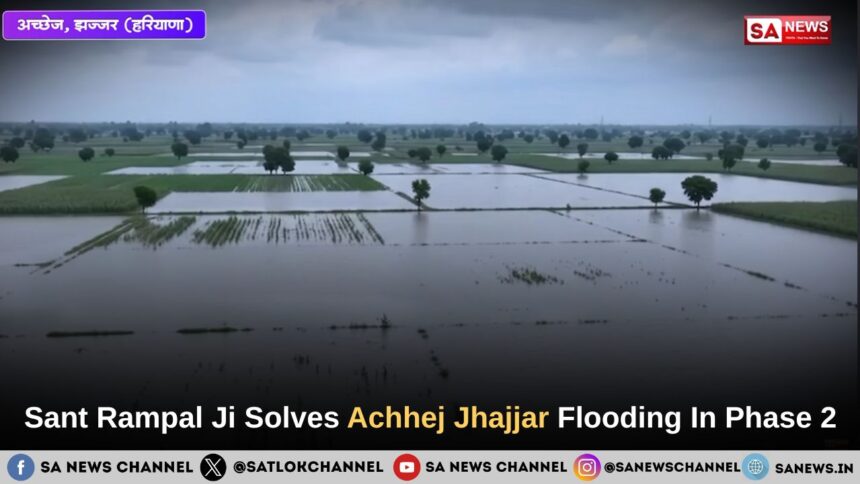
Achhej village, located within the Matanhail tehsil of Jhajjar district in Haryana, faced a persistent waterlogging and flood-like crisis for the past 50 to 60 years. According to local data, approximately 800 to 1,200 acres of agricultural land remained submerged or directly impacted by this ongoing issue.
- Geographical Causes And Impact On Housing And Public Infrastructure
- Limitations Of Government Interventions And Administrative Failure
- Formal Request To Sant Rampal Ji Maharaj And Immediate Action
- Technical Field Survey And Seven-Point Drainage Allocation
- Materials Distributed Under The Kisan Mazdoor Bachao Abhiyan
- Operational Directives For Heavy-Duty Water Pumps Delivery
- Local Testimonials, Technical Inspections, And Community Impact
- Agricultural Restoration And Long Term Economic Elevation Via Phase 2
Accumulation of water lasted for 8 to 9 months annually in multiple agricultural sectors. In specific farms, the severity of the waterlogging completely halted all agricultural and sowing activities for a continuous duration ranging from 15 to 25 years.
The recurring destruction of crops caused extensive financial damage to the local agrarian economy. In the preceding year alone, the total calculated financial loss incurred by the resident farmers reached 5 crore rupees.
Geographical Causes And Impact On Housing And Public Infrastructure
The fundamental cause of the waterlogging stems from the topographical layout of the region. The land of the neighboring village, Chhuchhakwas, sits at a higher elevation and is heavily utilized for paddy cultivation. When excess water overflows from Chhuchhakwas, it drains down directly into the low-lying fields of Achhej. This crisis extended beyond fields into the residential segments and public infrastructure of Achhej.
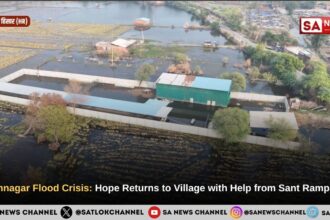
During heavy rains, the two primary village ponds overflew, pushing floodwaters directly into houses and residential properties. The main transit routes within the village became completely submerged under approximately 4 feet of water, cutting off internal movement.
This deep waterlogging directly affected the village cremation grounds, completely blocking the access paths and severely disrupting basic funeral rites. Local citizens, including women, were forced to navigate through four feet of stagnant water to dump manure, gather cattle fodder, and complete daily routines.
Limitations Of Government Interventions And Administrative Failure
The village administration, led by the 61-year-old Sarpanch Rajendra Singh, along with the village elders, made numerous formal appeals to governmental bodies and political authorities over several decades. The state administration provided temporary, low-capacity 3 Horsepower (HP) water pumps.
These small motors frequently burned out due to the high volume of water and extended running hours. Furthermore, the erratic rural electricity supply combined with extensive delays by mechanical repair teams—who often took hours or days to arrive at the pump stations—rendered the government infrastructure entirely ineffective.
Consequently, the local populace sought an alternate, permanent mechanism to drain the submerged lands.
Formal Request To Sant Rampal Ji Maharaj And Immediate Action
Upon observing the successful implementation of an advanced drainage system in the adjacent village of Panipur, the Gram Panchayat of Achhej decided to pursue an identical intervention. Under the leadership of Sarpanch Rajendra Singh, a formal delegation consisting of village elders, farmers, and laborers traveled to the Dhanana ashram to present a written petition outlining their grievances.
The delegation reported the precise state of the 1,200 acres of ruined land, the flooding of residential blocks, and the decades of economic stagnation. Sant Rampal Ji Maharaj directly issued immediate orders to a specialized technical survey team to inspect Achhej village, map the topography, and draft an immediate engineering layout for permanent water drainage.
Technical Field Survey And Seven-Point Drainage Allocation
The specialized survey team arrived in Achhej village within a few hours of the formal request to inspect the agricultural fields, residential blocks, water reservoirs, and natural drainage channels. Following a comprehensive physical and technical evaluation, the survey team divided the entire affected zone into 7 specific target points:
- Agricultural Fields Allocation: 5 specific points were designated across the submersed farmlands to manage field drainage.
- Residential And Pond Allocation: 2 specific points were designated at the main village ponds to intercept overflow before it enters housing sectors.
- Material Requirements Assessment: The technical evaluation concluded that securing these 7 points required a total of 20,600 feet of 8-inch diameter pipeline alongside 6 heavy-duty water pumps with a capacity of 10 Horsepower (HP) each.
Materials Distributed Under The Kisan Mazdoor Bachao Abhiyan
Following the submission of the field report, Sant Rampal Ji Maharaj directly approved and dispatched the required materials under the ‘Kisan Mazdoor Bachao Abhiyan’ within 36 hours of the initial petition.
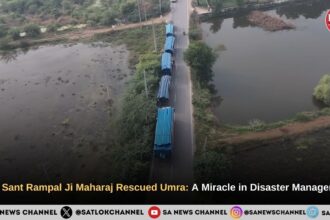
Multiple heavy-duty commercial trucks loaded with high-grade industrial equipment arrived at Achhej village. Sant Rampal Ji Maharaj directly provided the following items to the Gram Panchayat of Achhej:
- Main Pipeline System: 20,600 feet of heavy-duty, 8-inch diameter plastic pipeline.
- SR Bands: High-grade industrial SR bands required to manage pipeline turns and structural alignment.
- Air Valving Units: Specialized air valves designed to regulate internal pipeline pressure and prevent structural pipe bursts.
- Heavy-Duty Fasteners: A comprehensive supply of steel plates, industrial-grade nut-bolts, and durable rubber joints (jain).
- Adhesive Supplies: Industrial-grade Fevicol and specialized chemical solvents for airtight pipe joining.
Operational Directives For Heavy-Duty Water Pumps Delivery
The technical representatives of the ashram established a precise operational protocol with the Gram Panchayat regarding the deployment of the 6 heavy-duty 10 HP water pumps. The technical team clarified that all 6 pumps have been fully allocated and are securely stored.
The protocol mandates that the citizens and Gram Panchayat of Achhej must first complete the physical excavation and underground laying of the entire 20,600 feet of pipeline across the 7 designated points. Once the pipeline is completely subterranean, the technical team will conduct a secondary structural inspection.
Upon successful verification of the underground pipeline installation, all 6 heavy-duty 10 HP water pumps will be delivered and installed within 24 hours to initiate permanent drainage operations.
Local Testimonials, Technical Inspections, And Community Impact
The arrival of the material trucks prompted widespread celebration, marked by traditional music, drums, and the showering of flower petals by the villagers. The local population conducted manual checks on the delivered components to verify their industrial grade. Several key individuals recorded their observations on the development:
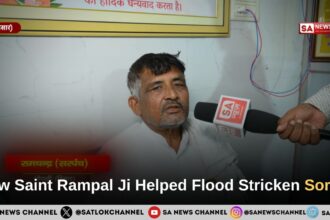
- Sarpanch Rajendra Singh: Stated that in his 61 years of life, he had never witnessed such execution speed. He noted that while governments take months or years to process files, this entire operation took under 36 hours.
- Sant Ram (Local Contractor): Confirmed that the steel nut-bolts, rubber joints, and plastic pipes are of premium quality. He remarked that even emergency services like the police take hours to arrive at nearby spots, whereas a massive infrastructure solution was delivered here within a single day.
- Anil (Village Resident): Highlighted that the main village pathways and residential quarters, which used to be trapped under 4 feet of water, will now remain permanently dry.
- Female Agricultural Laborers: A resident woman who moved to the village 25 years ago stated that her 2 acres of land had never yielded a single grain due to permanent flooding, forcing her family to purchase external grain. She stated this layout ensures food security for her household.
- 85-Year-Old Village Elder: Confirmed that across multiple decades and varying political regimes, no administration had ever laid a single permanent pipeline to relieve Achhej of its flood crisis.
Technical Specifications And Project Layout For Achhej Village
| Parameter / Category | Precise Technical And Field Data |
| Project Location | Achhej Village, Matanhail Tehsil, Jhajjar District, Haryana |
| Total Duration of Crisis | 50 to 60 Years (Five Decades of Recurrent Flooding) |
| Total Impacted Area | 800 to 1,200 Acres of Agricultural Land |
| Recorded Financial Loss | 5 Crore Rupees incurred in the preceding single year |
| Survey Allocation Points | 07 Points (05 for Farmlands, 02 for Ponds and Residential Units) |
| Pipeline Specifications | 20,600 Feet in length, 8-Inch total diameter |
| Auxiliary Components Provided | SR Bands, Air Valves, Steel Plates, Nut-Bolts, Rubber Joints, Fevicol |
| Pumping Infrastructure | 06 Heavy-Duty Water Pumps with 10 Horsepower (HP) capacity each |
| Execution Timeline | Survey completed in 7 hours; complete delivery within 36 hours |
| Pump Deployment Clause | Delivery to the village within 24 hours post underground pipe installation |
Agricultural Restoration And Long Term Economic Elevation Via Phase 2
Sant Rampal Ji Maharaj directly facilitated the complete restoration of the rural economy of Achhej village through the successful execution of this Phase 2 drainage intervention. The permanent removal of stagnant water from the 1,200 acres of land ensures that fields that lay barren for up to 25 years are now fully available for regular agricultural cycles.
This engineering layout guarantees that local farmers can successfully cultivate both primary seasonal crops, namely wheat and paddy, without the threat of sudden crop submergence. By bypassing administrative delays and providing heavy-duty industrial infrastructure directly to the community, this initiative establishes a sustainable framework for long-term food security, rural employment, and economic stability across Jhajjar district.