



Today, we are often told that health insurance is no longer optional. For many families, purchasing health insurance represents an important step in planning for potential healthcare expenses. However, choosing the right policy is challenging and confusing as the market is flooded with numerous insurance products. Additionally, premiums, waiting periods, exclusions, co-payments, claim processes and countless policy features make it difficult to know which plan truly offers the financial buffer your family needs.
- Best Health Insurance Plan in 2026 Highlights
- The Simplified Understanding of Health Insurance
- Family Health Insurance Simplified: How It Works and Why It Matters
- Can Your Family Afford to Be Without Health Insurance Today?
- How Much Health Insurance Coverage Does Your Family Really Need?
- Which Features Should You Compare Before Buying a Family Health Insurance Plan?
- What Hidden Clauses and Claim Risks Should You Check Before Buying Health Insurance?
- Disclose Your Medical History Completely
- Calculate the Real Cost of Co-payment
- Understand the Full Effect of Room-Rent Limits
- Check Disease-Wise and Procedure-Wise Sub-Limits
- Compare All Three Types of Waiting Periods
- Review Pre- and Post-Hospitalisation Coverage
- Confirm That Nearby Hospitals Offer Cashless Treatment
- Do Not Judge an Insurer by One Ratio Alone
- The Brochure Sells the Policy, The Policy Document Defines Your Coverage
- Exercising Caution
- What Does Health Insurance Usually Not Cover?
- How Do Network Hospitals Affect Cashless Treatment?
- How Can You Compare Health Insurance Plans Effectively?
- Which Family Health Insurance Plan Is Best for Different Families?
- Is Employer Health Insurance Alone Enough for Your Family?
- Should You Buy Health Insurance Online or Through an Insurance Advisor?
- What Are the Biggest Mistakes to Avoid When Buying Family Health Insurance?
- What Should You Do Before Buying a Family Health Insurance Plan?
- How Often Should You Review or Upgrade Your Family Health Insurance Plan?
- Is There a Way to Prevent Suffering Instead of Merely Paying for It?
- Can Every Health Problem Truly Be Prevented?
- FAQs: Family Health Insurance
This guide cuts through the complexity surrounding family health insurance by explaining how it works, identifying the policy features that matter most, drawing attention to commonly overlooked conditions, and helping you choose a plan with confidence.
Best Health Insurance Plan in 2026 Highlights
- Family health insurances are not a straightforward set of documents.
- They need to be studied well and analysed for the missing loops before making a decision.
- Policy features such as waiting periods, exclusions, claim settlement process, network hospitals and restoration benefits often matter more than the cheapest premium.
- Buying health insurance early generally results in lower premiums and shorter waiting periods for many conditions.
- Regular policy reviews help ensure your family’s coverage keeps pace with changing healthcare needs and rising medical costs.
- Reading the policy wording carefully before purchasing can prevent misunderstandings and unexpected claim disputes later.
The Simplified Understanding of Health Insurance
For an absolute beginner, understand that health insurance is a way for people to protect themselves from the financial burden of expensive medical treatment.Instead of waiting until someone falls ill and suddenly has to arrange a large amount of money, many people contribute a much smaller amount (called premium) to an insurance company. When a covered person needs eligible medical treatment, the insurer uses this pooled money to help pay the hospital expenses, subject to the policy’s terms and conditions.
Imagine there are 1,000 families living in a town. Every family contributes INR 1,000 each year to one large emergency fund. Together, they created a fund of INR 10,00,000.
Most of these families may not need to use the money that year because they may not face a major medical emergency. But suppose one child suddenly needs emergency surgery costing INR 4,00,000. Instead of that family scrambling to arrange INR 4,00,000 overnight, the money comes from the common fund that everyone helped build.
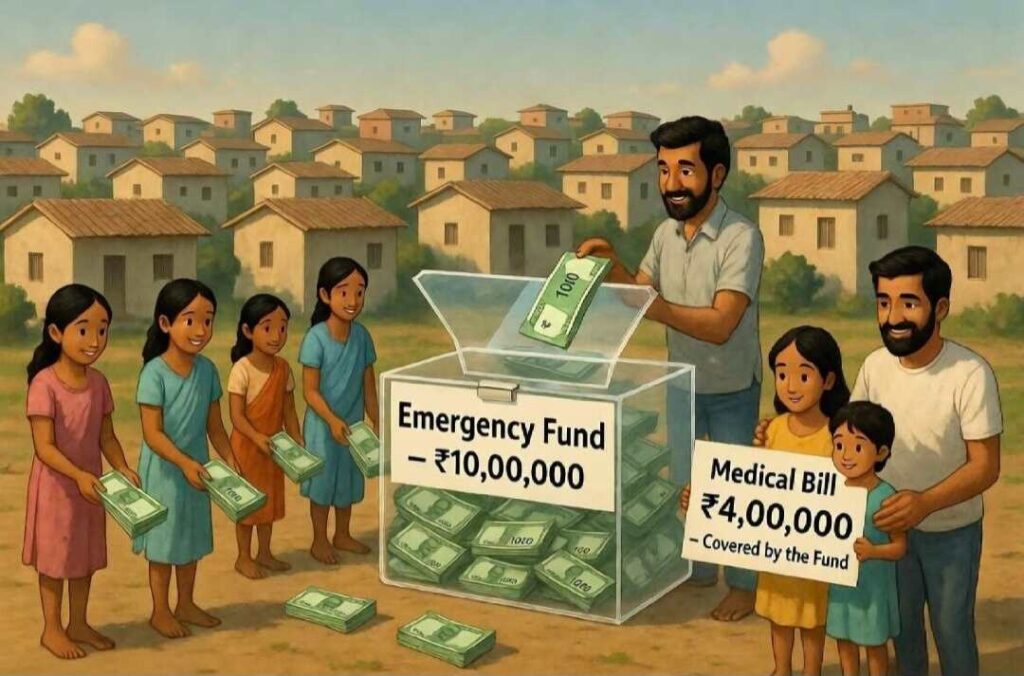
The following year, another family may need financial help, while the first family may not need any assistance at all. This is the basic principle behind insurance – many people contribute a small amount so that the few who face unexpected emergencies can receive financial support when they need it most.
However, a shared emergency fund cannot function without rules. Before joining, everyone agrees on how the money can be used.
These rules determine:
- Treatments covered
- Excluded expenses
- When claims can be made
- Actual amount that can be released
- Mandatory information required before joining such emergency funds
Health insurance works in exactly the same way. When you purchase a health insurance policy, you agree to these rules, which are written in the policy document. If your treatment meets the agreed conditions, the insurer helps pay the eligible medical expenses. If it does not due to some conditions not meeting, the insurer may reduce or reject the claim.
Understanding this simple concept makes choosing a health insurance policy much easier, should you wish to proceed with one.
Family Health Insurance Simplified: How It Works and Why It Matters
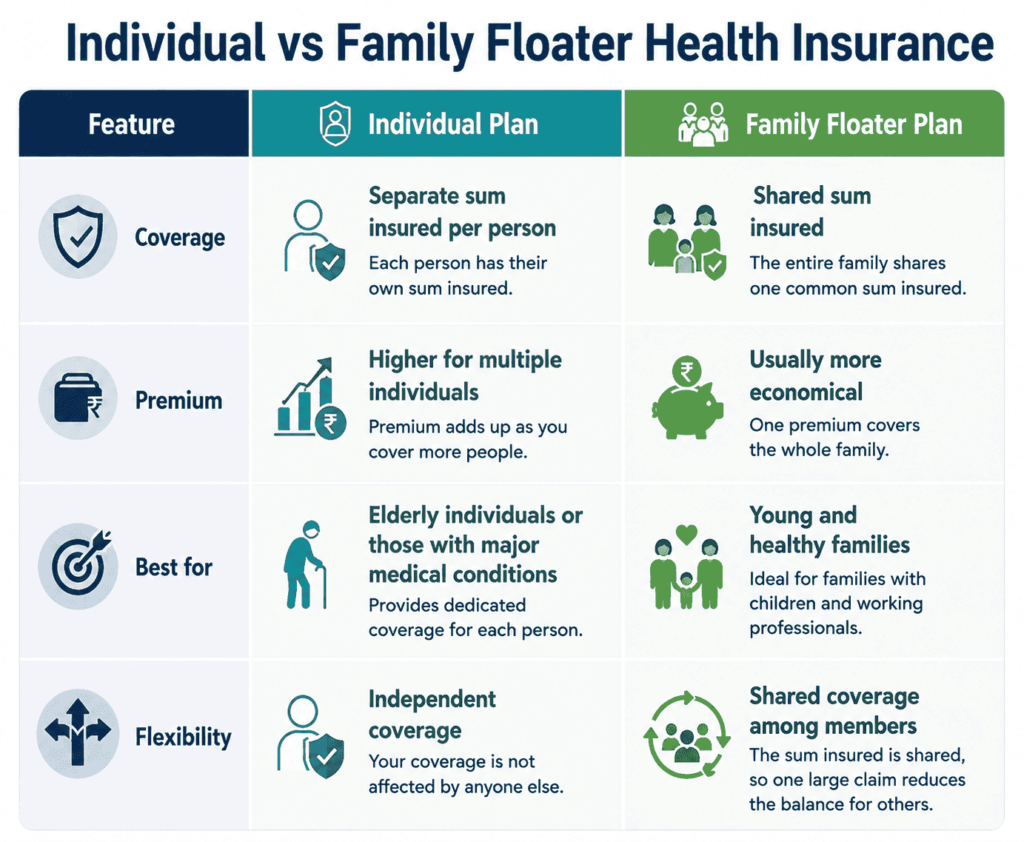
Now we move to the next stage from personal health insurance to family health insurance. Family health insurance is a policy that provides medical coverage for multiple eligible family members under a single sum insured.
Unlike purchasing separate policies for every individual, a family floater health insurance plan shares one overall coverage amount among all insured members. If one member requires hospitalisation, the policy pays eligible expenses from the available sum insured.
For example, suppose your family purchases an INR 20,00,000 family floater plan covering two adults and two children. If one family member incurs a hospitalisation bill of INR 6,00,000, the remaining available coverage becomes INR 14,00,000 for the rest of the policy year.
Family floater plans are generally pitched as suitable for:
- Young couples
- Families with children
- Individuals supporting dependent parents (depending on age and health profile)
- First-time insurance buyers
- Salaried and self-employed professionals
Can Your Family Afford to Be Without Health Insurance Today?
Family health insurance is projected as an instrument that ‘protects’ households from unexpected medical expenses while helping preserve long-term financial stability.
Healthcare costs continue to rise across India, making even routine hospital treatments financially challenging for many families. India’s health insurance sector crossed INR 1.2 lakh crore in premiums during FY 2024-25, reflecting growing awareness of financial protection against medical expenses. (Source: PIB Press Release, 2026)
Additionally, health insurance companies claim to offer several advantages such as:
- Protection against rising medical inflation
- Access to quality healthcare
- Cashless hospitalisation
- Tax deductions under applicable provisions such as Section 80D (subject to prevailing tax laws)
- Reduced financial stress during medical emergencies to a certain extent
One frequently advertised benefit is peace of mind. But, this brings us an important question – can anyone truly feel at peace while watching a loved one suffer during a medical emergency? Health insurance may help manage the financial consequences of illness, but it does not answer why do such unexpected hardships arise in our lives at all? We will decode this aspect too towards the end of this article.
Buying earlier also helps because younger individuals generally receive lower premiums and complete waiting periods sooner.
However, ‘whether family health insurance or even individual health insurances are necessary today’ is a question we will leave for the readers to decide after weighing all the pros and cons illustrated in this article.
How Much Health Insurance Coverage Does Your Family Really Need?
There is no definite answer to this as the ideal sum insured should reflect your family’s size, age profile, existing medical conditions and the cost of healthcare in your region. Therefore, no universal amount that suits everyone.
Always consider these factors:
- Number of family members
- Ages of insured individuals
- Existing illnesses
- Lifestyle risks
- City of residence
- Future family planning
- Employer insurance availability
As an example, let us take the following case. Figures used here are illustrative only. The actual figures will vary from requirement to requirement.
| Family Type | Coverage Range Could Be |
| Newly married couple | INR 10-15,00,000 |
| Couple with children | INR 15-25,00,000 |
| Family including elderly parents | INR 25,00,000 or higher |
| Self-employed family | Higher coverage with emergency protection |
Which Features Should You Compare Before Buying a Family Health Insurance Plan?
Here are the critical ones that must not be ignored while decision-making:
- Premium vs Coverage: A lower premium is attractive, but reduced coverage may result in significantly higher out-of-pocket expenses later.
- Waiting Period: Waiting periods are the timeframes during which specific illnesses, treatments or pre-existing conditions are not eligible for insurance claims under the policy. Shorter waiting periods are generally preferable, particularly if someone already has an existing medical condition.
- Pre-existing Disease Coverage: For this also review the waiting period before the coverage starts, permanent exclusions and disease-specific conditions
- Room Rent Limits: Policies with room rent restrictions may reduce claim payouts because related medical expenses are often proportionately adjusted.
- Co-payment Clause: Co-payment means you pay a fixed percentage of the claim yourself. Example: a 20% co-payment on an INR 5,00,000 hospitalisation means you pay INR 1,00,000.
- Restoration Benefit: A restoration benefit replenishes the sum insured if it is exhausted during the policy year, subject to policy conditions.
- No Claim Bonus: Many insurers reward claim-free years by increasing your sum insured without proportionately increasing premiums.
- Daycare Procedures: Modern treatments often do not require 24-hour hospitalisation. Therefore, ensure your policy covers cataract surgery, chemotherapy, dialysis, endoscopy and other eligible daycare procedures
- Maternity & Newborn Benefits: Young couples planning a family should carefully evaluate the maternity waiting period, delivery coverage, newborn coverage and vaccination benefits too.
- Preventive Health Check-ups: Many comprehensive plans include annual health check-ups, encouraging preventive healthcare.
- OPD Coverage: Some policies reimburse consultation, diagnostics or pharmacy expenses. Decide whether these benefits justify the additional premium.
What Hidden Clauses and Claim Risks Should You Check Before Buying Health Insurance?
Health insurance can reduce the financial impact of hospitalisation, but a large sum insured does not guarantee that every expense will be paid in full. The practical value of a policy depends on its co-payment, room eligibility, treatment sub-limits, waiting periods, exclusions, disclosure requirements and claim conditions.
- Health insurers disallowed or repudiated claims worth approximately INR 26,000 crore during FY 2023-24, up 19.1% from the previous financial year. (Source: IRDAI data reported by several news agencies)
- However, this figure does not mean that every rejected claim was unfairly denied.
- Claims may be declined because a treatment is excluded, a waiting period is still active, material medical information was not disclosed, documentation is incomplete or another policy condition has not been met.
- Reality Check: Health insurance reduces financial risk. It does not remove every healthcare expense.
- Even with an approved claim, you may still pay co-payments, deductibles, non-medical expenses, excluded items, proportionate deductions or costs above specified limits.
Here are some important things one must do along with checking all clauses within each family health insurance policy:
Disclose Your Medical History Completely
Complete medical disclosure means truthfully reporting every health condition and lifestyle detail requested in the insurance proposal form.
- This may include diabetes, high blood pressure, thyroid disorders, previous surgeries, ongoing medication, abnormal test results, smoking, alcohol consumption and earlier hospitalisation.
- A person may avoid mentioning diabetes because they believe it is unrelated to a future cancer, accident, or surgical claim.
- However, if the insurer considers the undisclosed condition material to its underwriting decision, the omission may create a claim dispute.
- Also, never allow an agent to complete the proposal form without checking each answer yourself. Always double check before signing the policy.
- The information submitted in your name becomes part of the insurance contract, even when another person fills in the form.
- Keep a copy of the submitted proposal form
- Obtain written clarification for any uncertain medical disclosure
- Never sign a blank proposal form or depend solely on verbal assurances.
- Written policy terms carry more weight than informal promises made during the sale.
Calculate the Real Cost of Co-payment
A co-payment clause requires you to pay a fixed percentage of every admissible claim from your own pocket. Although choosing a co-payment may lower the premium, the amount saved can be much smaller than your share of a future hospital bill.
- To understand better: A 20% co-payment on an admissible INR 8,00,000 claim would require you to contribute INR 1,6,00,000. A modest annual premium discount may not compensate for such a large payment during an emergency.
- That being said, co-payment need not automatically be a reason to reject a policy.
- Senior citizens, people with existing medical conditions or buyers with limited policy options may sometimes find that a co-payment plan is more affordable than a policy without one.
- Before accepting a co-payment, compare the percentage you must pay and whether it applies to every claim.
- Also check whether it applies only above a certain age, whether it applies only outside a preferred hospital network
- Another mandatory check is the annual premium saving and the maximum amount you could afford during a major claim.
- A co-payment should be evaluated as a future medical liability, not merely as a way to reduce today’s premium.
Understand the Full Effect of Room-Rent Limits
A room-rent limit restricts the hospital-room category or daily room charge eligible under the policy.
- In some policies, choosing a room above the permitted limit can affect not only the room charge but also certain associated treatment expenses.
- If, for example, your policy permits a room costing INR 5,000 per day, but you select one costing INR 8,000. Depending on the policy wording, you may have to pay the room-rent difference and a proportion of other linked charges if a proportionate-deduction clause applies.
- However, proportionate deductions do not work identically under every policy.
- The applicable calculation, exempt expenses, ICU rules and room-category conditions must be checked in the policy document.
- Therefore, always look for information regarding no room-rent cap, where affordable.
- Check eligibility for at least a single private room and separate ICU room eligibility.
- Verify the exact proportionate-deduction clause and the expenses excluded from proportionate deductions.
- Also, understand the restrictions linked to room type rather than daily cost.
- Room eligibility can influence the effective value of your entire hospitalisation cover, not just the cost of the bed.
Check Disease-Wise and Procedure-Wise Sub-Limits
A sub-limit is the maximum amount an insurer will pay for a particular treatment, procedure, or expense within the overall sum insured.
- As a result, your INR 10,00,000 health insurance policy may provide considerably less than INR 10,00,000 for a specific medical procedure.
- As an example case: A policy may cap cataract surgery, knee replacement, maternity expenses, ambulance charges, or certain modern treatments at a much lower amount. Once that limit is reached, the remaining expense becomes the policyholder’s responsibility.
- Therefore, always compare limits for cataract surgery, joint replacement, cardiac procedures, maternity and delivery expenses, ambulance services, AYUSH treatment, home healthcare, modern treatments, organ-donor expenses and disease-specific deductibles.
- Where possible, choose a policy with few or no restrictive treatment sub-limits, particularly for procedures that your family may reasonably require.
Compare All Three Types of Waiting Periods
A waiting period is the time during which specified medical claims are not covered after a policy begins.
- Buyers should check the initial waiting period, the waiting period for listed illnesses and the waiting period for pre-existing diseases separately.
- Initial Waiting Period: The initial waiting period applies to many non-accidental medical conditions immediately after policy purchase. Accidental hospitalisation is generally treated differently, subject to the policy terms.
- Suppose one develops a non-accidental illness shortly after buying the policy, the related treatment may not be covered until the initial waiting period ends.
- Specific-Disease Waiting Period: A specific-disease waiting period applies to listed conditions or procedures that may develop gradually. These can include conditions such as hernia, cataract, kidney stones or certain joint-related treatments, depending on the policy.
- A treatment may be medically necessary during the first policy year but remain ineligible because the policy specifies a longer waiting period for that condition.
- Pre-existing Disease Waiting Period: A pre-existing disease waiting period applies to declared medical conditions that existed before the policy began.
- Diabetes, hypertension, thyroid disorders or previous medical complications may fall within this category, depending on the applicable definition and underwriting decision.
- Therefore, compare both the duration and scope of the waiting period.
- A shorter period is helpful, but the exact definition of covered and excluded treatment is equally important.
Review Pre- and Post-Hospitalisation Coverage
Pre- and post-hospitalisation benefits cover eligible medical expenses incurred before admission and after discharge when they relate directly to a covered hospitalisation.
- Procedures like diagnostic tests, specialist consultations, blood investigations and scans may take place before admission. Medicines, follow-up consultations, physiotherapy and repeat tests may continue after discharge.
- Without adequate pre- and post-hospitalisation coverage, these related expenses can create a sizable out-of-pocket bill even when the main hospital claim is approved.
- Hence important to check the number of covered days before admission; the number of covered days after discharge; whether expenses must directly relate to the hospitalisation and whether consultations, tests and medicines are included.
- Also verify whether the benefit is cashless or reimbursement-based and the deadline for submitting bills and prescriptions.
- A policy offering 30-60 days of pre-hospitalisation and 60-90 days or more of post-hospitalisation coverage may provide useful protection. However, the eligibility rules matter more than the headline number.
Confirm That Nearby Hospitals Offer Cashless Treatment
A network hospital is a healthcare facility where eligible claims may be processed through the insurer’s cashless arrangement.
- A long national hospital list is less useful if the hospitals near your home are not included.
- During an emergency, most families prefer the nearest suitable hospital rather than one located across the city.
- Checking local network availability before purchasing can therefore make the policy more usable in practice.
- Hence, here one must verify hospitals near your home and workplace; preferred multispeciality hospitals; children’s and maternity hospitals; cancer and cardiac hospitals; and emergency and trauma centres.
- Also double check whether cashless service is available at the specific branch and the process for planned and emergency cashless approval.
Do Not Judge an Insurer by One Ratio Alone
While the claim settlement ratio is a useful metric and can be reassuring, it does not capture every aspect of an insurer’s claim service, such as processing efficiency, communication or the overall customer experience.
- A high settlement percentage may not show whether claims were paid in full, partially settled, delayed, disputed or resolved only after repeated follow-ups.
- Ratios may also cover the insurer’s overall business rather than the exact policy you are considering.
- Evaluate insurer reliability using several indicators such as claim settlement data, amount of claims paid, claim turnaround time, complaint records, partial-settlement practices, cashless authorisation process, customer-support accessibility, policy wording and exclusions, and assistance during reimbursement claims.
The Brochure Sells the Policy, The Policy Document Defines Your Coverage
The policy wording is the legal contract that determines what the insurer will and will not pay.
- Advertisements, comparison pages and sales conversations may simplify a plan’s benefits, but they cannot replace the complete policy document.
- Before purchasing a policy, take time to review its key sections, including definitions, scope of coverage, permanent exclusions, waiting periods, co-payment clauses, deductibles, room eligibility, treatment-specific sub-limits, and all the other points discussed so far.
- In addition, review the Customer Information Sheet supplied with the policy. It can provide a simpler summary of important features, but any uncertainty should still be checked against the complete policy wording.
Exercising Caution
A large sum insured does not automatically mean broad or dependable health coverage.
- The usable value of a policy depends on how much remains payable after co-payments, sub-limits, room restrictions, waiting periods, exclusions and non-covered expenses are applied.
- Therefore, do not buy a policy based only on its premium, advertised sum insured, celebrity endorsement, or an agent’s verbal recommendation.
- Before buying a health insurance policy, compare the terms carefully, disclose every relevant medical condition honestly, understand the costs you may still need to bear, and never hesitate to seek written clarification on unclear policy provisions.
- A suitable policy is not necessarily the cheapest or the one with the largest headline cover.
- The best family health insurance plan is not the one with the biggest promises, instead, it is the one whose terms you understand, whose limitations are transparent and whose remaining financial risk your family is prepared to handle.
What Does Health Insurance Usually Not Cover?
Health insurance exclusions are treatments or situations that a policy does not cover. Understanding exclusions before purchasing reduces the likelihood of claim surprises.
Common exclusions include:
- Cosmetic procedures
- Experimental treatments
- Certain dental treatments
- Self-inflicted injuries
- Non-medical expenses
- Waiting period-related illnesses
- Policy-specific exclusions
A thorough reading of the policy document before purchase can help you avoid misunderstandings later.
How Do Network Hospitals Affect Cashless Treatment?
Cashless hospitalisation allows policyholders to receive treatment at network hospitals without paying eligible medical expenses upfront, subject to policy terms and insurer approval.
- A strong hospital network provides greater convenience during emergencies.
- Thus, as discussed earlier in the article, before buying, always verify nearby network hospitals with a focus on super-speciality hospitals, children’s hospitals and emergency care availability, etc.
How Can You Compare Health Insurance Plans Effectively?
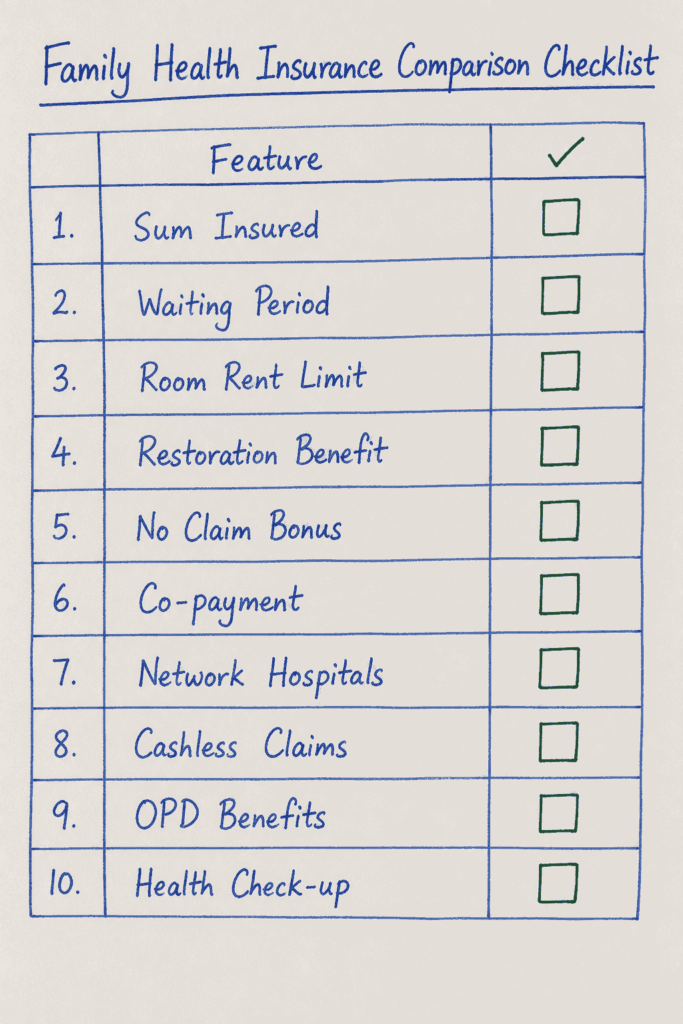
Comparing health insurance plans systematically helps identify the policy that offers the best balance between protection, affordability and service quality.
Use this template as your checklist while comparing your options:
Which Family Health Insurance Plan Is Best for Different Families?
Again there is no definite answer to this, but the decision for the best family health insurance plan will depend on your household’s age, medical history, financial goals and future healthcare needs, etc.
Some considerations could be:
- Newly married couples could focus on an affordable premium, restoration benefit, maternity coverage and a high sum insured.
- Families with children may prioritise pediatric care, vaccinations, daycare procedures and larger hospital network.
- Parents nearing retirement would want to consider separate senior citizen policy if appropriate, lower co-payment, shorter waiting periods and chronic disease coverage.
- Joint families may evaluate whether separate policies may provide better protection than one shared floater.
- Self-employed families may want to look at a higher coverage and emergency financial protection become especially important since employer insurance is unavailable.
Is Employer Health Insurance Alone Enough for Your Family?
Employer-provided health insurance is valuable but may not provide sufficient long-term protection for every family.
Employer policies can change when you switch jobs or retire. Accordingly, company benefits change and coverage limits can be reduced. Maintaining an independent family policy provides continuity regardless of employment.
Should You Buy Health Insurance Online or Through an Insurance Advisor?
Both online purchases and insurance advisors can help you buy health insurance, depending on your experience and comfort level.
- Buying online may offer easy comparison, faster purchase and a more transparent pricing.
- Whereas, working with a trusted advisor may help if your family has complex medical conditions, needs personalised guidance or if comparing multiple riders
Whichever option you choose, always read the policy wording independently.
What Are the Biggest Mistakes to Avoid When Buying Family Health Insurance?
Most buying mistakes happen because people focus only on premium rather than overall coverage quality. We have discussed these caution areas in detail so far in this guide, but a quick look at the common errors one can avoid are:
- Choosing the cheapest policy
- Ignoring exclusions
- Overlooking waiting periods
- Selecting insufficient coverage
- Forgetting room rent limits
- Ignoring co-payment clauses
- Not checking nearby network hospitals
- Depending only on employer insurance
- Failing to review the policy annually
What Should You Do Before Buying a Family Health Insurance Plan?
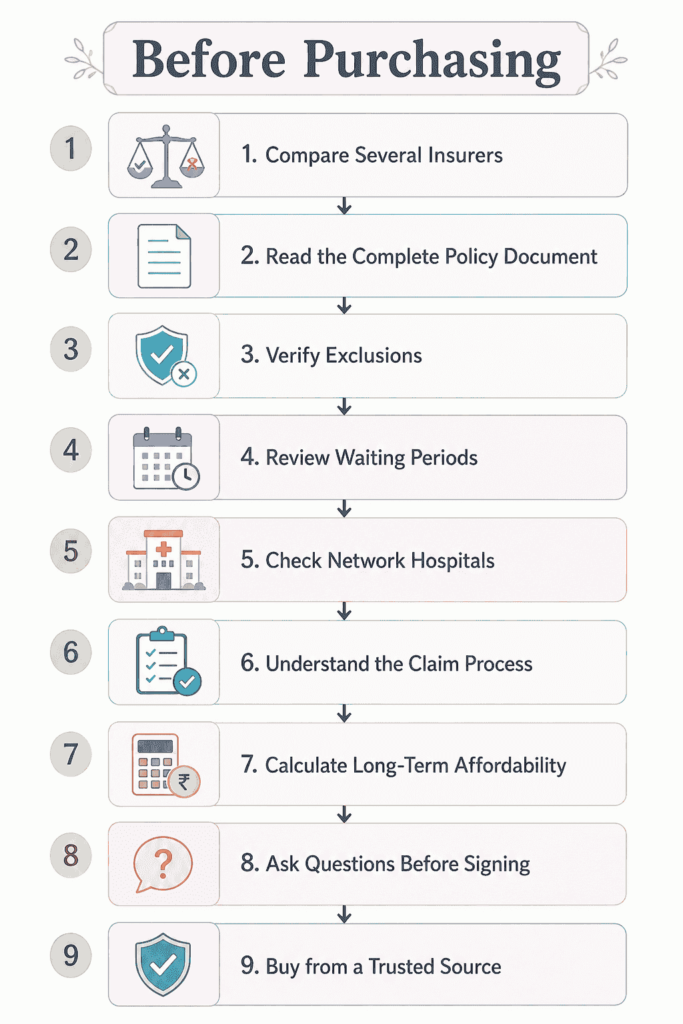
Buying health insurance should follow a structured decision-making process rather than an impulse purchase.
Recommend steps before making a decision:
How Often Should You Review or Upgrade Your Family Health Insurance Plan?
Reviewing your health insurance every one to two years helps ensure your coverage remains appropriate as your family’s circumstances change.
You should revisit your policy after:
- Marriage
- Birth of a child
- Addition of parents
- Diagnosis of chronic illness
- Significant income increase
- Rising healthcare costs
Periodic reviews help keep your financial protection aligned with your current needs.
Is There a Way to Prevent Suffering Instead of Merely Paying for It?
Health insurance can also provide tax benefits under applicable provisions of the Income Tax Act, making it financially attractive for many individuals and families. Unsurprisingly, this advantage is often highlighted in advertisements and marketing campaigns alongside its healthcare benefits.
However, an important question deserves reflection. Is reducing the financial burden of illness the highest solution we can aspire to, or should we also seek to understand why illness and suffering enters our lives in the first place?
Imagine buying a helmet before riding a motorcycle. The helmet may protect you if an accident occurs, but it cannot prevent the accident itself. Likewise, health insurance may reduce the financial impact of a medical emergency, but it cannot prevent disease, relieve physical pain or answer why such hardships arise unexpectedly. This leads to a point that modern healthcare and financial planning rarely address – Is there a way to reduce the very causes of suffering instead of merely preparing to cope with them?
Every hardship experienced by a soul has a deeper cause rooted in the law of karma. Unless that root cause is addressed, suffering continues to manifest in different forms despite our best material preparations.
At first, this may sound difficult to believe. And yet the scriptures repeatedly describe the transformative role of a Tatvdarshi Sant (Enlightened Saint). They explain that only such a realised spiritual master possesses the true method of worship capable of destroying sinful karmas, reducing suffering, and ultimately liberating the soul from the endless cycle of birth and death.
Health insurance can help protect your finances. A Tatvdarshi Sant shows the path to protecting something far greater – one’s life, destiny and eternal well-being.
Can Every Health Problem Truly Be Prevented?
According to the eternal spiritual law explained in the sacred scriptures, every event in our lives operates under the law of karma. The joys we experience, the illnesses we suffer and the hardships that unexpectedly enter our lives are not random occurrences but the consequences of actions performed in this life and previous births.
At first, this idea may seem difficult to accept, especially in an age where science has transformed medicine and healthcare. But it is worth asking some simple questions. Why do seemingly healthy individuals sometimes develop life-threatening illnesses without any obvious cause? Why do people who appear perfectly fit suddenly suffer a fatal heart attack or collapse without warning?
Medical science can often explain how an event occurred. It may identify a blocked artery, an abnormal heart rhythm or a sudden physiological change. But explaining the mechanism is not the same as explaining the ultimate cause. Why did that change occur at that precise moment? Why did one person survive while another, with a similar medical condition, did not?
Jagatguru Tatvdarshi Sant Rampal Ji Maharaj reveals the answer lies beyond the physical body. The unseen force governing these events is karma. The consequences of our actions from previous births manifest as the joys and sorrows we experience today. Good karmas may reduce suffering, while sinful karmas create obstacles, illnesses and hardships throughout life.
However, the scriptures also reveal a profound truth. The burden of accumulated karmas is not beyond redemption. Only a Tatvdarshi Sant (Enlightened Saint), the true messenger of Supreme God Kabir, possesses the authentic method of worship capable of destroying sinful karmas and freeing a soul from their consequences.
Jagatguru Tatvdarshi Sant Rampal Ji Maharaj is that Tatvdarshi Sant in the present age. Through the true worship of Supreme God Kabir bestowed by Him, innumerable disciples have experienced remarkable transformations in their lives, including relief from suffering, improvements in health and a deeper sense of peace and purpose. These experiences are regarded by devotees as manifestations of divine grace working through authentic spiritual practice.
The lives of countless disciples stand as a testimony to the profound changes attributed to the refuge of Sant Rampal Ji Maharaj. To understand how this authentic method of worship works and to explore the scriptural evidence supporting these teachings, listen to the spiritual discourses of Jagatguru Tatvdarshi Sant Rampal Ji Maharaj by visiting:
Website: www.jagatgururampalji.org
YouTube: Sant Rampal Ji Maharaj
Facebook: Spiritual Leader Saint Rampal Ji
‘X’ handle: @SaintRampalJiM
FAQs: Family Health Insurance
Q1) How much family health insurance coverage is enough?
Answer: The ideal sum insured depends on your family’s size, ages, medical history, lifestyle and the cost of healthcare where you live.
Q2) Why do health insurance claims get rejected?
Answer: Claims are commonly rejected due to non-disclosure of medical conditions, policy exclusions, waiting periods, or incomplete documentation.
Q3) What should I compare before buying a family health insurance policy?
Answer: Compare the sum insured, waiting periods, exclusions, co-payment, room rent limits, network hospitals, claim process and long-term affordability before making a decision.