

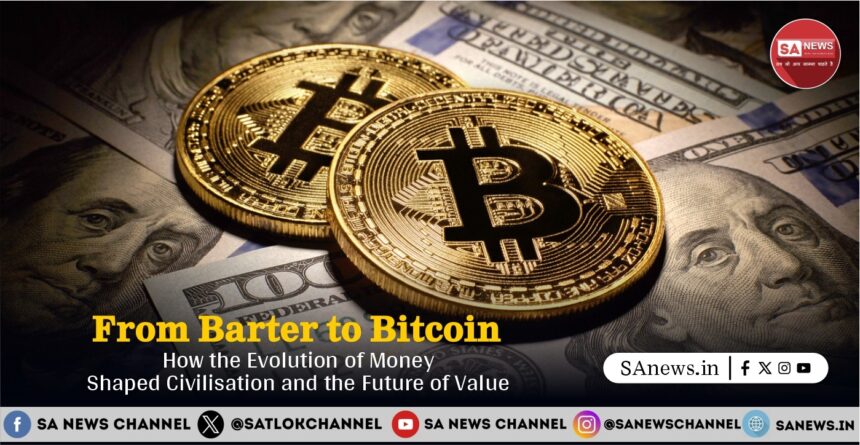
Evolution of Money: From the earliest days of barter to the rise of cryptocurrencies like Bitcoin, the history of money is essentially the history of civilisation itself. It reveals how humans learned to cooperate, how economies expanded beyond villages, how states asserted control and how technology continues to redefine value in the modern age. This article traces the evolution of money from primitive exchanges to digital decentralisation, uncovering not just what money is, but also why it came into existence and where it may be heading next.
- Life Before Money: The Age of Barter
- Gift Economies and Social Credit
- Cave Paintings and the Pre-Monetary World
- The First Forms of Money: Commodities with Value
- The Mesopotamian Ledger: Money as Debt
- The History of Money Before Coins: Rai Stones of Yap
- The Birth of Coinage: Standardised Value Enters History
- The History of Money: Paper Money Replaces Metal
- From the World’s First Banknotes to Banking System
- Europe’s Initial Resistance
- The Medici Family: The Foundations of Modern Banking
- The Spanish Peso: The First Global Currency
- Banking, Credit and the Invisible Money
- The Gold Standard and Its Collapse
- Fiat Money: Value by Decree
- Digital Money and the Cashless Revolution
- Bitcoin and Cryptocurrencies: A Radical Reimagining
- The Most Catastrophic Barter Ever Made
- FAQs: The Evolution of Money
Life Before Money: The Age of Barter
Money is so deeply woven into our daily lives that it often feels eternal, almost natural. We earn it, save it, worry about it, fight over it and dream of having more of it. Yet money, in its many forms, is neither timeless nor inevitable. It is a human invention that was born from necessity, but shaped by power, technology, belief systems and trust.
Before coins jingled in our pockets or numbers flashed on bank screens, humans relied on barter systems. Barter means exchanging products or services directly, without any form of currency. For example, a farmer might trade grain for pottery.
At first glance, barter appears simple. In reality, it was deeply inefficient.
The Problem of ‘Double Coincidence of Wants’
Barter works well only when two parties want exactly what the other is offering at the same time. This requirement, known as the double coincidence of wants, severely limited trade.
For example, a shoemaker may want wheat whereas a farmer may want tools and not shoes.
Without a common medium of exchange, transactions stalled.
Limited Scale, Limited Growth
Barter worked reasonably well in small, close-knit communities, where relationships were personal and needs were predictable. However, as societies grew, trade expanded and specialisation increased, barter became impractical.
According to historians, barter also failed to store value over time, measure worth consistently and enable complex economic planning. These limitations pushed humanity toward the idea of money.
However, it is imperative to take note of how money itself is driving economies to overstep the boundaries of humanity and value money over life. The current geopolitical instability in this world is driven by not just personal motives but also the greater objective of securing continued source of income for countries and nation debt being written off. Therefore, whether money successfully measures worth, or rather, human worth is highly debatable.
Gift Economies and Social Credit
Contrary to popular belief, early human societies did not operate through constant barter. Barter was real but not as central as many economics textbooks used to claim.
- In small tribal and village societies, people shared food, tools and labour.
- Value was measured through relationships.
- Obligation was social, not monetary. Memory and reputation acted as currency
- For example, If a farmer shared some grains today, he was not immediately ‘paid back’ through a barter. The community simply remembered. The return might come weeks, months or years later.
This system is known as a gift economy. Everything was done in pure faith, for example, the farmer who shared the grains would not have given it with expectation of a future return.
There was no need for money because trust was embedded in society. Survival depended on cooperation, not transactional exchange.
Money became necessary only when societies grew large enough that people no longer knew or trust one another personally.
Cave Paintings and the Pre-Monetary World
Cave paintings, reliefs, manuscripts, miniatures and coins themselves serve as some of the most compelling and noteworthy evidence for how early societies exchanged value, understood wealth and conceptualised obligation.
Because money is as much a social idea as an economic tool, art has proven indispensable in helping historians understand how people actually lived, traded and believed, especially in periods where written language was limited or restricted to elites.
While no cave painting explicitly depicts ‘money’, prehistoric art reveals exchange, gifting, sharing, and collective survival, which preceded monetary systems.
Two notable examples are:
- Lascaux Cave Paintings, France: Dated around 17,000 BCE. These depict communal hunting scenes, suggesting shared resources rather than individual ownership. Such imagery supports anthropological findings that early societies operated on collective distribution, not barter or currency.
- Bhimbetka Rock Shelters, India: Dated around 10,000 BCE. Scenes of hunting, dancing, gifting and food gathering illustrate cooperation and social cohesion. These visual records align with the idea of gift economies and reciprocity was remembered rather than measured.
What this tells us is that before money, value was not counted, it was rather embedded in participation. Art helps confirm that early economic life was relational, not transactional.
The First Forms of Money: Commodities with Value
Long before coins or paper, early societies began using commodity money. Commodity money primarily stands for objects that had intrinsic value and were widely accepted.
Some common early forms of commodity money were:
- Cattle: Wealth was often measured in livestock.
- Grain, especially in agricultural societies
- Salt: It was so valuable that Roman soldiers were sometimes paid in it. This was the origin of the word ‘salary’, relating to ‘salarium’ which meant ‘salt money’.
- Shells such as cowrie shells were used across Africa, Asia and the Pacific region.
- Metals like copper, silver and gold
These commodities shared key characteristics of durability, divisibility, portability and recognisable value.
Commodity money solved many problems of barter, but it still had limitations, especially as trade expanded across regions and empires.
The Mesopotamian Ledger: Money as Debt
The widely repeated idea that money grew out of barter has little support in historical or archaeological evidence. Research by historians and anthropologists, most notably David Graeber in ‘Debt: The First 5,000 Years’ along with extensive analysis of cuneiform records, shows that early money systems were built around credit, obligation and accounting, not the swapping of goods in open markets.
Here are some important aspects to note:
- In ancient Mesopotamia, beginning around 3500 BCE, economic life was organised by large institutional centres, primarily temples and royal palaces. These were not merely religious or political structures, instead, they functioned as the earliest financial authorities.
- They managed vast storehouses of grain and livestock, issued advances of seed and tools to farmers, oversaw long-distance trade, collected taxes and rents, and also maintained detailed records of what was owed and by whom.
- Transactions were documented on cuneiform clay tablets, forming the earliest known systems of bookkeeping. These tablets recorded debts, wages, rations, loans, and obligations rather than one-time barter exchanges. In effect, much of the economy operated through written accounts of credit and liability.
- Central to this system was the shekel (Akkadian šiqlu, Sumerian gin₂).
- Contrary to modern assumptions, the shekel was not a coin.
- Coinage would not appear until more than two millennia later, in Lydia during the 7th century BCE.
- Instead, the shekel functioned as a standard unit of weight, typically around 8.3-8.4 grams, though this varied by region and period.
- The shekel unit formed the basis of a dual-valuation system.
- Firstly, it was used for barley, the primary staple crop, and was used for everyday transactions such as wages, household rations and small obligations.
- Secondly, it was also used for silver, valued for its durability and portability, was used for large payments, taxes, fines and long-distance commerce.
- A fixed equivalence between the two, often described as the barley-to-silver price ratio, also allowed debts to be calculated in a common measure. For example, a debt might be recorded as a number of shekels in silver terms, yet repaid in barley at harvest according to the established conversion. This made the system both flexible and standardised.
- By the third and early second millennium BCE, particularly during the Old Babylonian period, legal codes, wages, contractual obligations were increasingly specified in ‘shekels of silver’, even when no physical silver changed hands. The unit served primarily as an accounting measure, not a circulating object.
How ‘Shekels of Silver’ Worked in Practice
A farmer might receive seed or tools from a temple at the beginning of the planting season. This ‘advance’ created a formal obligation recorded on a tablet as a debt measured in shekels. At harvest, the farmer could settle the account by delivering barley equivalent to the silver value listed. In some cases, the debt could be transferred to merchants or other officials, demonstrating that these obligations functioned as a form of abstract, transferable money.
In other words, much of Mesopotamian ‘money’ existed as numbers in ledgers rather than objects in circulation. Long before coins or banknotes, economic life was organised through written claims and credits or obligations.
This system reveals a crucial truth about the origin of money – it began as a social technology for managing debt in complex societies, not as a by-product of barter between individuals.
The History of Money Before Coins: Rai Stones of Yap
Before coins became the dominant currency of trade, several civilisations were already trading with their own indigenous systems. Here, we will illustrate one of such systems worth knowing:
The Rai Stones of Yap
One of the most remarkable examples in the history of money comes from the island of Yap in Micronesia. For centuries, the Yapese people used Rai stones. They were large circular limestone discs, some several metres across and weighing multiple tonnes. Rai stones were recognised as a form of wealth.
What made Rai stones extraordinary was not just their size, but the fact that they rarely changed physical location. Transporting them was dangerous and often impossible, so instead of moving the stones themselves, the Yapese transferred ownership through collective memory and oral record.
The Story of the Sunken Stone: One well-known Rai stone was lost at sea during a storm while being carried by raft from another island. When the survivors returned and explained what had happened, the community accepted that although the stone was no longer visible, it still existed and still belonged to its owner. For generations afterward, that unseen stone continued to be used in major transactions, such as land purchases and marriage payments, purely because everyone agreed it was still there.
This episode demonstrates a profound principle in monetary history that money did not need to be tangible to function for earlier civilisations.
The Birth of Coinage: Standardised Value Enters History
After Mesopotamian shekels, the next major breakthrough came around 600–700 BCE, when the Lydians (in present-day Turkey) introduced the world’s first known metal coins.
Coins were revolutionary because they:
- Had standardised weight and value
- Were backed by authority (often stamped with a ruler’s symbol)
- Enabled taxation, wages and large-scale trade
- Strengthened state power and governance
Gold and silver coins quickly spread through Greece, Rome, Persia, India and China. Money was no longer just a medium of exchange, it also became a tool of empires across the globe.
The History of Money: Paper Money Replaces Metal
While coins dominated for centuries, carrying large quantities of metal was inconvenient and risky. The alternate solution emerged in China, during the Tang and Song dynasties (7th-11th centuries).
Song Dynasty China: The World’s First Paper Money Experiment
While medieval Europe relied on wood to track value, China was undergoing what historians call a commercial revolution. During the Song Dynasty in the 11th century, trade expanded rapidly, but merchants faced a practical problem of carrying thousands of heavy metal coins. It was inefficient and dangerous.
- To solve this, the government introduced Jiaozi, the world’s first true paper currency.
- These were banknotes finely printed using woodblock techniques and were designed to represent deposits of metal coins held by the state.
- At first, the system worked well. However, it soon revealed a crucial lesson in monetary history.
- To finance military campaigns and administrative costs, authorities printed increasing quantities of Jiaozi without sufficient reserves of metal to support them.
- As more notes entered circulation, their value steadily declined.
- By the time Marco Polo reached China in the 13th century, he marvelled at the widespread use of paper money.However, the underlying imbalance had already set the stage for collapse.
- Inflation eroded trust, and eventually China abandoned paper currency and returned to silver-based systems for centuries.
From the World’s First Banknotes to Banking System
As we have just read, Chinese merchants began using paper receipts representing deposited metal coins. Eventually, the state took over this system, issuing official paper money.
Paper money worked because it was backed by trust – trust in the issuing authority, trust that it could be redeemed and trust that others would accept it. However, Europe was not thrilled with the idea of paper money initially, though eventually, the Medici family did contribute in a significant way to the banking systems. Here we will not only examine the Medici family’s role in the evolution of money, but also how the Spanish Peso (silver coins) were used despite experiments with paper money prior to Peso.
Europe’s Initial Resistance
Europe was slower to adopt paper money. Early experiments often failed due to overprinting lack of backing and very often, political instability
It wasn’t until the rise of central banks, such as the Bank of England (1694), that paper money gained widespread acceptance in the West.
However, at this stage it is important to take note of the Medici family’s role with respect to banking systems.
The Medici Family: The Foundations of Modern Banking
In 15th-century Florence, the Medici family changed the movement of money across Europe. At the time, Christian doctrine condemned ‘usury’, making open interest-based lending morally and legally dangerous.
The Medici bypassed this restriction through a financial innovation known as the bill of exchange. A merchant could deposit gold florins in Florence and receive a written instrument. He could then travel to cities such as Bruges, London or Venice and redeem the document for local currency.
The Medici earned their profit not through declared interest, but by adjusting exchange rates between currencies. This allowed them to transfer wealth across borders without physically moving gold. Such a system also reduced the risk of theft and created the first truly international banking network
By mastering financial flow rather than physical currency, the Medici became central figures in European commerce and major patrons of Renaissance art and culture. Their system laid the groundwork for modern banking, international trade and finance, and credit-based economies.
The Spanish Peso: The First Global Currency
In the 16th century, Spain uncovered vast silver deposits at Potosí in present-day Bolivia, often described as a ‘mountain of silver’. From this resource, Spain minted enormous quantities of a coin known as the Peso de Ocho, or ‘Piece of Eight’. Unlike earlier regional currencies, the Spanish peso achieved worldwide circulation.
It became the preferred medium of exchange:
- Across Europe
- Throughout the Americas
- In the trade networks of Africa and Asia
- In the markets of Manila, where it facilitated commerce between China, Southeast Asia and the New World
For the first time in history, a single coin functioned as a global standard of value. Its influence was so lasting that the United States dollar was modelled directly on the Spanish peso, and the coin itself remained legal tender in the United States until 1857.
The Spanish peso demonstrated that money was not paper money, however, its global silver connected distant economies
Banking, Credit and the Invisible Money
As economies expanded, money evolved beyond physical forms.
- Banks introduced deposits, loans, interest and credit systems.
- Money became increasingly abstract, that is, numbers in ledgers rather than objects in hand.
- Credit allowed individuals and governments to spend future income today.
- While this may have fuelled growth, it also introduced vicious debt cycles and financial crises, leading to economic inequality.
By the 20th century, most money existed not as cash, but as digital entries in bank accounts.
The Gold Standard and Its Collapse
For much of modern history, currencies were tied to gold. This meant paper money could theoretically be exchanged for a fixed amount of gold.
However, the Gold Standard also failed due to the following reasons:
- While gold provided stability, it also restricted governments’ ability to respond to crises.
- Major global events, especially World War I, the Great Depression and World War II, forced governments to abandon gold backing to print more money and stimulate economies.
- In 1971, the United States formally ended the gold standard, ushering in the era of fiat money.
Fiat Money: Value by Decree
Fiat money is another form of money but it has no intrinsic value. It is valuable because governments declare it legal tender and people trust it. Some aspects of fiat money that need to be discussed are:
- Today’s national currencies such as the pound sterling, the US dollar and the euro are known as fiat money.
- Unlike gold or other commodities, fiat money has no inherent material worth. Its value comes from a collective agreement backed by law where governments designate it as legal tender and people accept it as payment in everyday life.
- Fiat money functions through a combination of state authority, institutional systems and public confidence.
- Governments create ongoing demand for their currency by requiring taxes and official payments to be made exclusively in it.
- Central banks regulate the money supply, influence interest rates and attempt to maintain price stability.
- Commercial banks extend this system by issuing loans, which effectively bring new money into existence in the form of credit rather than physical cash.
- Because fiat money is not limited by scarce physical resources, states can expand or contract supply to manage economic growth, respond to recessions or fund national priorities.
- However, this flexibility carries risk. Excessive creation of currency can reduce purchasing power and lead to inflation, while a breakdown in confidence can trigger rapid devaluation.
Despite its flaws, fiat money dominates the modern financial system.
Digital Money and the Cashless Revolution
The late 20th and early 21st centuries saw money become increasingly digital.
Key Developments were were the introduction of:
- Credit and debit cards
- Online banking
- Mobile payment apps
- Contactless transactions, such as tapping of a debit or credit card on chip-enabled machines.
In many countries, physical cash is rapidly disappearing. Though cash is still used in India, the Digital India initiative by the Government of India has made it deeply into our daily lives today.
Also Read: $102 Trillion in Debt: How Money Became an Illusion We All Believe In?
Bitcoin and Cryptocurrencies: A Radical Reimagining
In 2008, amid a global financial crisis, an anonymous figure known as Satoshi Nakamoto introduced Bitcoin – a decentralised digital currency (cryptocurrency).
So how do cryptocurrencies actually work? While it is beyond the scope of this article to go in-depth on cryptocurrencies, we will, however, examine it briefly and warn readers of the associated dangers of cryptocurrencies.
Cryptocurrencies rely on blockchain technology, a decentralised digital ledger maintained by a global network of computers. Instead of a single institution keeping records, every transaction is verified by multiple participants and permanently added to a chain of encrypted data blocks.
Bitcoin, is essentially a type of cryptocurrency and is built on three defining features:
- Decentralised control: No central bank or organisation governs the network.
- Limited supply: Bitcoin is capped at 21 million units, preventing unlimited creation.
- Cryptographic validation: Transactions are confirmed through complex mathematical processes that protect against fraud and duplication.
Ownership is established through private digital keys, allowing users to send value directly to one another without intermediaries. This enables fast, borderless transactions that are difficult to censor or manipulate.
Beyond Bitcoin, thousands of alternative cryptocurrencies now exist. Some, such as Ethereum, allow developers to create contracts. Together, these innovations form the foundation of what is known as decentralised finance (DeFi).
Key Disadvantages and Challenges
Despite their promise, cryptocurrencies face significant obstacles:
- Extreme Price Fluctuations: Rapid gains and losses make them unreliable as everyday currency.
- Limited Transaction Capacity: Many blockchain networks process far fewer payments per second than conventional systems like Visa or Mastercard.
- High Energy Use: Some networks, especially Bitcoin, require large amounts of computing power, raising environmental concerns.
- Legal and Regulatory Uncertainty: Governments continue to debate how digital currencies should be taxed, regulated or restricted.
- Security Risks: Lost access keys mean permanent loss of funds, and mistaken or fraudulent transfers cannot be reversed.
Cryptocurrencies are the modern age gamble that poses more risks than what they claim to offer. The insatiable quest for more wealth has only blinded humanity to the dangers of cryptocurrencies in this age of digital fraud.
The Most Catastrophic Barter Ever Made
The greatest misconception we live under is the belief that money was created merely for survival, evolved to organise societies, enabled empires and ultimately, it has powered innovation.
Money continues to evolve because humanity has accepted it as the centre of life itself. We imagine that we have progressed from barter to Bitcoin, but the truth is far more unsettling and unbelievable, but truth it is.
In reality, we are still living a bartered existence, one we no longer recognise.
As history shows, barter has rarely been equal. And the barter we once accepted was not just unequal, it was catastrophic. It was the greatest mistake ever made by the human soul.
In that exchange, we traded immortality for mortality, peace for suffering and abundance for scarcity. We exchanged God for deception. We abandoned our Creator for a pretender. We chose infatuation over loyalty, illusion over truth.
Jagatguru Tatvdarshi Sant Rampal Ji Maharaj reveals this hidden tragedy – the most disastrous bargain in the history of existence. Through a monumental error of judgement and a failure of loyalty and discernment, souls turned away from Supreme God Kabir, the eternal Creator of all universes, and accepted the rule of Kaal Brahm (Satan), the lord of the material realm of 21 universes.
By doing so, we left behind our immortal origin, our imperishable bodies and a realm of limitless abundance (Satlok). We entered a mortal world governed by limitation, inequality and decay – a world where scarcity forces humanity into competition, constant conflict and division, even though all souls are children of the same One God.
This is why we now struggle for survival. This is why we fight over land, wealth, status and power. This is why we have been reduced to chasing pieces of paper stamped by governments and banks that are nothing but symbols of control in a world built on shortage.
Kabir, Yeh Maya Atpati, Sab Ghat Aan Adi |
Kis Kis Ku Samjhau, Kuye Bhaang Padi ||
What is the true mystery of our origin? How did immortal beings become prisoners of mortality? How did divine souls become puppets of systems that thrive on fear and debt?
The answers lie in the eye-opening spiritual knowledge of Sant Rampal Ji Maharaj, who exposes the greatest loss humanity has ever suffered – the most tragic barter in the history of existence, in this video:
To know more, visit:
- Website: www.jagatgururampalji.org
- YouTube: Sant Rampal Ji Maharaj
- Facebook: Spiritual Leader Saint Rampal Ji
- ‘X’ handle: @SaintRampalJiM
FAQs: The Evolution of Money
Q1) Did money really begin with barter?
Answer: Historical evidence shows that money emerged from systems of credit, debt and accounting long before widespread barter markets ever existed.
Q2) Why did societies move from coins to paper and digital money?
Answer: Societies adopted paper and digital money because it is easier to transport, store, standardise and manage than physical metals in expanding economies.