

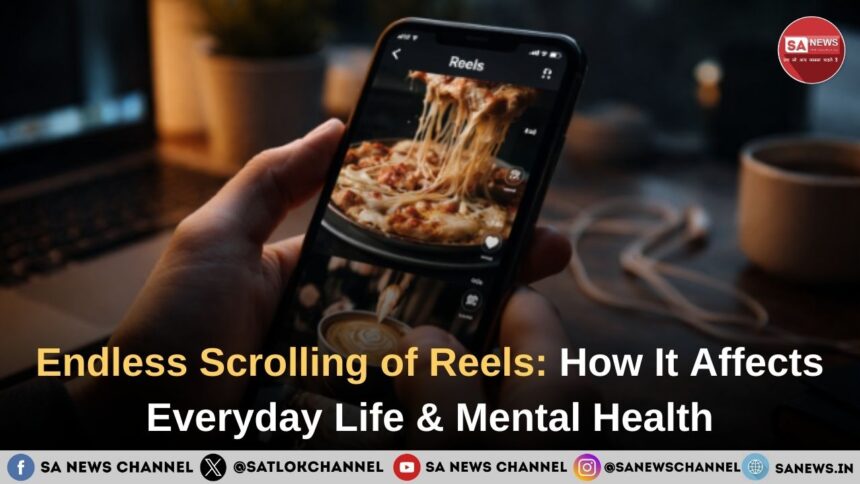
Endless Reels Scrolling: Short-video platforms like Instagram, TikTok, Facebook, YouTube, and Pinterest dominate today’s digital world. What begins as a few minutes of entertainment often turns into hours of nonstop scrolling. Mental health professionals are increasingly concerned about this widespread habit-across all age groups-and its impact on daily functioning and psychological well-being. If a competition were organized to find people who spend endless hours scrolling reels, almost every household would have at least one participant. Most people unknowingly lose 1–3 hours daily scrolling reels.
The Concept Behind Endless Scrolling Reels
In the digital age, the most valuable currency is your attention. What begins as a quest for a quick laugh often ends in a two-hour “scroll hole.” Whether it’s Instagram, TikTok, or YouTube Shorts, these platforms have turned entertainment into a high-stakes psychological game. Today, it’s rare to find a household without at least one “scroller” losing 1–3 hours daily. But when you break down the math, the cost is staggering:
| Frequency | Daily Time | Monthly Total | Annual Impact |
| 100 Reels | 25 Minutes | 12.5 Hours | 150 Hours |
| 300 Reels | 1.25 Hours | 38 Hours | 456 Hours |
| The “Power User” | 3 Hours | 90 Hours | 1,095 Hours |
In 1,000 hours, a person could learn a new language, train for a marathon, or build a side business. Instead, it is often traded for 15-second bursts of dopamine.
Also Read : Mental Health Awareness: A New Dimension of Healthy Living
How Customized Algorithms Maintain Your Interest
The “Endless Scroll” isn’t an accident; it’s an engineering feat. Using Variable Reward Schedules-the same logic behind slot machines-algorithms ensure you never know if the next video will be a hilarious meme or a shocking news clip.
- Dopamine Overload: Every “hit” of novelty triggers dopamine. Over time, your brain raises its threshold for pleasure, making real-life activities (like reading a book) feel excruciatingly dull.
- The Content Mirror: Highly customized algorithms learn your insecurities and interests faster than you do, creating an echo chamber that is hard to exit.
The “Morning Hijack”: Why the First 60 Minutes Matter
The most critical time of your day is the first hour after waking. Checking your phone immediately triggers an Instant Dopamine Spike, which sabotages your motivation for the rest of the day.
- Reduced Goal Focus: Your brain moves from “Creator Mode” to “Consumer Mode.”
- Cognitive Fog: Instead of mental clarity, you start the day with “context switching” fatigue.
- The Comparison Trap: Seeing idealized lives before you’ve even brushed your teeth breeds instant anxiety and “FOMO.”
Consequences for Mental Health
Mental health experts link excessive reel consumption to:
- Anxiety
- Stress
- Low self-esteem
Reels often portray idealized lives-perfect bodies, luxury lifestyles, success stories, and constant happiness. Continuous exposure can lead to unhealthy comparisons and dissatisfaction with real life. Long-term social media use has also been associated with loneliness and depression. Ironically, people may feel emotionally isolated despite being constantly “connected” online.
Also Read: How to Improve Your Quality of Sleep?
Disruption of Daily Routine and Sleep Disturbance
Endless scrolling often extends late into the night. Blue light from screens interferes with melatonin, the hormone responsible for sleep. Additionally, emotionally stimulating content keeps the brain alert, making it harder to fall asleep.
Sleep deprivation results in:
- Irritability
- Poor focus
- Memory issues
- Weak decision-making
This creates a vicious cycle where people scroll more to escape stress and exhaustion.
Overwhelming Emotions and Reduced Real-Life Engagement
Reels expose users to rapidly changing emotions-joy, anger, sadness, inspiration-within minutes. This emotional overload can make regulation difficult. Some users report feeling emotionally numb or overly reactive in real-life situations.
Excessive screen time also reduces participation in:
- Physical activity
- Hobbies
- Face-to-face interactions
This imbalance affects both physical and mental health.
A Practical Solution to Modern Mental Stress
Endless reel scrolling is a symptom of a restless mind seeking meaning through instant dopamine, leading to anxiety and the waste of a precious human life. Sant Rampal Ji Maharaj provides a practical solution by teaching that this human body is a rare opportunity for God-realization, not for trivial distractions. He instructs His disciples to master technology for noble causes-such as listening to spiritual discourses (Satsang) and studying the once-inaccessible scriptures of all religions-rather than wasting time on mindless entertainment.
According to scriptures, the soul is trapped in the cycle of birth and death; using technology to understand the path to the Eternal Abode (Satlok) transforms a digital addiction into a gateway for salvation. By strengthening the mind through this spiritual discipline, individuals naturally detach from the “scroll hole,” reclaiming their time and mental clarity for a truly purposeful life.
FAQs on Endless Scrolling of reels
1. How much reel scrolling is considered excessive?
Spending more than 1–2 hours daily on reels, especially without awareness, is generally considered excessive and potentially harmful.
2. Does reel scrolling affect children and teenagers more?
Yes. Developing brains are more sensitive to dopamine stimulation, making young users more prone to attention issues and addictive patterns.
3. Can limiting reels really improve sleep quality?
Yes. Reducing screen time before bed helps restore melatonin production and improves sleep duration and quality.
4. Are short videos worse than long-form content?
Short videos condition the brain for quick rewards, whereas long-form content encourages sustained attention and deeper engagement.
5. What is the easiest way to reduce reel addiction?
Setting app time limits, disabling autoplay, avoiding morning scrolling, and replacing screen time with offline activities are effective first steps.