


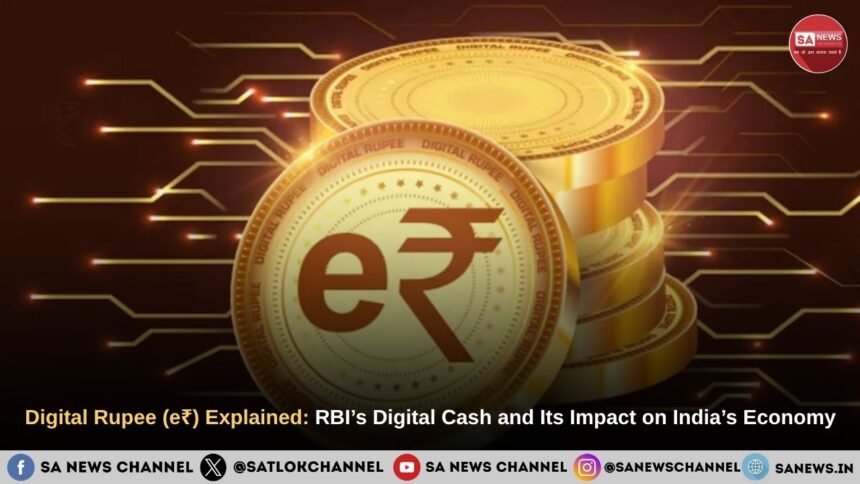
India is steadily moving toward a more advanced financial ecosystem, and the Digital Rupee (e₹) has emerged as a key pillar of this transformation. Introduced by the Reserve Bank of India (RBI), the Digital Rupee is India’s official Central Bank Digital Currency (CBDC). Unlike private cryptocurrencies, this is sovereign money, fully regulated, stable, and backed by the government. In simple terms, it is “cash, but digital,” designed to function just like physical currency while leveraging the convenience of modern technology.
- Understanding the Digital Rupee
- How It Works in Daily Life
- Key Features Driving Attention
- Growing Role in Government Schemes
- Adoption Still in Early Stages
- Benefits for the Economy
- Challenges That Need Attention
- The Road Ahead
- Digital Progress vs Eternal Truth: A Spiritual Reflection on the Digital Rupee
- FAQs about Digital Rupee (e₹)
Understanding the Digital Rupee
The Digital Rupee holds the same value as paper currency or coins. If you have ₹500 in your digital wallet as e₹, it is equivalent to holding ₹500 in cash. The only difference is the form, it exists digitally and can be stored in a secure wallet provided by participating banks.
This digital currency has been introduced in two segments. The retail version (e₹-R) is meant for everyday users, including individuals and businesses, while the wholesale version (e₹-W) is used by financial institutions for large-scale transactions. The retail version is what directly impacts the common citizen, enabling seamless digital payments without relying entirely on traditional banking intermediaries.
How It Works in Daily Life
The functionality of the Digital Rupee has been designed to be simple and familiar. Users can download a CBDC-supported wallet from their bank, load it with digital currency, and start making payments. One of its most notable features is compatibility with QR codes, including those used in the widely adopted Unified Payments Interface (UPI) ecosystem.
This means that a user can walk into a shop, scan a QR code, and pay using e₹ just as easily as they would using UPI apps. The transaction is direct and final, similar to handing over cash. There is no need for settlement delays or multiple intermediaries.
Key Features Driving Attention
One of the standout features of the Digital Rupee is its offline capability. Unlike many digital payment systems that require internet connectivity, the e₹ is being developed to work even in low or no network conditions. This is particularly significant for rural and remote areas where connectivity remains a challenge.

Another major feature is programmability. The Digital Rupee can be programmed for specific uses. For example, government benefits distributed in e₹ can be restricted to essential purchases like food or healthcare. This ensures that funds are used for their intended purpose, reducing misuse and leakage.
Additionally, the Digital Rupee enhances transparency in financial transactions. Since it is issued and monitored by the central bank, it provides a secure and traceable system that can help curb illegal activities such as money laundering and tax evasion.
Growing Role in Government Schemes
The Indian government is increasingly exploring the use of the Digital Rupee in welfare programs. Pilot projects are underway where subsidies and benefits are directly transferred to beneficiaries in the form of e₹. This approach minimizes the role of intermediaries and ensures that financial aid reaches the intended recipients efficiently.
Such initiatives also highlight the potential of CBDC in improving governance. By combining digital technology with sovereign currency, the system offers better accountability and control over public funds.
Adoption Still in Early Stages
Despite its promising features, the Digital Rupee is still in the pilot phase. The RBI is gradually expanding its use cases, testing different technologies, and collecting feedback from users. Adoption is growing, but it remains limited compared to established digital payment systems.
A major reason for this is the dominance of UPI, which has already transformed India into one of the world’s leading digital payment markets. For many users, UPI is fast, free, and convenient, making it challenging for the Digital Rupee to differentiate itself.
However, experts believe that the two systems are not competitors but complementary tools. While UPI is a payment interface that connects bank accounts, the Digital Rupee is actual money in digital form. Over time, both could coexist and serve different purposes within the financial ecosystem.
Benefits for the Economy
The introduction of the Digital Rupee brings several long-term benefits. It reduces the cost of printing and managing physical cash, which is a significant expense for the economy. It also improves the efficiency of transactions by enabling instant settlements.
Read in Hindi: Digital Rupee (e₹) क्या है? जानिए फायदे, उपयोग और पूरी गाइड
Financial inclusion is another major advantage. People without access to traditional banking services can still use digital currency through simple wallets, bridging the gap between the banked and unbanked population.
Moreover, the Digital Rupee strengthens India’s position in the global financial landscape. As more countries explore CBDCs, India’s early adoption and experimentation could give it a strategic advantage in shaping the future of digital finance.
Challenges That Need Attention
While the Digital Rupee offers multiple advantages, it also raises important concerns. Privacy is one of the biggest issues. Unlike physical cash, digital transactions can be tracked, which may lead to apprehension among users about data security.
Another challenge is technological infrastructure. Ensuring smooth operation across urban and rural areas requires robust systems and continuous innovation. Any technical glitches could affect user trust.
Awareness is also a key factor. Many people are still unfamiliar with the concept of CBDC and how it differs from existing digital payment methods. Educating users will be crucial for widespread adoption.
The Road Ahead
Looking forward, the Digital Rupee has the potential to redefine how money is used in India. The RBI is expected to expand pilot programs, introduce new features, and gradually scale up its implementation. There is also growing interest in using CBDCs for cross-border payments, which could make international transactions faster and more cost-effective.
As technology evolves and user confidence grows, the Digital Rupee could become a mainstream mode of payment. It represents not just a technological upgrade but a fundamental shift in the concept of money itself.
The Digital Rupee: Shaping India’s Next Financial Era
The Digital Rupee is a significant step in India’s journey toward a digitally empowered economy. By combining the reliability of cash with the efficiency of digital systems, it offers a unique solution tailored to modern financial needs.
Although still in its early stages, its impact is expected to grow steadily. With continued innovation, policy support, and public awareness, the Digital Rupee could soon become an integral part of everyday transactions, shaping the future of money in India.
Digital Progress vs Eternal Truth: A Spiritual Reflection on the Digital Rupee
Spiritual Perspective on Digital Rupee (e₹):
The rise of the Digital Rupee (e₹), introduced by the Reserve Bank of India, reflects how human society is continuously evolving in material comfort and convenience. While digital cash makes transactions faster and more secure, it also reminds us that wealth, whether physical or digital, remains temporary. According to spiritual teachings, especially as explained by Sant Rampal Ji Maharaj, the real purpose of human life is not the accumulation of money but attaining true devotion and salvation.
No matter how advanced financial systems become, they cannot bring inner peace or liberation. The Digital Rupee may simplify life, but it cannot solve the deeper questions of existence. True happiness comes from connecting with the Supreme God and following the right path of worship. Therefore, along with embracing digital progress, one should not forget the ultimate goal of life, spiritual awakening and attaining Satlok.
FAQs about Digital Rupee (e₹)
1. What is the Digital Rupee (e₹)?
The Digital Rupee (e₹) is India’s Central Bank Digital Currency issued by the Reserve Bank of India. It is a digital form of physical cash that holds the same value and can be used for everyday transactions.
2. How is the Digital Rupee different from UPI?
The Unified Payments Interface (UPI) is a payment system that transfers money between bank accounts, while the Digital Rupee is actual money stored in a digital wallet, similar to physical cash.
3. Can the Digital Rupee be used without the internet?
Yes, one of the key features being tested is offline functionality, allowing users to make transactions even without internet connectivity.
4. Is the Digital Rupee safe to use?
Yes, it is considered highly secure because it is issued and regulated by the Reserve Bank of India, ensuring trust and stability.
5. Who can use the Digital Rupee in India?
Currently, it is available to selected users as part of pilot programs. Over time, it is expected to be accessible to all citizens and businesses across India.