

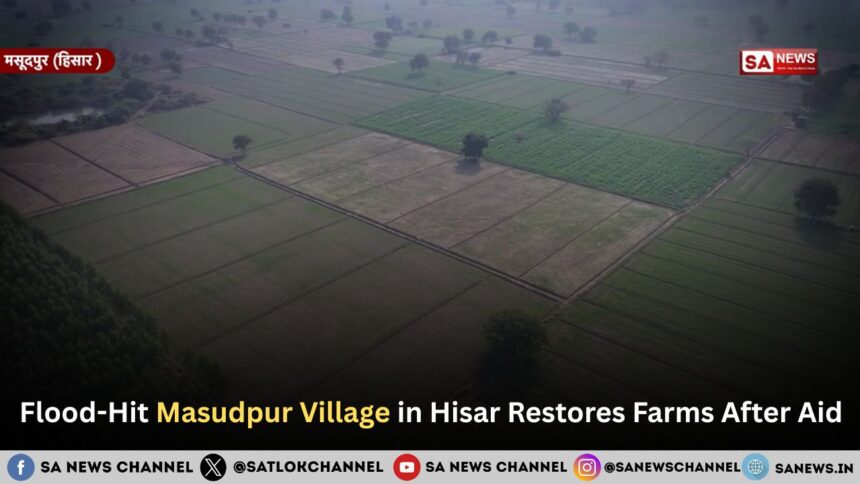
Masudpur village in Haryana’s Hisar district is witnessing widespread agricultural recovery after months of flood-induced waterlogging submerged fields, homes, and sports facilities. Villagers, farmers, and local officials report that nearly 98 per cent of standing water has been drained after large pumps and thousands of feet of pipelines were installed across the area.
- Key Takeaways on Masudpur Flood Recovery
- Widespread Flooding in Masudpur
- Arrival of Equipment and Drainage Operations
- Fields Replanted, Wheat Crops Emerging
- Statements From Farmers on Ground Conditions
- Village Administration on Scale of Recovery
- Rajiv Gandhi Sports Stadium Back in Use
- Residents Reflect on Impact
- A Village Looking Ahead
Wheat crops are now growing in fields that earlier had four to six feet of water, while irrigation has resumed using the same equipment that was first deployed for drainage. Village representatives and residents say only small boundary patches remain waterlogged, with work continuing.
Key Takeaways on Masudpur Flood Recovery
- Masudpur village in Hisar district had 700–800 acres of farmland submerged.
- Floodwater affected nearly 700–800 homes and filled the village stadium and ponds.
- Five 15 HP motors and about 22,000 feet of eight-inch pipelines were installed.
- Villagers and officials say about 98 per cent of water has now been removed.
- Wheat and mustard crops are growing; irrigation has restarted in many fields.
- Rajiv Gandhi Sports Stadium has reopened for training after months of flooding.
- Farmers estimate that 500–600 “kilas” of land have already been replanted.
- Only 30–40 kilas in low-lying boundary areas reportedly remain waterlogged.
Widespread Flooding in Masudpur
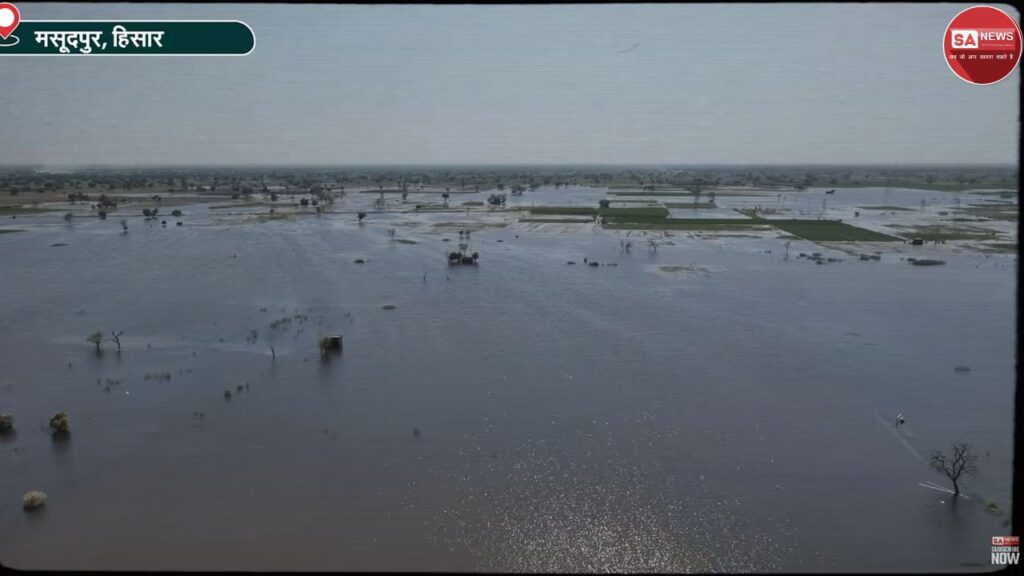
Residents say Masudpur, located in Hisar district of Haryana, had faced severe flooding that submerged large sections of farmland and residential areas. According to villagers, about 700–800 acres of land were underwater, while floodwater entered nearly 700–800 homes. The village stadium and ponds were also filled to capacity.
Farmers recalled that water in some areas reached chest height, between five and six feet, forcing them to construct makeshift boats from pipes to transport harvested paddy over long distances. Several residents said paddy crops were destroyed, and hopes for the next sowing season had nearly faded.
Also Read: A Story of Hope Rising from the Soil of Depal: Flood, Helplessness, and an Example of Humanity
Village representatives stated that after receiving what they described as assurances from government agencies, the sarpanch and the panchayat, led by Roshan Lal, approached Tatvadarshi Sant Rampal Ji Maharaj for assistance and submitted a written request in His Barwala situated Muninder Dharmarth Trust office. The petition asked for large motors and pipelines to remove water from both fields and residential areas.
Arrival of Equipment and Drainage Operations
Villagers reported that relief material arrived within days. According to statements at the site, a convoy of many vehicles reached Masudpur carrying equipment that included:
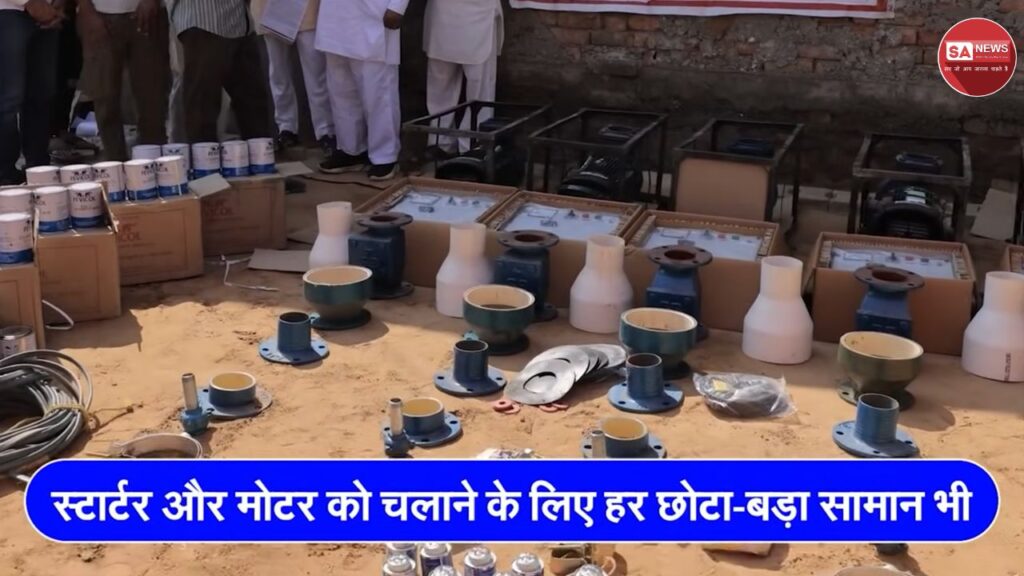
- Five large motors, each rated at 15 horsepower
- Around 22,000 feet of eight-inch, high-grade pipelines
- Additional electrical cables, starters, and supporting accessories
Residents said the pipeline network was spread across the village and surrounding fields, allowing continuous pumping of floodwater. Several motors were still operating during later visits, drawing water into nearby canals and low-lying channels.
Farmers added that the same pumps and pipelines used for drainage were later redeployed for irrigation once sowing resumed, allowing water from one field to be redirected to another.
Also Read: How a 20-Year-Old Ocean Dried Up in the Fields of Masudpur: The Flourishing Harvest
Fields Replanted, Wheat Crops Emerging
During follow-up visits about one to one-and-a-half months later, reporters observed wheat crops emerging four to five inches above the soil in many areas. Villagers said that sowing had been completed across large stretches of farmland and that the floodwater had largely receded.
Farmers estimated that out of the 700–800 kilas that were earlier submerged, about 500–600 kilas had already been replanted. Some deeper pockets continued to hold water, but pumping operations were ongoing.
Also Watch:
Cotton fields were also inspected in low-lying zones where motors were still running. In some plots, cotton had already been harvested, while in others water was being removed to save standing crops.
Statements From Farmers on Ground Conditions
Multiple villagers spoke about the changing situation. Yogesh, a local farmer who had earlier shared videos of the flooding on social media, said that water had once reached waist height in the fields and that seven to eight motors were later deployed to drain the area.
Another farmer, Sadhu Ram, said that his fields, once submerged during the paddy season, had now been replanted with wheat and irrigated using the same pipelines. He noted that school grounds that earlier had five feet of water were now dry.
Leva Ram, another resident, stated that he had replanted 15–16 kilas of land and that farmers across the village were relieved to resume cultivation.
Krishna, another villager, said that almost all the water in his area had been drained and that sowing had resumed across most plots.
Shamsher, who was cutting fodder for livestock, said that about 90 per cent of water in his side of the village had been removed, while pumping continued in boundary areas.
Ajay, another farmer, said that around 95 per cent of fields had been restored, adding that only about five per cent remained waterlogged near village limits.
Village Administration on Scale of Recovery
Sarpanch Bunty Dalal told reporters that Masudpur originally had 1,500–1,600 kilas affected by flooding. He said that only 30–40 kilas now remained waterlogged, mostly near the borders shared with neighbouring villages such as Data, Sindhar and Khanpur.
According to him, about 98 per cent of the work was complete and wheat sowing had taken place across nearly the entire village.
Dalal also estimated potential economic impact, stating that if one kila yields around 50 “man” of wheat, even farmers with 10 kilas could see significant returns. He added that the benefits were not limited to large landholders but extended to labourers, service workers and other residents because waterlogging had affected residential lanes, fields and playgrounds alike.
He confirmed that the equipment supplied included 22,000 feet of pipeline, five motors and a full range of accessories such as connectors, bands and electrical fittings, noting that some material was still stored by the panchayat for future use.
Rajiv Gandhi Sports Stadium Back in Use
The Rajiv Gandhi Sports Stadium in Masudpur was among the facilities severely affected. Football coach Kapil said that around four and a half feet of water had stood on the ground for three to four months, preventing training.
He explained that pipelines covering about 12 kilas were laid to drain the area and that motors ran continuously for around one-and-a-half months. The ground has since dried, grass has begun growing again and children have resumed practice sessions for more than a month.
Residents Reflect on Impact
Villagers, including elderly residents in their nineties, said they had not witnessed such large-scale voluntary assistance in their lifetimes. Several residents stated that where they felt abandoned earlier, the intervention had allowed them to resume farming and plan future harvests.
Farmers described the restoration of their fields as critical for survival, particularly those who had leased land and feared losing entire seasons of income.
A Village Looking Ahead
As pumping continues in the remaining low-lying boundary patches, residents say Masudpur is returning to routine agricultural life. Fields across the village are being irrigated, livestock fodder is again being harvested, and sports activities have resumed at the stadium.
Villagers say they are now preparing for future harvests after months of uncertainty, pointing to standing wheat crops and drying cotton fields as signs of recovery. The situation on the ground, they add, reflects how sustained drainage operations have reshaped daily life in a village that was once fully submerged.
For More Information Please Visit:
Website: www.jagatgururampalji.org
YouTube: Sant Rampal Ji Maharaj
Facebook: Spiritual Leader Saint Rampal Ji
‘X’ handle: @SaintRampalJiM