



The history of the modern internet is not a simple story of a single invention. Instead, it is a complex saga driven by political tension, academic brilliance, and necessary institutional changes. The digital architecture that powers our world today did not appear by accident. Engineers and scientists designed it specifically to solve problems of scale and survival during the Cold War. Over time, they refined these designs to create a global system capable of handling billions of users. This article analyzes the technical and organizational steps that transformed a military experiment into the decentralized global network we use today.
- Part I: The Cold War and the Need for Survival (The 1960s)
- Part II: The Experimental Era of ARPANET (1969–1974)
- Part III: The Birth of the Modern Internet (1974–1983)
- Part IV: Governance and Commercialization (1983–1995)
- Part V: The World Wide Web (1989–1996)
- A Legacy of Resilience
- Creation Story Of Everything
- FAQ’s on Creation Story of the Internet
Part I: The Cold War and the Need for Survival (The 1960s)
In the 1960s, the world faced the height of the Cold War. Military planners and scientists worried deeply about the fragility of their communication systems. At the time, the primary method for communication was the telephone system, which relied on a centralized model.
The Weakness of Circuit Switching
Traditional telephone networks operated on a principle called “circuit switching.” When a person made a call, the system established a dedicated, continuous physical path between the two parties. This worked well for voice conversations, but it posed a massive security risk.
Researchers at the RAND Corporation analyzed this system and found a critical flaw. The network relied on central switching facilities. If an enemy attack destroyed just a few of these central hubs, it would sever connections for the entire country. The system lacked resilience. This single point of failure forced the US military to seek a new way to build networks. They needed a system that could continue to function even if large parts of it were destroyed. This strategic military need provided the funding and motivation for the internet’s decentralized design.
The Invention of Packet Switching
To solve the problem of centralization, Paul Baran at the RAND Corporation proposed a radical new idea. He envisioned a network with no central switches. Instead, he proposed a system of unmanned nodes that could route information independently. If one node failed, the information would simply find another path.
Baran introduced the concept of breaking data down into small blocks before sending them. He suggested that the network should send each block independently. These blocks would travel through different paths and rejoin at the destination.
Simultaneously, a British scientist named Donald Davies at the National Physical Laboratory (NPL) developed a nearly identical concept. Davies called these data blocks “packets.” He coined the term “packet switching,” which the industry adopted. This method was far more robust and efficient than circuit switching.
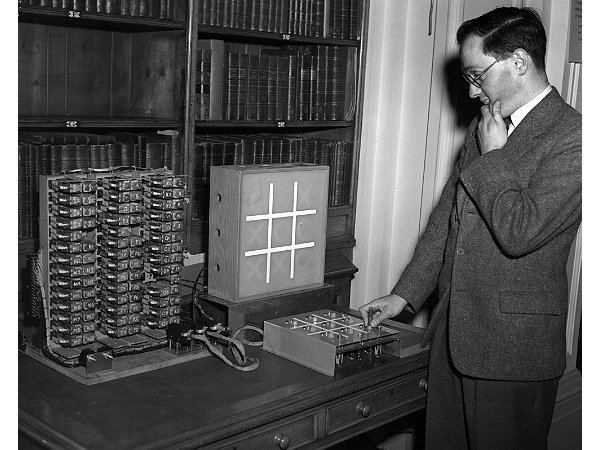
(Image Courtesy: Donald Davies – Alchetron, The Free Social Encyclopedia)
Mathematical validation soon followed. Leonard Kleinrock, a prominent researcher, applied queueing theory to prove that packet switching would work mathematically. His work bridged the gap between abstract theory and real-world engineering, giving the government the confidence to build the first experimental network.
Comparing Network Architectures
| Feature | Circuit Switching (Old Model) | Packet Switching (Internet Model) |
| Connection Style | Requires a dedicated physical path. | No dedicated path; data moves independently. |
| Reliability | Vulnerable; one break kills the connection. | Robust; data re-routes around failures. |
| Efficiency | Low; wasted capacity when silence occurs. | High; many users share the same lines. |
| Data Type | Continuous analog signal. | Discrete digital “packets.” |
Part II: The Experimental Era of ARPANET (1969–1974)
With the theory in place, the Advanced Research Projects Agency (ARPA) moved to build a real prototype. They called it ARPANET.
Building the First Network
ARPA did not originally build ARPANET to survive a nuclear war, despite the military funding. The immediate goal was practical: resource sharing. Computers were incredibly expensive and rare. Researchers at different universities wanted to share these scarce computing resources. Charles M. Herzfeld, a director at ARPA, noted that the project grew from the frustration of having limited access to powerful computers.
Under the leadership of Robert Taylor and Lawrence Roberts, ARPANET began operations in 1969. The team used specialized computers called Interface Message Processors (IMPs) to handle the traffic. These IMPs acted as the ancestors of modern routers.
The initial network connected four specific research institutions:
* UCLA: Home to Leonard Kleinrock’s measurement center.
* Stanford Research Institute (SRI): Home to Douglas Engelbart’s research center.
* University of California, Santa Barbara (UCSB).
* University of Utah.
The first successful connection occurred on October 29, 1969. A student programmer at UCLA, Charley Kline, attempted to log into the computer at Stanford. He typed the letter ‘L’, then ‘O’. However, before he could type ‘G’ to complete the command “LOG”, the system crashed. Despite this crash, the transmission proved that the concept worked.
The Limitations of the First Protocol (NCP)
The engineers needed a set of rules, or a protocol, to govern how these computers talked to each other. They created the Network Control Protocol (NCP). While NCP worked for the small ARPANET, it had significant flaws that limited future growth.
NCP assumed that the network itself was reliable. It did not have built-in ways to check if data arrived correctly; it relied on the hardware to be perfect. Furthermore, it could not easily handle connections between different types of networks (like connecting a radio network to a satellite network). As traffic grew, especially after Ray Tomlinson sent the first email in 1971, these limitations became a bottleneck. The architects realized they needed a new language for the network.
Also Read: The Internet of Things (IoT) Effects: Transforming Our World – SA News
Part III: The Birth of the Modern Internet (1974–1983)
The realization that NCP could not scale led to a complete architectural overhaul. Vinton Cerf and Robert Kahn took on the challenge of creating a “network of networks.”
Separating Routing from Reliability: TCP/IP
Cerf and Kahn revolutionized networking by changing where the “intelligence” of the network lived. In the old model, the network infrastructure was smart, and the devices were simple. Cerf and Kahn reversed this. They decided the network should be simple, and the computers at the endpoints should handle the complex work.
They created a two-layer protocol suite known as TCP/IP:
- Internet Protocol (IP): This layer handles the movement of data. It functions like a postal service. It looks at the address and moves the packet to the next step. It does not promise that the packet will arrive; it only promises to try its best.
- Transmission Control Protocol (TCP): This layer sits on top of IP. It manages reliability. TCP checks if data arrived in the correct order and asks for a retransmission if something goes missing.
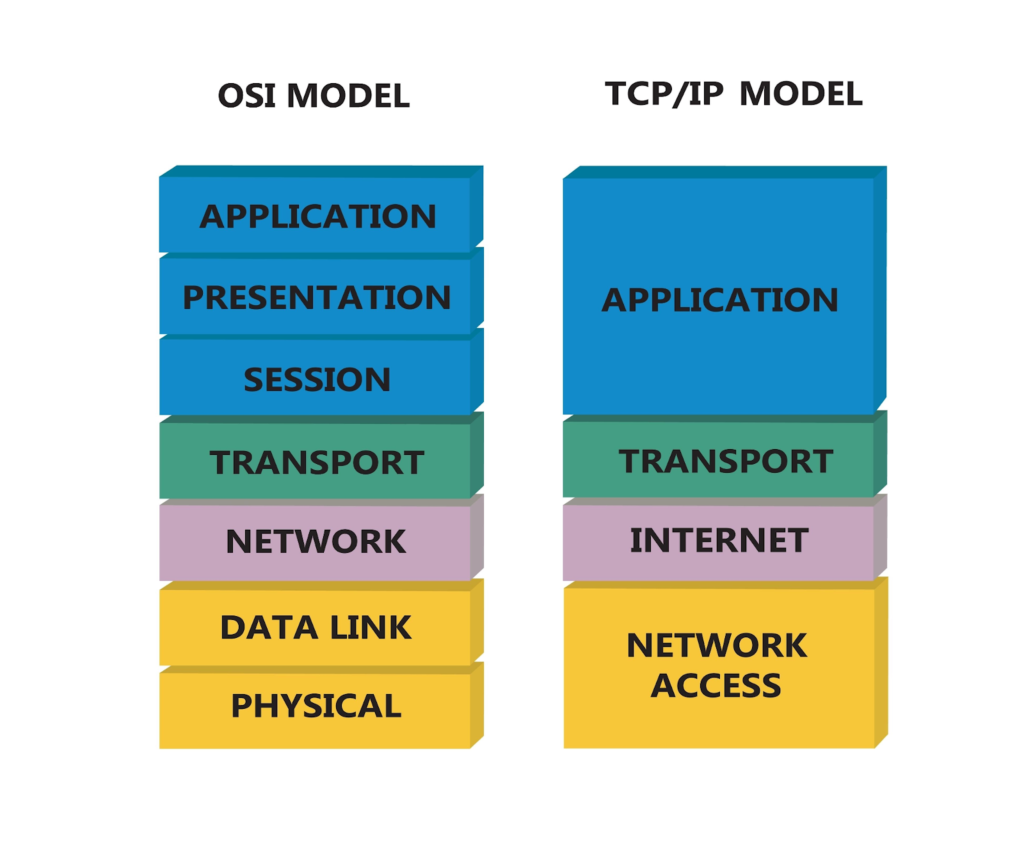
This separation allowed any type of network to join the internet. As long as a system could move IP packets, it could participate. This decoupled architecture is the reason the internet can run on everything from copper phone lines to fiber optics and Wi-Fi today.
Flag Day: The Great Switch
Changing the fundamental language of the network was not easy. It required a coordinated effort that is impossible to imagine today. On January 1, 1983, network administrators forced every machine on the ARPANET to switch from NCP to TCP/IP.
Engineers call this event “Flag Day.” The transition required all nodes to shut down and restart with the new software simultaneously. This moment marked the official birth of the modern internet. It proved that the network could evolve. Immediately following this switch, the military split their operations into a separate network called MILNET, leaving ARPANET for research. This proved that TCP/IP could successfully connect different networks into a larger whole.
Part IV: Governance and Commercialization (1983–1995)
With the technical foundation secured, the internet entered a phase of rapid growth and management evolution.
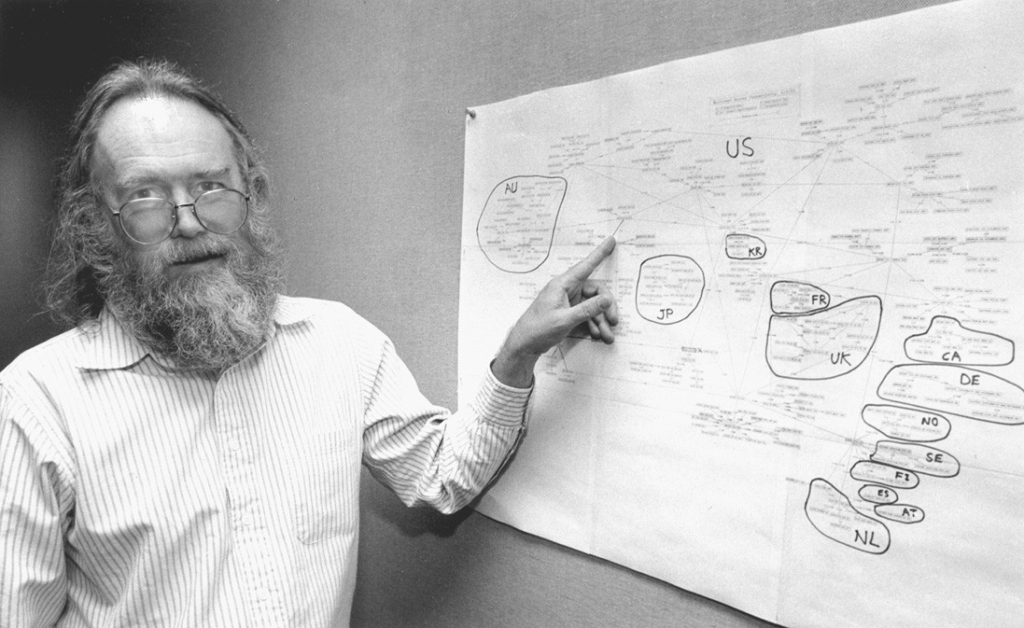
(Image Courtesy: Meet Jon Postel, the Man Who Invented dot com – How We Get To Next)
Making Addresses Human-Readable
As the network expanded, users found it difficult to remember numerical IP addresses (like 192.168.0.1). To solve this, engineers introduced the Domain Name System (DNS). DNS acts as a phonebook for the internet. It translates human-friendly names, like “example.com,” into the machine-readable IP addresses that computers use.
Jon Postel played a crucial role during this period. He managed the assignment of addresses and edited the Request for Comments (RFC) series, which are the official documents that define internet standards. His work ensured that the growing network remained organized and standardized.
The Role of the National Science Foundation (NSF)
By the mid-1980s, the National Science Foundation (NSF) took over the backbone of the network from the military. They built the NSFNET to connect universities across the US. However, the NSF had a strict rule: the Acceptable Use Policy (AUP). This policy strictly prohibited commercial traffic. No one could use the network for profit; it was solely for research and education.
Paradoxically, this ban on commerce actually helped the commercial market. The NSF funded a high-speed nationwide infrastructure that businesses could see but not touch. This created massive “pent-up demand.” Private companies watched the efficiency of the academic network and became eager to build their own.
Privatization
In April 1995, the NSF officially defunded the NSFNET backbone. This decision forced the internet to transition into a private, competitive marketplace. The government stepped back, and private internet service providers (ISPs) took over the job of carrying traffic. This shift from a government project to a commercial utility established the economic model that drives the internet today.
| Era | Network Authority | Policy Goal | Outcome |
| 1969–1985 | ARPANET (Military) | Experimental Research | Created the technology (Packet Switching, TCP/IP). |
| 1985–1995 | NSFNET (Science Foundation) | Academic Connection | Built the national backbone; banned commerce. |
| 1995–Present | Commercial ISPs | Private Competition | Created the modern global market for connectivity. |
Part V: The World Wide Web (1989–1996)
By the early 1990s, the internet worked perfectly, but it was hard for average people to use. It required technical commands to find information. The final piece of the puzzle was the invention of a user-friendly interface: The World Wide Web.
Tim Berners-Lee and the Web
Tim Berners-Lee, a scientist at CERN in Switzerland, wanted to help scientists share information more easily. In 1989, he proposed a system that combined the internet with “hypertext.” Hypertext allows users to click a word or link to jump immediately to another document.
Berners-Lee developed three core standards that we still use:
- HTML: The language used to format web pages.
- HTTP: The protocol used to send web pages across the internet.
- URL: The address system for finding pages.
In a vital move, CERN released these technologies to the public for free in 1993. This decision prevented any single company from owning the Web, allowing it to become a universal standard.
The Graphical Revolution
While Berners-Lee built the engine, the Web needed a steering wheel. In 1993, the National Center for Supercomputing Applications (NCSA) released the Mosaic browser. Before Mosaic, web pages were mostly text. Mosaic allowed images to appear on the same page as text. This visual improvement triggered an explosion in popularity.
The number of websites grew from about 130 in 1993 to over 100,000 by 1996. Companies like Netscape followed, bringing millions of users online. The Web became the public face of the internet, transforming it from a tool for physicists into a household utility.
A Legacy of Resilience
The modern internet stands as a monument to successful architectural design. Its survival relies on the early decisions made by Cold War engineers. The choice to use packet switching ensured that the network could handle damage and heavy traffic. The decision to separate TCP from IP allowed the network to adapt to new technologies like fiber optics and smartphones without breaking the core system.
Furthermore, the transition from military control to academic stewardship, and finally to private enterprise, allowed the network to scale. The government nurtured the technology until it was strong enough to survive in the free market. Today, while we face new challenges regarding scale and governance, the fundamental architecture laid down fifty years ago remains the bedrock of our global digital society. The internet is not just a collection of wires; it is a carefully designed system built to survive, adapt, and connect.
Creation Story Of Everything
Just as the internet has turned out to be very different from what it was initially designed for, our universe is way different from what we perceive it to be. And the best way to realise what that reality is, we must first understand the true origins of our universe and ourselves.
Sant Rampal Ji Maharaj with the help of all the holy scriptures has put forth an explanation for all existence that has coherently unified and explained all prior interpretations presented to date, whilst answering other questions that were previously impossible to answer.
He asserts that this technology was given to us by God in order for humanity to arrive at a place in its existence where we are capable of understanding and spreading the truth of this universe. Which is that we live in a world ruled by the devil “Kaal” himself and that he has been playing god. And us humans or rather souls made a bad decision that led us in this prison called the universe.
To understand deeply and truly as to how this is possible, what’s the proof and what are the implications, please refer to Srishti Rachna By Sant Rampal Ji Maharaj.
FAQ’s on Creation Story of the Internet
1) What is the origin of the internet?
Ans :- The internet originated in the 1960s as a US military project (ARPANET) designed to create a resilient, decentralized communication network during the Cold War.
2) Who is the inventor of the internet?
Ans :- There is no single inventor; it was a collaborative effort over decades, with Vinton Cerf and Robert Kahn designing the core architecture and Tim Berners-Lee creating the World Wide Web.
3) Who are the 3 fathers of the internet?
Ans :- They are generally considered to be Vinton Cerf and Robert Kahn (who created the TCP/IP protocols that run the network) and Tim Berners-Lee (who invented the World Wide Web).
4) What is the original name of the internet?
Ans :- The original experimental network was called ARPANET (Advanced Research Projects Agency Network).
5) What are the 4 phases of internet evolution?
Ans:- The four main phases are: 1. Experimental Research (ARPANET), 2. Standardization (Transition to TCP/IP), 3. Governance & Expansion (NSFNET), and 4. Commercialization (The World Wide Web).