


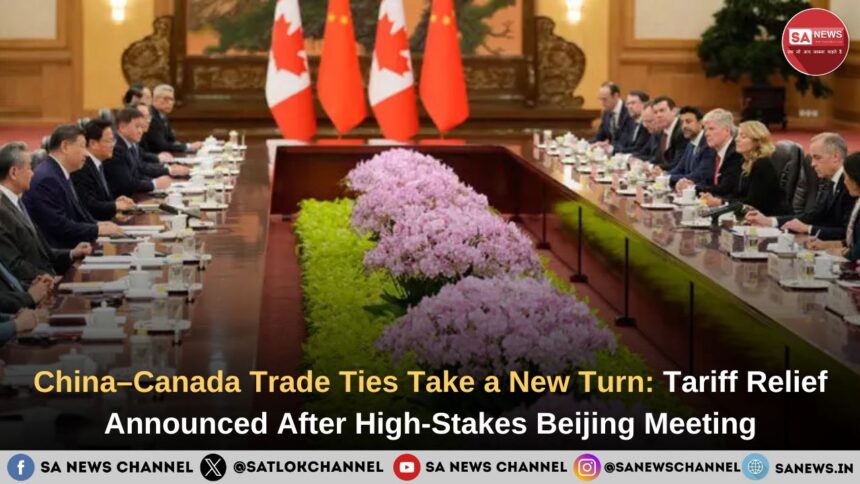
Beijing, January 16, 2026 — After years of strained bilateral trade relations marked by retaliatory tariffs and declining imports, China and Canada have announced a significant easing of trade barriers following a high-stakes meeting in Beijing.
- Background: Years of Trade Friction and Tit-for-Tat Tariffs
- High-Stakes Leadership Talks in Beijing
- Major Relief for Canadian Canola Oil Exports
- Canada Softens Stance on Chinese Electric Vehicles
- Expanded Tariff Reductions on Food and Seafood Products
- Impact of Trade Tensions on Import Volumes
- Ongoing Economic Dialogue and Cooperation
- A New Chapter in China–Canada Trade Relations
The announcement came after Canadian Prime Minister Mark Carney held direct talks with Chinese President Xi Jinping in the Chinese capital, signaling a major de-escalation in economic tensions between the two countries.
The meeting, held on January 16, 2026, is being viewed as a critical diplomatic and economic breakthrough, aimed at stabilizing trade relations that have remained under pressure due to successive rounds of tariff hikes imposed by both sides in recent years.
Background: Years of Trade Friction and Tit-for-Tat Tariffs
China and Canada have experienced prolonged trade friction, driven largely by tariff disputes and retaliatory measures. Over the past few years, both countries imposed steep duties on key imports, leading to a cooling of bilateral trade ties.
These tit-for-tat tariffs affected major sectors including agriculture, food products, and electric vehicles, significantly disrupting trade flows.
The situation worsened after Canada imposed 100% tariffs on Chinese electric vehicles in 2024, a move that drew strong opposition from Beijing.
In response, China introduced tariffs on more than $2 billion worth of Canadian farm and food products, escalating tensions further and impacting exporters on both sides.
High-Stakes Leadership Talks in Beijing
Against this backdrop, the meeting between Prime Minister Mark Carney and President Xi Jinping in Beijing, China, was widely seen as a high-stakes attempt to reset economic relations. The leaders acknowledged the damage caused by prolonged trade disputes and emphasized the need for pragmatic engagement to restore confidence between businesses and investors.
The talks focused on reducing trade barriers, restoring market access, and laying the groundwork for longer-term economic cooperation.
Major Relief for Canadian Canola Oil Exports
One of the most significant outcomes of the meeting was China’s commitment to ease tariffs on Canadian canola oil, a key export commodity for Canada. China is expected to reduce levies on Canadian canola oil from 85% to 15%, with the change scheduled to take effect by March 1, 2026.
This decision is expected to provide major relief to Canadian farmers and exporters, for whom China remains one of the most important international markets. The reduction marks a sharp reversal from previous policies that had severely restricted canola oil shipments.
Canada Softens Stance on Chinese Electric Vehicles
In a reciprocal move, Canada agreed to lower tariffs on Chinese electric vehicles (EVs). Under the new arrangement, Chinese EVs entering the Canadian market will be taxed at the most-favoured-nation (MFN) rate of 6.1%, a dramatic reduction from the punitive tariffs imposed two years earlier.
This shift reflects a recalibration of Canada’s trade policy toward China, balancing domestic industry concerns with the need to normalize trade relations.
Import Cap on Chinese EVs Remains
Despite easing tariffs, Canada has maintained a quantitative safeguard. The agreement allows only 49,000 Chinese electric vehicles to enter the Canadian market at the reduced 6.1% tariff rate. This cap highlights Ottawa’s effort to protect domestic manufacturers while still offering market access to Chinese producers.
Expanded Tariff Reductions on Food and Seafood Products
Beyond canola oil, China also agreed to reduce tariffs on additional Canadian exports. These include lobsters, crabs, and peas, products that have been particularly affected by earlier trade restrictions. Lower duties on these items are expected to benefit Canada’s seafood and agricultural sectors, improving competitiveness in the Chinese market.
Impact of Trade Tensions on Import Volumes
The economic cost of the trade tangible impact of tariffs and reduced market access. The decline affected a broad range of products, contributing to financial pressure on Canadian exporters.
The newly announced tariff relief aims to reverse this downward trend and restore trade volumes over the coming months.
Strategic Shift in Canada’s Trade Policy
Prime Minister Mark Carney’s engagement with China is part of a broader strategy to diversify Canada’s trade relationships.
Ottawa has been seeking to reduce its heavy reliance on the United States market by strengthening economic ties with other major economies, including China.
Improving access to the Chinese market is viewed as a key pillar of this diversification effort, particularly for Canada’s agriculture, energy, and manufacturing sectors.
Ongoing Economic Dialogue and Cooperation
The Beijing meeting follows earlier rounds of economic dialogue between the two countries. Prior engagements included meetings between Canadian officials and prominent Chinese business executives, as well as discussions on energy cooperation and broader trade partnerships.
These earlier interactions laid the groundwork for the January 16 announcement, helping to rebuild trust and create momentum toward tariff relief.
A New Chapter in China–Canada Trade Relations
The tariff relief announced on January 16, 2026, marks a turning point inChina–Canada economic relations. While challenges remain, the agreement reflects a shared recognition that prolonged trade disputes have harmed both sides.
With key measures such as the March 1, 2026 canola oil tariff reduction, the easing of EV duties, and expanded access for food and seafood products, both countries have signaled a willingness to move from confrontation toward cooperation.
The coming months will determine how effectively these changes translate into renewed trade growth and stronger bilateral ties.