


Deadliest Universe Objects Black Holes: You’re floating in space, admiring the cosmos, when suddenly you notice something strange. A pinpoint of darkness that seems to swallow the stars around it. Before you can react, you feel an invisible force pulling at your feet, stronger than your head. Within seconds, you’re being stretched like taffy, your atoms torn apart one by one. Welcome to spaghettification, just one of the many horrifying ways the universe can kill you.
- Black Holes: The Universe’s Deadliest Predators
- Magnetars: The Universe’s Deadliest Magnets
- Space Debris Fields: The Universe’s Deadliest Shooting Galleries
- Gamma-Ray Bursts: The Universe’s Deadliest Explosions
- The Boötes Void: The Universe’s Deadliest Emptiness
- When the Universe Makes You Look Inward
- FAQs About the Universe’s Deadliest Objects
- Q: How do scientists know what would happen near these deadly objects without actually going there?
- Q: Could a black hole ever reach Earth and swallow our planet?
- Q: What’s the difference between a regular neutron star and a magnetar?
- Q: Has Earth ever been hit by radiation from any of these deadly cosmic objects?
- Q: Is there anything in the universe deadlier than a black hole?
- Q: Could humans ever develop technology to survive near these deadly objects?
- Q: What would happen if two of these deadly objects collided with each other?
The cosmos isn’t just beautiful, it’s brutally unforgiving. Out there in the vast expanse of space exist objects and places so dangerous that they make Earth’s most extreme environments look like peaceful gardens. Let’s explore the deadliest corners of our universe, where the laws of physics become weapons of mass destruction.
Black Holes: The Universe’s Deadliest Predators
When we talk about the deadliest objects in the universe, black holes reign supreme. These cosmic monsters are regions where gravity has become so intense that nothing, not even light, can escape their grip.
According to available details, if you fall toward a black hole, something horrifying called “spaghettification” happens to your body. The gravity at your feet becomes so much stronger than at your head that you’d be stretched like taffy. Your atoms would be pulled apart, strand by strand, until you’re nothing more than a thin stream of particles spiraling into oblivion.
But here’s what makes black holes truly deadly: the point of no return called the event horizon. Cross this invisible boundary, and you’re done. There’s no rocket powerful enough, no force in the universe strong enough to pull you back out. You’d fall faster and faster, watching the universe outside speed up and age billions of years in what feels like moments, before everything goes dark forever.
The supermassive black holes at the centers of galaxies are particularly terrifying. Some are billions of times more massive than our Sun, capable of swallowing entire star systems whole.
Magnetars: The Universe’s Deadliest Magnets
If black holes are the universe’s ultimate trap, magnetars are its most violent weapons. These are neutron stars with magnetic fields so powerful they redefine what “strong” means.
Picture this: A magnetar’s magnetic field is about a quadrillion times stronger than Earth’s. According to available measurements, if a magnetar existed just 600 miles (~1000 km) from Earth, it would strip the information from every credit card on the planet and pull the iron from your blood.
But it gets worse. If you somehow got within 600 miles of an actual magnetar, the magnetic forces would be so intense that the atoms in your body would literally deform. Your molecular bonds would snap. You wouldn’t just die—you’d cease to exist as coherent matter before you even realized what was happening.
Magnetars also throw cosmic temper tantrums called starquakes. When their crusts crack, they release more energy in a tenth of a second (0.10 sec) than our Sun produces in 100,000 years. These eruptions send gamma-ray bursts screaming through space at the speed of light.
Space Debris Fields: The Universe’s Deadliest Shooting Galleries
Space appears empty, but many regions are crowded with fast-moving fragments of rock, ice and metal. These zones function like a natural shooting range where every object behaves like a high-speed projectile.
Calculations show that even a paint particle the size of a grain of sand, travelling at typical orbital velocities of about 17,000 miles per hour, could pass straight through a spacesuit and the human body before the impact was even noticed. There would be no pain, only a clean puncture.
Asteroid belts and debris regions amplify this risk. The Kuiper Belt beyond Neptune contains an enormous population of icy bodies, many no larger than small stones, all travelling at extreme speeds. A spacecraft passing through such an area would face serious danger. A piece of ice no bigger than a marble could penetrate a spacecraft hull with the same ease as a bullet passing through paper.
Also Read : Exploring the Depths of Space: A Journey through Space Science Missions
What makes these regions especially hazardous is that most of the threat is effectively invisible. A rock the size of a fist moving at 20,000 miles per hour cannot be seen in time to avoid it. There is no opportunity to steer away or take protective action. The result is sudden and catastrophic damage.
Gamma-Ray Bursts: The Universe’s Deadliest Explosions
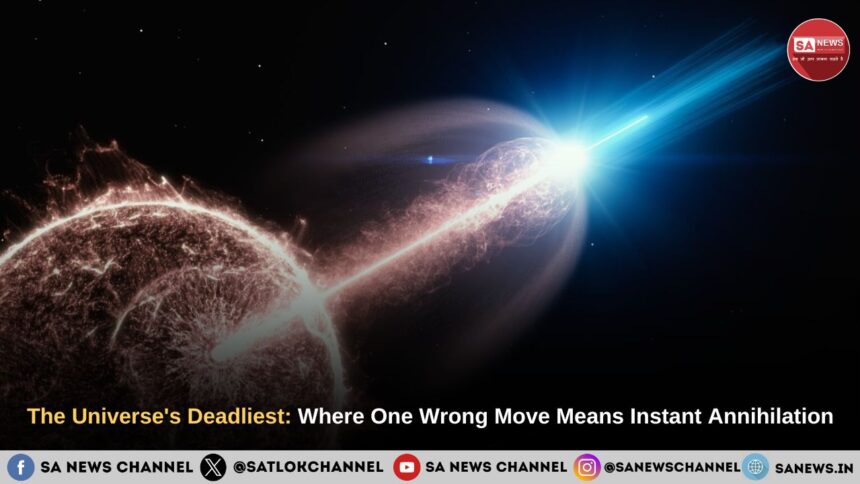
Speaking of gamma rays, let’s talk about the most energetic explosions the universe can produce. Gamma-ray bursts are brief flashes of the deadliest form of light, released when massive stars collapse or when neutron stars collide.
These aren’t just bright, they’re apocalyptic. A single gamma-ray burst releases more energy in seconds than our Sun will produce in its entire 10-billion-year lifetime. According to available research, if a gamma-ray burst occurred within a few thousand light-years of Earth and pointed our way, it would strip away our ozone layer, bathe the planet in deadly radiation, and potentially trigger a mass extinction event.
The terrifying part? We wouldn’t see it coming. Gamma rays travel at light speed, so the deadly radiation would arrive at the exact same moment as the light announcing its existence. Your first warning would also be your last.
Scientists believe gamma-ray bursts from nearby galaxies could explain some of Earth’s ancient mass extinctions. The universe’s deadliest weapon might have already struck our planet, hundreds of millions of years ago.
The Boötes Void: The Universe’s Deadliest Emptiness
Not all cosmic threats are violent explosions or crushing gravity. The Boötes Void represents a different kind of horror: absolute nothingness. This spherical region of space spans 330 million light-years but contains only about 60 galaxies, when it should contain roughly 2,000.
Also Read: Geminids Meteor Shower 2025: A Celestial Spectacle Lighting Up December Skies
Imagine being stranded in the Boötes Void. The nearest galaxy would be millions of light-years away. Looking up at the night sky, you’d see almost nothing, just profound darkness stretching in every direction. The isolation would be absolute, the loneliness incomprehensible. Even traveling at the speed of light, it would take hundreds of millions of years to escape.
While the emptiness wouldn’t kill you directly, the psychological impact of such complete isolation makes it one of the universe’s most existentially terrifying places. It reminds us that space isn’t just dangerous because of what’s there, but sometimes because of what isn’t.
The universe is spectacularly beautiful, but these deadliest objects and places remind us that it’s also spectacularly dangerous. Every star, every galaxy, every mysterious phenomenon exists in a delicate balance between creation and destruction. We’re fortunate to observe these cosmic horrors from the relative safety of Earth, our pale blue sanctuary floating in an ocean of dangers we’re only beginning to understand.
When the Universe Makes You Look Inward
The universe is filled with places that can destroy anything in seconds. Black holes stretch matter apart, magnetars rip atoms to pieces, and exploding stars release more energy than our planet has seen in its entire lifetime. Seeing how powerful and uncaring these places are reminds us that humans are tiny compared to the forces shaping the cosmos. Yet this same realization can shift our thinking in an important way. When we understand how fragile life is in the wider universe, we naturally begin to wonder why we exist at all and whether there is something deeper behind everything we see.
This change from looking outward to looking inward is not a contradiction. It is a natural step. If the physical universe can erase entire worlds without effort, then meaning cannot depend only on physical things. Purpose has to come from understanding, reflection, and a sense of connection that goes beyond what telescopes can capture. Many people throughout history have used the mysteries of the universe as motivation to explore questions about the soul, destiny, and the possibility of a guiding force behind creation.
For readers beginning this journey, books like “Gyan Ganga” and “Way of Living” by Saint Rampal Ji Maharaj offer simple and clear guidance. They explain spiritual ideas in a practical way and describe authentic methods of worship and living that bring clarity, peace, and purpose. Reading these works can turn the universe’s vastness from something frightening into inspiration for discovering who you are and why your life matters.
FAQs About the Universe’s Deadliest Objects
Q: How do scientists know what would happen near these deadly objects without actually going there?
A: Scientists use a combination of mathematical models, physics equations (especially Einstein’s theories of relativity), and observations from telescopes that detect different wavelengths of light and radiation. They also study extreme conditions in labs and use supercomputer simulations to predict how matter and energy behave in these environments. When they observe similar objects at different distances, they can verify their predictions and refine their understanding.
Q: Could a black hole ever reach Earth and swallow our planet?
A: No, this won’t happen. The nearest black hole is thousands of light-years away, and black holes don’t roam around “sucking up” everything like cosmic vacuum cleaners. They only affect objects that come very close to them. Even if a black hole somehow replaced our Sun (it won’t), Earth would simply orbit it just like we orbit the Sun now—we wouldn’t get sucked in unless our orbit drastically changed.
Q: What’s the difference between a regular neutron star and a magnetar?
A: Both are incredibly dense collapsed stars, but magnetars have magnetic fields roughly 1,000 times stronger than typical neutron stars. While all neutron stars are dangerous, magnetars are specifically deadly because of their extreme magnetism and their tendency to have violent magnetic eruptions that release massive amounts of energy.
Q: Has Earth ever been hit by radiation from any of these deadly cosmic objects?
A: Yes, we detect gamma-ray bursts regularly, but they’re from extremely far away—billions of light-years distant—so they’re harmless by the time they reach us. Scientists suspect that closer gamma-ray bursts might have contributed to ancient mass extinctions, like the Ordovician extinction 450 million years ago, but this is still debated. We’re constantly bathed in low levels of cosmic radiation, but Earth’s atmosphere and magnetic field protect us.
Q: Is there anything in the universe deadlier than a black hole?
A: It depends on how you measure “deadly.” Black holes are inescapable once you cross the event horizon, but gamma-ray bursts can kill across vast distances. Some theorists speculate about even more exotic phenomena like colliding neutron stars, strange matter that could convert normal matter on contact, or hypothetical objects like “naked singularities,” but none are definitively more dangerous than supermassive black holes.
Q: Could humans ever develop technology to survive near these deadly objects?
A: Almost certainly not near the most extreme ones. The forces involved—like the gravity gradient near a black hole or the magnetic fields around a magnetar—would tear apart any atoms, including those in any spacecraft or protective technology. We might someday observe them from safer distances with advanced probes, but getting close to objects like magnetars or black holes would require physics-defying technology that may simply be impossible.
Q: What would happen if two of these deadly objects collided with each other?
A: When extremely dense objects collide, they create the most energetic events since the Big Bang. Two neutron stars colliding produce gravitational waves (ripples in space-time itself), massive gamma-ray bursts, and scatter heavy elements like gold and platinum throughout space. Two black holes merging create enormous gravitational waves but no light. These collisions have been detected by instruments like LIGO, and they release more energy in seconds than entire galaxies produce over the same time period.
.