


For the second year in a row, India has held its ground as the sixth-most competitive manufacturing hub in Asia. That is the verdict from the just-released Asia Manufacturing Index (AMI) 2026 by Dezan Shira & Associates. While India still holds strong cards with its massive consumer base and deep labor pool, the report offers a bit of a wake-up call: the competition is heating up. Neighbors like Malaysia and Thailand aren’t just watching; they are upgrading their industries fast, putting new pressure on New Delhi to perform.
Key Points: Asia Manufacturing Index 2026
- Still the King: China takes the top spot for the third year running.
- The Surprise Winner: Malaysia shot up to 2nd place, knocking Vietnam down a peg.
- India’s Spot: Stuck at 6th, trailing behind the “Asian Tigers” and the top ASEAN players.
- Movers and Shakers: Vietnam dipped to 3rd, while Thailand climbed two spots to land at 8th.
- What India Does Well: Ranked 3rd in Economy and sits at the top tier for Workforce Availability.
- Where It Hurts: Moving goods is too slow (logistics), the rules are tricky (compliance), and there aren’t enough trade deals.
The Asian Manufacturing Shuffle: A New Order
The 2026 lineup shows a real shake-up among the 11 big Asian players. The index looks at eight different categories like how good the roads are, labor costs, and tax rules; and the results show the region is changing.
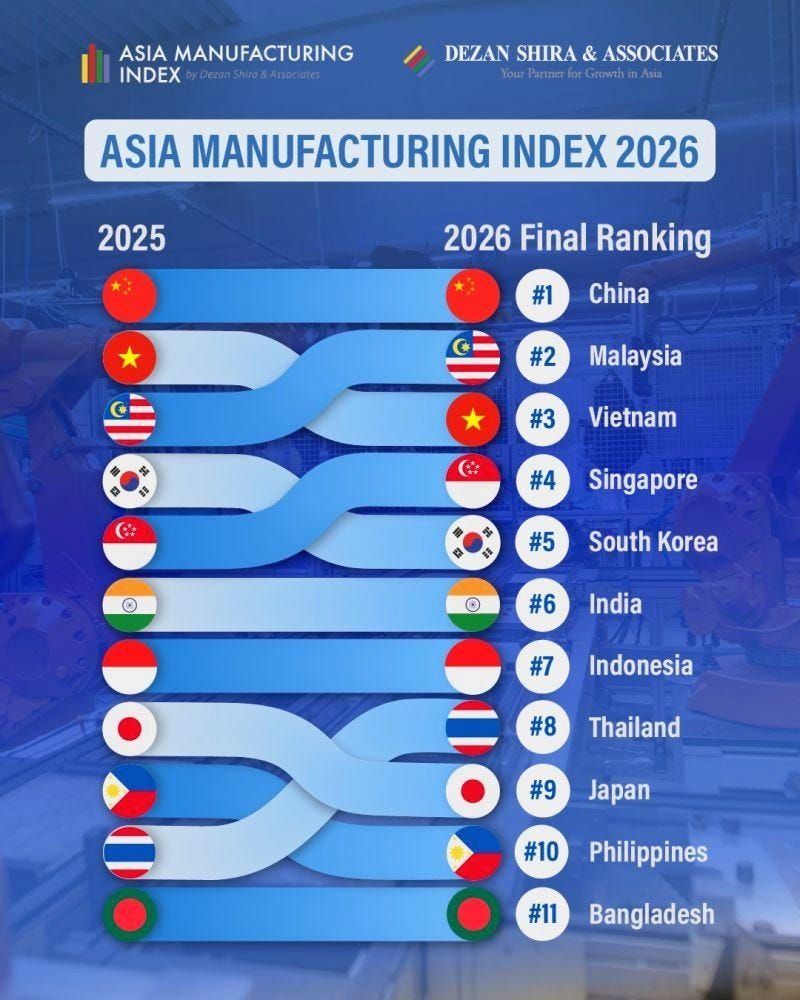
China is still the heavyweight champion. Their supply chains are just too deep and their factories too big to beat right now. But the real story this year is Malaysia. They used to be in the middle of the pack, but they’ve catapulted to second place. How? They pivoted hard toward high-end electronics and made it much easier for foreign money to flow in.
Vietnam, usually seen as the main alternative to China, slipped a bit to third place. Meanwhile, Singapore (4th) managed to beat out South Korea (5th), proving that even with high costs, you can win if your tech capability is strong enough.
India’s Performance: A Mixed Bag
The report paints a picture of India that is a bit of a paradox: huge potential fighting against old structural friction.
The Economic and People Power
India’s biggest weapon is its sheer size. The index ranked India 3rd for its Economy, right behind China and Vietnam. It’s a double win for manufacturers: you can build here and sell here. Plus, the “demographic dividend” is real. India is leading the pack in the Workforce category, offering a young, cost-effective labor pool that aging countries like China and Thailand just can’t match anymore.
The Logistics and Policy Drag
But having the people isn’t enough if you can’t move the goods efficiently. The report flags “structural bottlenecks” in logistics as a major headache. India trails behind six other nations in this area. It simply costs too much and takes too long to get products through ports, which eats away at the money saved on cheap labor.
Also, despite big government pushes like the PLI (Production Linked Incentive) schemes, the day-to-day rules are still sticky. The report notes that tax compliance and administrative red tape are heavier here than in competitor nations like Indonesia or Vietnam.
Why the “Sharper Push” Can’t Wait
The report’s warning that India needs a “sharper push” comes from the fact that stability isn’t safe. Staying at number six is risky when everyone else is sprinting. Thailand, for instance, jumped from 10th to 8th in just a year.
To crack the top five and challenge the ASEAN bloc, experts analyzing the data suggest India needs to focus on three things immediately:
- Fix Logistics: We need to finish the Dedicated Freight Corridors (DFCs) fast. The goal should be to get logistics costs down from double digits to under 10% of GDP.
- Sign Trade Deals: Malaysia and Vietnam are winning partly because they are plugged into trade pacts like RCEP. India needs to finalize its own FTAs with the UK and EU to open up duty-free export lanes.
- Go High-Tech: Assembly jobs are great, but India needs to start making the actual components and adding high-tech value, just like Malaysia did to steal the #2 spot.
Time to Bridge the Gap
The Asia Manufacturing Index 2026 isn’t saying India has failed; it’s saying the window of opportunity is getting smaller. As global supply chains find their new homes, the difference between “potential giants” and “actual leaders” is becoming starker. India has all the right ingredients; the challenge now is to bridge the gap between policy intent and what actually happens on the ground.
FAQs: Asia Manufacturing Index 2026
1. What is India’s rank in the Asia Manufacturing Index 2026?
India ranks 6th, unchanged from last year. While it leads in workforce size and economy (3rd), it trails rivals due to slower logistics and complex regulations.
2. Why is Malaysia ranked higher than India?
Malaysia jumped to 2nd place by dominating in high-tech electronics and ease of doing business. Its “plug-and-play” infrastructure attracts investors faster than India’s current setup.
3. Who topped the Asia Manufacturing Index 2026?
China remains #1. Its massive industrial scale, deep supply chains, and superior infrastructure keep it ahead of all other Asian nations for the third consecutive year.
4. What are the main challenges for Indian manufacturing?
The report cites three big hurdles: high logistics costs, tax compliance burdens, and limited free trade deals compared to neighbors like Vietnam.
5. What must India do to improve its ranking?
Experts say India needs a “sharper push”: finish freight corridors to cut costs, simplify tax rules for factories, and sign more trade deals with the EU and UK.