



In this digital era, where every click decides your revenue, A/B testing comes out to be your secret weapon for website optimization. Imagine refining just one single headline, layout or button color and your conversion rates rocketing high– without pure guesswork.
This complete step-by-step guide to A/B testing your website uncovers the process. Whether you are a small business owner or a seasoned marketer, this guide will help you master A/B testing that can unlock data- based insights to improve engagement, maximise ROI and reduce bounce rates.
What is A/B Testing?
A/B Testing or split testing, is a scientific way of comparing two different versions of a webpage or element to find out which version performs better, based on real user data.
By directing a portion of your website traffic to each version, you can analyse key metrics such as click-through rates, time on page or conversions, and use the statistical analysis to identify which variant works best. This approach helps you make cumulative improvements that improve user experience and business outcomes, such as higher sales or sign-ups.
Why Does Your Website Requires A/B Testing?
A/B Testing is required to boost your website’s conversion rates. When visitors arrive at your website through paid ads or SEO but often leave without signing up, buying or doing any action. The typical conversion rates often stuck at 1-3% while optimised sites achieve 5-10% conversion rates or higher. This gap shows that you are wasting marketing spend on traffic that doesn’t generate any revenue.
By performing an A/B Testing on a website, revealing accurate changes – such as sharper headlines, better buttons, or faster load times – one can increase the conversion rates upto 20-50% from the same visitors. This will help attain higher sales and ROI without increasing the budget, turning pure guesswork into scientific profit growth.
Key Elements to Test First
Focus on high-impact elements that directly influence conversion rates:
- Headlines: Headlines can play an important role in influencing conversion rate. You can also experiment with the different length of the headlines. Shorter heading requires a catch whereas long heading are more descriptive and helps to give an insight of your page.
- CTAs: A Call to Action (CTA) is a clear prompt– such as a link or button– which tells visitors what to do exactly, like “Buy Now”, “Sign Up” or “Take your Guide”. In A/B Testing, just interchanging “Learn More” with “Claim your deal” often levels up click by 20-47% since they directly offer benefits to the users.
- Page layouts & images: Page layouts and images can also have high-impact on A/B Testing as they control user flow and attention. Poor layouts often create confusion, while weak images often fail to build trust or urgency of the user. Use contrasting colors with enough white space around key elements so that users can naturally follow the path to CTA, directly boosting results.
- Pricing: Pricing and buttons represent prime A/B Testing targets as they directly control revenue. By only introducing small changes such as highlighting a mid-tier plan as “Most Popular” or “Deal of the Month” or testing $49 vs $59 can boost conversion upto 25-57%.
- Buttons: Buttons around pricing such as “Start Free Trial” vs “Buy Now”) often paired with urgency (“Limited Time Deal”) or building trust (“Safe and Secure”), often hikes click 20-40%, since they reduce hesitation of the visitor.
- Forms & checkout: Forms and checkout are often the main deciding factors for conversion rates. Lengthy and confusing forms often irritate visitors. A/B test single column vs multi step forms, autofill enabled vs manual entry, and account creation vs guest checkout, can lift rates 20-50% by reducing friction.
Also read: Biography of Samuel Taylor Coleridge: Poet, Dreamer and a Romantic Icon
Free Tools for A/B Testing (2026)
In 2026, many free tools for A/B Testing enable website owners to optimise conversions without loading the budget. Here are some of them:
- Google Optimize alternatives: Google Optimize offers a seamless integration with Google Analytics for multivariate experiments and user-friendly visual editors.
- VWO free tiers: VWO’s free plan offers reliable testing with up to 50 visitors monthly.
- Microsoft Clarity: It provides heatmaps, basic split testing and session recordings powered by AI- driven insights.
How to Analyze Test Results
The most important step in guide to A/B Testing is to analyze A/B testing result data in order to produce actionable insights for accomplishing improvements to a website. Avoid drawing premature conclusions from your analysis of A/B test results, only conduct analysis after determining the statistical significance, which usually occurs at 95% confidence that you have at least 100 conversions per variant using a statistical significance calculator (such as the one from Google Optimize or Evan Miller) as part of your analysis.
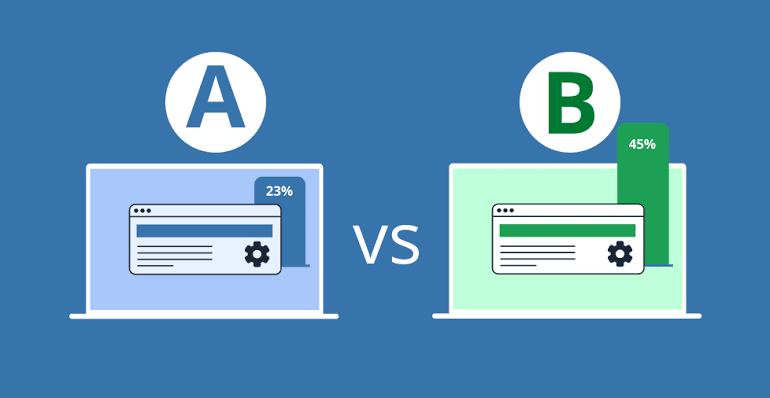
When you have established values for the statistical significance of your results, compare key performance indicators (KPIs), including the conversion rate, the bounce rate, and the average session duration, by creating side-by-side charts. When you find that Version B out-performed Version A by a quantifiable margin (10-20% uplift), segment your results by traffic source, device, or audience type, to determine the reasons why.
Next, you should create an additional round of A/B tests to confirm your findings. Lastly, document your results in a shared report that describes the practical implications of your results and identifies next steps, and be mindful of the possibility of an external influence, such as seasonality, on your A/B test results.
Common A/B Testing Mistakes
Common mistakes can detail website optimization and lead to wrong decisions. Here are common errors you should avoid while A/B Testing:
- Ending tests too early before reaching the statistical significance (commonly 95% confidence and sufficient conversions), that can make random noise look like a real enhancement.
- Performing a test for too many variables at once (such as headlines, images, CTA in the same experiment) so that it is difficult to analyse which element actually boosted the conversion rate.
- Not performing audience segmentation and treating all traffic the same, instead of checking out how the test performs on different traffic sources, old vs new, mobile vs desktop.
- Failing to track what happens after the test ends, allowing the “winning” variation to stop working over time due to traffic shifts, seasonality or other factors.
- Not documenting hypotheses, results, key metrics in a central place, which can increase the risk of repeated mistakes and missed opportunities to learn from the tests performed earlier.
Perform a Test on Your Deeds and Way of Worship
A/B Testing can help enhance conversion rate on the website and generate better revenue. But what about the deeds that one performs during their lifetime? What is it that can change our mindset and enhance our thinking towards one another?
In this fast paced world, where everyone is concerned about oneself, only saints descend to do good for humanity. Saint Rampal Ji Maharaj ji from Haryana, is the only well- wisher saint for humanity. His spiritual knowledge of the scriptures and worship of Supreme God Kabir Saheb is transforming the lives of millions worldwide. To know more visit www.jagatgururampalji.org.