

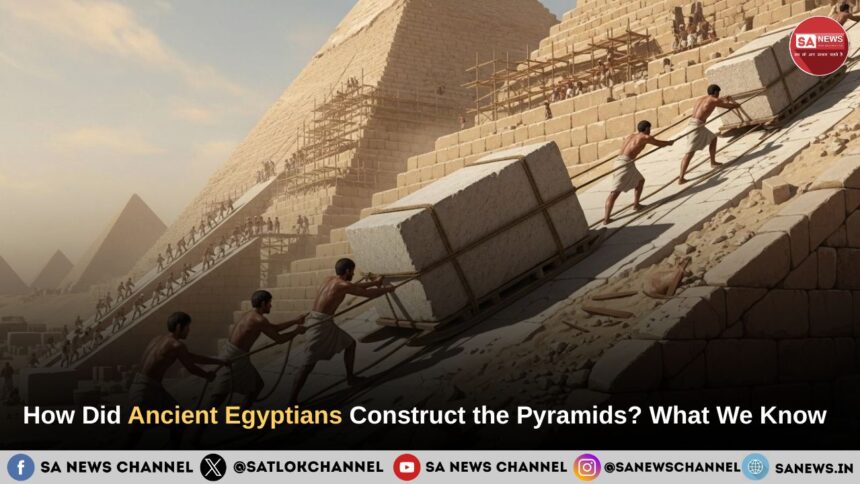
At the time of construction, the Great Pyramid at Giza was the tallest building in the world. The pyramids contain approximately 2.3 million blocks of stone, and were constructed without the aid of cranes, steel, or engines.
Although we don’t know every detail of how ancient Egyptians built the pyramids, archaeologists have put together a good picture of the construction process. New discoveries in the last decade such as ancient diaries, buried rivers, and steep ramps in quarries mean we know more now than ever.
This article will explain how pyramids were built. We will cover where stones were taken from, how they were transported and lifted, Who Built them, and what is still debated.
Why Did Ancient Egyptians Build Pyramids?
Egyptian Kings were considered intermediary between humans and gods. The pyramids protected the bodies of the kings to allow their souls to ascend to the afterlife. The shape may represent the first piece of ground that rose in the waters of creation.
It evolved over time. Imhotep designed the Step Pyramid for King Djoser, made from 6 mastaba tombs stacked on top of one another. King Sneferu built the Bent Pyramid, which contained a mistake in the slope. He also built the Red Pyramid, the first truly smooth sided pyramid. Archaeologist Mark Lehner describes Sneferu’s pyramids as ‘experimental’.
Khufu was able to build his pyramid on a tried method, however on a much larger scale.
Also Read: Interesting facts about ancient civilisations!
How were the Pyramids built?
There were 5 major steps in building pyramids. Thousands of people were involved in an organised way. Below is a table giving data on the Great Pyramid.
| Feature | Value |
| Height | 146.6m (481ft) |
| Length of base per edge | 230m (756ft) |
| Number of blocks | 2.3 million |
| Average weight of block | 2.5 tonnes |
| Total weight | 6 million tonnes |
| Heavier granite beams | 25-80 tonnes |
| Construction time | 20 years |
Because the Great Pyramid was built in 20 years, over 12 blocks had to be placed every hour, 24/7. This means that 800 tonnes of stone had to be placed every day. To allow this to happen efficiently, there had to be a permanent workforce, port, bakeries, and a large supply chain. This was very much a logistical feat.
1. Site preparation
The Giza Plateau was chosen as the site as it had stable limestone rock. The pyramid is essentially built around a natural rocky hill, saving workers having to carve and carry in some stone.
Surveyors measured out the square base of the pyramid. A ceremony known as pedj shes (meaning stretching the cord) allowed for very accurate alignment with compass directions using star observations. As a result, the base is extremely level and square. Even modern surveyors are impressed by its precision.
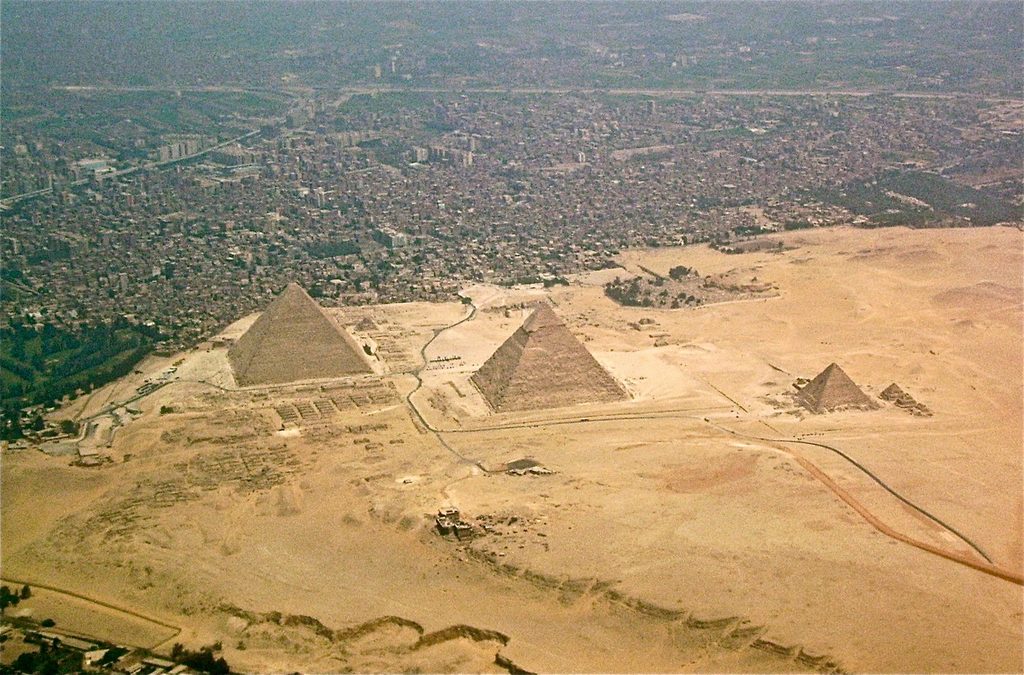
Additionally, this site made sense as there was local stone available. There was also once a branch of the Nile nearby. Careful planning resulted in years of time being saved.
2. Stone preparation
Most stone was taken from the Giza Plateau. As the rock was strata of horizontal lines of limestone, it made the cutting process easier. The core blocks were cut close to the site, saving significant transport time.
There were 3 different types of stone in the Great Pyramid. Local limestone formed the core, white fine limestone formed the exterior, and red granite formed the chambers around the burial chamber. Limestone was cut using copper chisels and other manual tools. It is commonly believed that to split the stone, wooden wedges were inserted into cracks. Once wet, the wood expanded causing the stone to split. However, granite is very hard. Even now, experts are unsure exactly how well the Egyptians were able to shape it.
However, the best stone had to be brought from far away. White casing stone was obtained from Tura, across the Nile. Granite was obtained from Aswan, over 800km away. This means that the heaviest beams, weighing between 25-80 tonnes, were brought from very far away. The best quality stone was transported via boat.
3. Transporting the Blocks
Navigating the Nile
From a number of papyruses from ancient Egypt, we know how the blocks were transported via boat. In 2013, archaeologist Pierre Tallet and others discovered hundreds of papyri fragments in artificial caves in Wadi al-Jarf (Red Sea coast). One of these documents was a log book written by an official named Merer to record the work done by his team of approximately 40 people.
This diary was written in the last few years of Khufu’s reign. This group loaded white limestone from Tura onto boats and transported it to Giza, completing return journeys in 4 days. It also contains the original name of the Great Pyramid – Akhet Khufu (Horizon of Khufu). The papyrus is often referred to as the oldest known written papyrus. It appears to be a logbook of work done by a man in his job. In addition to white limestone, copper tools from Sinai, timbers from Lebanon and cattle from farms in the Delta were transported via boats on the Nile and canals to feed the workers.
In 2024, scientists discovered evidence of a previously unknown branch of the Nile near 31 pyramids (including Giza), known now as the Ahramat Branch. It ran for approximately 64 km along the edge of the desert. Many pyramids have causeways leading towards this old bank, ending with valley temples. These may have acted as ports along the river. However, the river eventually silted up, meaning that the pyramids are now far away from water sources.
The Nile therefore made it possible to construct the pyramids.
Sledges and Moist Sand
Once blocks arrived at the construction site, workers dragged them on a wooden sledge attached to ropes. A painting in the tomb of Djehutihotep (centuries after the construction of the Giza pyramids) depicts 172 people dragging a large statue. In the image, a man at the front appears to be pouring a liquid onto the sand ahead of the sledge.
It was once believed by some scholars that this may have been a religious practice. However, in 2014, physicists from the University of Amsterdam carried out an experiment on this method. The results were published in Physical Review Letters. It showed that if the sand was the correct moisture level, half the force was required to pull the block. However, if it was too dry or too wet, no benefit was seen. The best results were achieved with approximately 5% moisture.
Fewer people would be required to move each block. Although some experts debate whether this was a real technique, it is clear from this experiment.
4. How did they get the blocks so high? Ramp Debate
Once blocks were moved across level sand, it became much more difficult to lift the blocks 140m+ into the air. Most Egyptologists agree that ramps were used to assist in this, but disagree on their form. Suggested designs include:
- Straight ramps: One long ramp on one side. However, it would require as much material as the pyramid.
- Corkscrew ramps: Ramps circling the pyramid, perhaps made from mud bricks covered in plaster.
- Internal ramps: Some researchers suggest internal ramps.
In 2018, a team from France and Britain discovered new evidence in the alabaster quarry at Hatnub in the Eastern Desert of Egypt. In the centre of the quarry, there was a main ramp with 2 staircases either side. There were many post-holes. Workers could attach ropes to posts, allowing heavy loads on the sledge to be pulled up inclines of 20% or greater. This is much steeper than previously thought. The system has tool markings and inscriptions, and so can be dated to during the reign of Khufu.
This proves that during Khufu’s reign, workers were able to transport heavy stones up very steep inclines. However, experts are cautious. This is an alabaster quarry, and no evidence has yet proven that this type of ramp was used on the Great Pyramid.
5. Accuracy
The Great Pyramid is extremely precise in its construction. The difference in length between each base side is only approx 4.4cm, and the base is level to within approx 2cm. In addition, the 3 pyramids in Giza are very accurately aligned with compass directions. This may be due to star sightings, or by watching the shadow on certain dates (such as equinox).
The outside casing stones were angled and polished white limestone, giving the pyramid a shiny appearance. Most of this casing has been removed over time. As a result, the pyramid is now much shorter (approx 138m).
Despite claims that aliens helped build the pyramids, many pieces of evidence contradict this. Evidence exists for boats, sledges, ramps, papyri log books, and worker towns. The precision displayed was created by skilled people with careful planning, rather than mysterious technology.
6. Who Built the Pyramids?
Herodotus, a Greek Historian, suggested that 100,000 men worked on the Great Pyramid for 20 years. He lived 2000 years after construction, and archaeological evidence does not support this suggestion of slave labour.
In 1988, Mark Lehner and others started excavating a workers’ town, south of the Sphinx. Known as Heit el-Ghurab or the Wall of the Crow, the town contained bakeries, granaries, and long corridors possibly used as barracks for rotating worker groups. Although the site was primarily used by workers building the later pyramids at Giza, traces of an earlier settlement below the town date back to Khufu’s time. At any one time, it is estimated that between 8,000-10,000 people worked here.
Feeding this many people was a huge task. Daily food included bread and beer. Officials in Egypt reported that approximately 21 cattle and 23 sheep were given to 10,000 workers every day, coming from farms across the country. Simple tombs containing jars of bread and beer for the afterlife have also been found in nearby cemeteries. From the tombs found by Zahi Hawass, it can be determined that the builders were paid workers. Many scholars also suggest that many workers were on rotating duty for the state.
Despite this, conditions were still tough. Skeletons show signs of arthritis and stressed spines. Interestingly, work gangs even carved their group names into hidden blocks of the pyramid. Some names even contain the name of the pharaoh!
The pyramids were built by organised workers, who were well-fed and housed. They were not slaves.
Also Read: History of Africa – Ancient civilisations to Modern Innovations!
Common Misconceptions
There are many misconceptions regarding how the pyramids were built. Three common ones include:
- Slaves: Evidence of worker towns, bakeries and tombs suggest that the workers were organised. They were fed and housed by the state.
- Alien/lost technology: All evidence points to tools, boats, ramps and the papyri books belonging to Bronze Age Egypt. Despite a popular book in the 1970s suggesting otherwise, no archaeological evidence supports this idea.
- 100,000 people: Modern estimates suggest that 10,000-20,000 workers, in addition to bakers, doctors and priests, could have completed this task.
In reality, the pyramids were an impressive feat, made by normal people.
Data and trends
Much has changed in our knowledge of how the pyramids were made in recent decades. 5 key discoveries are shown below.
| Year | Discovery | Information gained |
| 1988 | Workers town at Heit el-Ghurab, Giza | Builders were provided housing, food and organisation |
| 2013 | Papyrus diary of Merer in Wadi al-Jarf | Stone was transported from Tura to Giza by boat. |
| 2014 | Experiments with moist sand (University of Amsterdam) | Using moist sand can reduce force required in half. |
| 2018 | Ramps at Hatnub quarry | Ramps with steep gradients and rope/ pole systems existed in Khufu’s time. |
| 2024 | Ahramat Branch of Nile | Major water source was present next to 31 pyramids. |
It can be seen that each discovery has provided information to help answer specific practical questions. Overall it shows that the construction of the pyramids was a well managed project across the nation. It was certainly not a miracle!
There is still some uncertainty. It is still debated exactly what type of ramp system was used at Giza, and how the heaviest granite beams were cut and raised. However, with satellite radar and new fieldwork, we are likely to find more answers.
Conclusion
To conclude, the pyramids were built using boats on the Nile, sledges on moist sand, steep ramps, careful management, and thousands of organised and well fed workers. Most importantly, the pyramids were made due to people sharing a desire to do something meaningful for something beyond their lifetimes. This reminds us that incredible feats can be achieved with patience, teamwork and belief in something greater.
These questions of meaning in life, death and the soul are deeply profound. Therefore, if these questions resonate with you, try reading Gyan Ganga and Way of Living by Saint Rampal Ji Maharaj with an open mind. Regardless of your journey, allow curiosity and humbleness to guide you. May you build a meaningful life!