

The Delhi Iron Pillar: Leave an old iron bicycle chain out in the monsoon and check it a few months later. It has turned orange. Poke it and it flakes apart in your fingers.
- A King, an Inscription and a Long Journey
- How Ordinary Iron Rusts
- Built by Hand: Bloomery Iron and Forge Welding
- The Thin Skin That Changed the Story
- An Ingredient Engineers Usually Avoid
- An Amorphous Layer Against the Metal
- How Scientists Saw It
- Back to the Pocketknife
- A Map of Iron’s Options
- Why the Skin Has Lasted
- Eternal Satlok: Beyond the Perishable Mortal Realm
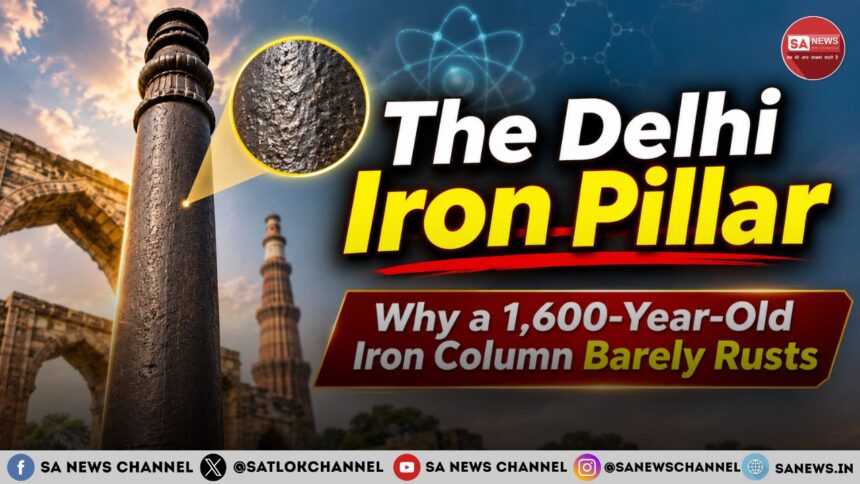
Now picture an iron column about seven metres tall and about six tonnes heavy, standing in the open air of Delhi’s Qutb complex. It has been there for roughly 1,600 years. Monsoons have soaked it. Summer heat has baked it. It has not turned into a heap of red rust.
Up close it looks more like dark stone or polished bronze than iron. So here is a question. If you scraped that surface with a pocketknife, what would you find underneath? Please don’t try it, because the pillar is a protected monument. Chemists have answered it without scratching anything, and we will return to it.
A King, an Inscription and a Long Journey
The pillar carries a Sanskrit inscription in Gupta-era script. It praises a king named Chandra for his victories and his devotion to Vishnu. Many historians identify him as Chandragupta II, who ruled around the late fourth and early fifth centuries CE. That is a reading, because the inscription never spells out the full name.
The text gives no date of construction and no original location. One influential theory says the pillar began at Udayagiri in central India and reached Delhi in the medieval period, possibly in the eleventh century. The journey is undocumented.
How Ordinary Iron Rusts
Rusting is a small electrical process. Picture a raindrop on a gate latch. Inside it, the iron behaves like a tiny battery. At one spot, an iron atom (Fe) gives up two electrons and becomes an iron(II) ion (Fe2+).
Fe → Fe2+ + 2e−
The electrons travel through the metal to the edge of the drop, where oxygen (O2) from the air has dissolved in the water. The oxygen grabs the electrons and, together with water (H2O), makes hydroxide ions (OH−).
O2 + 2H2O + 4e− → 4OH−
The two kinds of ions meet in the water and form iron(II) hydroxide (Fe(OH)2).
Fe2+ + 2OH− → Fe(OH)2
With more oxygen, that compound turns into iron(III) oxyhydroxide (FeOOH), a main ingredient of rust.
4Fe(OH)2 + O2 → 4FeOOH + 2H2O
FeOOH is an oxyhydroxide, a compound of iron, oxygen and hydrogen, and it has several crystal forms. Early rust is often lepidocrocite (γ-FeOOH), which is loose and porous. After many rounds of wetting and drying, it dissolves and settles again as goethite (α-FeOOH), which packs together more tightly. Scale also collects magnetite (Fe3O4), an iron oxide containing both Fe2+ and Fe3+ ions.
Figure 1 shows a typical rust scale on weathering steel, a steel designed to rust in a controlled way. Water, oxygen and chloride ions (Cl−) arrive from above. The outer layer is cracked and porous. It holds magnetite, lepidocrocite and akaganeite (β-FeOOH), a form that appears where the air is salty. Underneath sits a denser inner layer of goethite and lepidocrocite mixed with amorphous rust, which has no regular crystal pattern. Water and oxygen slip through the cracks and pores like rain through a torn roof, so the chain keeps rusting.
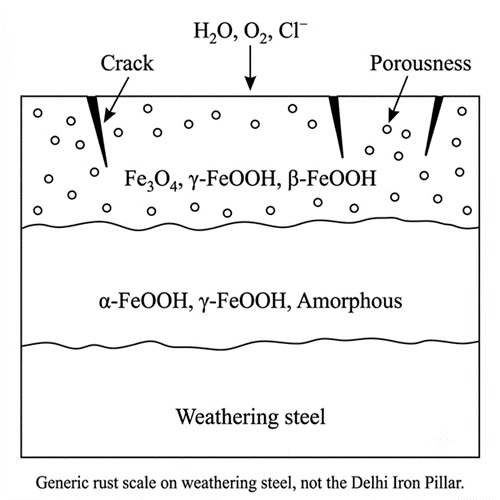
Figure 1. A generic rust scale on weathering steel: a cracked, porous outer layer sits over a denser inner layer.
Built by Hand: Bloomery Iron and Forge Welding
Gupta-era ironworkers used a bloomery, a clay furnace filled with iron ore and charcoal. Bellows pushed air in through a clay pipe called a tuyere, so the charcoal burned hot, often around 1,200 °C. That is well below the melting point of iron, about 1,538 °C.
With limited air, burning charcoal (carbon, C) makes carbon monoxide (CO).
2C + O2 → 2CO
Carbon monoxide then steals oxygen from the ore. The main ore compound is iron(III) oxide (Fe2O3). The gas pulls its oxygen away and leaves metallic iron (Fe), while the carbon monoxide becomes carbon dioxide (CO2).
Fe2O3 + 3CO → 2Fe + 3CO2
Because the iron never fully melted, it gathered as a hot, spongy lump called a bloom, stuffed with slag, the glassy non-metallic leftovers from the ore. In Figure 2, the charge (the ore and charcoal mixture) fills the top, the bloom forms near the air pipe, and liquid slag drains into a pit.
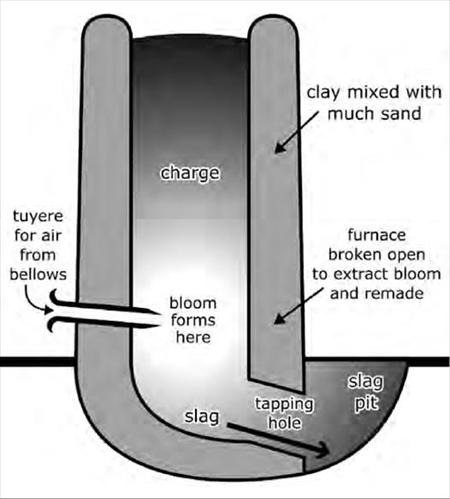
Figure 2. Cutaway of a bloomery furnace. Air from bellows enters at the tuyere, the bloom forms beside it, and slag drains to a pit.
Source: Bloomery furnace cutaway diagram
Smiths broke the furnace open and hammered the bloom again and again, squeezing out much of the slag like water from a sponge. What remained was wrought iron with some slag still trapped inside. Under a microscope, the pillar is mostly ferrite, a soft form of iron that holds very little carbon. Some regions contain pearlite, a layered mix of ferrite and iron carbide (Fe3C). Dark slag particles remain, and they can contain fayalite (Fe2SiO4), an iron silicate.
Joining the Pieces
No single bloom could make a six-tonne column, so the pillar was probably assembled from many pieces. Smiths heated the surfaces until they turned soft and pasty, then hammered them together. This is forge welding. Unlike modern electric welding, it needs no melting, only heat and pressure. Hammer marks and weld lines on the pillar fit this method.
One estimate says about 200 furnaces, each making blooms of roughly 40 kilograms, could have supplied the iron. That is a calculation, not a count of furnaces anyone has found. How the finished pillar was moved and raised is also unknown.
The Thin Skin That Changed the Story
An Ingredient Engineers Usually Avoid
Steelmakers treat phosphorus (P) as an impurity to control, because too much can gather along grain boundaries, the seams between metal crystals, and make steel brittle. The pillar goes the other way. Published analyses report phosphorus from about 0.11% to 0.48% by weight, depending on the sample. A figure near 0.25% is often quoted as the average. That is high for structural steel.
One idea is that the bloomery process, which never fully melted the iron, let phosphorus from the ore stay in the metal instead of leaving with the slag. This is a hypothesis, not a settled fact. More phosphorus is not always better either, since the pillar’s low carbon and unusual manufacturing history make comparisons with modern steel tricky.
An Amorphous Layer Against the Metal
Studies of scale from the pillar describe a layered skin, drawn in Figure 3. On the outside sit goethite (α-FeOOH) and lepidocrocite (γ-FeOOH) together with magnetite (Fe3O4). Right against the metal lies a layer of amorphous iron oxyhydroxide, usually written δ-FeOOH and called misawite. Amorphous means the atoms have no regular pattern. Think of a heap of sand versus a tiled floor. The model also shows phosphorus and magnetite enriched near the metal.
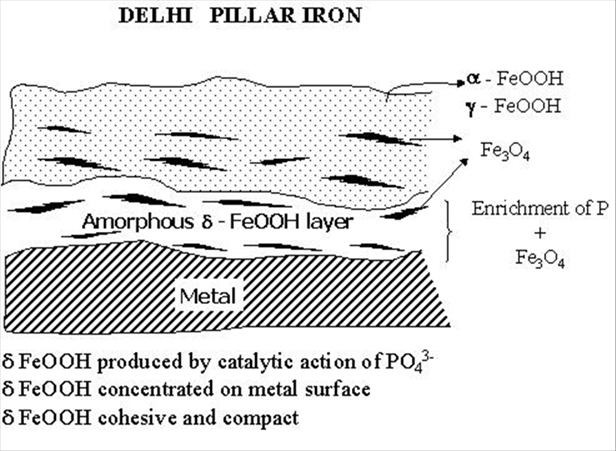
Figure 3. Proposed layers in the Delhi Iron Pillar’s scale, with an amorphous δ-FeOOH layer against the metal.
Source: Schematic of the proposed corrosion-scale model for the Delhi Iron Pillar, after R. Balasubramaniam
In this model, phosphate ions (PO43−) act as a catalyst. A catalyst speeds up a reaction without being used up. Phosphate is thought to help rust form a compact amorphous layer instead of loose crystals, tight against the metal. This is a proposed mechanism, and researchers still debate how much protection it gives.
Phosphate appears in a second way. A simple classroom picture says iron(III) ions (Fe3+) meet phosphate ions and form iron(III) phosphate (FePO4).
Fe3+ + PO43− → FePO4
Treat that equation as a sketch. Free phosphate ions are scarce in damp, near-neutral conditions, and the real scale is not pure FePO4. Diffraction studies found one specific crystalline phase, iron hydrogen phosphate hydrate (FePO4·H3PO4·4H2O). Evidence suggests it grows from a gel-like phosphate-rich material as monsoon rain and hot sun take turns, like wet mud baking into a crust.
How Scientists Saw It
No single instrument sees the whole skin. X-ray diffraction (XRD) sends X-rays into a sample, and regular rows of atoms scatter them into a repeating pattern, much as a tiled floor repeats. That is how XRD identified the crystalline phosphate. It struggles with amorphous material, because atoms with no regular rows give no clear pattern.
Fourier-transform infrared spectroscopy (FTIR) works differently. It measures how chemical bonds vibrate when infrared light hits them. Bonds in amorphous oxyhydroxides and phosphate groups still vibrate in recognisable ways, so FTIR could detect what diffraction missed. Its limit is the reverse of XRD’s: it shows which bonds are present, but not how atoms are arranged over long distances. Mössbauer spectroscopy adds another view of the chemical state and magnetic behaviour of the iron atoms.
Back to the Pocketknife
Now the scratch. Cut through the dark skin and you would reach solid metallic iron, not flaky rust. The skin is described as a fraction of a millimetre thick, far thinner than a coin. It is like dried paint on a wall, except that this paint grew out of the wall itself.
A Map of Iron’s Options
To ask which form of iron is stable under given conditions, chemists use a Pourbaix diagram, also called an E-pH diagram. The horizontal axis is pH, how acidic or alkaline the water is. The vertical axis is E, the electrochemical potential in volts, which describes how strongly the surroundings pull electrons off the metal. Figure 4 is the version for iron (Fe) in water (H2O).
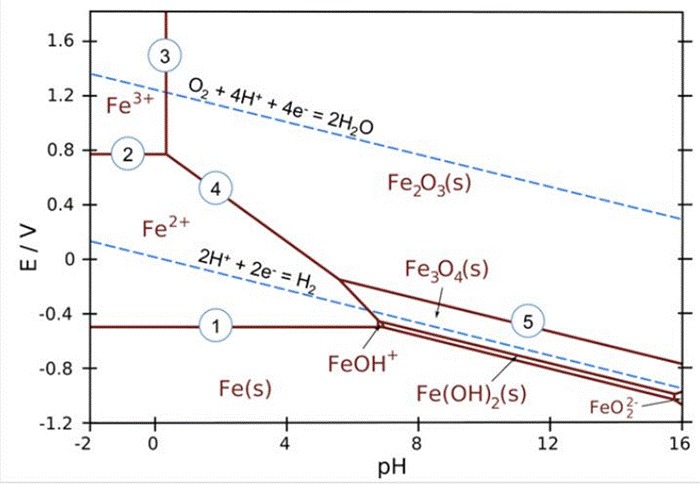
Figure 4. Pourbaix (E-pH) diagram for iron in water. It maps equilibrium stability, not reaction speed or film adhesion.
Source: Fe-H2O Pourbaix (E-pH) diagram
Read it as a map with three territories. In the corrosion territory, iron sits in the water as dissolved Fe2+ or Fe3+ ions, so the metal wears away. In the immunity territory at the bottom, solid iron is stable and oxidising it is not favoured. In the passive territory, solids such as iron(III) oxide (Fe2O3) and magnetite (Fe3O4) are stable. These solids can coat the surface, though a stable solid is not automatically a tight barrier.
The horizontal line near −0.5 V is where solid iron turns into dissolved Fe2+, the same step as our first rusting equation. The two dashed blue lines show where water itself is stable. On the upper line, oxygen takes up electrons and hydrogen ions (H+) to make water.
O2 + 4H+ + 4e− = 2H2O
On the lower line, hydrogen ions take up electrons and make hydrogen gas (H2).
2H+ + 2e− = H2
Between them, water is stable.
Two warnings come with this map. First, it describes equilibrium, where a system would end up given enough time. It says nothing about speed. A sheet of paper in air could burn, yet it sits on a desk for years. Speed depends on kinetics and on activation energy, the energy hurdle a reaction must clear. The pillar has many reactions running at once, so no single activation energy describes the whole process. Second, this diagram covers plain iron and water. It has no phosphorus and cannot show how well a film sticks. Explaining the pillar needs an expanded Fe-P-H2O diagram with insoluble iron phosphates.
Why the Skin Has Lasted
A film that protects metal for centuries has several jobs. It has to slow the spread of oxygen (O2), water (H2O) and salts toward the iron. Diffusion through a compact layer is far slower than through the cracks and pores in Figure 1. It also has to stay put. Through day, night and season, the metal and its crust expand and shrink by different amounts, the same stress that cracks a cold glass dish when hot water hits it. Ordinary rust cracks and flakes under that stress. The pillar’s skin has held on, though exactly why is still under study.
A third job is harder to judge. Corrosion needs electrons moving through the scale and ions moving through the moisture film on top. Whether this skin slows the electrons, the ions or both is an open question.
The pillar is not rust-proof, and Delhi’s air has changed. Traffic and industry now release sulphur dioxide (SO2). In moist air it can end up as sulphuric acid (H2SO4).
SO2 + ½O2 + H2O → H2SO4
The acid lowers the pH of the water film on the metal, which can encourage iron to dissolve. Nobody has shown that this has broken down the pillar’s skin, but the buried base sits in damp soil with chloride salts (Cl−), so conservators keep watching. How long the thin film can keep doing its job is a question the pillar has not finished answering
Eternal Satlok: Beyond the Perishable Mortal Realm
Even the resilient Delhi Iron Pillar will eventually yield to time, but the supreme realm of Satlok knows zero aging, corrosion, or death. Revered as the imperishable eternal abode (Shasvat Sthan) in Gita Chapter 18, Verse 62, its mystery is hidden within the inverted cosmic tree described in Gita Chapter 15, Verses 1–4. Today, Jagatguru Sant Rampal Ji Maharaj is that very Tatvadarshi Sant who imparts this true spiritual wisdom and decodes the path to liberation.
| Feature | Mortal Realm / Heaven (Svarga) | Eternal Satlok (Sachkhand) |
| Lifespan & Form | Subject to disease, old age, and death | Immortal, radiant Noori bodies glowing like 16 suns |
| Abundance & Labor | Endless toil, physical hunger, and scarcity | Rivers of milk, mountains of gems, zero labor |
| Material State | Perishable, decaying, and prone to corrosion | Ever-fresh, indestructible, and self-illuminated |
For more information, download the “Sant Rampal Ji Maharaj” app from the Google Play Store.
Frequently Asked Questions
1. Is the Delhi Iron Pillar rust-proof?
No. It is wrought iron, not a corrosion-proof alloy. Its surface has developed a protective scale that slows damage.
2. What prevents rusting?
A thin, phosphorus-rich film containing iron oxyhydroxides and magnetite (Fe₃O₄) restricts oxygen and moisture. Studies have also identified iron hydrogen phosphate hydrate in the corrosion layer.
3. Why does ordinary iron flake?
Ordinary rust is often porous and poorly attached. The pillar’s wet-dry exposure helped form a cohesive, adherent layer.
4. Can a Pourbaix diagram explain it?
Only partly. A standard iron-water diagram does not account for phosphorus, reaction rates or the film’s adhesion.