

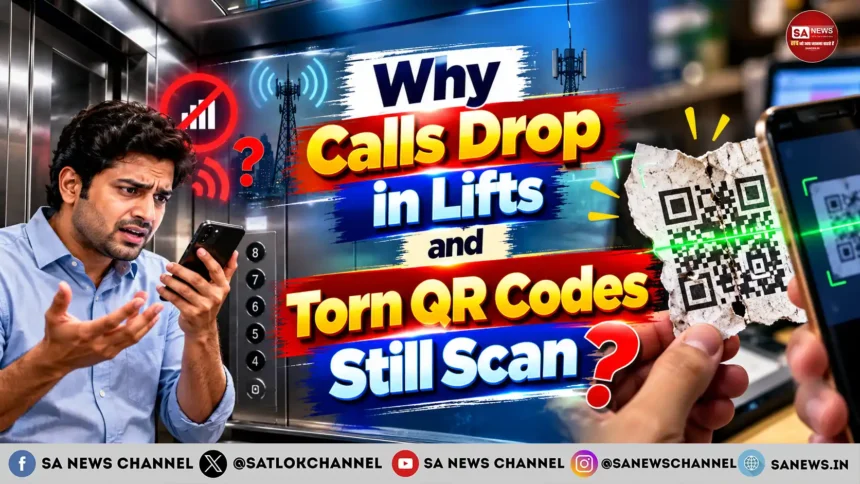
Picture yourself stepping into a lift at 8:40 on a Tuesday morning, talking to a friend on your mobile. By the fourth floor, the line goes dead. When the doors open in the lobby, your network bars return to full.
- Why Do Phone Calls Drop Inside a Lift? The Faraday Cage Effect
- Why Do Basements and Glass Buildings Ruin Your Mobile Network?
- Why Does Google Maps Freeze Indoors? The 20,000-Kilometre Problem
- How Can Cameras Read QR Codes Upside Down? The 1:1:3:1:1 Secret
- Why Do Torn and Scratched QR Codes Still Scan? Reed-Solomon Maths
- How Do QR Code Scams Work? Staying Safe on UPI
- How the Three Gunas Influence Human Beings on Earth
- Frequently Asked Questions (FAQ)
Twelve hours later, at a crowded tea stall, you point your phone at an old payment sticker. One corner is torn (the empty one, with no big square), a key scratch runs through the middle, and tea stains cover the paper. Yet within half a second, the seller’s name appears and your ten rupees go through.
Both stories answer one question: how does digital information survive when the physical world gets in the way? Here is the science behind six everyday tech puzzles.
Why Do Phone Calls Drop Inside a Lift? The Faraday Cage Effect
A metal lift cabin acts like a Faraday cage. When radio waves from a tower hit the steel walls, the free electrons in the metal move and create an opposite electrical push. This cancels the wave before it reaches your phone. In 1836, Michael Faraday showed that electric charge stays on the outside of a metal container, which is why any signal-blocking metal box carries his name. You can see the effect by wrapping a phone tightly in several layers of aluminium foil. Calls to it usually fail, and the caller hears that the number is not reachable.
Why Your Network Bars Jump Up and Down Between Floors
A lift is not sealed. Gaps around the doors, roof vents and open doorways on every floor let a little energy in by bending around edges, a process called diffraction. When the cabin passes a floor, your bars rise. Deeper in the shaft, iron beams and thick concrete absorb the weak leftover signal. When the doors open on the ground floor, the shield breaks and your phone reconnects.
Why Do Basements and Glass Buildings Ruin Your Mobile Network?
Waves lose power as they pass through thick materials, a process called attenuation. Malls, metro tunnels and basements are built from reinforced concrete, which is cement and stone poured over a cage of iron bars called rebar.
- Wooden doors and thin plaster walls barely bother a mobile wave. Most of it passes through.
- Thick cement walls soak up a lot of wave energy, like a dry sponge soaking up water.
- The iron rebar grid hidden inside the cement acts like a mesh Faraday cage. It breaks up and scatters the signal.
By the time a signal passes through several concrete floors and soil, it can lose a huge share of its strength.
Glass can be a barrier too. Low-E (low-emissivity) glass, used to keep rooms cool, has a very thin metallic coating, often silver layers between layers of metal oxide. The coating reflects heat from sunlight. But mobile waves are close relatives of light waves, so coated windows can also bounce phone signals back to the street.
The table below shows how common building materials affect a mobile signal.
| Building Material | How Much Signal It Blocks | Why It Happens |
| Clear Window Glass and Wood | Very Low | These materials let radio waves pass through with very little loss. |
| Thick Brick and Cement | High | Dense stone and dried cement soak up wave energy and turn it into tiny amounts of heat. |
| Concrete with Iron Rebar | Very High | The hidden iron grid scatters the wave while the cement absorbs the rest. |
| Steel Lift Walls and Low-E Glass | Extreme | Free electrons in the metal or the window coating push the wave back outside. |
How Indoor Antennas and Wi-Fi Calling Fix Dead Zones
Large buildings such as airports, metro stations and malls fix dead zones with Distributed Antenna Systems (DAS). A main antenna on the roof picks up a clean signal from the nearest tower. Cables then carry it deep into the building, where small antennas on the ceiling share it.
In flats and thick-walled offices without such systems, Wi-Fi Calling helps. When you switch it on, your phone stops trying to reach an outside tower through the walls. Instead, it sends your voice as internet data through your Wi-Fi router and broadband line.
Why Does Google Maps Freeze Indoors? The 20,000-Kilometre Problem
Inside a mall, you may have full internet bars while your blue map dot freezes or jumps. That is because mobile internet and GPS come from different places.
Mobile towers stand nearby and send strong signals. Navigation satellites orbit far above. GPS satellites are about 20,000 kilometres up, and India’s NavIC satellites sit even higher, mostly at about 36,000 kilometres. Modern phones use several systems, including GPS, Galileo, GLONASS, BeiDou and NavIC.
A GPS satellite transmits with only about 50 watts, roughly the power of a car headlight. By the time the signal travels 20,000 kilometres, it is extremely faint, so even a concrete roof can block it.
Your phone finds your position using a method called trilateration. The rule is simple: three satellites for position, and a fourth for time.
- Satellite 1 sends a radio signal with the exact time it left the satellite. Your phone measures how long the signal took to arrive and works out the distance to that satellite.
- Satellites 2 and 3 do the same. Where the three distances meet, your phone finds your 3D position (latitude, longitude and height).
- Satellite 4 fixes your phone’s clock. Satellites carry extremely precise atomic clocks, while your phone has a cheap quartz clock that drifts slightly. Your phone uses a fourth satellite to correct its own small clock error.
Even a signal that slips in through a skylight may bounce off escalators and shop windows. This is called multipath interference. The longer, zig-zag path makes the satellite seem farther away, so your dot jumps. When the pale circle around your dot grows, your phone is telling you it has lost the satellites and is guessing roughly from nearby Wi-Fi routers.
How Can Cameras Read QR Codes Upside Down? The 1:1:3:1:1 Secret
QR stands for Quick Response. Masahiro Hara and his team at Denso Wave, a Toyota group company, invented it in Japan in 1994. Factories then used one-dimensional barcodes that held only about 20 characters and had to be scanned from the right direction. Hara played the board game Go, which uses black and white stones on a grid, and this gave him the idea of storing data in a two-dimensional square grid.
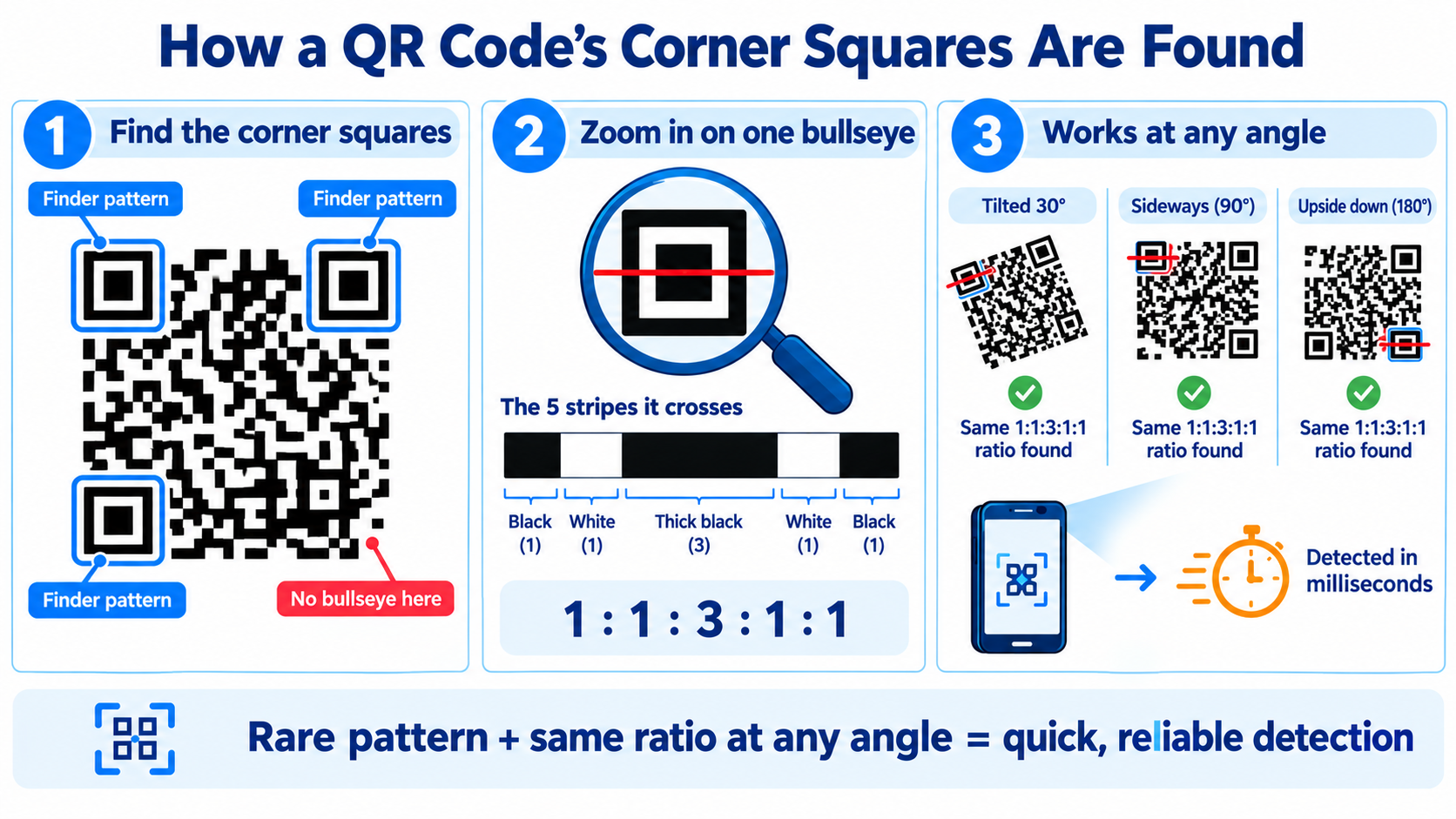
Look at any QR code and you will see three large square bullseyes in the top-left, top-right and bottom-left corners. These are called finder patterns. A line drawn through the centre of one crosses black, white, a thick black centre, white and black again, in the width ratio 1:1:3:1:1. The team studied printed material to find a pattern that rarely appears by accident, and this one won. A camera can detect the ratio at any angle, even upside down, within milliseconds.
The empty bottom-right corner matters too. Because only three corners have a bullseye, the camera can tell which way the code is facing and turn the image straight. Detailed codes, such as UPI codes, also have a smaller alignment pattern near that corner. It helps the camera flatten the image if the sticker is on a curved surface.
Why Do Torn and Scratched QR Codes Still Scan? Reed-Solomon Maths
A torn-off phone number cannot be recovered, but a QR code carries hidden backup data using Reed-Solomon error correction. Irving Reed and Gustave Solomon invented it in 1960. The same method helps scratched DVDs play and lets NASA’s Voyager probes send clear data across billions of kilometres.
A simple puzzle shows the idea. Your friend sends three numbers, 5, 8 and 2, plus a backup clue: their total, 15. If tea hides the 8, you add the survivors (5 + 2 = 7) and subtract from 15 to recover it. This works only because you know which number is missing.
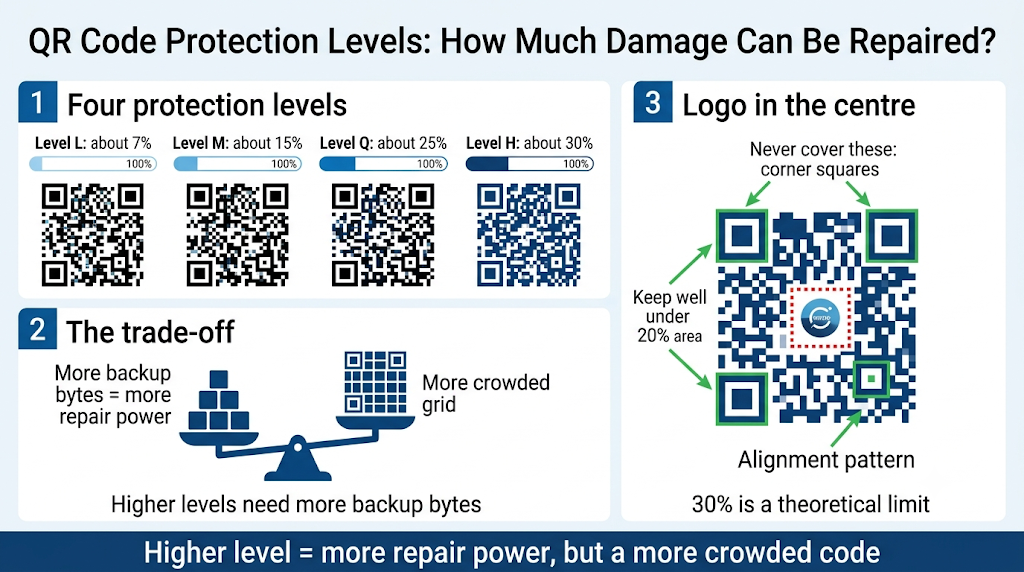
A QR code does the same on a larger scale. The payment address is stored as bytes. The encoder treats these bytes as the coefficients of a polynomial over a finite field and calculates extra bytes, called error-correction codewords, which are printed alongside the data. When a phone scans a damaged code, the decoder uses these extra bytes to find which bytes are wrong and calculate their correct values. Finding unknown error positions costs more backup. Each damaged byte needs two correction bytes, while a byte known to be missing needs only one.
Creators choose from four levels. Level L repairs up to about 7% of the code, M about 15%, Q about 25% and H about 30%. Higher levels need more backup bytes and make the grid more crowded. Level H is why many payment codes can carry a small logo in the centre. But 30% is a theoretical limit, so designers keep logos well under 20% of the area and never cover the corner squares or the alignment pattern.
Three Things That Can Still Break a QR Code
Even the smartest maths has limits. A damaged sticker will stop working if:
- Too much is lost. If the damage is more than the code’s protection level allows (30% at most), too few clues survive to rebuild the data.
- A corner square is torn off. The backup maths protects only the data inside the grid, not the three 1:1:3:1:1 corner squares or the white border around the code. Without a corner square, the camera may not recognise the code at all.
- Glare hits shiny tape. If a bulb shines directly on cello-tape covering the sticker, the white glare can stop the camera from telling black squares from white ones. Tilting your hand usually fixes it.
How Do QR Code Scams Work? Staying Safe on UPI
Scanning a QR code does not harm your phone by itself, but the link or payment request behind it can. Reed-Solomon maths makes sure the message reaches your phone without mistakes. It cannot check who printed the sticker. A QR code is only text written in black and white squares. A UPI code spells out a payment link with the shopkeeper’s bank address (VPA) and name, and anyone can make one online in seconds. Common tricks include:
- Fake sticker swap: A scammer pastes their own code over a shop’s real one at a petrol pump or street stall. If you do not check the name on your screen, your money goes to the thief.
- ‘Scan to get money’: A fake buyer sends a QR code and asks you to scan it and enter your PIN to receive money. This is false. Scanning a payment code and entering your PIN only sends money out of your account.
- Fake collect request: A collect request is a payment request that appears inside your UPI app, not something you scan. Scammers send one and pretend it is a refund. If you approve it with your PIN, money leaves your account.
Two habits protect most users:
- Match the name. Before you type the amount, read the registered name on the payment screen and check that it matches the shop or person you mean to pay.
- Never scan or enter a PIN to receive money. Your UPI PIN is only for sending money out.
If you are cheated: Report it quickly. You can call the national cybercrime helpline at 1930 or file a complaint at cybercrime.gov.in.
How the Three Gunas Influence Human Beings on Earth
You already understand how GPS satellites and mobile towers send invisible signals across kilometers, and how thick walls block them. Similarly, three invisible spiritual qualities, Rajogun, Satogun, and Tamogun, constantly broadcast their influence over every human on Earth.
Just as the aroma of chilies tempered in a kitchen spreads across an entire house and makes people sneeze from afar, the three deities reside in their respective realms yet project the invisible network of their Gunas across the world:
- Rajogun (Lord Brahma) compels living beings toward desire and reproduction.
- Satogun (Lord Vishnu) fosters love, attachment, and preservation.
- Tamogun (Lord Shiva) triggers anger, ignorance, and destruction.
Much stronger than any cellular wave, this Trigun Maya binds souls into karmic bondage (Karmabandhan) and the cycle of birth and death. According to the Bhagavad Gita, only true devotion to the Supreme God through a “Tatvadarshi Saint” can neutralize this unseen frequency and grant liberation. In the present time, Sant Rampal Ji Maharaj is the only Tatvadarshi Saint in the entire world who provides this true spiritual knowledge and path to complete liberation.
Frequently Asked Questions (FAQ)
Why does my phone show a bar in a lift, yet my call drops?
A little signal leaks through the door gaps and shows a bar. But your phone’s transmitter is far weaker than a tower’s, so it cannot send a strong signal back out through the steel and concrete.
How much of a QR code can be damaged and still scan?
It depends on the protection level: L, M, Q and H repair about 7%, 15%, 25% and 30%. The three corner squares must stay intact.
Who invented the QR code?
Masahiro Hara and his team at Denso Wave, a Toyota group company, invented it in Japan in 1994 to track car parts. QR means Quick Response.
Why does a phone need four GPS satellites?
Three give your position: latitude, longitude and height. The fourth corrects your phone’s cheap, drifting clock using the satellites’ precise atomic clocks.