

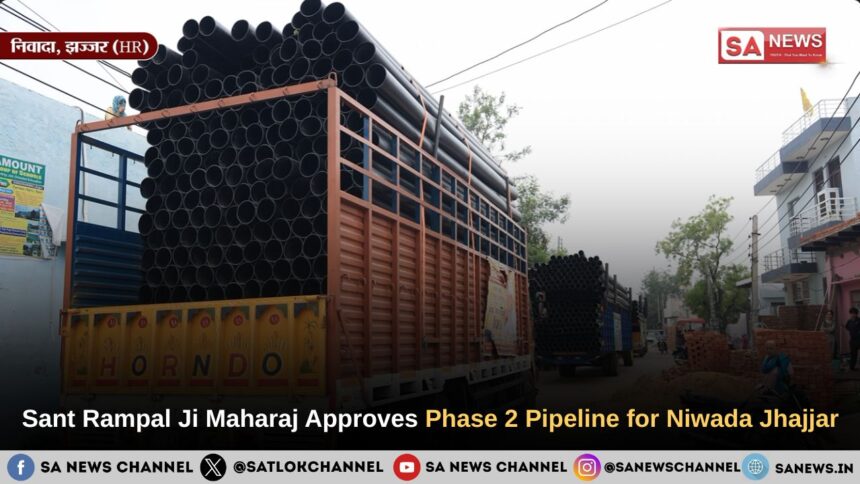
Niwada, Jhajjar, Haryana: Sant Rampal Ji Maharaj has approved a comprehensive water infrastructure project for Niwada village in Salhawas tehsil of Jhajjar district, Haryana, addressing two long-standing challenges reported by residents: agricultural waterlogging and the shortage of safe drinking water.
- Decades of Agricultural Waterlogging in Niwada
- Long-Standing Drinking Water Shortage
- Gram Panchayat Seeks Structural Assistance
- Drone and Ground Survey Conducted
- Sant Rampal Ji Maharaj Approves Expanded Infrastructure
- Technical Guidelines for Installation
- Relief Materials Reach Niwada
- Aimed at Long-Term Water Management
According to information provided by local representatives, Sant Rampal Ji Maharaj approved the required material support under Kisan Majdoor Bachao Abhiyan Phase 2, Shuddh Peyjal Seva Abhiyan and Annapurna Muhim. The initiative includes agricultural drainage pipelines, a drinking-water distribution network, electric motors, a Reverse Osmosis (RO) purification plant and associated installation equipment.
Decades of Agricultural Waterlogging in Niwada
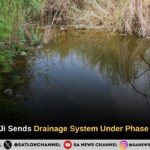
Niwada has reportedly faced recurring waterlogging for decades. Local representatives said that major flood events in 1992–1993 and 1995 were followed by annual accumulation of rainwater across agricultural fields.
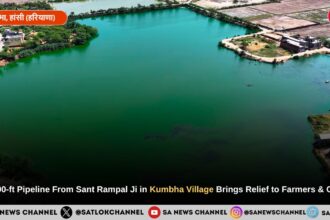
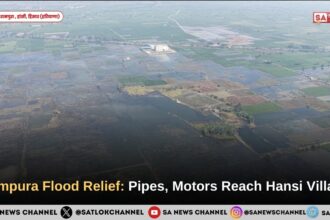
During the rainy season, standing water has reportedly reached three to four feet in some locations, affecting an estimated 250 to 300 acres of agricultural land. The affected area is described as approximately 100 to 125 acres on one side of the village and around 150 acres on the other.
The absence of adequate drainage infrastructure has reportedly resulted in repeated damage to paddy, locally known as jeeri, while also encouraging the growth of wild weeds known as patera.
According to residents, runoff from neighboring villages, including Dhakla, Kasni and Mundada, has contributed to the problem. Unmaintained drainage channels near the local lake and breaches in earthen embankments have reportedly allowed additional water to enter Niwada.
The affected agricultural fields are reportedly around 12 to 14 kille from the government drainage system. During periods of heavy rainfall, accumulated water has also reportedly submerged the main access road and surrounded the village.
Long-Standing Drinking Water Shortage
The village has also reportedly experienced serious difficulties in accessing potable water.
A stone-and-cement drinking-water pipeline was reportedly installed in Niwada during the 2000–2001 tenure of former Haryana Chief Minister Om Prakash Chautala. Over the years, the pipeline reportedly developed cracks, allowing dirty water from open drains along the Redwas route to enter the supply.
At the same time, groundwater from the village borewell reportedly became saline. Local representatives have cited a Total Dissolved Solids (TDS) level of approximately 2,000 and stated that medical testing conducted monthly by health officials raised concerns about the water’s suitability for consumption.
According to residents’ accounts, the problem continued for approximately 15 to 16 years. During this period, villagers reportedly travelled two to three kilometres to obtain drinking water from locations including Chadwana, Redwas and the Kanwa Peer Baba site.
Residents reportedly used motorcycles and bicycles or carried containers manually to transport water back to their homes.
Gram Panchayat Seeks Structural Assistance
After repeated written petitions to government departments reportedly failed to produce a permanent infrastructure solution, the Gram Panchayat of Niwada submitted a formal petition to Sant Rampal Ji Maharaj seeking assistance.
The Panchayat initially requested 4,400 feet of eight-inch pipeline and one 10 HP electric motor to drain water from the agricultural fields. It also requested 8,000 feet of six-inch pipeline and one 10 HP motor for drinking-water distribution.
Sant Rampal Ji Maharaj accepted the request and ordered a technical assessment of the village before finalizing the infrastructure requirement.
Drone and Ground Survey Conducted
A technical survey team subsequently visited Niwada and conducted an aerial as well as ground inspection. The survey reportedly used drone photography and Google Maps to assess the extent of waterlogging and determine suitable pipeline routes.
The team examined affected agricultural plots and mapped the proposed drainage route toward the government medical facility and the main drainage channel.
For the drinking-water system, the survey team assessed a route of approximately three kilometres from the tubewell point toward the village post office and residential areas, including Scheduled Caste residential areas.
The technical assessment reportedly established that the infrastructure required was greater than the Gram Panchayat’s initial estimate.
Sant Rampal Ji Maharaj Approves Expanded Infrastructure
After reviewing the survey findings, Sant Rampal Ji Maharaj approved an expanded material package under the stated initiatives.
For agricultural drainage, He provided 5,000 feet of eight-inch heavy-duty PVC pipeline, exceeding the Panchayat’s original request of 4,400 feet. He also provided one 10 HP electric motor to complement an existing motor available with the village.
For drinking-water distribution, He provided 10,000 feet of six-inch PVC pipeline, compared with the initially requested 8,000 feet. The additional material is intended to cover the approximately three-kilometre route identified during the survey.
He also provided a 10 HP submersible motor, replacing the inadequate five HP motor described in the project information.
In addition, Sant Rampal Ji Maharaj approved a Reverse Osmosis (RO) purification plant with a capacity of 2,000 litres per hour to support the provision of treated drinking water.
Project Summary
| Infrastructure | Gram Panchayat Request | Approved by Sant Rampal Ji Maharaj |
| Agricultural drainage pipeline | 4,400 ft of 8-inch pipe | 5,000 ft of 8-inch heavy-duty PVC |
| Drinking-water pipeline | 8,000 ft of 6-inch pipe | 10,000 ft of 6-inch PVC |
| Drainage motor | 1 × 10 HP | 1 × 10 HP |
| Tubewell motor | 1 × 10 HP | 1 × 10 HP submersible |
| Water purification facility | Not specified | 2,000 LPH RO plant |
| Installation accessories | Not specified | Air valves, PVC bends, joining pipes, solvent cement, nuts, bolts, T-tags and iron plates |
Technical Guidelines for Installation
Sant Rampal Ji Maharaj has also established technical guidelines for implementing the project.
The Gram Panchayat and local residents are required to lay the entire 15,000 feet of pipeline underground. Before the trenches are covered, water is to be pumped through the installed pipelines to check for leakage, faulty joints and pipe separation.
Air valves are to be installed at designated intervals to help prevent airlocks and excessive pressure that could potentially damage the pipeline.
Once the underground installation is complete, the Gram Panchayat must notify the technical survey team for a secondary field inspection.
According to the stated procedure, after successful inspection, Sant Rampal Ji Maharaj will authorize the handover of both 10 HP electric motors on the following day.
Relief Materials Reach Niwada
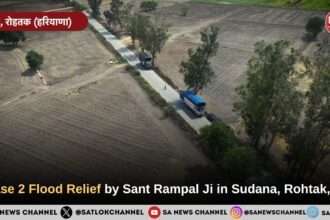
The pipes and associated installation materials have reportedly reached Niwada through Annapurna Muhim. Gram Panchayat representatives and residents used tractors to receive and transport the materials after meeting the relief trucks at the village boundary.
The material delivery marks the transition toward the implementation stage of the project.
Aimed at Long-Term Water Management
The proposed 5,000-foot agricultural drainage pipeline is intended to channel accumulated rainwater from approximately 250 to 300 acres of affected agricultural land toward the government drainage system near the government medical facility.
The drinking-water component, meanwhile, is designed to connect the tubewell source with the village through approximately 10,000 feet of six-inch PVC pipeline. The 2,000-litre-per-hour RO plant is intended to provide treated water for household consumption.
According to local representatives, the project follows years of requests for solutions to Niwada’s water problems. With the materials now reportedly delivered, the next stages involve underground installation, testing, technical inspection and commissioning.
The initiative approved by Sant Rampal Ji Maharaj is therefore intended to provide infrastructure for both agricultural drainage and drinking-water supply, with the stated objective of reducing recurring waterlogging and ending residents’ dependence on distant locations for drinking water.