


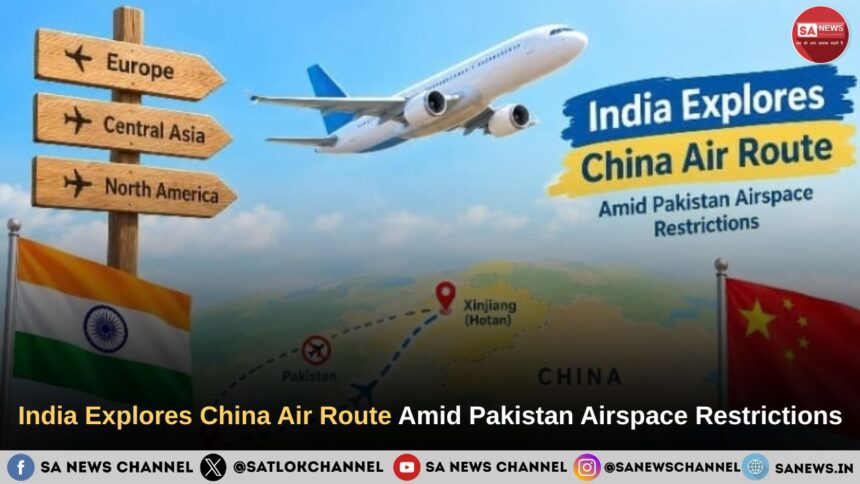
India is exploring an alternative international flight route through China’s Xinjiang region as Pakistani airspace restrictions continue to affect Indian airlines. According to recent statements and reports, Indian and Chinese authorities are discussing the possibility of allowing flights to use an air corridor near Hotan in southwestern Xinjiang. The proposed route could provide Indian carriers with another option for flights connecting to Europe, the UK, Central Asia, and North America. Current diversions around Pakistani airspace have increased flying time, fuel consumption, and operating costs on some routes. However, the proposed China air route remains under discussion, with no final agreement or operational start date announced yet.
- Why Is India Exploring an Alternative Flight Route Through China?
- How Does the Proposed Hotan Route Work?
- Impact of Pakistani Airspace Restrictions on Indian Airlines
- Could the China Route Reduce Flight Time and Costs?
- Key Challenges in Using Chinese Airspace
- What Could the China Route Mean for Passengers?
- India’s Push for More Resilient Aviation Connectivity
- What Happens Next?
- A Perspective on Peace, Harmony, and Universal Well-being
- FAQ on Flight Routes via China
Why Is India Exploring an Alternative Flight Route Through China?
Ongoing Pakistan airspace restrictions have created operational challenges for Indian airlines operating international services. Since the restrictions were imposed, some flights from northern and western India heading toward western destinations have had to use longer alternative routes.
Recent reports indicate that India is exploring access to Chinese airspace, particularly through a possible corridor near Hotan in Xinjiang. Civil Aviation Minister Ram Mohan Naidu confirmed that discussions on the Hotan route are taking place between India and China, with the Ministry of External Affairs involved in the discussions.
It is important to note that the route is still under discussion. No final agreement has been announced, and there is currently no confirmed operational start date.
Also Read: Exercise Veer Guardian 2026: India, Japan Enhancing Air Force Cooperation
How Does the Proposed Hotan Route Work?
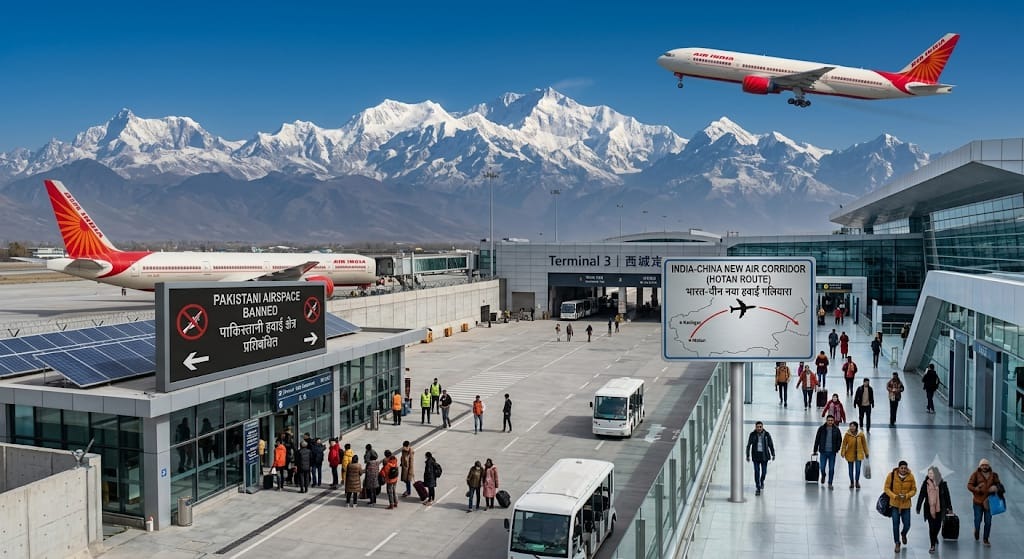
The proposed Hotan air route could provide Indian airlines with an alternative path that avoids Pakistani airspace.
According to reports, a possible routing would take flights from Delhi and Mumbai toward Leh, enter Chinese airspace near Hotan in southwestern Xinjiang, and then continue west toward Central Asia before connecting with existing international routes toward Europe, the UK, and North America.
The exact route, however, would depend on the permissions and air traffic arrangements agreed between India and China.
Why Is Hotan Important?
Hotan is located in southwestern Xinjiang and is geographically positioned near routes connecting South Asia with Central Asia.
If access is approved, the proposed corridor could provide some Indian airlines with a more direct alternative to the longer routes currently being used to avoid Pakistani airspace.
However, establishing a commercial air corridor requires government-level agreements, air traffic coordination, safety procedures, and other technical clearances.
Impact of Pakistani Airspace Restrictions on Indian Airlines
Avoiding Pakistani airspace has increased flight times on several international sectors. Recent reports indicate that some affected flights have experienced approximately 45 minutes to two hours of additional flying time, depending on the route.
Longer routes can increase:
– Aviation fuel consumption
– Crew operating costs
– Aircraft utilisation time
– Overall airline operating expenses
These additional costs are particularly relevant for airlines operating long-haul services from major Indian hubs such as Delhi and Mumbai.
Air India, which operates a significant number of western long-haul services, has also been affected by the longer routing.
Could the China Route Reduce Flight Time and Costs?
The main objective of exploring the Xinjiang air route is to find a more efficient alternative to existing detours.
If Chinese airspace access is approved and the final route is shorter, Indian airlines could potentially save flying time and fuel on selected international services. Reports have identified destinations in Central Asia, Georgia, Baku, and northern Europe as areas where a suitable route could provide potential benefits.
However, the exact savings cannot be confirmed at this stage. They would depend on the final route, aircraft type, air traffic restrictions, weather conditions, fuel prices, and other operational factors.
Therefore, the potential benefits should not be treated as guaranteed until the route is officially approved and operational.
Key Challenges in Using Chinese Airspace
Although the proposed route could offer an alternative for Indian aviation, several challenges remain.
Bilateral Approval
India and China would need to reach an agreement before Indian commercial aircraft could regularly use the proposed corridor.
Air Traffic Management
The two countries would also need to coordinate air traffic control, communication procedures, flight safety, and other operational requirements.
Airspace Restrictions
Parts of the Xinjiang region have airspace and operational restrictions, meaning the exact corridor available to commercial aircraft would depend on Chinese aviation authorities and applicable clearances.
Commercial Viability
Airlines would also need to consider overflight and navigation charges, fuel savings, flight time, and other operating expenses before adopting the route.
What Could the China Route Mean for Passengers?
If the proposed China flight route becomes operational, passengers on selected international services could potentially benefit from shorter journeys.
A shorter flight path could mean:
- Reduced flying time on eligible routes
- Lower fuel consumption for airlines
- More efficient aircraft utilisation
- Greater flexibility in international route planning
However, passengers should not automatically expect lower airfares. Ticket prices depend on several factors, including fuel prices, demand, airline pricing, airport charges, and competition.
India’s Push for More Resilient Aviation Connectivity
The exploration of the Hotan corridor reflects the importance of having alternative international air routes.
Geopolitical developments can affect established aviation corridors and force airlines to make rapid changes to their flight plans. Having additional airspace options can therefore help airlines maintain international connectivity when traditional routes become unavailable.
For India, alternative routes could also support its growing aviation sector and international connections with Europe, Central Asia, the UK, and North America.
What Happens Next?
The next step depends on the ongoing discussions between Indian and Chinese authorities.
If an agreement is reached, aviation authorities would still need to work out the technical details, including approved flight paths, air traffic management, safety procedures, and operational permissions.
As of now, there is no confirmed launch date for the proposed Hotan route, and India and China have not announced a final operational agreement.
A Perspective on Peace, Harmony, and Universal Well-being
The disruption of international air routes shows how geopolitical tensions can affect ordinary people through longer journeys, higher operating costs, and changes in international connectivity.
In spiritual teachings associated with Sant Rampal Ji Maharaj, emphasis is placed on peace, mutual respect, compassion, and spiritual knowledge known as Satgyaan.
From this perspective, peaceful resolution of disputes and cooperation between nations can be viewed as important for reducing difficulties faced by ordinary people. While aviation policies and international airspace agreements are matters of government and civil aviation authorities, the broader message of peaceful coexistence connects naturally with the idea of reducing unnecessary hardship and promoting human welfare.
FAQ on Flight Routes via China
1. Why is India exploring an air route through China?
India is exploring an alternative route to reduce the longer detours caused by Pakistani airspace restrictions.
2. Where is the proposed China route located?
The proposed corridor is being discussed near Hotan in southwestern Xinjiang, China.
3. Could the China route reduce flight time?
It could potentially reduce flight time on some routes if the proposed corridor is approved and becomes operational.
4. Is the Hotan route operational yet?
No. Discussions are ongoing, and no official operational start date has been announced.
5. Why are Indian airlines avoiding Pakistani airspace?
Pakistani airspace restrictions on Indian aircraft have forced some airlines to use longer alternative routes for certain international flights.