


Imagine an Indian poet sitting under a banyan tree over two thousand years ago, reciting verses aloud. (This scene is imagined, but the counting problem was real.) A metrical verse has ten syllable slots. Each beat can be short or long, light or heavy. The poet wonders: how many distinct rhythmic patterns can exist in this line without missing a single one?
- The Birth of Counting: From Indian Verses to Global Ideas
- Jain Philosophy and the Art of Selection
- Pingala, Prosody, and the First Binary Code
- Stepping Up the Powers of Two
- The Mountain of Numbers: Meru-prastāra
- Beating the Clock with Mātrāmeru
- Nārāyaṇa Paṇḍita and Systematic Permutations
- A Cross-Cultural Evolution: The Global Journey of Counting
- Greek Puzzles and Propositional Logic
- Lexicography in the Golden Age of Islam
- Chinese Hexagrams and Root Extracting Triangles
- European Change Ringing and Renaissance Games
- Where Modern Combinatorics Runs Our High-Tech World
- Graph Theory and Networks: Mapping Connections
- Combinatorial Optimization: Finding the Optimal Route
- Machine Learning and Combinatorics: Exploring AI Decision Spaces
- Quantum Computing: Superposition and Exponential State Spaces
- Cryptography and Post-Quantum Security: Protecting Data Complexity
- Coding Theory and Information Theory: Error Correction
- Bioinformatics and DNA Computing: Nature’s Combinatorial Code
- Why These Ancient Counting Concepts Still Matter
- Unlocking the True Science of Mantras: Why Most Fail and Only a Few Work
If each of the ten positions can be either short or long, the math is straightforward:
2¹⁰ = 1,024
That way of thinking is an early landmark in combinatorics: the branch of mathematics focused on counting, arranging, and optimizing discrete structures.
The Birth of Counting: From Indian Verses to Global Ideas
Combinatorics did not start as dry calculations inside academic classrooms. It arose out of religious debates, medicine, perfume compounding, and classical Sanskrit poetry. Scholars wanted orderly rules to explore every possible outcome without getting lost.
| Classical Indian Concept | Modern / Mathematical Equivalent | Context & Foundation |
| Syllables in Verse | Binary States (Laghu / Guru) | Sanskrit prosody (Chandas); mapping short (1 beat) and long (2 beats) syllables to binary logic. |
| Meru-prastāra | Pascal’s Triangle / Binomial Coefficients | Systematic expansion of verse combinations, described in Piṅgala’s rules and diagrammed by Halāyudha (10th century), centuries before Pascal. |
| Mātrāmeru | Fibonacci Sequence | Additive sequences counting rhythms with fixed total duration (mātrā), documented by Virahāṅka, Gopāla, and Hemacandra. |
| Gaṇita Kaumudī | Factorials, Permutations & Combinations | 14th-century work by Nārāyaṇa Paṇḍita detailing systematic algorithms for permutations (prastāra), combinations, and partitions. |
Jain Philosophy and the Art of Selection
The Jain Bhagavatī Sūtra, traditionally dated to about 300 BCE, asks how many ways items can be chosen one, two, or three at a time. It is one of the earliest recorded encounters with binomial coefficients.
Pingala, Prosody, and the First Binary Code
Around the third or second century BCE (traditional dating), a scholar named Pingala wrote the Chandaḥśāstra, a manual analyzing Sanskrit poetic meters. Pingala classified every syllable into one of two fundamental rhythmic weights: laghu (light, short) and guru (heavy, long).
To help poets navigate all possible rhythmic verses, Pingala designed an algorithmic toolkit:
- Prastāra: A systematic expansion table that unpacks every permutation of a meter row by row.
- Naṣṭa: An algorithm to determine the exact pattern of a verse given only its row number in the list.
- Uddiṣṭa: A reverse algorithm that calculates the exact position of a verse by inspecting its pattern of short and long beats.
While Pingala used poetic syllables rather than modern zeros and ones, his two-state model represents the earliest recorded ancestor of binary sequences.
Stepping Up the Powers of Two
Consider how rapidly possibilities multiply when you flip a coin or set a metrical beat.
- 1 syllable with 2 options yields 2¹ = 2 patterns.
- 2 syllables yield 2² = 4 patterns.
- 3 syllables yield 2³ = 8 patterns.
- 4 syllables yield 2⁴ = 16 patterns.
For an n-syllable line, the total pool of arrangements expands exponentially:
2ⁿ
This exact exponential curve explains how digital memory works today. A system with thirty yes-or-no switches does not produce sixty states; it generates over one billion unique combinations.
The Mountain of Numbers: Meru-prastāra
When medieval commentator Halāyudha explained Pingala’s rules in the tenth century CE, he illustrated them with a pyramidal diagram called Meru-prastāra (the staircase of Mount Meru). Each row begins and ends with the number 1, and every interior number equals the sum of the two numbers situated directly above it:
1
1 1
1 2 1
1 3 3 1
1 4 6 4 1
These values represent binomial coefficients (given in image):
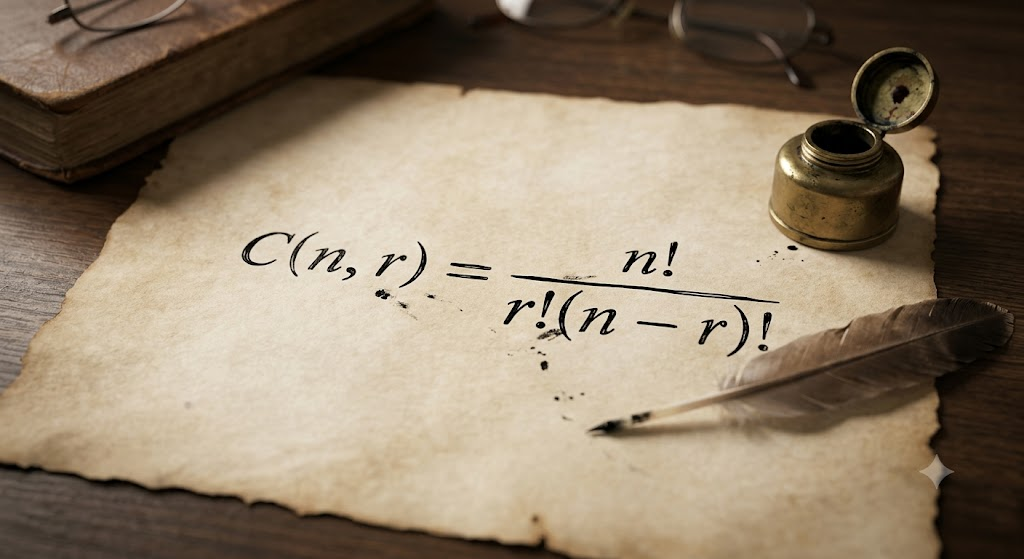
If you want to know how many distinct six-syllable lines contain exactly two long syllables, you evaluate C(6, 2) = 15. While this pyramid is called Pascal’s Triangle in modern textbooks, it was diagrammed and utilized by Indian, Persian, and Chinese mathematicians hundreds of years before Blaise Pascal composed his treatise in the 1650s.
Beating the Clock with Mātrāmeru
Poets also measured rhythm by total musical duration (mātrā), where a short syllable lasts one beat and a long syllable counts as two. Counting how many rhythmic patterns add up to a fixed total duration follows a recursive relation:
F(n) = F(n – 1) + F(n – 2)
This recurrence produces the sequence:
1, 1, 2, 3, 5, 8, 13, 21, 34 and so on
(With F(1) = F(2) = 1, the number of patterns with total duration n is F(n + 1).)
Scholars such as Virahāṅka (around the seventh century) and Hemacandra (twelfth century) documented this exact sequence to measure poetic cadences long before Leonardo of Pisa introduced the identical series to European merchants in his 1202 work Liber Abaci.
Nārāyaṇa Paṇḍita and Systematic Permutations
By 1356 CE, mathematician Nārāyaṇa Paṇḍita compiled the Gaṇita Kaumudī. He moved far beyond the mechanics of poetry to analyze permutations, multinomial combinations, and general integer partitions for pure mathematical puzzles. He offered step-by-step algorithms to generate every arrangement of items in alphabetical order without skipping any. This was a major step in combinatorics becoming a standalone science rather than a poetic device.
A Cross-Cultural Evolution: The Global Journey of Counting
Combinatorics developed across multiple cultures through trade, astronomy, language study, and logic.
| Period | Scholar or Text | Culture | Major Milestone |
| c. 300 BCE (traditional dating) | Bhagavatī Sūtra | India | Early rules for selections and combinations |
| c. 200 BCE | Pingala, Chandaḥśāstra | India | Binary expansion (prastāra), powers of two |
| 1st Mill. BCE | I Ching (Yijing) | China | 64 hexagrams built from broken and solid lines |
| c. 250 BCE | Archimedes, Stomachion | Greece | Dissecting geometric squares into 14 pieces |
| c. 750 CE | Al-Khalil, Kitāb al-ʿAyn | Iraq | Permutations of Arabic consonants to build dictionaries |
| c. 1050 CE | Jia Xian | China | Binomial coefficient tables for polynomial roots |
| c. 1140 CE | Abraham ibn Ezra | Spain / France | Astrological planetary conjunction calculations |
| 1321 CE | Levi ben Gershon | France | Formal inductive proofs for permutations and combinations |
| 1356 CE | Nārāyaṇa Paṇḍita | India | Lexicographical algorithms to order permutations |
| 1654 CE | Pascal and Fermat | France | Modern probability theory based on counting outcomes |
| 1736 CE | Leonhard Euler | Switzerland | Bridges of Königsberg problem launching graph theory |
Greek Puzzles and Propositional Logic
In ancient Greece, where mathematics leaned toward geometry, counting still surfaced. Archimedes studied the Stomachion, a 14-piece dissection puzzle that can form a square in 17,152 arrangements (536 when rotations and reflections are treated as the same). The Stoic philosopher Chrysippus also explored the combinations of compound logical statements.
Lexicography in the Golden Age of Islam
In eighth-century Basra, Al-Khalil ibn Ahmad calculated permutations of Arabic consonants to build the first comprehensive Arabic dictionary, Kitāb al-ʿAyn. Separately, later scholars such as Al-Karaji developed arithmetic triangles of binomial coefficients.
Chinese Hexagrams and Root Extracting Triangles
The I Ching’s 64 hexagrams (2⁶) combine six broken or solid lines. Jia Xian and Yang Hui built binomial triangles up to the sixth power, and Zhu Shijie extended them to the eighth in 1303.
2⁶ = 64
European Change Ringing and Renaissance Games
English church bell-ringers explored permutations through change ringing, later codified in Fabian Stedman’s Tintinnalogia (1668). In 1654, Pascal and Fermat applied similar counting to gambling problems, helping found modern probability theory.
Where Modern Combinatorics Runs Our High-Tech World
Counting patterns is no longer confined to verses or board games. Discrete mathematics now provides the structural framework for cutting-edge engineering and modern software systems.
Graph Theory and Networks: Mapping Connections
Modern networks, from social relationships to global communication systems, can be represented mathematically as graphs made up of nodes (points) and edges (connecting lines).
Consider an office network with four computers (A, B, C, D), where every computer needs a direct link to every other computer. The number of required connections is calculated using:
n(n−1)/2 = (4×3)/2 = 6
| Computers | Direct Connections |
| A-B | 1 |
| A-C | 1 |
| A-D | 1 |
| B-C | 1 |
| B-D | 1 |
| C-D | 1 |
| Total | 6 |
This same connection logic scales to massive telecommunications networks and social-media graph databases containing billions of active nodes.
Combinatorial Optimization: Finding the Optimal Route
Optimization problems involve examining huge sets of possibilities to find the most suitable route, schedule, or allocation. For example, a traveler visiting three cities (A, B, C) must visit each exactly once and return to the starting point. This produces two distinct routes:
- A→B→C→A
- A→C→B→A
These are the same loop traveling in opposite directions. If direction doesn’t matter, there is only one distinct route.
This small example captures the basic idea behind the Traveling Salesman Problem, which logistics systems tackle at much larger scales.
Machine Learning and Combinatorics: Exploring AI Decision Spaces
Artificial intelligence systems work with enormous combinations of parameters, conditions, and features. If three binary conditions can each be either True or False, there are 2³ = 8 possible configurations.
As machine-learning models grow to billions of parameters, training requires efficient ways to explore these high-dimensional spaces.
Relational data, such as molecules, is often handled with Graph Neural Networks, where atoms are nodes and bonds are edges. A four-atom chain is simply A–B–C–D.
Quantum Computing: Superposition and Exponential State Spaces
Quantum systems use qubits that can exist in superposition, creating computational possibilities that differ fundamentally from classical bits. Four classical bits have 2⁴ = 16 possible bit patterns:
| Qubits | Computational Basis States |
| 1 | 2 |
| 2 | 4 |
| 3 | 8 |
| 4 | 16 |
| n | 2ⁿ |
Quantum computers do not simply try every state at once. Their speedups come from using interference to amplify correct answers on specific problems, such as simulating molecules or factoring large numbers.
Cryptography and Post-Quantum Security: Protecting Data Complexity
Digital security depends on creating key spaces large enough to make brute-force attacks impractical. A standard four-digit passcode has 10⁴ = 10,000 possible combinations. Quantum computers threaten today’s public-key systems, such as RSA, through Shor’s algorithm. Post-quantum protocols therefore rely on different hard problems (lattice-, code-, and hash-based) designed to resist quantum attacks.
Coding Theory and Information Theory: Error Correction
Data can become corrupted when transmitted through noisy communication channels. Coding theory addresses this by adding carefully calculated redundancy. For example, a message containing three data bits and three check bits produces a six-bit transmission block, improving error detection. The same principle underlies error-correcting codes used in systems ranging from deep-space probes to QR codes (which use Reed-Solomon codes rather than this simple example).
Bioinformatics and DNA Computing: Nature’s Combinatorial Code
Genomic information is built from four nucleotide bases: A, T, C, and G. Across two positions, these bases produce 4² = 16 possible sequences. Synthetic biology extends this combinatorial principle to create genetic libraries and design targeted molecular compounds.
Why These Ancient Counting Concepts Still Matter
The true value of this historical journey is not that ancient scholars secretly invented modern laptops. They did not have silicon microchips, digital screens, or high-speed fiber cables.
The real discovery was far more fundamental: they recognized that whenever a system creates many possibilities, you need a disciplined framework to map, count, and navigate them. The same intellectual blueprint links an ancient poetic cadence, a molecular diagram, a shipping route, and a quantum processor.
Technological tools have transformed beyond recognition over the past two thousand years. The underlying mathematical challenge remains the same: understand the pieces, calculate every option, and bring clarity to an expanding universe of choices.
Unlocking the True Science of Mantras: Why Most Fail and Only a Few Work
In combinatorics, countless combinations exist, but only the exact formula delivers the desired outcome. The same principle governs mantras. Though thousands of mantras and three distinct methods of recitation exist, randomly choosing them never yields results. Mantras act like precise medicines: combining the wrong ones cures nothing, while the right prescription transforms life.
True spiritual science cannot be decoded through intellectual guesswork. It demands scriptural authority and divine grace through an enlightened spiritual master. Discover the genuine mantras for worldly well-being and ultimate salvation, understand the vital rules of recitation, and awaken their latent power. Download the Sant Rampal Ji Maharaj App today to explore books like ”Gyan Ganga” and uncover the authentic path to spiritual liberation.
FAQ
Why is Pascal’s Triangle named after Blaise Pascal if earlier cultures used it?
In seventeenth-century Europe, Blaise Pascal wrote Traité du triangle arithmétique, which brought together many properties of the triangle and linked them to the emerging theory of probability. European mathematical texts popularized his name, even though identical diagrams had been documented centuries earlier by Halāyudha in India, Al-Karaji in Persia, and Yang Hui in China.
Did Indian poets discover the Fibonacci sequence before Leonardo of Pisa?
Yes. Indian prosodists such as Virahāṅka and Hemacandra formulated the recurrence sequence F(n) = F(n-1) + F(n-2) to calculate the number of metrical patterns of a specific temporal duration. They described these numbers centuries before Leonardo of Pisa included them in his 1202 book Liber Abaci.
Do combinatorics directly power tools like ChatGPT?
Combinatorics does not drive ChatGPT on its own. Modern large language models rely primarily on calculus, probability, matrix operations, and specialized hardware to train neural networks. Combinatorics operates in the background, shaping network architectures, feature selection, discrete token processing, and search optimization strategies.
What is the practical difference between a permutation and a combination?
In a permutation, the arrangement order of items matters. For example, the lock combination 1-2-3 is completely different from 3-2-1. In a mathematical combination, the order does not matter. Choosing a team of two players from Alice, Bob, and Charlie treats the pair (Alice, Bob) and the pair (Bob, Alice) as the exact same selection.