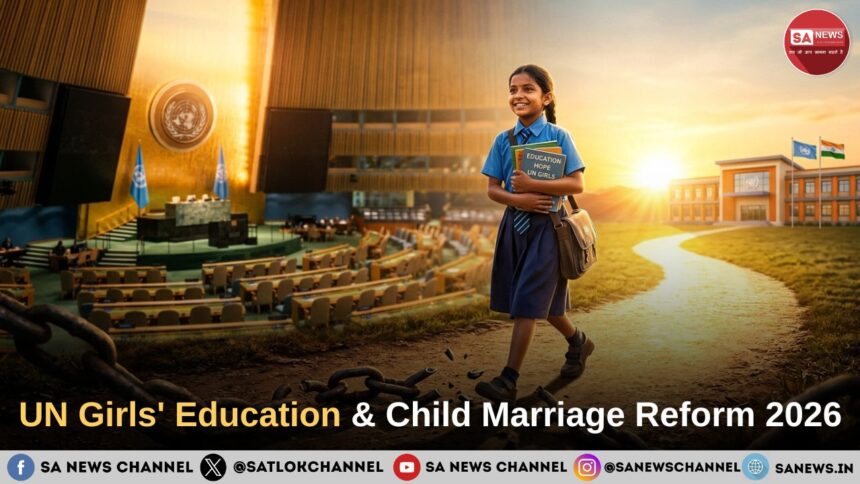
Girls’ education and child marriage remain closely connected global challenges. When girls leave school because of early or forced marriage, they can lose opportunities to gain knowledge, skills and economic independence. During the 2025–2026 UN General Assembly period, the United Nations continued highlighting the importance of protecting girls’ rights, expanding education and addressing harmful practices. A significant development came in September 2026, when the General Assembly adopted Resolution 80/309, proclaiming an International Day for the Elimination of Child, Early and Forced Marriage. The initiative is intended to strengthen awareness, advocacy and accountability while encouraging action on education, protection, empowerment and legal reform.
- UN Girls’ Education and Child Marriage Reform: Why the Issue Matters
- What Happened at the UN General Assembly in 2025–2026?
- Why Is Girls’ Education Central to Child Marriage Reform?
- What Does the Latest UN Resolution Actually Do?
- Child Marriage Remains a Global Challenge
- Education Can Provide More Than Academic Knowledge
- The Connection Between Poverty, Education and Early Marriage
- Why Legal Reform Alone Is Not Enough
- The Role of Families and Communities
- Girls’ Education Is Also an Economic Issue
- What Should Happen Next?
- 1. Keep Girls in School
- 2. Strengthen Child Protection
- 3. Improve Enforcement
- 4. Address Economic Barriers
- 5. Listen to Girls
- Why Listening to Girls Is Becoming a Bigger Part of the Solution
- Technology Is Helping Governments Track Progress
- Social Norms Can Change, but Change Takes Time
- Education, Dignity and Social Responsibility
- FAQs on UN Girls’ Education & Child Marriage Reform
UN Girls’ Education and Child Marriage Reform: Why the Issue Matters
Education is more than a classroom experience. For millions of girls, it can determine whether they have the opportunity to develop skills, find employment, participate in their communities and make informed decisions about their futures.At the same time, child marriage can interrupt this journey. A girl who marries before adulthood may face increased responsibilities at home, early pregnancy, reduced economic opportunities and greater difficulty continuing her education.
The United Nations has repeatedly connected these issues. The UN’s 2026 information on girls’ rights notes that child marriage can prevent girls from staying in school and can affect their health, safety and future opportunities. This is why girls’ education, child marriage prevention, gender equality, girls’ rights and legal reform are increasingly discussed together rather than as separate issues.
What Happened at the UN General Assembly in 2025–2026?
The 80th session of the UN General Assembly brought renewed attention to children’s rights, education and harmful practices affecting girls.One important development occurred on 4 September 2026, when the General Assembly adopted Resolution 80/309, titled International Day for the Elimination of Child, Early and Forced Marriage. The resolution was adopted without a vote. The resolution establishes an annual international observance intended to keep the issue visible and encourage governments, organizations and communities to strengthen their efforts.
The UN General Assembly discussion emphasized several areas:
- strengthening legislation;
- improving implementation and enforcement;
- investing in girls’ education;
- protecting girls at risk;
- supporting survivors;
- expanding health and social services;
- addressing harmful social norms; and
- creating greater economic opportunities for girls and young women.
Importantly, the UN itself acknowledged that creating an international day cannot, by itself, eliminate child marriage. The accompanying discussion emphasized that lasting progress also requires effective laws, institutions, education, economic opportunities, community engagement and sustained political commitment.
Why Is Girls’ Education Central to Child Marriage Reform?
Education Can Delay Marriage
Keeping girls in school is one part of a broader strategy for reducing child marriage.
When girls remain in education, they have more time to develop academic and vocational skills before entering adulthood. Schools can also provide access to teachers, health information, peer networks and other support systems.The relationship works in both directions: child marriage can push girls out of school, while barriers to education can make girls more vulnerable to early marriage.
Earlier UN General Assembly resolutions on the girl child have also identified child marriage, early pregnancy, gender-based violence, unpaid care responsibilities and harmful gender stereotypes among barriers to girls’ education.
Education Builds Future Opportunities
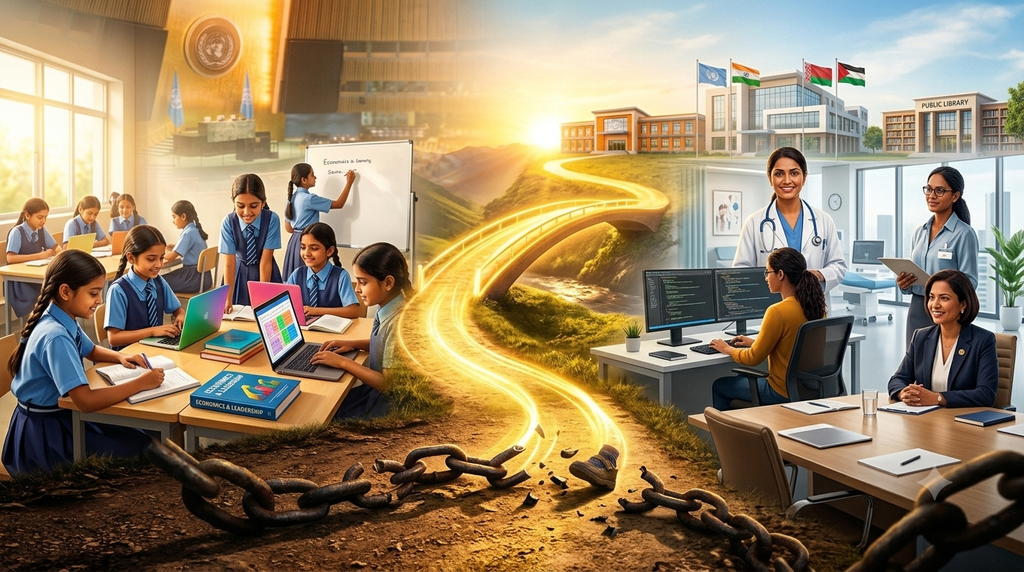
A quality education can give girls skills that are useful throughout adult life.Literacy, numeracy, digital skills, vocational training and higher education can improve access to employment and economic participation.This matters because poverty and limited economic choices can interact with social pressures surrounding early marriage.The UN’s 2026 General Assembly discussion specifically connected ending child marriage with greater investment in girls’ education, protection and empowerment.
What Does the Latest UN Resolution Actually Do?
It is important to understand the nature of Resolution 80/309.The resolution establishes an International Day for the Elimination of Child, Early and Forced Marriage. It is primarily an international awareness and advocacy mechanism rather than a single global law changing the marriage age in every country.The UN discussion described the annual observance as an opportunity to:
- renew political commitment;
- strengthen advocacy;
- raise public awareness;
- promote accountability;
- encourage stronger legislation and enforcement;
- increase investment in girls’ education and protection;
- challenge harmful practices; and
- amplify the voices of girls and survivors.
That distinction is important.Marriage laws remain matters of national legal systems, while the United Nations can establish international standards, encourage cooperation and provide a platform for countries and organizations to address shared challenges.
Child Marriage Remains a Global Challenge
Although progress has been made, child marriage has not disappeared.According to the UN’s 2026 Sustainable Development Goals reporting, nearly one in five young women globally was married before the age of 18. The report says child marriage declined faster during 2015–2024 than during the previous decade, but significant regional differences remain. The same UN reporting identifies sub-Saharan Africa and Southern Asia as regions with particularly high levels of child marriage, with rates of 31% and 25%, respectively, among young women in the cited measure. These figures show why child marriage reform continues to appear on the international development agenda.At the same time, the numbers also demonstrate that progress is possible. The challenge is maintaining and accelerating progress while reaching communities where girls continue to face barriers to education and protection.
Education Can Provide More Than Academic Knowledge
The conversation around girls’ education is increasingly broader than school attendance or examination results. UNICEF describes secondary education as important for helping young people transition into adulthood and notes that education can improve learning outcomes and earning potential while also acting as a protective factor against child marriage and adolescent pregnancy. For girls, this can include learning practical skills, understanding their rights, developing confidence and gaining knowledge that helps them navigate important decisions.
Education can also connect adolescents with teachers, peers and support systems. This does not mean that attending school automatically prevents child marriage. Instead, education is one component of a wider environment in which girls have greater access to information and opportunities. This is why international discussions increasingly connect education quality, life skills, adolescent empowerment and gender equality rather than treating schooling as an isolated issue.
The Connection Between Poverty, Education and Early Marriage
Child marriage rarely has one simple cause.
Economic insecurity, social expectations, gender inequality, limited access to secondary education, conflict, displacement and concerns about safety can interact in different ways.For some families, education may become difficult to afford when household resources are limited. In other situations, girls may have to travel long distances to school, lack safe transportation or face inadequate sanitation facilities.These practical barriers can influence whether girls remain in education.This is why education access, social protection, economic empowerment, safe schools and community awareness need to be considered alongside legal measures.
Also read: International Day of Education 2026: Know About the Real Aim of Education
Why Legal Reform Alone Is Not Enough
A strong legal framework is an important part of protecting children.However, a law is effective only when people know about it, institutions can implement it and girls can actually access protection when their rights are threatened.During the 2026 General Assembly discussion, Sierra Leone highlighted its Prohibition of Child Marriage Act 2024 and emphasized that legislation needs to be accompanied by effective enforcement, strong institutions, education, community engagement, economic empowerment and sustained leadership.
This illustrates an important principle of child protection policy: legal reform and social change need to work together.
The Role of Families and Communities
Governments and international organizations cannot solve child marriage alone.Families, teachers, community leaders, civil society organizations and young people themselves all have roles to play.Parents can support girls by encouraging them to continue their education. Schools can create safe environments where students can report concerns. Community leaders can help challenge harmful expectations. Civil society organizations can provide information, protection and support.Most importantly, girls should have a voice in decisions affecting their lives.The UN’s 2026 discussion specifically highlighted the importance of amplifying the voices of girls and survivors.
Girls’ Education Is Also an Economic Issue
The benefits of educating girls extend beyond individual students.When girls gain education and skills, they can participate more fully in the workforce and contribute to household and community economies.The UN General Assembly discussion on child marriage described ending the practice as an investment in human capital because early marriage can restrict economic opportunity and prevent girls from contributing fully to social and economic development. This makes women’s economic empowerment, skills development and quality education important parts of the wider conversation.
What Should Happen Next?
The UN’s latest action creates a recurring opportunity to focus attention on child, early and forced marriage.But meaningful progress will depend on what happens beyond international observances.
1. Keep Girls in School
Governments and communities can work to remove practical barriers that prevent girls from completing secondary education.
2. Strengthen Child Protection
Girls facing forced or early marriage need accessible protection, support services and appropriate legal remedies.
3. Improve Enforcement
Laws need effective institutions and enforcement mechanisms to translate legal commitments into real protection.
4. Address Economic Barriers
Social protection and economic opportunities can help reduce pressures that make girls vulnerable to early marriage.
5. Listen to Girls
Girls and survivors should have meaningful opportunities to participate in discussions about policies that affect them.
These measures are consistent with the areas highlighted in the UN General Assembly’s 2026 discussion.
Why Listening to Girls Is Becoming a Bigger Part of the Solution
One important aspect of the current global approach is giving girls and young people a greater role in discussions that affect them. Child marriage policies are often designed by governments and institutions, but the experiences of girls themselves can reveal problems that statistics alone cannot show.
UNICEF-supported programmes are increasingly using child participation, leadership activities and community engagement to help young people speak about their rights and concerns. In Jharkhand, for example, a UNICEF-supported Child Reporters Programme trains children to raise awareness, communicate with communities and engage with policymakers. The programme treats children not only as people who need protection but also as participants who can contribute to solutions.
This approach adds an important dimension to the girls’ rights conversation: policies should not simply be created for girls; where appropriate and safe, girls should also have opportunities to contribute to discussions about education, safety and their future.
Technology Is Helping Governments Track Progress
Technology is also becoming part of efforts to improve adolescent education and child protection. In India, UNICEF’s 2025 programme reporting describes efforts to strengthen digital monitoring of school-based adolescent programmes. The report says that a management information system is being used to replace fragmented manual reporting and provide more timely information about programme delivery, including outreach to adolescent girls receiving health and life-skills education.
By 2026, the programme expected more than 140,000 schools and 280,000 teachers to report through the system. Better monitoring can help authorities identify where programmes are reaching students and where gaps remain. This does not mean that technology itself prevents child marriage. Rather, accurate and timely information can help governments and programme partners understand implementation and adjust their work. In this way, digital education monitoring, data systems and accountability can become supporting tools within wider efforts to keep adolescents connected with education and services.
Also read:National Technology Day 2026: Is Science & Technology greater than Spirituality?
Social Norms Can Change, but Change Takes Time
Child marriage is influenced not only by individual decisions but also by social expectations. UNICEF identifies factors including poverty, perceptions that marriage provides protection, family honour, social norms, inadequate legal frameworks and weaknesses in civil registration systems among factors that can place children at risk. This means that changing attitudes can be an important part of long-term prevention. Community conversations can help families discuss the value of education and the consequences of early marriage.
UNICEF’s global programme reported that more than 14 million people participated in group education and community dialogues during 2025. Such figures demonstrate the scale of community-based work, although participation in a dialogue should not automatically be interpreted as proof that attitudes or marriage rates have changed. Sustainable social norm change generally requires continued engagement involving families, community leaders, adolescents and local institutions.
Education, Dignity and Social Responsibility
Ending child marriage and ensuring girls’ education requires more than policy-it demands a fundamental shift in how society views human dignity. Through the lens of Satgyaan (true spiritual knowledge) as taught by Sant Rampal Ji Maharaj, every human soul, regardless of gender, carries equal divine worth as a child of the Supreme God. Discriminating against daughters or forcing young girls into early marriage stems from moral ignorance (Agyaanta) and directly violates divine law.
True spiritual knowledge actively dismantles the root causes of early marriage-such as the financial burden of dowry-by promoting simple, 17-minute dowry-free marriages (Ramaini). By removing economic anxiety and instilling deep moral accountability, Satyaan ensures that girls are valued, educated, and protected. When international frameworks like the UN’s initiatives align with this internal spiritual awakening, laws transition from forced mandates into living moral values, guaranteeing every child the opportunity to learn, grow, and thrive.
FAQs on UN Girls’ Education & Child Marriage Reform
1. What did the UN General Assembly decide on child marriage in 2026?
The General Assembly adopted Resolution 80/309 on 4 September 2026, establishing an International Day for the Elimination of Child, Early and Forced Marriage.
2. How does child marriage affect girls’ education?
Child marriage can interrupt schooling and reduce girls’ opportunities to complete education and develop employable skills.
3. Why is girls’ education important for preventing child marriage?
Education can help girls develop skills, access opportunities and remain connected to supportive institutions and services, making continued schooling an important part of broader child-marriage prevention efforts.
4. Can a UN resolution alone end child marriage?
No. The UN discussion emphasized that lasting change requires effective laws, enforcement, education, economic opportunities, community engagement and sustained political commitment.
5. How many girls are affected by child marriage globally?
UN 2026 SDG reporting says nearly one in five young women globally was married before age 18, although the prevalence varies significantly by region.