


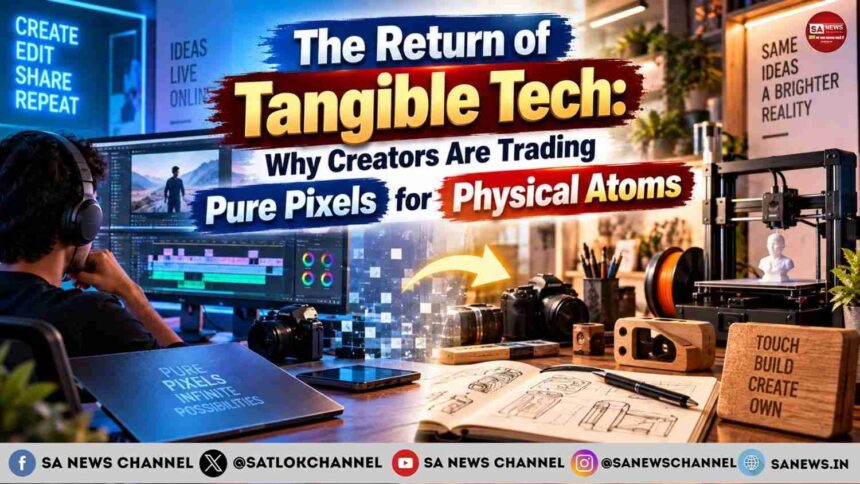
For over a decade, the tech world pushed a single vision of the future: sleek, minimalist rectangles of glass. Everything was supposed to live in the cloud, smooth out into touchscreens, and hide away behind frictionless software interfaces.
But a quiet counter-revolution has taken root on maker desks, in hacker spaces, and across developer communities.
Young creators, engineers, and digital artists are turning back to the physical world. They are wiring up custom microcontrollers, 3D printing bespoke enclosures, building custom mechanical keyboards, and hacking analog hardware to run alongside modern high-tech software.
The future of technology, it turns out, isn’t purely virtual—it has weight, texture, and clicky switches. Here is why tangible tech is making a massive comeback.
3D printing and physical computing bring digital code into real-world objects (Source: News at IU – Indiana University)
Escaping “Glass Screen Fatigue”
Touchscreens are incredible engineering feats, but they suffer from one fundamental flaw: they feel like nothing.
Swiping on a glass pane offers no tactile feedback, no physical muscle memory, and no satisfying click. When every tool from a music synthesizer to a game controller to a writing app looks and feels like the exact same smooth slab of glass, creative work can start to feel disembodied.
Building physical hardware breaks this monotony:
- Tactile Feedback: Physical knobs, mechanical switches, and custom rotary encoders give immediate, satisfying physical responses that screen buttons can never replicate.
- Dedicated Interfaces: Instead of opening another browser tab or software window, physical devices act as dedicated tools designed for a single, intentional task.
- Ownership: When you hold a device you soldered or 3D printed yourself, your relationship with the tool changes completely. It is no longer just a consumable product, it is a personal craft.
The Low-Fi Manufacturing Revolution
A generation ago, manufacturing physical hardware required specialized factories, massive minimum order quantities, and thousands of dollars in tooling costs. Today, the barriers to physical manufacturing have collapsed.
With a basic desktop setup, anyone can now turn a digital concept into a physical prototype in a single afternoon:
- Accessible 3D Printing: Desktop FDM and resin printers allow creators to rapidly iterate on physical enclosures, mechanical gears, and ergonomic grips without leaving their rooms.
- Cheap Microcontrollers: Powerful chips like the Raspberry Pi Pico and ESP32 cost less than a cup of coffee while offering built-in Wi-Fi, Bluetooth, and enough power to run complex logic.
- On-Demand PCB Fabrication: Ordering custom-designed circuit boards online is now as easy as uploading a design file and receiving a professional board in the mail days later.
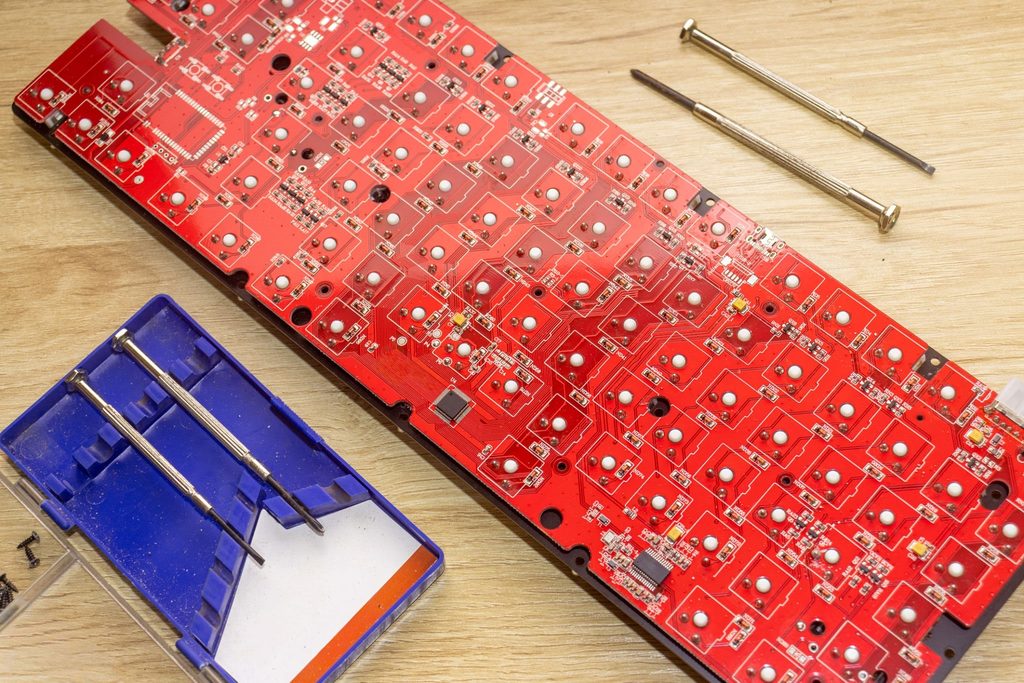
Hardware hacking allows creators to customize circuit boards, switches, and layout (Source: Andrei DJ Berja / Getty Images)
High-Tech Software Meets Low-Fi Hardware
The return of tangible tech isn’t an anti-technology movement, it is a hybrid movement. Creators aren’t discarding modern software; they are giving high-level code a physical body.
Some of the most exciting developments happen right at this intersection:
- Custom Input Controllers: Game developers and artists are building bespoke controllers tailored precisely to their games or creative workflows using game engines paired with physical USB hid-devices.
- Ambient Physical Displays: Instead of checking phone notifications, creators build low-power e-ink dashboards or LED matrices that subtly show build statuses, local weather, or server health.
- Retro-Futuristic Gadgets: Hacking vintage cameras, radio casings, or retro handheld consoles to house modern microprocessors and open-source software stacks.
Hardware as Personal Expression and Identity
In a world dominated by mass-produced consumer electronics, custom hardware has become the ultimate form of personal identity.
Building a custom macropad, modifying an analog audio setup, or prototyping a wearable gadget isn’t just about utility, it’s a creative outlet. The imperfections of a 3D print layer line, the warmth of an analog dial, or the glow of an exposed circuit board tell a story that mass-produced plastic simply cannot match.
Community hackathons, hardware side-quests, and open-source design sharing have turned hardware tinkering into a vibrant social culture where showing off your wiring harness is just as cool as showing off your code repository.
The Road Ahead: The Atom is back
We spent the last twenty years moving everything from the physical world into the digital realm. Now, the pendulum is swinging back toward balance.
As low-cost digital fabrication tools get smarter and software tools become more integrated with hardware design, the distinction between a “software developer” and a “hardware maker” is fading. The next big wave of personal computing won’t just live in the cloud, it will be designed, printed, soldered, and held right in our hands.
Retracing the Roots
Despite the staggering technological advancements in the past years, we find ourselves retracing back to the questions circling around the creation of this universe and the purpose of this life yet found nothing convincing.
क्या सृष्टि की रचना के पीछे है कोई दिव्य शक्ति? Srishti Rachna Fully Explained |Creation Of Universe
This is where Sant Rampal Ji Maharaj steps in! He’s the only TatvaDarshi Sant on this planet who’s giving out the right way of worship as foretold in our holy scriptures by showing evidence right from those very books!
FAQs
What is tangible tech?
Tangible tech refers to physical, tactile hardware—such as custom microcontrollers, 3D-printed enclosures, and mechanical switches—designed to interface directly with modern digital software.
Why are creators choosing physical controls over touchscreens?
Physical hardware provides tactile feedback, dedicated controls, and muscle memory that smooth glass touchscreens cannot replicate, reducing screen fatigue and improving focus.
What tools make hardware prototyping accessible today?
Low-cost desktop 3D printers, affordable microcontrollers (like the ESP32 and Raspberry Pi Pico), and on-demand custom PCB fabrication have lowered the cost and complexity of building physical devices.
Does tangible tech replace software development?
No. Tangible tech complements software by giving code a physical presence, resulting in hybrid systems like custom game controllers, ambient e-ink displays, and retrofitted analog devices.
How can beginners get started with hardware hacking?
Beginners can start with an entry-level microcontroller starter kit (like Arduino or Raspberry Pi Pico), learn basic breadboard wiring, and utilize open-source designs and tutorials from maker communities.