


India’s GDP grew 7.8% in the April-June 2026 quarter which was very impressive. But what exactly grew by 7.8%? Did every Indian become 7.8% richer? Did salaries rise by 7.8%? Did India simply make 7.8% more money? Not quite the case here. We hear GDP everywhere – from news headlines and government announcements to discussions about whether an economy is booming or slowing down. But behind those three intimidating letters is an idea simple enough for a five-year-old to understand. Forget the economic jargon for a few minutes. Let us shrink an economy of more than a billion people into one tiny imaginary village and discover what GDP is actually all about.
- GDP Explained: Key Highlights
- What Is GDP? Let’s Build a Tiny Village
- Why Can’t We Simply Add Up Everything That Gets Sold?
- Does Everything We Do Count Towards GDP?
- India Grew 7.8%, But Did Indians Become 7.8% Richer?
- Real GDP vs Nominal GDP: Did We Produce More, or Did Prices Just Rise?
- What Powered India’s 7.8% GDP Growth?
- Does 7.8% GDP Growth Mean Every Indian Became 7.8% Richer?
- What Is GDP Per Capita? Let’s Divide Our Village
- Can GDP Rise While People Are Still Struggling?
- Why Did India Change the Way It Measures GDP?
- Is Higher GDP Growth Always Good?
- Why Does GDP Matter So Much Then?
- India’s GDP Grew 7.8%: Now You Know What That Actually Means
- What Does Growth Mean If Someone Still Sleeps Hungry?
- Annapurna Muhim: When Economic Growth Must Become Human Progress
- FAQs: What is GDP?
GDP Explained: Key Highlights
- India’s real GDP grew 7.8% in April-June 2026, beating the RBI’s 7.0% estimate and the 7.1% forecast of economists surveyed by Reuters. But what exactly grew by 7.8%?
- India produced an estimated INR 81.36 lakh crore worth of real economic output during the quarter, up from INR 75.46 lakh crore in the same period a year earlier.
- Does that mean every Indian became 7.8% richer?
- Nominal GDP grew 10.3%, while real GDP grew 7.8%.
- Why are there two GDP growth numbers for the same economy? The answer brings inflation straight back into the picture.
- Investment surged 11.9%, household consumption grew 7.1% and exports rose 12.0%. These numbers help reveal what was actually powering India’s strong GDP performance.
- Manufacturing expanded 9.2%, while financial, real-estate, IT and professional services grew 12.1%. GDP isn’t one giant number appearing from nowhere, it is built from activity taking place across different parts of the economy.
- India’s investment share climbed to 34.3% of GDP from 31.4% a year earlier.
- A bigger GDP can signal expanding economic activity, but it still cannot tell us how equally the benefits of that growth reach individual Indians.
- India now measures GDP using an updated series with 2022-23 as its base year. The new framework also uses more detailed price data and over 300 price deflators, compared with roughly 180 previously.
- GDP measures economic output, not whether prosperity is evenly distributed, whether every family can afford its needs or whether anyone is going to bed hungry.
What Is GDP? Let’s Build a Tiny Village
Leaving aside the usual economics class to understand heavy weight terms like the GDP. We will keep all analogies extremely simple and clear for us to understand this daunting concept.
We will now consider a tiny village called Little India. It has a farmer who grows vegetables, a baker who makes bread, a tailor who stitches clothes, a barber who cuts hair and a small factory that makes toys. Every day, something is being produced or a service is being provided.
Now imagine if someone asks, ‘How much did our entire village produce this year?’ One way to find out would be to calculate the value of all the final goods and services produced in Little India during that year. Scale our little village up to an entire country and you have the basic idea behind GDP – or Gross Domestic Product.
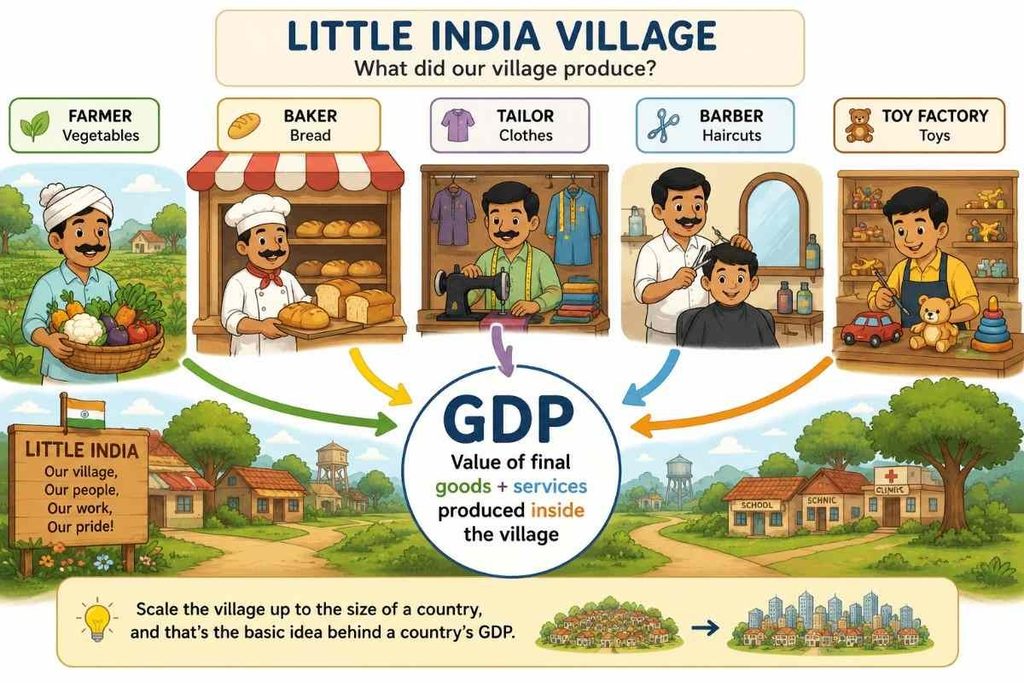
In simple words, GDP measures the monetary value of final goods and services produced within a country during a particular period.
Even the scary-looking name becomes easy when we break it apart:
- Gross: Consider it as the total amount being measured.
- Domestic: It must be produced within the country’s borders.
- Product: It includes the goods and services the economy produces.
So GDP is not simply asking how much money does India have, it is asking something closer to how much economic production took place inside India during this period.
That is why everything from cars, clothes and vegetables to haircuts, medical services and hotel stays can contribute to GDP.
But there is a catch. We simply cannot add the value of every single thing that gets sold along the way. This provision is made to help us avoid even accidentally count the same production more than once.
Why Can’t We Simply Add Up Everything That Gets Sold?
Let us now visit the baker in Little India. Before he can make bread, he needs wheat. A farmer sells wheat that eventually reaches the baker. The baker uses it to make bread and the finished bread is then sold to a customer.
Now if we counted the wheat and then counted the entire value of the bread without making the necessary adjustment, part of the value represented by that wheat would effectively appear again inside the price of the bread.
Apply this across millions of supply chains involving raw materials, factories, wholesalers and finished products and our measurement could become seriously distorted. That is why GDP calculations are designed to avoid repeatedly counting the same economic value as a product moves through different stages of production.
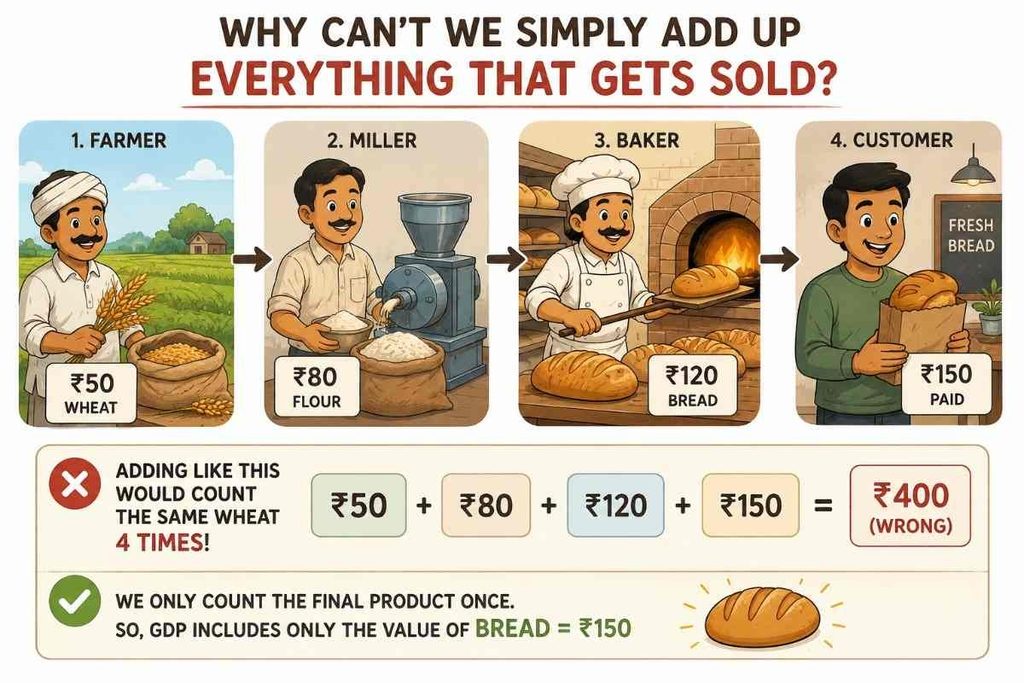
For our five-year-old, the rule is much easier – Do not count the same thing twice just because it changed hands or became part of something else.
Think of making a cake. You would not say you made flour, butter, sugar and a cake as four completely separate finished products if all those ingredients went into making that one cake.
The cake is the final product. This is why the word ‘final’ in the definition of GDP matters far more than it first appears.
Does Everything We Do Count Towards GDP?
This can be a little tricky. Suppose you are hungry and you cook dinner for yourself at home. You would certainly have produced something useful, but your home-cooked meal is generally not recorded as a market transaction in GDP.
On the other hand, if you walk into a restaurant and pay someone to prepare dinner for you. That service enters measured economic activity.
Or suppose you clean your own house. No payment changes hands. But if you hire a professional cleaner to perform the same task and a market service has been created that can be captured in GDP. Does that mean the cleaner’s work is valuable but yours is not? No. It simply reveals something important about GDP:
GDP was never designed to measure the value of everything humans do. It measures economic production according to specific accounting rules.
This is our first clue that a country’s GDP, however enormous, can never tell us everything about the lives of the people living there.
Also Read: Recession क्यों आती है? जानिए आर्थिक मंदी के मुख्य कारण और इसका असर
India Grew 7.8%, But Did Indians Become 7.8% Richer?
Let us now leave Little India for a moment and return to the real one. Between April and June 2026, India’s real economic output was 7.8% higher than in the same three months a year earlier. Now that we understand GDP, that headline should already mean something very different.
- It does not mean every Indian became 7.8% richer.
- It does not mean everyone’s salary increased by 7.8%.
- It certainly does not mean India simply created 7.8% more money.
- Instead, it tells us that, after adjusting for changes in prices, India’s measured economic output was 7.8% higher than in the corresponding quarter a year earlier.
- India’s real GDP for the quarter was estimated at around INR 81.36 lakh crore, compared with approximately INR 75.46 lakh crore during the same quarter a year earlier.
- There is also another reason the number attracted attention. The RBI had projected growth of around 7%, while economists surveyed by Reuters had expected about 7.1%.
- But India came in at 7.8%. So definitely the latest GDP number for India is impressive.
But now comes another important question – How can we tell whether the economy actually produced more or whether everything simply became more expensive? And this is where GDP meets something we hear again and again – Inflation.
If you find understanding inflation as daunting as GDP, read ‘Inflation Explained Like You’re 5: Is Your Money Shrinking?’ to understand it like a breeze.
Real GDP vs Nominal GDP: Did We Produce More, or Did Prices Just Rise?
Now we need to go back to the bakery in Little India to understand this concept. Suppose the baker made 100 cakes last year, selling each for INR 100. The total value of those cakes was INR 10,000.
This year, he again makes exactly 100 cakes. Nothing about the quantity has changed. But each cake now costs INR 110. The total value is suddenly INR 11,000.
On paper, it looks as though the bakery’s output has become more valuable. But did the baker actually produce more cakes? The number of cakes stayed exactly the same. Only their price changed.
This is why economists distinguish between nominal GDP and real GDP. Nominal GDP tells us what the economy’s output is worth based on the prices people are paying at that time. Whereas, real GDP adjusts for changes in prices, helping us see whether the economy is actually producing more goods and services rather than simply charging more for them.
And India’s latest numbers demonstrate this difference perfectly because in April-June 2026, India’s nominal GDP grew 10.3%, while real GDP grew 7.8%.
An easy way to remember would to remember the following questions:
- Nominal GDP – What is everything worth at today’s prices?
- Real GDP – How much has actual economic output changed after accounting for price changes?
What Powered India’s 7.8% GDP Growth?
An economy does not grow because one giant GDP machine somewhere starts running faster. Remember the Little India example to understand this.
Its economy would expand if its factory produced more goods, its shops and restaurants served more customers, families purchased more things, businesses invested in new equipment, construction increased and service providers became busier.
India works on the same basic principle, but just on an enormous scale. The April-June 2026 quarter saw strong activity across important parts of the economy. Manufacturing expanded strongly, services recorded robust growth, household consumption increased and investment remained an important contributor.
Think of it as lakhs or crores of pieces moving together in a way that:
- A factory produces more.
- A construction company builds more.
- A restaurant serves more meals.
- A technology company provides more services.
- A family purchases a new appliance.
- A business invests in machinery.
One transaction DOES NOT create India’s GDP growth. But when economic activity expands across a country of India’s scale, those millions of individual actions begin adding up to something much bigger.
GDP growth is essentially the economy telling us that together, we produced more than before.
Does 7.8% GDP Growth Mean Every Indian Became 7.8% Richer?
A country’s GDP growing by 7.8% does not mean every person’s income or wealth increased by 7.8%. We need to go back to Little India again to understand this better.
Imagine a scenario where Little India has only two people. Together, they produce goods and services worth INR 10 lakh.
Now suppose the village economy grows substantially the following year. That tells us the village produced more economic value overall. But it does not tell us who received the additional income created by that growth.
One person’s business might have expanded rapidly while the other person’s income barely changed. This distinction becomes enormously important when talking about an entire country. India’s GDP can grow strongly while different families, workers, industries and regions experience that growth very differently.
So when you hear statements such as ‘India’s economy grew 7.8%’, it does not automatically translate mean the citizens became richer by 7.8%. These are two very different statements.
GDP tells us about the size and growth of economic production. To begin asking what that economic output means relative to the number of people in the country, we need another measure – GDP per capita.
What Is GDP Per Capita? Let’s Divide Our Village
Now we go a step further by considering two villages instead of one. Village A produces goods and services worth INR 10 lakh and has 10 people. Village B also produces INR 10 lakh, but has 100 people.
Both villages have exactly the same GDP. Would you immediately assume their residents are equally well-off? This is where GDP per capita becomes useful.
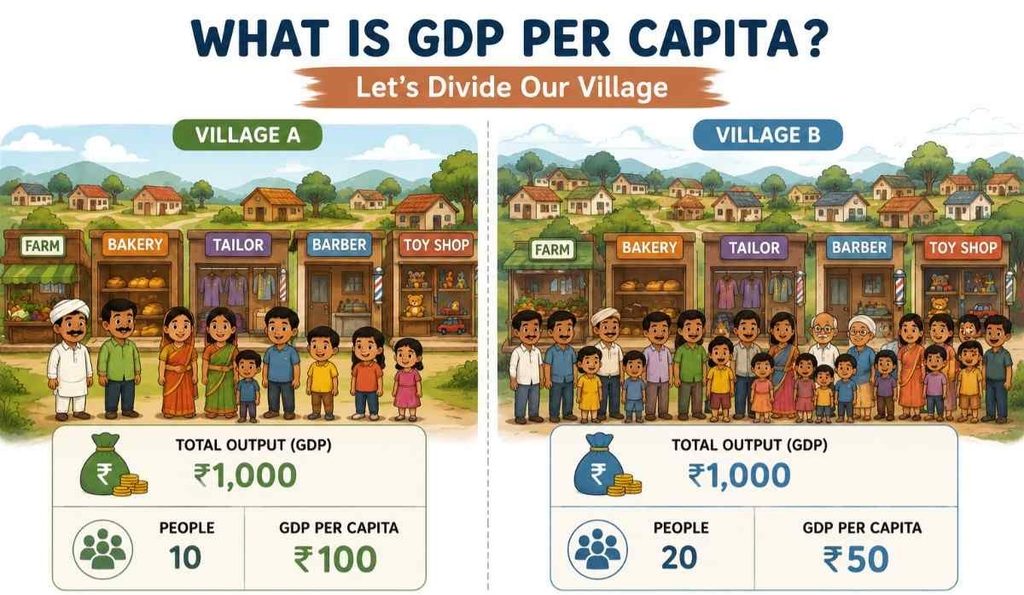
In very simple terms, GDP per capita takes a country’s GDP and divides it by its population.
So if our imaginary INR 10 lakh economy had 10 residents, the GDP per capita would work out to INR 1 lakh. But if the same INR 10 lakh economy had 100 residents, it would be only INR 10,000.
There is, however, one warning our five-year-old must remember that GDP per capita is an average. It does not mean every person actually earns that amount.
If five children have ten chocolates altogether. The average is two chocolates per child. But one child could be holding six chocolates while another has none. The average is also not a false figure. It simply does not tell you how the chocolates are distributed.
GDP per capita works in much the same way. It can help us compare economic output relative to population, but it cannot tell us how evenly income or prosperity is actually shared.
Can GDP Rise While People Are Still Struggling?
GDP can grow strongly even while some people continue to face unemployment, rising living costs, low incomes or financial hardship. That does not automatically make GDP useless. GDP was never designed to answer this question in the first place. Let us understand further.
Think about a school. Suppose you know that its students scored an average of 80 marks. That is useful information. But can that one number tell you whether every child performed well? No it cannot an neither does it tell us whether some failed, are the students happy, are they being bullied, are the classrooms safe, etc. It cannot reveal the condition inside the school.
The average score tells you something important, but not everything important. GDP works similarly. It can tell us about the amount of economic production taking place and whether that production is growing or shrinking.
But GDP alone cannot tell us whether income is distributed evenly, whether everyone can afford a home, whether every child receives a good education, whether people have access to healthcare, whether the environment is improving or whether people feel secure and satisfied with their lives.
That is why a record GDP number should neither be dismissed nor treated as the final verdict on how a country is doing. GDP is one vital sign of an economy and not its complete health report.
Also Read: UN Predicts India’s 6.4% GDP Growth in 2026: Can India Lead Asia’s Economy?
Why Did India Change the Way It Measures GDP?
Economies change, people buy different things, new industries emerge, technology transforms businesses and better sources of economic data become available. So the way we measure an economy occasionally needs an update too.
India has recently introduced a new GDP series with 2022-23 as its base year, replacing the earlier 2011-12 base. But what is a ‘base year’?
Suppose we take a photograph of the economy at a particular point in time and using it as a reference while comparing how production changes later. That is roughly the job of a base year. Updating it helps economic measurements better reflect the structure of today’s economy rather than relying indefinitely on an older economic picture.
The new series also incorporates updated data sources, price measures and methodological changes intended to improve how India’s economic activity is captured. If the economy changes over time, the tools used to measure it occasionally need updating too.
Is Higher GDP Growth Always Good?
Generally, a growing economy is a positive sign. It can mean businesses are producing more, consumers are spending, factories are expanding, investment is increasing and new economic opportunities are being created.
But does that mean the fastest possible GDP growth is always the best possible outcome? Not necessarily. To understand this better let us visit Little India again.
Suppose the village suddenly starts producing far more goods. Its factories are busy, shops are crowded and businesses are expanding rapidly. It definitely sounds wonderful.
But now what if prices are also racing upward, families are taking on unsustainable debt, pollution is worsening and most of the new prosperity is reaching only a small group of villagers. The village’s GDP could still look impressive. Yet clearly, GDP alone would not tell us the whole story.
What matters over the long term is not simply whether an economy grows, but also whether that growth is sustainable and capable of improving people’s lives.
For example, for a child, growing taller is usually a healthy sign. But no doctor would measure only the child’s height and declare that everything is perfect. They would look at several indicators before understanding the child’s overall health.
An economy also deserves the same treatment. GDP growth is an important vital sign, but it should never be mistaken for the economy’s complete health report.
Why Does GDP Matter So Much Then?
If GDP cannot tell us everything, why do governments, economists, investors and businesses pay so much attention to it? Because what GDP can tell us is extremely useful.
- It helps show whether an economy is expanding or shrinking, how quickly economic activity is changing and which broad parts of the economy are contributing to that movement.
- Governments can use economic data while shaping policies.
- Businesses can use the economic outlook when deciding whether to expand or invest.
- Central banks watch growth alongside inflation and other indicators when making monetary-policy decisions.
- When GDP falls significantly for an extended period, it can signal serious weakness in economic activity.
So the lesson is not that GDP doesn’t matter. It is that GDP matters enormously, but know what it is actually measuring. Once we understand that distinction, economic headlines become much easier to decode.
India’s GDP Grew 7.8%: Now You Know What That Actually Means
Recapitulating what we have learnt so far:
- GDP tells us how much an economy produces.
- Real GDP helps separate actual growth from rising prices.
- GDP per capita puts economic output in the context of population.
- Other indicators are needed to tell us how that prosperity reaches people’s everyday lives.
GDP tells us how much the economic pie has grown. It does not tell us how every slice has been shared.
What Does Growth Mean If Someone Still Sleeps Hungry?
India’s 7.8% GDP growth tells an encouraging story about the economy. More is being produced, businesses are expanding, investment is rising and overall the economic activity is moving forward.
But GDP cannot answer one extremely important question that deserves attention, irrespective of expanding economies – What does that growth mean to someone who does not have enough food for tonight?
A country can produce more wealth while some families still struggle for the most basic necessities. A rising GDP does not automatically put food on every plate, pay every child’s school fees, arrange treatment for every sick person or place a safe roof over every family.
Despite our constitution ensuring the ‘Right to Life’ article, the disparity within our economy is glaring. The constitution of a country may not be able to provide even the most basic necessities of life, but the constitution of Jagatguru Tatvdarshi Sant Rampal Ji Maharaj does.
Annapurna Muhim: When Economic Growth Must Become Human Progress
Sant Rampal Ji Maharaj has been quietly spearheading what could become one of the most remarkable humanitarian movements of our time. However, you may rarely hear about it in the news. Perhaps because feeding a hungry family, educating a child or rebuilding the home of someone who has nothing left is not considered glamorous enough to dominate headlines.
But to the people whose lives are being transformed, it means the world.
The one-of-a-kind Annapurna Muhim, led by Sant Rampal Ji Maharaj, is built around an extraordinary principle – if someone is genuinely helpless and in need, help should reach them, completely free of cost. And that help is not limited to a packet of food.
Families in need are being provided free ration, clothing, education, books and medical treatment. For those without a safe place to live, the assistance can go as far as building an entirely new home for them and that too without charging them a single rupee.
As word of Annapurna Muhim spreads largely from person to person, more needy families are coming forward themselves, sharing the difficulties they have been silently living with. When a genuine need is identified, Sant Rampal Ji Maharaj wastes no time in sanctioning the assistance required.
In an age when almost nothing comes without a price and when even an extraordinary act of generosity can make us instinctively wonder what the catch is, all of this may sound almost too good to be true. So don’t simply take our word for it. Watch the following video. Witness the work taking place on the ground and then decide for yourself:
Sant Rampal Ji Maharaj had already placed two of India’s most vulnerable groups at the heart of this mission – the helpless and the farmers. But Annapurna Muhim is continuing to expand its reach.
Under Phase 3 of Annapurna Muhim, small-scale farmers are being supported with essential agricultural inputs such as seeds, fertilisers, crop-protection products and other farming necessities. The purpose goes far beyond providing temporary relief. By taking these essential cultivation expenses off their shoulders, the initiative aims to substantially reduce their farming costs and help them move towards greater financial self-reliance.
You too can become a part of this extraordinary welfare movement. Not by donating money. Not by contributing funds. Simply by spreading the word. Somewhere, there may be a struggling family that has never heard of Annapurna Muhim. A farmer may still be unaware that such help exists. Someone may know a family desperately in need but have no idea where to direct them.
Your one message could become the bridge between that person and the help they desperately need.
To know more about Jagatguru Tatvdarshi Sant Rampal Ji Maharaj and the complete body of humanitarian and spiritual work being carried out under His guidance, visit:
Website: www.jagatgururampalji.org
YouTube: Sant Rampal Ji Maharaj, Annapurna Muhim
Facebook: Spiritual Leader Saint Rampal Ji
‘X’ handle: @SaintRampalJiM
FAQs: What is GDP?
- What is GDP in simple words?
Answer: GDP measures the monetary value of final goods and services produced within a country during a specific period.
- Does higher GDP mean everyone in the country becomes richer?
Answer: No. GDP can increase without income or the benefits of economic growth being distributed equally among people.
- What is the difference between real GDP and nominal GDP?
Answer: Nominal GDP measures output at current prices, while real GDP adjusts for price changes to better show changes in actual economic production.