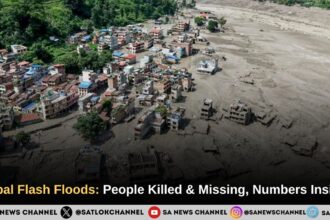


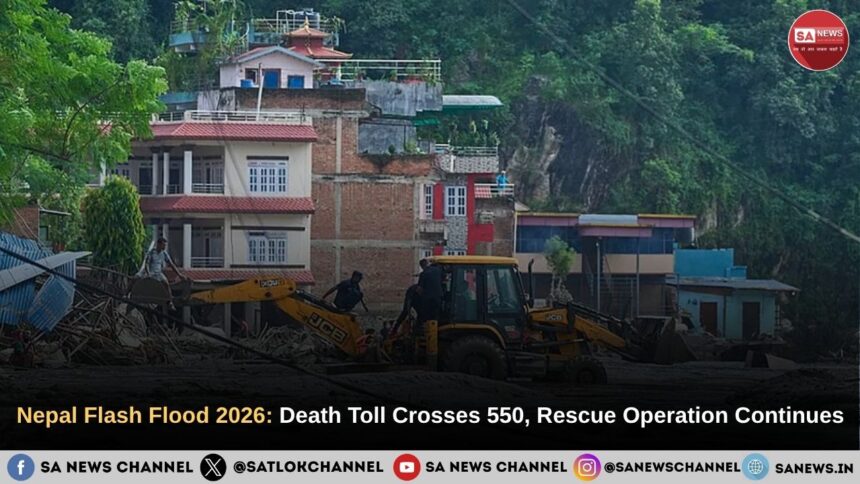
Nepal is in the throes of what may be the worst flood disaster to hit the country in years. A flash flood has left its mark on sections of the Himalayan region near the border with China, and with the death toll now over 550 and some 1,000 unaccounted for, rescue efforts are in full swing.
- Nepal Flash Flood 2026: Key Highlights
- How Did the Nepal Flash Flood Happen?
- Rasuwa District is among the worst affected area
- New threat from a new formed lake
- Thousands of People Rescued
- Foreign Visitors and Pilgrims Affected as Well
- Over 90,000 People Affected
- Why Himalayan Flood Risks Are Increasing
- Nepal Flash Flood 2026: A Lesson for the Himalayas
The catastrophe, which made landfall on August 26, 2026, was set off by a combination of glacial collapse and rockfall that sent a torrent of water and debris down from the mountains. Official figures put the number of fatalities in Nepal at 547; there have also been five deaths in Tibet, China.
Those numbers could change as rescue personnel make their way into the more isolated and hard-hit zones to confirm the situation with the nearly 1,000 who are missing. In the aftermath, authorities are contending with ruined roads and bridges, as well as serious damage to hydropower assets. Many homes have been lost and thousands displaced while relief work goes on.
Nepal Flash Flood 2026: Key Highlights
- Roads, Bridges and Hydropower Projects Destroyed in Rasuwa District
- Newly Formed Lake Raises Risk of Another Disaster
- 3,700 People Rescued, Over 3,000 Airlifted Amid Landslides
- Foreign Tourists and Pilgrims Among Those Affected, India Steps Up Assistance
- More Than 90,000 People Hit, Homes and Health Facilities Damaged
- Glaciers, GLOFs and Climate Change are the reasons
- Toll Crosses 550, Himalayan Disaster Raises Alarms Over Climate Risks
How Did the Nepal Flash Flood Happen?
Analysts do not see this as a typical monsoon event. It seems a sudden giving way of ice and rock let loose an enormous quantity of material into the river system. From there the surge made quick work of the narrow valleys of the Himalayas, the mixture of mud, ice and stone only adding to its power.
It is a stark reminder of how exposed the communities are that make their living along these rivers, with little time to react when such hydrological or geological upheavals occur.
Rasuwa District is among the worst affected area
Rasuwa district is one of the worst affected place in Nepal. It’s mostly affected area around the Bhote Koshi and Trishuli river system.
Many roads and bridges have been felled which has enforced connectivity among community and surrounding areas. Tragically, the damage also has affected transport and emergency access which has prevented teams from reaching people who are stranded in remote areas.
A number of the hydropower facilities were also severely damaged. Rescue teams were also forced to contend with thick layers of mud and debris while searching for people who may still be trapped inside damaged structures and tunnels.
New threat from a new formed lake
Even as rescuers turn their attention to the search for survivors, there’s a new potential risk that authorities have to keep in mind.
A newly formed barrier lake, is said to have built up after an ice-and-rock avalanche clogged the natural water flow in the mountainous terrain. This new lake is being closely monitored as there could be a sudden breach that could lead to the release of a huge volume of water downstream.
The threat of flooding has obviously complicated the rescue operations. Teams are trying to balance the need to search for missing people with the risk posed by unstable terrain and changing water levels.
The authorities are using satellite data and field assessment to monitor the situation and to assess whether there is an immediate threat of the new lake to the downstream communities.
Thousands of People Rescued
Teams from Nepal’s Army, police and other emergency agencies have been carrying out rescue operation in different parts of the affected area.
Helicopters were leveraged, as many roads and bridges were damaged. Thousands of stranded people who were isolated helped to be transferred to safer places.
In recent reports, nearly 3,700 people have been rescued from affected areas, including more than 3,000 people who were airlifted from remote areas that were hard to reach by road.
Rescue teams are also sweeping through mud and debris from damaged hydropower plants and residential areas.
The rescue operation is still difficult due to unstable mountain slopes, damaged infrastructure, the weather situation and risk of additional landslides and flooding.
Foreign Visitors and Pilgrims Affected as Well
The disaster also has caused concern outside the nation, as a large number of foreign tourists and pilgrims were traveling through the Himalayan region when the disaster hit.
Citizens from India, the United States, Australia, Britain and Canada, as well as other nations have also been reported to be among those missing or affected in the disaster.
Indian authorities are also attending to Indian citizens who were traveling in the disaster-affected area.
The disruption of roads and communications have added to the difficulty for families who are still waiting for information about their relatives traveling through the region.
Over 90,000 People Affected
The impact of the flash flood in Nepal is much broader than the reported death toll.Humanitarian agencies say more than 90,000 people have been severely affected by the disaster. Many people are at risk of losing their homes, livelihoods and access to basic services.
The damage to healthcare facilities has added to the challenge, with reports indicating damage to several health facilities. The displaced residents need urgent assistance with food, drinking water, temporary shelter, sanitation facilities and medical assistance.
Why Himalayan Flood Risks Are Increasing
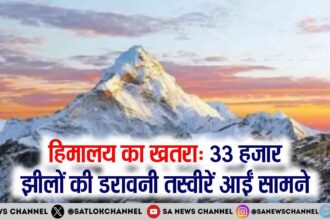
The disaster again has focused global attention on the increasing risks of climate change and rapid environmental change in the Himalayas. The region is home to thousands of glaciers and glacial lakes. With increasing temperatures, glaciers can retreat and the high-altitude region can become increasingly unstable.
A main risk is a Glacial Lake Outburst Flood, or GLOF. A GLOF is defined as the catastrophic release of a large volume of water from a glacial lake due to the breaking of a natural barrier that holds it back. The floodwater can carry incredibly huge mass of rocks, mud, trees and debris and can, therefore, be extremely destructive.
This is why experts have been demanding increased monitoring of glaciers, better early-warning systems and improved disaster preparedness in the Himalayan region.
Nepal Flash Flood 2026: A Lesson for the Himalayas
The Easterner Drone Nepal Flash Flood 2026 has shown how rapidly a natural hazard event in the high Himalayas can evolve into a large-scale humanitarian disaster. With the death toll already over 550 across Nepal and Tibet and hundreds of persons still missing, the full scale of the tragedy is still unknown.
The immediate priority for Nepal is to search for survivors, find the missing and protect communities from more flooding but the disaster has also opened up a bigger question about how Himalayan countries can prepare for an increasing level of risk of glaciers, extreme rainfall, landslides and flash floods.
Improved early-warning systems, regular monitoring of glaciers and glacial lakes, stronger infrastructures and quicker communication in the event of an emergency could all reduce casualties when the next disaster occurs.
For now, various teams are working through mud, debris and damaged mountain terrain while families in Nepal and other countries await updates on relatives.