

Remember when only countries could send rockets to space? Those days are changing, and India is leading this revolution. In November 2022, something incredible happened that many people didn’t talk about enough – India’s first private space company successfully launched a rocket. Let me tell you why this matters and why it’s exciting.
- What exactly is Vikram-1?
- The Dream Makers: Skyroot Aerospace
- Why is This a Big Deal for India?
- Understanding the Vikram-1 Rocket
- The Historic Launch
- How This Changes India’s Space Story
- The Global Context
- What’s Next?
- Why You Should Care
- The Bigger Picture
- Takeaway
- Sant Rampal Ji Maharaj’s teachings on Technology and Development
What exactly is Vikram-1?
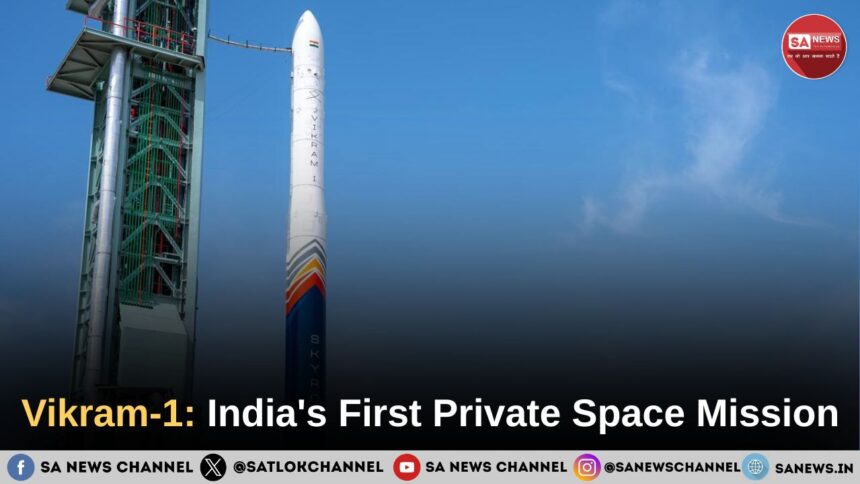
Vikram-1 is India’s first privately developed satellite launch vehicle. In simple words, it’s a rocket that was built by an Indian private space company. The rocket was created to carry satellites into space – satellites that help with communication, weather monitoring, Earth observation, and much more.
Think of it like this: Imagine you needed to deliver packages to the airport, and for years, only the national transport company could do it. But now, private delivery companies are doing it too, sometimes better and cheaper. That’s what Vikram-1 is. A private option for launching things into space.
On 18 November 2022, Vikram-S completed India’s first private suborbital rocket launch.The maiden mission carried multiple customer payloads and technology demonstrations, including Skyroot’s SCOPE satellite, DCUBED’s payload, Grahaa Space’s satellite, and Cosmoserve Space’s robotic-arm experiment. This might sound simple, but it’s a monumental achievement for India’s space industry.
The Dream Makers: Skyroot Aerospace
Behind Vikram-1 stands a brilliant team from a startup called Skyroot Aerospace. This company was founded by young Indian engineers who dreamed of making space accessible. Founder Pawan Kumar Chandana and his team believed that space technology shouldn’t be limited to government organizations.
The Skyroot team represents the new India – young, ambitious, and determined to solve problems innovatively. They proved that private companies can compete in a field that was once exclusively a government domain.
Why is This a Big Deal for India?
For decades, India has had a strong space program through ISRO (Indian Space Research Organisation). ISRO has done incredible work and put India on the global space map. But ISRO is a government organization. With Vikram-1’s success, we’re seeing something different:
- Opening Economic Opportunities:
Space technology can create jobs. Lots of them. Private companies will need engineers, technicians, support staff, and business professionals. This means more employment and economic growth in the tech sector.
- Competition Drives Innovation:
When private companies enter a field, they bring fresh ideas and competitive energy. They often find smarter, cheaper ways to do things. This competition pushes everyone, including government organizations, to improve.
- Global Market Access:
Many countries and companies need affordable satellite launch services. Skyroot and other private Indian companies can tap into this global market, earning revenue and reputation for India on the world stage.
- Self-Reliance:
India has always valued self-reliance (Atmanirbharta). Developing homegrown space technology companies strengthens this vision and reduces dependence on other nations.
Understanding the Vikram-1 Rocket
Let’s break down what makes Vikram-1 special from a technical standpoint, without getting too complicated.
- A Four-Stage Rocket:
Vikram-1 is a four-stage, expendable orbital small-lift launch vehicle developed by Skyroot Aerospace. Its first three stages are solid stages, while the fourth stage is a liquid stage, powered by hypergolic propellant. Once each stage does its job, it falls away. This design is efficient and proven.
- Solid Fuel Technology:
Vikram-1 uses solid fuel for its engines. This is a well-established technology that’s reliable and cost-effective.
- Carrying Capacity:
Vikram-1 can carry up to 350 kg to Low Earth Orbit (LEO). While it might not be as powerful as some global rockets, it’s perfectly suited for many commercial needs and is more affordable.
- Made in India:
Perhaps the most important part – the rocket, its engines, and systems are designed and manufactured in India. This highlights India’s growing technical capabilities.
The Historic Launch
On 18 July 2026, Skyroot Aerospace successfully launched Vikram-1 from Sriharikota during Mission Aagaman, making it India’s first privately developed orbital launch vehicle. It was a moment of national pride. For the first time, India proved that private companies could independently design, build, and launch orbital rockets. The successful deployment of three satellites into orbit showed that Indian private companies could meet global standards.
How This Changes India’s Space Story
- Before Vikram-1:
Space launches were India’s exclusive club. ISRO handled everything. While ISRO is excellent, it’s a government organization with limited resources and many responsibilities.
- After Vikram-1:
Now, private companies like Skyroot can also launch satellites. This creates an ecosystem. More competition. More options. More innovation.
- Future Plans:
Skyroot has bigger ambitions. They’re already developing more powerful rockets. Other private companies are entering the space. India could become a major hub for satellite launches, similar to how SpaceX operates in the United States.
The Global Context
The global space industry is worth hundreds of billions of dollars. Satellites launched every year handle everything from communication to banking, weather forecasting to disaster management. India getting its own private launch provider means we can capture a piece of this market and be self-reliant.
What’s Next?
Skyroot isn’t stopping here. They’re developing Vikram-2, a more powerful rocket. Other Indian companies are also jumping into the space business. Over the next few years, expect to see more launches, more satellites, and more Indian presence in space commerce.
Why You Should Care
- Better satellites: More competition means better satellite technology and services
- New jobs: Space industry growth creates high-paying technical jobs
- National pride: An Indian company achieving something globally significant
- Economic growth: The space business brings money and growth to the country
The Bigger Picture
Vikram-1 represents something deeper than just a rocket launch. It shows that Indian entrepreneurs and engineers can innovate and execute at world-class levels. It proves that with determination, skill, and the right support, we can compete globally. The space industry was always seen as too complex, too risky, too expensive for private companies in India. Skyroot Aerospace proved everyone wrong. They took something that seemed impossible and made it real.
This is the story of modern India – young people with big dreams, taking risks, and changing what’s possible.
Takeaway
Vikram-1 isn’t just a rocket; it’s a symbol of India’s growing technical capability and entrepreneurial spirit. It opened doors that were previously closed. Every time Skyroot launches another rocket, as future launches follow, they’re not just launching satellites – they’re launching India into a new era of space exploration and commerce.
The space age used to feel far away, distant, something happening in developed countries. Now, it’s happening here, made by Indians, for India and the world.
Sant Rampal Ji Maharaj’s teachings on Technology and Development
Sant Rampal Ji Maharaj views modern technology not as a separate human invention, but as a divine tool orchestrated by the Supreme God (Kabir) to spread true spiritual knowledge worldwide during this era. His movement heavily embraces electronic media, the internet, and modern machinery for outreach and administration.
Sant Rampal Ji Maharaj teaches that advancements like televisions, projectors, the internet, and vehicles are provided by God so people can examine holy scriptures from home. Modern communication tools break past geographical and institutional barriers, allowing masses to hear spiritual discourses without getting misled by false intermediaries
FAQs
1. What is Vikram-1?
Vikram-1 is India’s first privately developed orbital satellite launch vehicle, built by Skyroot Aerospace. It successfully launched from Sriharikota on 18 July 2026, marking a major milestone for India’s private space industry.
2. How is Vikram-1 different from Vikram-S?
Vikram-S, launched in 2022, was India’s first private suborbital rocket used for technology demonstration. Vikram-1 is the first private Indian rocket designed to place satellites into orbit, representing a significant advancement in launch capability.
3. Why is Vikram-1 important for India’s space industry?
Vikram-1 opens new opportunities for private companies in satellite launches, encourages innovation, creates high-skilled jobs, and helps India compete in the growing global space economy alongside ISRO.
4. How much payload can Vikram-1 carry?
Vikram-1 can carry up to 350 kg of payload to Low Earth Orbit (LEO), making it suitable for launching small satellites for commercial and research purposes.
5. Who founded Skyroot Aerospace?
Skyroot Aerospace was co-founded by Pawan Kumar Chandana and Naga Bharath Daka, former ISRO engineers who aimed to make satellite launches more accessible and affordable through private innovation.