



Buried deep inside a quiet cave, a tiny fragment of charred wood from a forgotten campfire looks like a mere speck of dark soot. Yet scientists can state with absolute certainty that the tree fell in 742 BCE. How is that possible? The secret lies in a celestial fingerprint embedded right inside the object. An internal atomic hourglass counts down the centuries inside all formerly living matter until we learn to read it.
- Why Is It Called Carbon Dating?
- Why Carbon Dating Changed Science Forever?
- The Chained Discovery Sequence: From Rays to Atoms
- Discovery 1: Radioactivity (1896)
- Discovery 2: Radioactive Decay (1902-1903)
- Discovery 3: Discovery of Isotopes (1913)
- Discovery 4: Half-Life Principle (Early 20th Century)
- Discovery 5: Discovery of Cosmic Rays (1912 onward)
- Discovery 6: Discovery of the Neutron (1932)
- Discovery 7: Discovery of Carbon-14 (1940)
- Discovery 8: The Carbon Dating Method (1946-1949)
- The Reasoning Chain
- Laboratory Development & Egyptian Artifact Validation
- Why It Was Invented (The Necessity)
- Step-by-Step: How Radiocarbon Dating Works in Nature
- Phase I: Atmospheric Generation
- Phase II: Biological Absorption
- Phase III: Decay & Chronological Dating
- The Dinosaur Myth Debunked
- Dating the Past, Unlocking the Eternal: Where Science Ends and Creation Begins
- FAQ
Scientists have a name for the method that reveals how old an organic object is: carbon dating, or more formally, radiocarbon dating. It works because of a single radioactive isotope, radiocarbon, and the way it behaves inside living things. Throughout its life, every organism absorbs carbon. That intake stops the moment the organism dies. From that point forward, the unstable carbon isotopes trapped inside begin decaying at a rate that never changes. Scientists measure how much of that decaying carbon remains, and from that measurement, they calculate exactly how long ago the organism died.
Why Is It Called Carbon Dating?
Carbon dating combines carbon (the element measured through carbon-14) and dating (determining age). It is a method used to estimate the age of once-living materials by measuring their remaining carbon-14.
Other Names of Carbon Dating
Depending on whether you encounter it in casual conversation or formal research papers, this technique goes by four distinct names.
- Carbon Dating
- Radiocarbon Dating
- Carbon-14 Dating (or ¹⁴C Dating)
- Radiocarbon Chronometry
Why Carbon Dating Changed Science Forever?
For centuries, scientists and archaeologists searched for a reliable way to date ancient objects made from once-living materials. Carbon dating provided that method, transforming archaeology and deepening our understanding of human history.
Problems Before Carbon Dating
Prior to radiocarbon analysis, historical records, inscriptions, stylistic comparisons, and soil layer sequences formed the foundation of most chronological estimates. These techniques only revealed relative placement rather than exact numerical ages. As a result, researching prehistoric societies without written records posed significant obstacles. Five primary hurdles routinely obstructed historical analysis:
- Undated Organic Material: Direct calendar ages could not be reliably assigned to organic remains such as wood, charcoal, bones or textiles.
- Sequential Uncertainty: Relative dating allowed objects to be arranged in chronological order. Yet the specific number of years separating those items remained entirely unknown.
- Textual Silence: Reconstructing historical timelines proved difficult for the majority of ancient cultures that left behind no written records.
- Geographic Incompatibility: Regional variation rendered dating methods effective in one territory largely inapplicable to another, impeding comparisons across distinct civilizations.
- Unresolved Timelines: Arguments regarding the rise, fall, and co-existence of ancient societies frequently stalled due to a lack of exact chronological data.
The urgent necessity for an accurate method to establish the age of former living matter ultimately drove the invention of radiocarbon dating.
The Scientific Revolution It Created
Carbon dating transformed chronology from interpretation to scientific measurement, allowing researchers to build more accurate timelines of archaeology and human history.
The Chained Discovery Sequence: From Rays to Atoms
Carbon dating was not one discovery. It was the result of eight, spread across more than fifty years. Each one answered a question the last one raised. Together, they gave Willard Libby everything he needed to build a working method in 1949.
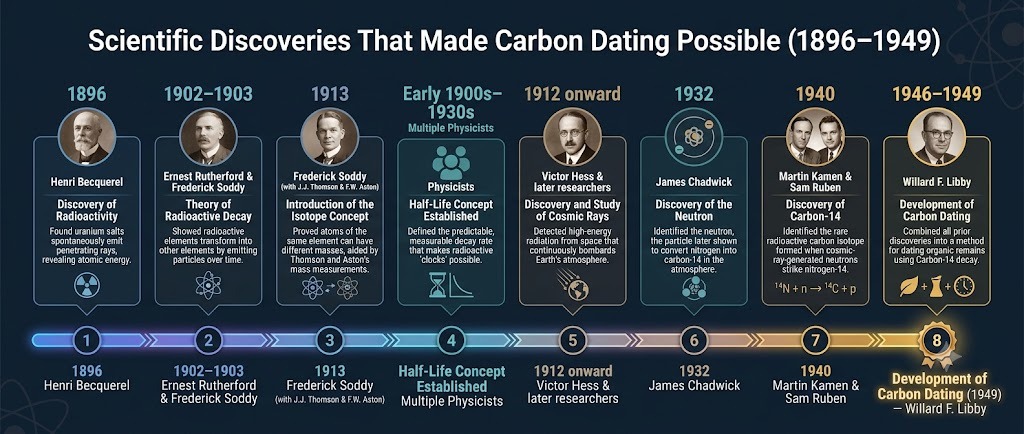
Discovery 1: Radioactivity (1896)
Henri Becquerel found that uranium salts gave off rays with no outside energy source. This was the first proof that atoms are not always stable; some break down on their own.
Discovery 2: Radioactive Decay (1902-1903)
Ernest Rutherford & Frederick Soddy showed that radioactive elements transform into other elements, and that they do it at a fixed, predictable rate. This turned radioactive atoms into natural clocks.
Discovery 3: Discovery of Isotopes (1913)
Frederick Soddy found that atoms of the same element can have different masses. These are called isotopes. This is why carbon has both a stable form and a radioactive form.
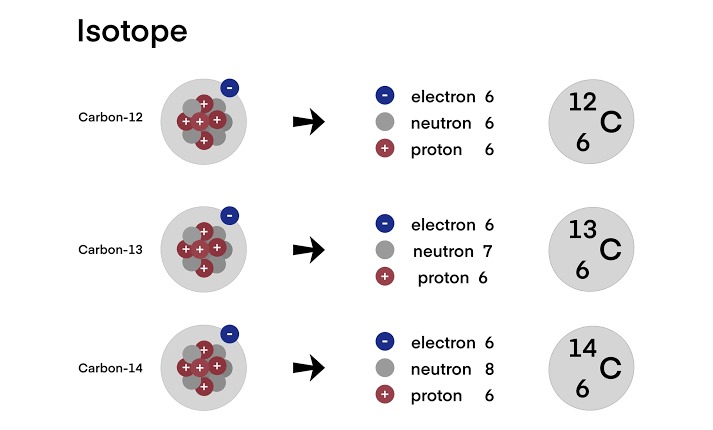
Discovery 4: Half-Life Principle (Early 20th Century)
Scientists worked out the half-life: the fixed time it takes for exactly half of a radioactive substance to decay. For carbon-14, that is about 5,730 years. This became the math behind
N₀ = starting amount • Nₜ = amount left after time t • t₁/₂ = half-life
The same fraction always decays in the same amount of time.
Discovery 5: Discovery of Cosmic Rays (1912 onward)
Victor Hess discovered cosmic rays that are high-energy particles from space that constantly strike Earth’s atmosphere.
Discovery 6: Discovery of the Neutron (1932)
James Chadwick discovered the neutron, a particle inside the atomic nucleus with no electric charge. This was the missing piece, the neutron that would later be shown to convert nitrogen into carbon-14 high in the atmosphere.
Discovery 7: Discovery of Carbon-14 (1940)
Martin Kamen & Sam Ruben discovered carbon-14. Scientists later worked out how it forms: cosmic rays create neutrons high in the atmosphere, and those neutrons collide with nitrogen atoms, converting them into carbon-14.
¹⁴N + n → ¹⁴C + p
nitrogen-14 + neutron → carbon-14 + proton
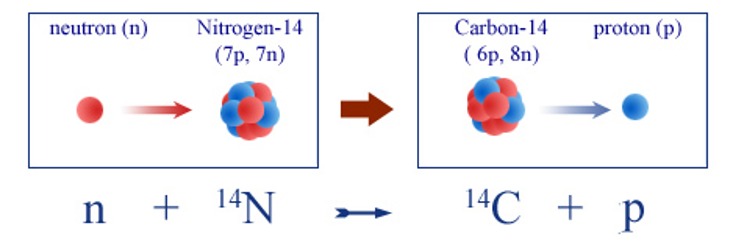
source:radioactivity.eu.com
A cosmic ray creates a neutron, the neutron turns nitrogen into carbon-14.
Discovery 8: The Carbon Dating Method (1946-1949)
Willard F. Libby combined all seven discoveries into one method. Every living thing keeps a steady level of carbon-14 while it is alive. Once it dies, that intake stops, and the carbon-14 inside begins to decay on the fixed schedule set by its half-life. Measuring what is left reveals how long ago it died.
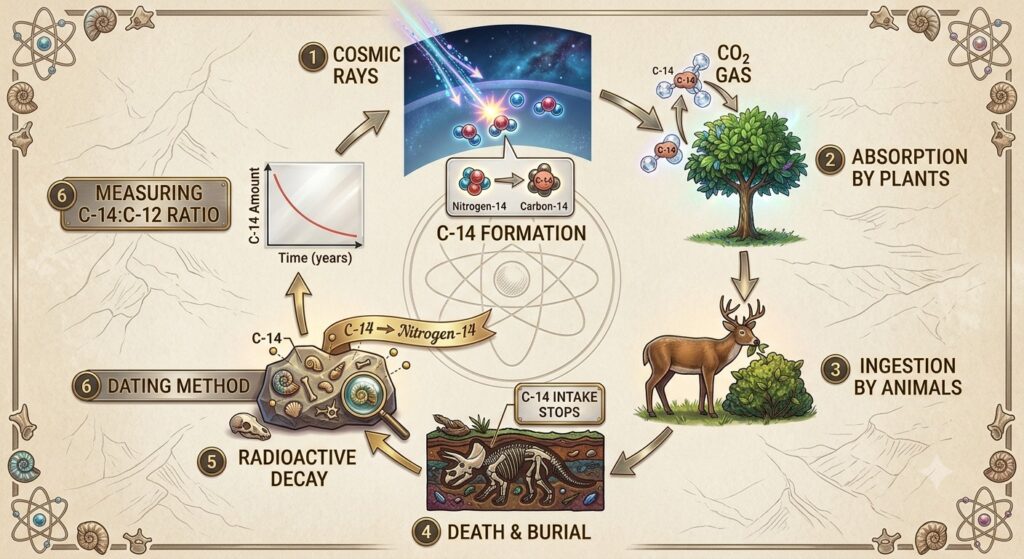
Seven discoveries, five decades, one method measuring the quiet decay of a single atom to read the age of the past.
The Reasoning Chain
You can understand the development of carbon dating like a chain that works in the following way:
- Step 1: Origin. Cosmic rays strike the upper atmosphere without pause.
- Step 2: Formation. This constant bombardment continuously generates Carbon-14 (¹⁴C).
- Step 3: Conversion. Rapid oxidation quickly turns that ¹⁴C into radioactive carbon dioxide (¹⁴CO₂).
- Step 4: Absorption. Plants take in this ¹⁴CO₂ during photosynthesis.
- Step 5: Transfer. Animals eat those plants, passing the ¹⁴C further along the chain.
- Step 6: Equilibrium. Across every living organism, the atmospheric proportion of ¹⁴C locks into balance.
- Step 7: Death. The moment an organism dies, carbon intake stops entirely.
- Step 8: Decay. The ¹⁴C already inside begins decaying back into nitrogen, with nothing left to replace it.
- Step 9: Measurement. What remains after death is measurable.
- Step 10: Conclusion. Measuring that remainder makes it possible to calculate exactly how much time has passed since the organism died.
Laboratory Development & Egyptian Artifact Validation
Between 1947 and 1949, Libby and his team (notably James Arnold and Ernest Anderson) faced an engineering challenge: natural radiocarbon emissions are extremely faint and easily masked by background radiation. They developed:
- Heavy lead and iron shielding to block terrestrial radiation.
- Anticoincidence counters (Geiger counters arranged around the sample) to filter out background cosmic rays.
- Methods to reduce biological samples to pure elemental carbon (lampblack) to coat the inside of measurement cylinders.
To prove the method worked, Libby constructed the “Curve of Knowns.”
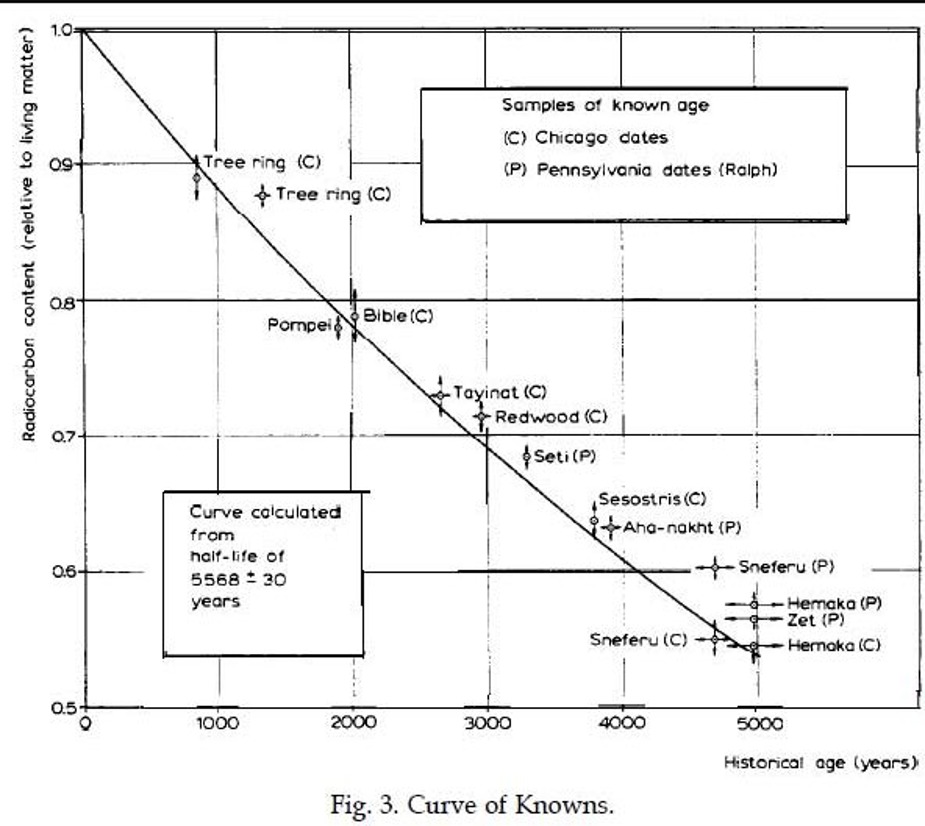
He tested organic artifacts whose ages were already established by historical records such as wood from the funerary boat of Egyptian Pharaoh Senusret III and timber from the tomb of King Zoser. When the radiocarbon measurements matched the historical dates of these Egyptian artifacts, it delivered the first major “case closed” payoff, verifying that the locked ledger of biological decay could be read.
Why It Was Invented (The Necessity)
Libby’s invention was driven by the post-WWII intersection of nuclear science and historical inquiry. The Manhattan Project had refined radiation-detection technology and isotope chemistry. Libby recognized that these nuclear tools could solve archaeology’s oldest problem: establishing an absolute, objective global timeline for human civilization.
Step-by-Step: How Radiocarbon Dating Works in Nature
Phase I: Atmospheric Generation
- Cosmic Collisions: Deep space radiation bombards gas particles near Earth’s upper atmosphere, shattering nuclei to release high-speed neutrons (n).
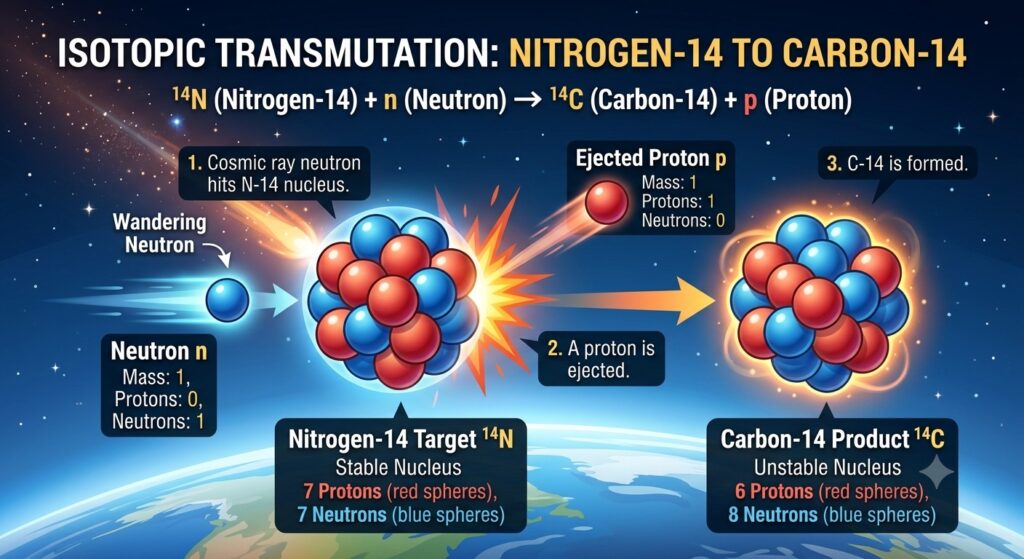
- Isotopic Transmutation: Wandering neutrons impact standard nitrogen-14 (¹⁴N) targets, ejecting single protons (p) and generating unstable carbon-14 (¹⁴C).
¹⁴N + n → ¹⁴C + p
- Chemical Oxidation: Freshly produced carbon-14 rapidly combusts with atmospheric oxygen, forming radioactive carbon dioxide (¹⁴CO₂).
¹⁴C + O₂ → ¹⁴CO₂
Phase II: Biological Absorption
- Photosynthetic Assimilation: Flora absorb ambient dioxide molecules both standard (¹²CO₂) and heavy (¹⁴CO₂) variants during light processing.
- Trophic Distribution: Herbivores and carnivores ingest plant material, sustaining an equilibrium ratio between isotope species across their active lives.
- Metabolic Cessation: Dying halts carbon exchange instantly. With zero incoming isotopic replenishment, initial abundance (N₀) freezes and the radiometric countdown begins.
Phase III: Decay & Chronological Dating
- Beta Disintegration: Unstable nuclei experience gradual beta-minus breakdown over millennia. A neutron transforms into a proton, releasing an electron (e⁻) along with an antineutrino , reverting the atom back into stable nitrogen-14 (¹⁴N).

- Half-Life Kinetics: Decay follows a steady half-life (t₁/₂) evaluated at 5,730 years. Every cycle reduces the total remaining isotopes by half. The annual rate constant is computed as:

- Isotopic Measurement: Analysts analyze ancient organic artifacts (such as timber or bone) to calculate remaining isotope levels (Nₜ) relative to baseline living proportions (N₀).
- Age Determination: Evaluating the surviving isotopic ratio yields exact sample age (t) using natural logarithms:

The Dinosaur Myth Debunked
A widespread misconception is that carbon dating is used to determine the age of dinosaur fossils.Non-avian dinosaurs died out approximately 66 million years ago. Radiocarbon ¹⁴C possesses a half-life of 5,730 ± 40 years. Because radioactive decay follows an exponential decay function:
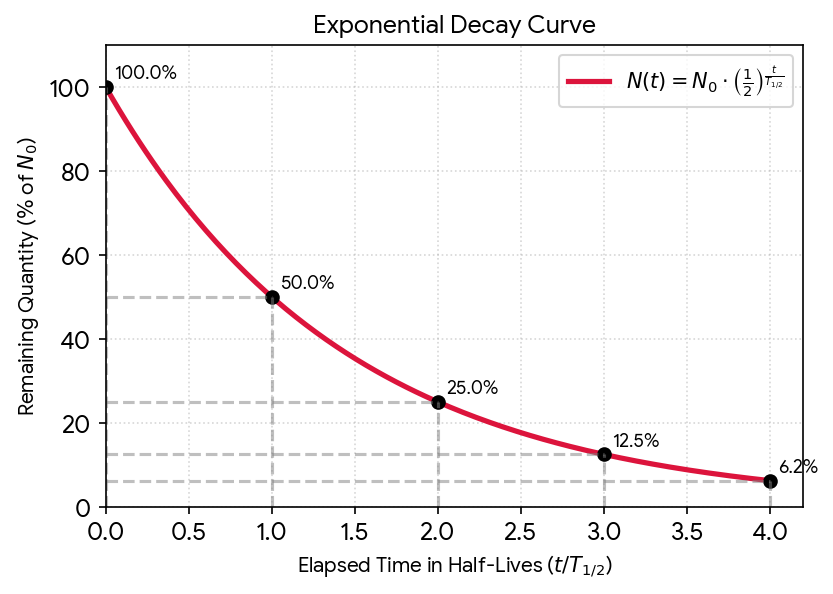
The remaining fraction of ¹⁴C decreases exponentially with each passing half-life:
- 1 Half-Life (5,730 years): 50% remaining
- 5 Half-Lives (28,650 years): 3.125% remaining
- 10 Half-Lives (57,300 years): ~0.097% remaining
By 10 to 11 half-lives (~50,000 to 60,000 years), less than 0.1% of the original ¹⁴C remains.
True fossilized dinosaur bones contain zero residual biogenic ¹⁴C; the organic matrix has long been replaced by inorganic minerals (permineralization).
Geologists and paleontologists date dinosaur-bearing strata through radiometric dating of surrounding igneous rocks (e.g., volcanic ash layers) such as:
- Potassium-40 (⁴⁰K to ⁴⁰Ar ): Half-life of ~1.25 billion years
- Uranium-235 (235U to ²⁰⁷Pb): Half-life of ~704 million years
Dating the Past, Unlocking the Eternal: Where Science Ends and Creation Begins
Carbon dating can establish when historical events occurred, but no scientific method can explain why nature was created. Just as we learn history from those who came before us, we can understand creation from the Supreme Being who existed before all else.
Consider life’s undeniable realities: we fear death, aging, loss, and suffering, yet none of us can escape them. Even immense wealth cannot buy peace of mind or protect us from constant anxiety. Nothing in this world is truly safe or permanent.
Where do our deep-seated desires for lasting peace and happiness come from, and how can they be fulfilled? To explore these answers, watch the video below and read Gyan Ganga written by Sant Rampal Ji Maharaj.
FAQ
Q: Who invented radiocarbon dating and how was it validated?
A: Willard F. Libby developed radiocarbon dating in the late 1940s by building on research in radioactivity, isotopes, neutrons and cosmic rays. He validated it using samples of known age (for example, Egyptian timbers) to produce a “curve of knowns.”
Q: Can carbon‑14 be used to date dinosaur fossils?
A: No. Non‑avian dinosaurs died ~66 million years ago. Any original organic ¹⁴C has long decayed or been replaced during fossilization. Geologists use much longer‑lived isotopes (e.g., ⁴⁰K→⁴⁰Ar, 235U→²⁰⁷Pb) to date dinosaur‑age rocks.
Q: What is the half‑life of carbon‑14 and why does it matter?
A: The half‑life of carbon‑14 is about 5,730 years. Because decay is predictable, measuring the remaining ¹⁴C gives an estimate of time since death.
Q: How does carbon‑14 (radiocarbon) form?
A: Cosmic rays strike the upper atmosphere, producing neutrons that convert atmospheric ¹⁴N into ¹⁴C. That carbon becomes ¹⁴CO₂ and enters the biosphere through photosynthesis and the food chain.
Q: How far back can radiocarbon dating reliably measure?
A: About 50,000 years, with some special cases extending farther but with lower precision.
Q: What modern machine is used?
A: Accelerator mass spectrometry (AMS), a highly sensitive machine that measures carbon-14 atoms directly.