



Finding the best tax-saving investment option in India is not just about choosing the investment with the highest deduction. It is about selecting one that matches your financial goals, investment horizon and tax regime. This comprehensive guide compares the top tax-saving investments, explains their features and helps you make confident, tax-efficient investment decisions.
- Highlights on Best Tax-Saving Investment Options in India
- What Are Tax-Saving Investment Options in India?
- Why Are Tax-Saving Investments Important?
- Understanding Tax Deductions Before Investing
- Choose Your Tax Regime Before Choosing Your Investments
- Understanding Your Tax-Saving Investment Choices in India
- ELSS Mutual Funds
- Public Provident Fund (PPF)
- National Pension System (NPS)
- Employee Provident Fund (EPF)
- Tax-Saving Fixed Deposits
- Sukanya Samriddhi Yojana (SSY)
- National Savings Certificate (NSC)
- Senior Citizens’ Savings Scheme (SCSS)
- ULIPs
- Life Insurance Plans
- How Should Beginners Choose the Right Tax-Saving Investment?
- Start Tax Planning Early Instead of Waiting Until the Last Minute
- Tax Planning vs Tax Evasion: Staying on the Right Side of the Law
- Review Your Existing Tax Benefits Before Investing More
- Build a Tax-Saving Portfolio Instead of Relying on One Investment
- What Mistakes Should You Avoid While Investing to Save Tax?
- How to Choose the Right Tax-Saving Investment: A 5-Step Decision Framework
- Step 1: Define Your Financial Goal
- Step 2: Understand Your Risk Appetite
- Step 3: Consider the Lock-in Period
- Step 4: Compare Potential Returns with Inflation
- Step 5: Diversify Instead of Relying on One Investment
- The Tax No One Can Escape
- The Only Income That Can Pay Off Karmic Taxes
- FAQs: Best Tax-Saving Investments in India
Highlights on Best Tax-Saving Investment Options in India
- Reducing tax is an outcome of good financial planning, not its sole purpose.
- Choosing the wrong tax regime can reduce the value of an otherwise suitable investment.
- Every tax-saving investment involves a trade-off between returns, risk, liquidity and investment horizon.
- No single tax-saving instrument is ideal for every investor or every financial goal.
- The most rewarding investment decisions are those that combine meaningful tax savings with sustained financial growth over time.
- Tax-saving investments are government-approved financial products that help eligible taxpayers reduce taxable income while working towards long-term financial goals.
- The best tax-saving investment depends on your goals, investment horizon, liquidity needs and risk tolerance – not tax benefits alone.
- Reviewing your investment strategy every financial year helps keep it aligned with changing tax rules and personal objectives.
What Are Tax-Saving Investment Options in India?
As a complete novice, many times, tax-saving investments can seem daunting. The simplification lies in understanding the systems provided by the government itself first and then expanding your knowledge depending on which income bracket you lie in.
- Tax-saving investment options are government-approved financial products that allow eligible taxpayers to reduce taxable income while simultaneously building long-term wealth.
- Unlike ordinary investments, these instruments qualify for deductions under specific provisions of the Income Tax Act, provided you meet the eligibility criteria and opt for the applicable tax regime.
- For example, investing INR 1,50,000 lakh in eligible Section 80C instruments under the old tax regime can reduce your taxable income by the same amount. However, saving tax and creating wealth are not always the same thing.
- Some investments prioritise capital growth.
- Others prioritise capital protection.
- The ideal investment balances both.
However, the answer to which are the best tax-saving investments in India has more layers to it than we see as it also depends on your income bracket and personal growth objectives.
Why Are Tax-Saving Investments Important?
Tax-saving investments matter because they reduce your tax liability while helping you achieve important financial goals.
Rather than viewing taxes as an annual burden, tax planning allows you to direct part of your income into investments that can benefit your future.
Some major advantages include:
- Lower taxable income
- Long-term material wealth creation
- Retirement planning
- Financial discipline
- Inflation-beating returns (depending on investment type)
- Goal-based investing
- Capital protection through government-backed schemes
As an example: Someone investing consistently in ELSS over 20 years may benefit from equity market growth while simultaneously claiming eligible tax deductions.
Meanwhile, someone nearing retirement may prioritise PPF or SCSS for stability.
We will decode all these abbreviations in this article.
Understanding Tax Deductions Before Investing
Tax deductions reduce your taxable income, not your investment amount.
Before choosing any investment, you should understand the sections under which deductions are available.
Section 80C
Section 80C provides deductions of up to INR 1,50,000 lakh annually under the old tax regime through eligible investments such as:
- ELSS
- PPF
- EPF
- NSC
- Tax-saving FD
- Sukanya Samriddhi Yojana
- Life insurance premium
- Home loan principal repayment
- Children’s tuition fees (as stated on the Income Tax website)
Note: Section 80C of the Income Tax Act allows eligible deductions for specified investments, subject to the prevailing annual limit under the old tax regime.
Section 80CCD(1B)
Apart from the Section 80C deduction, taxpayers investing in the National Pension System (NPS) can also claim a separate tax deduction of up to INR 50,000 under Section 80CCD(1B), subject to the applicable conditions. (Income Tax website)
Section 80D
Health insurance premiums may qualify for deductions under Section 80D, subject to applicable limits.
Old vs New Tax Regime
This is one of the biggest considerations today.
- The old tax regime allows most deductions under Sections 80C, 80D and related provisions.
- The new tax regime generally removes these deductions, although employer contributions to NPS under Section 80CCD(2) continue to remain available under specified conditions.
Choose Your Tax Regime Before Choosing Your Investments
Your choice of tax regime lays the foundation for the rest of your tax planning, including whether many popular tax-saving investments deliver meaningful benefits. This often results in money being locked into long-term investment products without delivering the expected tax benefit.
- India currently offers two tax regimes, each with a different approach to taxation.
- The old tax regime allows taxpayers to claim various deductions and exemptions through eligible investments and expenses, while the new tax regime generally offers lower tax rates but restricts many of these deductions.
- Before investing under Section 80C or purchasing any tax-saving product, compare your estimated tax liability under both regimes.
- When the new tax regime proves more tax-efficient for your income, purchasing tax-saving investments simply for deductions may not be the most prudent use of your money.
- Choosing the right tax regime first ensures that every investment you make contributes meaningfully to both your financial goals and your tax planning strategy.
The First Tax Decision You Need to Get Right
Choosing the right tax regime depends on your income, eligible deductions and overall financial situation. There is no one-size-fits-all answer, which is why comparing both regimes before making any investment decisions is essential.
Rather than choosing a tax regime by default, take a moment to consider these factors:
- How dependent is your current tax bill on deductions available under Sections 80C, 80D, NPS and other eligible provisions? If your total deductions are substantial, the old tax regime may reduce your tax liability more effectively.
- Do you have very few deductions or prefer a simpler tax filing process? In such circumstances, the new tax regime deserves serious consideration, as its lower tax rates may offset the absence of many deductions and exemptions.
- Which regime delivers greater tax efficiency for your financial situation? Use an online income tax calculator or consult a qualified tax professional to estimate your tax under each regime. A quick comparison can help you determine which option leaves you with greater post-tax income.
Your choice of tax regime should be based on actual tax savings rather than assumptions. This will require you to actually compute what is working out best for you. Reviewing both options before investing to ensure that every rupee you invest is working towards both your financial goals and tax efficiency.
Once you have selected the tax regime that best suits your financial circumstances, the next step is to identify the tax-saving investments that align with your goals, risk appetite and investment horizon.
Understanding Your Tax-Saving Investment Choices in India
Rather than focusing solely on potential returns, evaluate tax-saving investments based on whether they suit your financial priorities, risk tolerance and long-term plans.
Let us explore each option.
ELSS Mutual Funds
ELSS stands apart from many other tax-saving options by combining equity market participation with Section 80C tax benefits.
- Recommended by industry experts for young investors, long-term material wealth creation and investors comfortable with market fluctuations
- Lock-in: 3 years
- Risk: High (as defined by the industry standards)
- Return Potential: Market-linked
- Tax Benefit: Section 80C
Public Provident Fund (PPF)
Investors who value stability and capital preservation over market-driven growth may find the Public Provident Fund (PPF) better suited to their long-term financial objectives.
- Lock-in: 15 years
- Risk: Very Low
- Returns: Government notified
- Tax Benefit: Section 80C
- Maturity: Generally tax-efficient (EEE structure under prevailing rules)
National Pension System (NPS)
The National Pension System (NPS) is a retirement-focused investment that combines market-linked investing with tax benefits.
Benefits include:
- Section 80C eligibility (within prescribed limits)
- Additional INR 50,000 deduction under Section 80CCD(1B)
- In certain cases, employer contributions to the NPS are also eligible for tax deductions under Section 80CCD(2), subject to the applicable provisions.
- Recommended by industry experts for salaried employees, retirement planning and long investment horizons
Therefore, the National Pension System combines retirement planning with tax benefits and provides eligible taxpayers with an additional deduction under Section 80CCD(1B), subject to applicable rules.
Employee Provident Fund (EPF)
For many salaried employees, the Employees’ Provident Fund (EPF) serves as one of the primary vehicles for building retirement savings through regular contributions.
It provides:
- Aimed at regular retirement savings
- It is the employer contribution
- Tax benefit: Section 80C benefits for eligible cases
- Government-backed framework
Tax-Saving Fixed Deposits
Tax-saving FDs suit investors seeking predictable returns.
Features include:
- Lock-in: 5 years
- Guaranteed returns on maturity
- Regarded as lower risk
- Tax benefit: Section 80C deduction
Sukanya Samriddhi Yojana (SSY)
Designed exclusively for the girl child, SSY offers attractive long-term savings along with tax benefits.
Suitable for:
- Parents and guardians
- Purpose has been defined by industry experts as suitable for education and marriage expense planning of the girl child.
- It is important to note here that while several parents plan for the marriage ‘expenses’ of their daughter, giving and taking dowry is both legally prohibited in India under Dowry Prohibition Act 1961. Although dowry has been outlawed for decades, the country continues to record tragic deaths linked to the practice each year.
National Savings Certificate (NSC)
NSC is another government-backed savings instrument offering fixed returns with Section 80C eligibility.
Senior Citizens’ Savings Scheme (SCSS)
SCSS provides regular income for senior citizens while offering tax benefits under eligible conditions.
ULIPs
ULIPs are designed to serve a dual purpose by offering life insurance alongside investment opportunities linked to the performance of financial markets.
Suitable only after carefully understanding the charges, the lock-in period and your personal investment objectives.
Life Insurance Plans
Unlike investment-oriented insurance products, pure term insurance focuses solely on providing a financial safety net for your beneficiaries. Traditional insurance plans may also qualify for deductions under 80C.
Comparison of the Best Tax-Saving Investments
| Investment | Returns | Lock-in | Tax Deduction | Risk | Liquidity | Best For |
| ELSS | Market-linked | 3 Years | High | 80C | Medium | Material Wealth creation |
| PPF | Government declared | 15 Years | Very Low | 80C | Low | Conservative investors |
| NPS | Market-linked | Retirement | Moderate | 80C, 80CCD(1B) | Low | Retirement |
| EPF | Government notified | Retirement | Low | 80C | Low | Salaried employees |
| Tax-saving FD | Fixed | 5 Years | Low | 80C | Low | Conservative investors |
| SSY | Government declared | Long-term | Very Low | 80C | Low | Girl child planning |
| NSC | Fixed | 5 Years | Low | 80C | Low | Stable returns |
| SCSS | Government declared | 5 Years | Low | Eligible | Medium | Senior citizens |
| ULIP | Market-linked | 5 Years | Moderate | 80C | Low | Insurance, investment |
| Life Insurance | Depends | Varies | Low | 80C | Low | Protection |
How Should Beginners Choose the Right Tax-Saving Investment?
The right tax-saving investment depends on your age, financial goals, liquidity needs and willingness to take risk.
A simple framework to begin with could be as follows, as recommended by financial experts:
- Recommended tax-saving investment products for people in their 20s are ELSS, NPS and SIP investing.
- Recommended tax-saving investment products for people in their 30s are ELSS, PPF, EPF and NPS.
- Recommended tax-saving investment products for people planning for children are SSY and PPF.
- Recommended tax-saving investment products for people nearing retirement are SCSS, PPF and EPF. One can also choose some of these schemes should you want to plan your retirement in advance along with tax-saving.
Ultimately, the most suitable tax-saving investment depends on an investor’s financial goals, investment horizon, liquidity needs and tolerance for risk, not on tax benefits alone.
Also read: SIP vs Lump sum: Which Investment Option is Right for You?
Start Tax Planning Early Instead of Waiting Until the Last Minute
Every year, many taxpayers rush to make tax-saving investments during the final weeks of the financial year. While this may help claim deductions, hurried decisions often lead to unsuitable investments and missed opportunities.
- Starting your tax planning at the beginning of the financial year offers several advantages.
- It allows you to spread your investments across monthly instalments rather than making a large lump-sum contribution at the last minute.
- If you choose equity-linked products such as ELSS, investing through a Systematic Investment Plan (SIP) also helps average out market fluctuations over time.
- Planning early gives you enough time to compare investment options, assess your financial goals, understand lock-in periods and make informed decisions instead of investing under pressure.
Tax planning should be viewed as a year-round financial habit rather than a year-end exercise.
Tax Planning vs Tax Evasion: Staying on the Right Side of the Law
Saving tax legally and avoiding tax illegally are two very different things. This is important to address at this juncture.
- Tax planning involves making legitimate use of deductions, exemptions and investment options provided under the Income-tax Act.
- Tax evasion, on the other hand, includes practices such as concealing income, submitting false documents or claiming deductions that you are not entitled to receive. Such actions may attract penalties and legal consequences.
- When investing for tax benefits, always ensure that your investments are genuine, your claims are accurate and your supporting documents are safely maintained.
A well-planned investment strategy not only helps reduce taxes but also ensures complete compliance with tax laws.
Review Your Existing Tax Benefits Before Investing More
Before making fresh tax-saving investments, take a closer look at the deductions and benefits you may already be receiving.
- Many salaried employees automatically contribute towards the Employees’ Provident Fund (EPF), pay premiums for life or health insurance or receive employer contributions to the National Pension System (NPS).
- These existing contributions may already utilise a significant portion of the available deductions under the Income-tax Act.
Reviewing your salary structure, insurance policies and ongoing investments before committing additional funds helps prevent unnecessary investments and ensures that your money is allocated where it creates the greatest financial value.
Build a Tax-Saving Portfolio Instead of Relying on One Investment
There is no single tax-saving investment that suits every investor.
- Each option has its own risk profile, lock-in period, return potential and financial objective, as we have already seen so far in this guide.
- Rather than investing all your money in one product, consider building a diversified tax-saving portfolio based on your goals and risk tolerance.
- Diversification helps balance growth, stability and liquidity while reducing dependence on any single investment.
- Over time, a well-balanced portfolio is generally better equipped to meet changing financial needs than relying on one tax-saving product alone.
What Mistakes Should You Avoid While Investing to Save Tax?
Avoiding common mistakes can improve both your tax efficiency and long-term financial outcomes.
Common errors include:
- Investing only in March
- Buying insurance solely for tax benefits. Don’t take it if you don’t need it.
- Ignoring lock-in periods
- Chasing returns without assessing risk
- Failing to diversify
- Ignoring inflation
- Never reviewing investments annually
For example, investing in a five-year tax-saving FD simply because it qualifies under Section 80C may not suit someone who needs access to funds within two years.
Practical Tax Planning Checklist
A yearly tax planning checklist helps you make informed investment decisions instead of rushed ones.
Follow these steps:
- Estimate your taxable income.
- Select the Tax Regime
- Check your remaining Section 80C limit.
- Review EPF contributions.
- Consider NPS if retirement planning is a priority.
- Diversify rather than relying on one product.
- Complete investments well before the financial year ends.
- Retain investment proofs for tax filing.
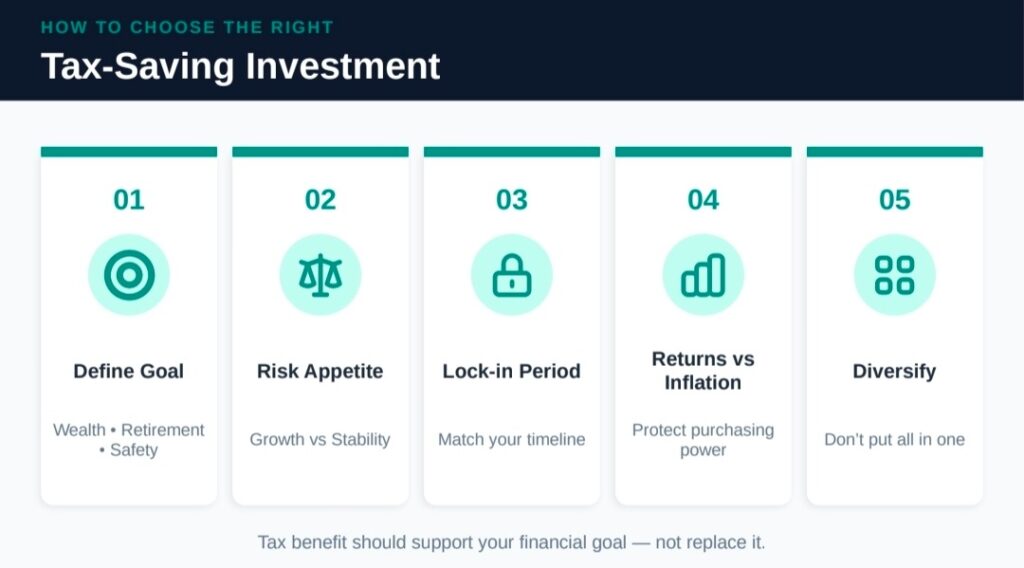
How to Choose the Right Tax-Saving Investment: A 5-Step Decision Framework
With so many tax-saving investment options available, choosing the right one can feel overwhelming.
Instead of comparing products in isolation, work through these five steps to identify the tax-saving investment that best fits your financial goals, risk profile and tax position.
Step 1: Define Your Financial Goal
Begin by asking yourself why you are investing along with tax-saving being the main motive. Some questions that can help you here are as follows:
If you want to save tax and build or plan for the following:
- Long-term wealth: Consider ELSS.
- Retirement: NPS or EPF may be more appropriate.
- Looking for guaranteed returns with minimal risk possible: PPF, NSC or a Tax-Saving Fixed Deposit could be better choices.
A tax benefit should complement your financial objective but not replace it.
Step 2: Understand Your Risk Appetite
Every investor has a different comfort level with risk even with tax-saving options.
- Choose higher-risk, higher-growth options if you have a long investment horizon, can tolerate short-term market fluctuations or want the potential for inflation-beating returns.
- Consider lower-risk investments if protecting your capital and reducing uncertainty matter more to you than maximising long-term returns.
As a general rule, ELSS carries market risk, whereas PPF, NSC and Tax-Saving Fixed Deposits offer greater stability.
Step 3: Consider the Lock-in Period
Tax-saving investments often require your money to remain invested for a fixed period.
Therefore, before investing, ask yourself the following questions:
- Is this money earmarked for any major expense in the near future?
- Can I comfortably leave it untouched? And for how long?
- Does the lock-in period match my financial plans?
Choosing an investment with a lock-in period that suits your timeline helps avoid unnecessary financial stress later.
Step 4: Compare Potential Returns with Inflation
An investment that saves tax but fails to grow your wealth may not be the best long-term choice.
When evaluating different options, consider:
- Expected long-term returns.
- Whether the expected growth is sufficient to offset the rising cost of living.
- The balance between risk and reward.
- Again, your overall investment horizon.
Remember, preserving purchasing power is also important along with reducing taxes.
Step 5: Diversify Instead of Relying on One Investment
You do not have to choose only one tax-saving instrument. A diversified approach often provides a better balance between growth, stability and retirement planning along with tax-saving too.
The Tax No One Can Escape
Why do we pay taxes? No economy can function without tax revenue, which enables governments to maintain public services, develop infrastructure and meet administrative responsibilities. As beneficiaries of these resources, citizens are legally bound to contribute. Refusing to do so carries serious consequences.
But, did you know? This earthly system reflects a far greater law – one that governs every soul, regardless of nationality, religion or status?
The owner of the 21 universes has entrusted duties to his administrators and every soul is accountable under his law. Every facility we use in this world is taxable under whichever ministry it falls in. We have been unaware of these taxes for innumerable births, forget about even the repayment.
Through our actions, we accumulate these karmic debts that cannot be settled by wealth, influence or worldly power. Without overcoming this hidden liability, the soul cannot escape the repeated process of taking birth, dying and returning again.
However, there is hope for us. At divinely appointed times, such as today, the Supreme God sends a Tatvdarshi Sant – the only spiritual authority empowered to free souls from their accumulated karmic debt and reveal the true path to salvation.
Who is the Tatvdarshi Sant of our time?
The Only Income That Can Pay Off Karmic Taxes
The Tatvdarshi Sant (Enlightened Saint) of our time is Jagatguru Tatvdarshi Sant Rampal Ji Maharaj, who reveals the hidden spiritual laws governing this world. He explains that every resource we enjoy, from the food we eat and the air we breathe to the land we occupy and the comforts we possess, belongs to the dominion of Kaal Brahm (Satan) and its countless departments. Just as governments levy taxes for the facilities they provide, every action performed within Kaal’s realm creates a corresponding karmic liability.
For countless lifetimes, humanity has remained unaware of this invisible debt because only a Tatvdarshi Sant can unveil the true nature of creation. Jagatguru Tatvdarshi Sant Rampal Ji Maharaj imparts the authentic mantras ordained in our sacred scriptures, through which the karmic liabilities accumulated across innumerable births are gradually settled while allowing a person to continue fulfilling their family and worldly responsibilities.
At first glance, this may seem difficult to believe. But consider this – why does the material world mirror systems of governance, administration and accountability of this universe so precisely? And despite years of religious practices, pilgrimages and rituals, why do anxiety, suffering and repeated hardships continue to accompany human life? The answer lies in the fact that our spiritual debt remains unpaid because the true method of worship has remained hidden.
Jagatguru Tatvdarshi Sant Rampal Ji Maharaj reveals that lasting freedom is attained only through the authentic worship of Supreme God Kabir. This alone releases the soul from karmic bondage and brings an end to the endless cycle of birth and death.
Throughout life, we devote immense effort to choosing the right investments, protecting our wealth and planning for retirement. And yet the greatest investment a human being can ever make is the investment that secures eternal freedom. Every other gain remains behind at death, but the spiritual wealth earned through true devotion accompanies the soul forever.
To understand these profound spiritual truths and discover the authentic path to complete salvation, listen to the enlightening spiritual discourses of Jagatguru Tatvdarshi Sant Rampal Ji Maharaj by visiting:
Website: www.jagatgururampalji.org
YouTube: Sant Rampal Ji Maharaj
Facebook: Spiritual Leader Saint Rampal Ji
‘X’ handle: @SaintRampalJiM
FAQs: Best Tax-Saving Investments in India
Q1) Which is the best tax-saving investment option in India?
Answer: The best tax-saving investment depends on your financial goals, risk tolerance, investment horizon and the tax regime you choose.
Q2) Should I choose the old or the new tax regime for tax-saving investments?
Answer: Compare your tax liability under both regimes, as tax-saving investments generally offer greater benefits under the old tax regime.
Q3) How can I maximise tax savings through investments in India?
Answer: Maximise tax savings by selecting the right tax regime, investing early, diversifying wisely and using eligible deductions that suit your financial goals.