



JWST Discovers Beta Pictoris d: The James Webb Space Telescope discovered a massive exoplanet. It had been concealed within one of the most well-examined planetary systems in the Milky Way. Through the JWST, astronomers were finally able to identify Beta Pictoris d, an unknown planet in the well-studied Beta pictorius system. Earlier research had confirmed that Beta Pictoris, the young and nearby star, was home to two giant planets. This included Beta Pitorises b and c, which were among the first exoplanets ever identified through direct imaging. Beta Pictoris has been confirmed, making it the second planetary system to have photographed at least three planets.
- About the James Webb Space Telescope Behind These Discoveries
- Beta Pictoris Discovery Made Through Atmospheric Chemistry, Not a Photograph
- James Webb Space Telescope Captures Supermassive Black Hole Feeding Process
- Black Hole Feeding Cycle May Explain Decades-Old Astrophysics Puzzle
- Beyond the Stars: The Greatest Discovery May Be Within
Two separate research groups announced the discovery of Beta Pictoris d on July 15, 2026. Both teams were independently verified. Recently discovered, the world is a gas giant orbiting the Beta Pictoris system, which is located approximately 23 million years away from Earth and at 63 light years in diameter.
Ben Sutlieff from the University of Edinburgh and Markus Bonse from a European Southern Observatory research group were led by Aidan Gibbs from UCD, San Diego. The Astrophysical Journal Letters featured the results of both groups on the same day, without any indication that they had made different discoveries. Astronomers have been fascinated by the Beta Pictoris system, which is just 63 light years away and located at an extreme distance from Earth.
About the James Webb Space Telescope Behind These Discoveries
Since its opening, the same observatory has been the primary instrument for this type of research, enabling both discoveries’. The James Webb Space Telescope’s objective is to travel further into space to observe the formation of ancient stars and galaxies in the universe, as well as distant dust clouds that provide insights into the evolution of stars. The object is named after James E, and it contains a massive 6.5-meter segmented mirror that gathers almost six times more light than the Hubble Space Telescope. NASA’s second head office was occupied by Webb, who served during the Apollo era.
Webb, launched on December 25, 2021, from Europe’s Spaceport in French Guiana on an Ariane 5 rocket, after decades of planning that began with a workshop in 1989 that asked for ideas post-Hubb. Webb orbits the Sun at a distance of 1.5 million kilometers, which is not far enough for astronauts to reach, unlike Hubble’s orbit around Earth. The telescope is a joint venture between NASA, the European Space Agency, and the Canadian Space Agency.
A precise launch left it with enough fuel to more than double its minimum planned mission life of 10 years, and since becoming operational it has steadily reshaped what astronomers know about distant galaxies, exoplanets, and the structures within our own solar system.
Beta Pictoris Discovery Made Through Atmospheric Chemistry, Not a Photograph
Unlike Beta Pictoris b and c, Beta Pictoris d was discovered not by identifying a bright point of light, but by detecting the unique chemical fingerprint of its atmosphere, a technique that could transform future exoplanet searches. Using JWST’s Near-Infrared Spectrograph (NIRSpec), a distinct pattern of peaks and troughs emerged in the data where researchers expected a smooth spectrum, resembling the absorption lines of carbon monoxide, a hallmark of a giant planet’s atmosphere.
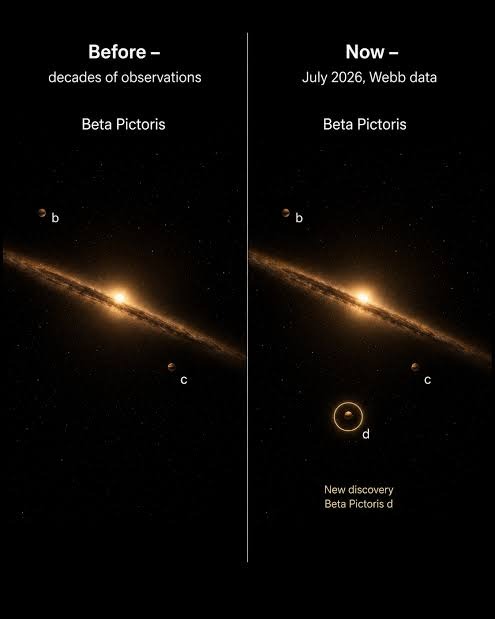
Lead researcher Aidan Gibbs said the team was not looking for a new planet but was trying to understand one already known to exist, when a telltale signal appeared in the data where it was not expected. Subsequent observations using JWST’s Mid-Infrared Instrument (MIRI) detected both water vapor and methane at the same location.
The research team determined that the planet’s speed, position, and alignment with the debris disk were all consistent with something orbiting Beta Pictoris rather than a background star or a brown dwarf containing carbon monoxide in its own atmosphere. This marks the first time a directly observed planet has been found primarily through moderate-resolution spectroscopy rather than a resolved image.
A separate team using the European Southern Observatory’s Very Large Telescope (VLT) in Chile independently detected the same planet. The VLT team traced Beta Pictoris d through observations spanning 11 years, and reviews of the VLT’s historical data showed apparent signals of the planet dating back over a decade. The planet is now considered the faintest exoplanet ever directly imaged from Earth after correcting for distance. The complementary discoveries demonstrate two different paths to finding hidden worlds: the VLT showed that extremely faint planets can still be recovered through improved image processing and archival observations, while JWST demonstrated that moderate-resolution spectroscopy can reveal planets even when conventional imaging struggles against overwhelming dust and glare.
Mass and Orbit Estimates for the Beta Pictoris Planet Vary by Method
A photometric analysis by the VLT team placed Beta Pictoris d’s mass at approximately 2.4 times Jupiter’s, while the JWST team’s spectroscopic analysis estimated a broader range of two to four times Jupiter’s mass, since the NIRSpec method removes much of the planet’s broadband continuum, making mass inference less direct. Both estimates make Beta Pictoris d the smallest of the three known planets in the system, as its siblings b and c each weigh approximately eight to ten times Jupiter’s mass. Beta Pictoris d also has the widest orbit of the three known planets in the system. Scientists estimate that the planet takes around 91 years to complete one orbit around its star, and although it is one of the larger planets in the system by mass, it is nearly 100 times fainter than its neighboring planets, making it extremely difficult to detect.
The physical size of Beta Pictoris d has not yet been determined by this detection method. Researchers say they plan to continue analyzing the data to refine estimates of the planet’s temperature, atmospheric composition, and precise orbit.
Also Read : Beyond the Big Bang: JWST & The Unborn Dark Energy
James Webb Space Telescope Captures Supermassive Black Hole Feeding Process
In a separate study published the same month, JWST has given astronomers their clearest look yet at how supermassive black holes obtain the gas needed to grow. JWST captured unusually detailed images of gas feeding the supermassive black hole at the center of galaxy NGC 4696, with a vast filament appearing to funnel material into an 800-light-year-wide spinning disk, where gas races around at up to 600 kilometers per second.
The observations focused on NGC 4696, the central galaxy of the Centaurus Cluster, located about 145 million light-years from Earth. Nearly every large galaxy contains a supermassive black hole millions or billions of times more massive than the sun, and when one actively consumes surrounding material, it becomes what astronomers call an active galactic nucleus, or AGN, which can launch powerful jets that heat nearby gas, slow star formation, and reshape its host galaxy.
The research was led by Université de Montréal professor Julie Hlavacek-Larrondo, with Michigan State University helping an international team perform the observations and interpret the data. The results were reported in the July 14 issue of The Astrophysical Journal Letters. NGC 4696 lies within a spectacular multiphase nebula of filaments extending over tens of kiloparsecs and spanning six decades in temperature, from hot, X-ray-emitting plasma at 100 million kelvin to cold molecular gas.
Earlier Hubble Space Telescope images had already shown an unusual S-shaped swirl within the sphere of influence of the galaxy’s supermassive black hole, but it took Webb’s more powerful infrared capabilities to reveal what that swirl actually was. Using the telescope’s NIRSpec instrument, researchers examined the region’s inner 618 by 618 parsecs at a resolution of 10 parsecs, revealing that the swirl was in fact a rotating circumnuclear disk receiving gas from a network of surrounding filaments. These observations tracked hydrogen emission known as Paschen-alpha, which does a better job of revealing the gas’s motion than the more commonly used Hydrogen-alpha line.
Using nearly eight hours of observing time with JWST’s NIRSpec instrument, the team produced detailed maps of the gas’s motion deep inside the black hole’s sphere of influence, at a resolution sharp enough to pick out features roughly 30 light-years across, a tiny slice of a galaxy hundreds of thousands of light-years wide. The filament connecting to the disk is about 105 parsecs wide and at least 350 parsecs long, though it likely extends beyond JWST’s field of view, and gas near the connection point appears more turbulent than gas farther away.
Black Hole Feeding Cycle May Explain Decades-Old Astrophysics Puzzle
For decades, astrophysicists have been puzzled by how actively feeding supermassive black holes, which blast out enough energy to blow away and heat their own food supply, manage to keep growing. The findings suggest black holes may recycle their own fuel by heating gas with jets and later drawing the cooled material back in. Black holes, according to the research, do not simply destroy; they cycle their fuel, creating a feedback mechanism that allows them to sustain their own growth over billions of years.
Observations support a self-regulating cycle where jets from the black hole heat surrounding gas, which later cools, collapses into filaments, and feeds a rotating disk around the black hole. Three-dimensional magnetohydrodynamic simulations tailored to NGC 4696 closely resemble the JWST observations, showing how magnetic fields help channel cool gas toward the black hole, fueling new jets and restarting the cycle. The research team tested the JWST observations against a computer simulation and found that gas in the infalling filament scenario would indeed take a shape similar to the one seen in NGC 4696.
Helen Russell of the University of Nottingham, a member of the research team, said JWST is now showing the final link of this closed loop. Megan Donahue, an MSU University Distinguished Professor of physics and astronomy, added that JWST observations are offering thousands of new facts and measurements, describing it as a lot to absorb, and noted that researchers are working together to solve questions about how black holes get their fuel and interact with their host galaxies.
Also Read :The Life Cycle of a Star: From Nebula to Supernova
Scientists hope the findings could help explain how supermassive black holes with masses millions, and sometimes billions, of times that of the sun grew so quickly in the early universe. By following gas from large filaments into a compact disk, JWST has supplied the clearest view yet of how a supermassive black hole can heat its surroundings without cutting off the fuel that keeps it active.
Beyond the Stars: The Greatest Discovery May Be Within
The James Webb Space Telescope continues to expand humanity’s understanding of the universe, revealing hidden planets and uncovering the remarkable processes that shape galaxies and black holes. Yet, as every new discovery answers one question, it often raises even deeper ones about our origin, purpose, and place in the cosmos. Alongside scientific exploration, many people also seek spiritual insight to better understand life’s greater meaning.
For readers interested in this journey, the books “Gyan Ganga“ and “Way of Living“ by Saint Rampal Ji Maharaj offer thoughtful perspectives on authentic worship, self-realization, and living a meaningful life. Together, scientific curiosity and sincere spiritual reflection can inspire a richer understanding of both the universe and ourselves.