The Big Bang theory is the foundation we use to understand how our universe began, how it moves, and how it is structured. In its simplest form, this theory states that the universe did not always exist. Instead, it emerged from a tiny, intensely hot, and dense point about 13.8 billion years ago. From that single moment, the very fabric of space and time began to expand and cool down. This cooling process allowed basic particles to group together, eventually forming the massive webs of galaxies, stars, and planets we see today. A nod to the non-eternal life of the universe.
- The Ideation and Formalization Of The BBT
- The Kinematics of Expansion: How the Universe Stretches
- Expansion Is Not Constant: Deceleration and Acceleration
- The Cosmic Jerk: A Constant Rate of Change
- The Cosmic Coincidence: The Hubble Time vs. True Age
- JWST Rewrites the Timeline: The Crisis at Cosmic Dawn
- New Findings: The Hubble Tension and Dynamical Dark Energy
- The Take Away
- The Start Of A New Era
- FAQs
The Ideation and Formalization Of The BBT
Albert Einstein’s General Theory of Relativity provides the math behind this idea. Einstein showed that gravity is not just a pull between objects. Instead, gravity is the curving of space and time caused by mass and energy; like a ball placed on a stretched out cloth, BUT in 3D space. When we look at the universe on the largest scales, we assume it looks roughly the same in every direction and has an even density. This assumption simplifies the math and helps scientists track how the universe grows over time, however there are many many differences in the space as a whole i.e. the universe isn’t truly uniform.
Today, the standard explanation for the universe is called the Lambda Cold Dark Matter model. This model states that three main ingredients control the universe. First, we have ordinary matter. This includes the protons, neutrons, and electrons that make up stars, planets, and humans. Second, we have Cold Dark Matter. This is an invisible substance that does not interact with light but provides the gravitational “glue” that holds galaxies together against the stretching of space. Third, we have the cosmological constant (Λ). This represents dark energy, a mysterious force built into space itself that acts like anti-gravity, pushing the universe apart at an accelerating rate. This invisible, unknown and frankly spooky force is something only known about due to the anomalies it created in the visible universe as it interacts only through gravity.
While this model has successfully predicted astronomical events for decades, new technology is revealing major problems. Modern tools, especially the James Webb Space Telescope (JWST) and the Dark Energy Spectroscopic Instrument (DESI), are gathering data that challenges our basic timeline of the cosmos.
Key insight: The Big Bang was not an explosion IN space, but an explosion OF space. The universe continues to expand today, driven by dark energy.
Space Is The Thing That Came From The Big Bang.
The Kinematics of Expansion: How the Universe Stretches
To truly understand how the universe changes, we must look at exactly how fast space stretches over time. Cosmologists measure this stretching using a simple math tool called the “scale factor.” The scale factor tracks how the distances between galaxies grow over time. We set the scale factor to exactly one for the present day. In the past, when the universe was smaller and denser, the scale factor was less than one.
The total amount of mass and energy in the universe controls how fast the scale factor grows. We use the Friedmann equations to calculate this. The first Friedmann equation shows how the expansion rate connects to the density of matter, radiation, and dark energy:
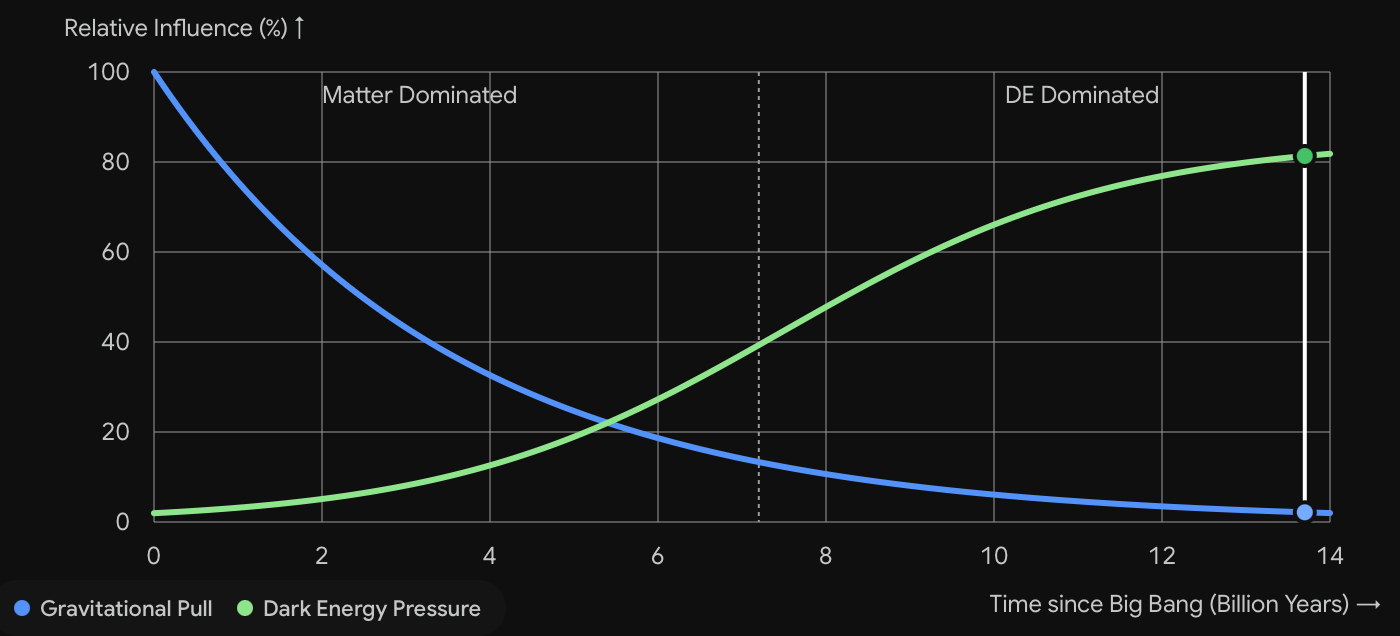
Because different ingredients thin out at different speeds as space expands, the history of the universe splits into three distinct eras.
In the very early universe, radiation (like light particles) dominated the energy. As space grew, radiation thinned out quickly because its wavelengths stretched. About 47,000 years after the Big Bang, the universe cooled enough for matter to take over. During this “matter-dominated era,” the gravity of matter slowed the expansion down. Finally, because dark energy represents a constant energy of empty space, it did not thin out as the universe grew. About 4 to 5 billion years ago, dark energy overpowered the thinning matter. This shift started our current dark-energy-dominated era, pushing the universe to expand faster and faster.
Now you might ask? How? How is dark energy constant in an expanding universe, how does something just come into existence without any cause to be seen? Where did dark energy and dark matter come from?
And the answer, dear reader, IS UNKNOWN. It’s one of the greatest questions of our time. NO ONE knows how dark energy just keeps growing.
Cosmic Expansion Timeline. Source: ttsz / Getty Images
Expansion Is Not Constant: Deceleration and Acceleration
The Expansion Rate of the universe is NOT constant, it accelerates and decelerates AND the rate of this expansion also changes – called JERKING. More on that ahead.
To track how the expansion speed changes, cosmologists use the Hubble parameter. The Hubble parameter measures the basic speed of cosmic expansion. The current value of this parameter is called the Hubble constant (H0). This constant explains Hubble’s Law: the further away a galaxy is from us, the faster it appears to move away. While this value is constant across space right now, it actually drops as the universe ages.
Before the late 1990s, scientists assumed that gravity was the only long-range force shaping the universe. Because gravity pulls things together, everyone expected the expansion of the universe to be slowing down. Scientists created a specific number, called the deceleration parameter, to measure exactly how fast the universe was hitting the brakes.
However, observations of exploding stars in 1998 shocked the scientific world. The data proved that the universe is not slowing down at all. Instead, it is speeding up. Because the expansion is accelerating, the deceleration parameter actually has a negative value today. This startling discovery provided the first solid proof of dark energy, a mysterious pressure strong enough to overpower the gravity of all the matter in the universe.
Key insight: The universe experienced a “tug of war” between gravity and dark energy. Gravity won for the first 9 billion years, but dark energy is winning now.
This entails that after a long time, our sky would ONLY have The Milky Way.
No other galaxies.
The Cosmic Jerk: A Constant Rate of Change
We know the universe started by slowing down (when matter ruled) and later switched to speeding up (when dark energy took over). Because the universe shifted from hitting the brakes to hitting the gas, the rate of acceleration itself had to change over time. In physics, when acceleration changes, we call it “jerk.” To study this, cosmologists measure the cosmic jerk parameter.
In standard kinematics, jerk is simply the rate of change of acceleration. In cosmology, the jerk parameter acts as a critical test for our standard model of the universe. While the Hubble parameter tracks speed, and the deceleration parameter tracks acceleration, the jerk parameter maps the exact path the universe took when it transitioned between different eras.
One of the most beautiful mathematical properties of our standard model is that the jerk parameter never changes. For a flat universe containing only ordinary matter, cold dark matter, and a constant dark energy, the jerk parameter locks exactly at one:
J = 1
Why does this matter? The mathematical proof for j=1 requires perfect cancellation. When scientists use the Friedmann equations to calculate the changing acceleration, the math tied to the thinning matter perfectly cancels out the math tied to the changing Hubble parameter. The only number left behind is exactly one.
This constant jerk creates a perfectly smooth bridge across cosmic history. Maintaining a constant jerk is the simplest mathematical way to connect the early slowing universe to the modern speeding universe. This rule also provides a strict test for scientists. If future telescopes prove that the cosmic jerk does not equal exactly one, it would destroy our current understanding of physics. We would have to admit that dark energy is not constant or that Einstein’s laws of gravity need a major rewrite.
AND THAT IS THE CASE NOW!!!
Although it’s up for debate as of now, the universe’s expansion was just accelerating. However, fresh cosmological data indicates that the “pedal” controlling this acceleration is itself shifting. While the universe is still expanding and speeding up, the rate of that speeding up is not constant. This third derivative of position (after velocity and acceleration) is known as the jerk.
Current research is highly debated. While the DESI findings suggest a changing acceleration rate, other researchers, including Nobel laureates, argue that the data might contain age biases related to younger, fainter supernovae. Correcting for these biases could mean the universe’s expansion is actually decelerating. These discrepancies are pushing astrophysicists to explore new theories of dark energy or even modifications to Einstein’s theory of general relativity
The Cosmic Coincidence: The Hubble Time vs. True Age
A common point of confusion in astronomy involves the relationship between the expansion speed of the universe and its absolute age. Because the Hubble constant measures velocity over a specific distance, dividing one by the Hubble constant gives you a measurement strictly in units of time. We call this the “Hubble Time.”
If you naively assume the universe has expanded at the exact same speed since the Big Bang, you can calculate its age easily. You just divide the distance of a galaxy by its speed:
When scientists plug the current Hubble constant into this simple equation, they get an age of roughly 13.9 billion years. This number is incredibly close to the highly accurate age of 13.787 billion years calculated by the Planck satellite.
However, the physical assumption behind this simple math is completely wrong. As we discussed with deceleration and jerk, the universe has never expanded at a constant speed. In the deep past, gravity pulled heavily on early galaxies, slowing the expansion dramatically. If the universe were made only of matter, its true age would be much younger than the simple math suggests. On the other hand, if the universe were completely empty except for dark energy, it would have been accelerating forever, making it infinitely old.
To find the true age of the universe, scientists must use calculus to add up the changing speeds across every second of cosmic history. This requires a complex integral that accounts for radiation, matter, and dark energy at every stage.
So, why does this simple math work so well? Scientists call it the “cosmic coincidence.” For the first 9 billion years, gravity slowed the universe down, meaning the true age was younger than the constant-speed math predicted. But 5 billion years ago, dark energy hit the gas pedal. This recent acceleration pushed the true age back up. By pure luck, we live at the exact moment in cosmic history where the early slowing and the recent speeding perfectly cancel each other out.
JWST Rewrites the Timeline: The Crisis at Cosmic Dawn
While our math elegantly explains the expansion of space, we currently face a massive crisis regarding how physical structures formed inside that space. The James Webb Space Telescope (JWST) was built specifically to look through cosmic dust and observe the “Cosmic Dawn.” This is the period within the first billion years after the Big Bang when the very first stars ignited.
Under our standard model, galaxies build themselves from the bottom up. Small clumps of dark matter form first. These clumps pull in gas, merge together slowly over hundreds of millions of years, and eventually create enough gravity to spark star formation. Because the early universe was so young, the time available for galaxies to grow was very limited. Theorists predicted that early galaxies would be tiny, lacking in dust, chemically simple, and very rare.
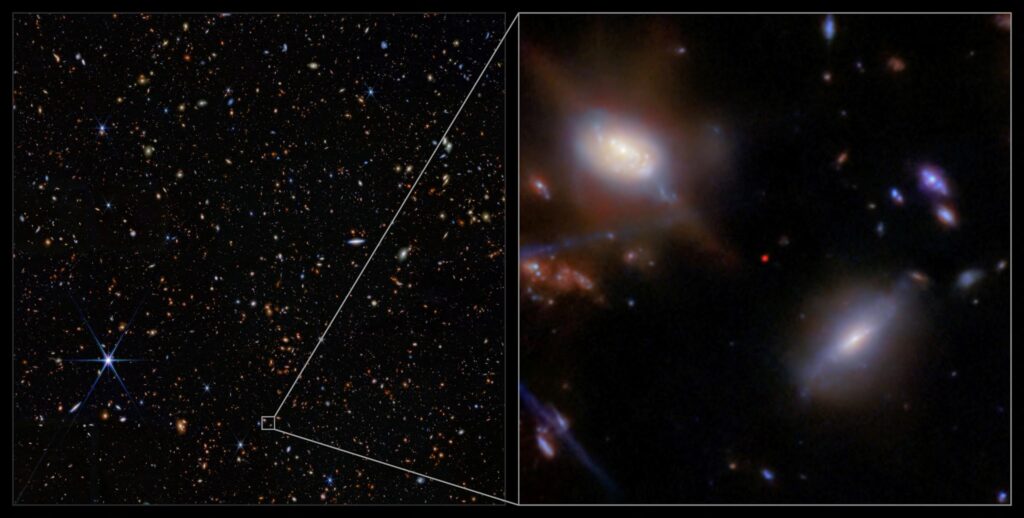
JWST has completely destroyed these predictions. The telescope has found a large population of incredibly massive, bright galaxies existing far earlier than our models allow. The biggest rule-breaker is a galaxy named JADES-GS-z14-0.
JADES-GS-z14-0 spotted by JWST. Source: ESA/Webb, NASA & CSA, JADES Coll / via REUTERS
| Feature | Measurement for JADES-GS-z14-0 |
| Lookback Time | ~13.5 billion years |
| Time after Big Bang | ~290 million years |
| Physical Size | ~1,600 light-years across |
| Stellar Mass | Hundreds of millions of suns |
Finding a galaxy that spans 1,600 light-years and holds hundreds of millions of stars just 290 million years after the Big Bang breaks our timeline. To make matters worse, scientists found oxygen and carbon in this galaxy. The presence of oxygen is devastating for our slow-growth models. It means multiple generations of giant stars must have formed, burned through their fuel, created heavy elements, and exploded as supernovas all within a 290-million-year window.
Scientists now face two diverging paths. First, they can change their astrophysics. Perhaps early gas turned into stars much more efficiently than it does today. Some suggest that early stars formed in massive bursts, making the galaxies look heavier than they actually are. Second, scientists can change their cosmology. Some theories suggest an “Early Dark Energy” helped dark matter collapse faster. Other theories suggest that gravity itself was stronger in the early universe, allowing matter to group together at impossible speeds.
New Findings: The Hubble Tension and Dynamical Dark Energy
While JWST breaks the early universe, another severe crisis plagues the modern universe. We call this the “Hubble Tension.” Despite a century of modern astronomy, scientists cannot agree on the exact value of the Hubble constant today.
The tension comes from a severe disagreement between two measurement methods:
- Early Universe Measurements: Scientists look at the ancient light from the Big Bang. By applying our standard model to this ancient light, they predict a slow modern expansion rate of about 67.4 km/s/Mpc.
- Late Universe Measurements: Scientists look at the actual movement of local stars and supernovas. This direct measurement yields a significantly faster expansion rate of about 73.0 km/s/Mpc.

The Hubble Tension. Source: Reuters Photographer / REUTERS
The difference between these two numbers is too large to be a simple mistake. It suggests that applying the rules of the early universe to the modern universe using a strict, unchanging dark energy is fundamentally flawed.
Recently, the Dark Energy Spectroscopic Instrument (DESI) provided a potential breakthrough. DESI maps the expansion of space using sound waves (not to be confused with literal sound but the literal pressure waves that rippled through the hot, primordial plasma, acting exactly like sound waves moving through air) frozen into the distribution of ancient galaxies. In our standard model, dark energy is constant. However, early data from DESI suggests a statistical preference for “Dynamical Dark Energy.” This means the strength of dark energy might actually change over time.
This evolving dark energy reveals incredibly complex behavior. Data suggests the universe may have undergone a “phantom crossing.” In the deep past, dark energy might have acted differently, slowly shifting its properties until it triggered our current acceleration. Some complex models even suggest that dark energy was negative in the past, acting as a pulling force, before switching signs to become a pushing force. This “sign-switching” behavior could help solve the Hubble tension by allowing the expansion rate to naturally drop from high local measurements to low ancient measurements.
However, adding dynamical dark energy creates new contradictions. When researchers try to force the fast local expansion rate to fit the DESI data, the mathematical models struggle. Fixing one anomaly seems to make another one worse. The universe simply refuses to fit neatly into one simple equation.
The Take Away
The Big Bang theory and our standard model of cosmology represent a towering achievement in human history. They provide an incredibly precise description of how space works, anchored by elegant math like the constant cosmic jerk and the beautiful coincidence of the Hubble time.
Yet, we stand at a critical turning point. The sheer volume of new data from precision tools like JWST and DESI demands a new way of thinking. The impossibly massive early galaxies force us to rethink how quickly structures can form. Simultaneously, the stubborn Hubble tension and the hints of dynamical dark energy tell us that our concept of empty space is too simple. The next decade of astronomy will not just add small details to our existing models. It will likely rewrite the fundamental laws governing the history, physics, and ultimate fate of our universe.
All this to say, WE as humanity have a long way to go to truly understand our universe through physical means. However….
The Start Of A New Era
…However, history has a funny way of repeating itself, doesn’t it?
Think about it: we used to be absolutely positive the Earth was flat. Then we thought everything revolved around us. We leveled up from heliocentrism to Newton’s gravity apple, then Einstein completely bent our understanding of space and time. Now? We are scratching our heads over this spooky, seemingly unborn dark energy. It is an endless cycle that proves one massive point: physical science is always going to hit a wall. According to the profound spiritual knowledge imparted by Sant Rampal Ji, this entire physical universe and its mind-bending laws are basically just child’s play within the massive domains of Kaal (the ruler of our mortal world) and Par Brahm (Mahakaal). There will always be something out there that our math just cannot touch, because the ultimate truth of creation sits way outside the reach of our biggest telescopes.
But here is the beautiful plot twist, all these scientific wild goose chases are not useless. The very same discoveries that let us measure the stars also gave birth to technologies that would look like literal magic to anyone living before the 1900s. We are talking about the global internet, pocket supercomputers, and instant communication. Why? Because it is a divine gift. God essentially gave us these mind-blowing tech upgrades to help us wake up. We are using these tools to spread absolute spiritual truth across the globe, kicking off a mini “Satyug” (a golden age of truth) right in the middle of our chaotic “Kalyug” (the dark age). Ultimately, these discoveries aren’t just for staring into the dark abyss of space; they are here to show us the limits of the physical world, point us toward the true spiritual path, and help us finally know the Supreme Creator.
If you are ready to stop wandering through the ever-shifting theories of astrophysics and want the absolute, unchanging truth about our existence and how to escape this cycle of birth and death, the answers are already here. Sant Rampal Ji offers a complete, verse-by-verse breakdown of our most sacred textsunlocking secrets that have been hidden in plain sight for centuries. To dive into the real ultimate reality, check out his profound satsangs and discourses available right now on YouTube and major broadcast networks worldwide and to start off you can look at this video that showcases how this change will take place :
For a deeper exploration of these theological foundations and the evidence cited from various religious scriptures, readers can visit jagatgururampalji.org or access literature such as “Gyan Ganga” and “Jeene Ki Raah” to examine the proofs directly, by free ordering or downloading these books for free.
FAQs
- What is the “cosmic jerk” in the expansion of the universe?
Ans: The cosmic jerk measures the exact mathematical rate at which the universe transitioned from initially slowing down to actively accelerating its expansion.
- How is the James Webb Space Telescope (JWST) rewriting the history of the universe?
Ans: JWST has discovered impossibly massive, fully formed galaxies existing just hundreds of millions of years after the Big Bang, defying our standard models of how quickly cosmic structures can grow.
- What is the “Hubble tension” in modern astronomy?
Ans: The Hubble tension is an unresolved scientific crisis where early-universe measurements predict a much slower modern expansion rate than what we actually observe in local, modern galaxies.
- Is dark energy a constant force, or is it changing over time?
Ans: While long thought to be a strict, unchanging force, new data from the Dark Energy Spectroscopic Instrument (DESI) suggests dark energy is actually “dynamical” and actively evolves over cosmic time.
- What is the “cosmic coincidence” regarding the age of the universe?
Ans: The “cosmic coincidence” is the lucky phenomenon where the universe’s early deceleration and recent acceleration perfectly balance out, making a simple, constant-speed calculation accidentally match its true age of 13.8 billion years.
- How do modern cosmic discoveries connect with ultimate spiritual truth?
Ans: Modern cosmic anomalies reveal the permanent limits of physical science, while the advanced technology born from these discoveries serves as a divine tool to help humanity connect and discover the ultimate spiritual truth taught by Sant Rampal Ji.