


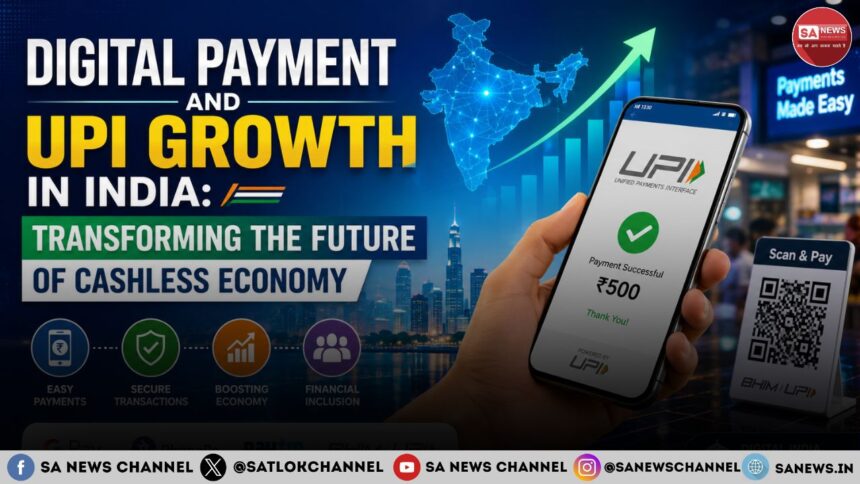
India has witnessed a remarkable transformation in the way financial transactions are carried out over the past decade. The rapid adoption of digital payment systems and the phenomenal success of the Unified Payments Interface (UPI) have revolutionized the country’s financial ecosystem. From purchasing groceries at a local shop to paying utility bills, booking tickets, transferring money, shopping online, and conducting business transactions, digital payments have become an integral part of daily life.
- Digital Payments: Changing the Way India Pays
- What is UPI?
- Journey of UPI in India
- Why UPI Became So Popular
- Instant Transactions
- Easy to Use
- No Need to Carry Cash
- Secure Payment System
- Available 24×7
- Zero or Minimal Charges
- Government Initiatives Driving Digital Payments
- Digital Payments Supporting Financial Inclusion
- Impact on Small Businesses
- E-commerce and Online Shopping
- Benefits for Farmers
- Digital Payments in Education
- Healthcare Sector Benefits
- Digital Payments in Public Services
- Role of Banks and FinTech Companies
- UPI and Rural India
- Women Empowerment Through Digital Payments
- Advantages of Digital Payments
- Challenges Facing Digital Payments
- Cybersecurity Threats
- Digital Literacy
- Internet Connectivity
- Smartphone Accessibility
- Safety Tips for UPI Users
- India’s Growing Global Recognition
- Future of Digital Payments
- Final Thoughts:
- Spiritual Perspective Inspired by Sant Rampal Ji Maharaj
- Know the Real Purpose of Human Life
- Frequently Asked Questions (FAQs)
Today, India is recognized as one of the global leaders in digital payments. Millions of people use UPI every day because it offers instant, secure, and hassle-free transactions. The country’s digital payment revolution is not only promoting financial inclusion but also contributing significantly to economic growth, transparency, and technological innovation.
Digital Payments: Changing the Way India Pays
Digital payment refers to any financial transaction carried out electronically without the exchange of physical cash. Payments can be made through mobile banking, internet banking, debit cards, credit cards, QR codes, digital wallets, and UPI-enabled applications.
The increasing availability of affordable smartphones, faster internet services, government initiatives, and improved banking infrastructure have encouraged people across urban and rural India to adopt digital payment methods.
Whether it is a vegetable vendor accepting QR code payments or a multinational company conducting high-value transactions digitally, digital payments have become the preferred mode of payment for millions of Indians.
What is UPI?
Unified Payments Interface (UPI) is an instant real-time payment system developed by the National Payments Corporation of India (NPCI). It enables users to transfer money directly from one bank account to another using a mobile phone without entering lengthy bank account details.
UPI allows users to:
– Send and receive money instantly.
– Pay utility bills.
– Shop online.
– Pay at retail stores through QR codes.
– Transfer money 24×7.
– Link multiple bank accounts to one application.
– Conduct secure transactions with PIN authentication.
Popular UPI applications include Google Pay, PhonePe, Paytm, BHIM, Amazon Pay, and several banking apps.
Journey of UPI in India
UPI was launched in 2016 with the objective of creating a simple, secure, and interoperable payment system.
Initially, only a limited number of banks supported UPI. However, within a few years, the platform experienced exponential growth due to its simplicity and convenience.
The introduction of QR code payments further accelerated adoption among small merchants, street vendors, restaurants, and local businesses.
The COVID-19 pandemic also played a significant role in increasing digital payment adoption. During lockdowns, people preferred contactless transactions to reduce physical contact, leading to a surge in UPI usage.
Today, UPI has become one of the world’s largest real-time digital payment systems.
Why UPI Became So Popular
Several factors have contributed to UPI’s extraordinary success.
Instant Transactions
Unlike traditional banking systems that often required waiting periods, UPI transfers money within seconds.
Easy to Use
Users only need a mobile number or UPI ID to transfer funds.
No Need to Carry Cash
Consumers no longer need to carry wallets full of cash while shopping.
Secure Payment System
Multiple authentication layers, PIN verification, and banking security protocols make UPI highly secure.
Available 24×7
UPI services remain available throughout the year, including weekends and public holidays.
Zero or Minimal Charges
Most UPI transactions are free for users, encouraging widespread adoption.
Government Initiatives Driving Digital Payments
The Government of India has played a crucial role in promoting digital payments through initiatives such as Digital India, Jan Dhan Yojana, Aadhaar integration, Direct Benefit Transfer (DBT), and BHIM (Bharat Interface for Money) app.
Financial literacy campaigns have educated citizens about secure digital payment practices, while banks and fintech companies have continuously introduced user-friendly mobile applications.
Government departments increasingly encourage online payments for taxes, utility bills, public services, and various schemes, making digital transactions more convenient for citizens.
Digital Payments Supporting Financial Inclusion
One of the biggest achievements of India’s digital payment revolution is financial inclusion.
Millions of previously unbanked citizens now have access to banking services through smartphones and digital payment platforms.
People living in remote villages can receive government subsidies directly into their bank accounts, reducing corruption and ensuring transparency.
Women, senior citizens, farmers, and small entrepreneurs are also benefiting from easy access to digital financial services.
Impact on Small Businesses
Small businesses have experienced significant growth due to digital payments.
Street vendors, grocery stores, tea stalls, vegetable sellers, pharmacies, and local retailers now accept UPI payments through QR codes.
Digital transactions reduce the need for maintaining cash, simplify bookkeeping, improve transparency, and help businesses build financial records that can assist in obtaining loans.
Customers also appreciate the convenience of cashless payments, increasing business efficiency and customer satisfaction.
E-commerce and Online Shopping
The rapid growth of online shopping platforms has further accelerated digital payment adoption.
Consumers now purchase clothes, electronics, groceries, medicines, food, travel tickets, and educational courses online using UPI within seconds.
Quick refunds, secure transactions, and seamless payment experiences have strengthened consumer confidence in online commerce.
Benefits for Farmers
Digital payments are transforming agriculture as well.
Farmers receive government subsidies, crop insurance claims, and financial assistance directly into their bank accounts.
They can purchase seeds, fertilizers, pesticides, machinery, and agricultural equipment through online payments.
Agricultural markets increasingly support digital transactions, reducing dependence on cash and improving transparency in trade.
Digital payment records may help farmers establish financial credibility while applying for agricultural loans.
Digital Payments in Education
Educational institutions have adopted online payment systems for admission fees, examination fees, hostel charges, library payments, and other services.
Parents can pay school fees instantly without visiting campuses.
Students purchasing online courses and educational materials also benefit from secure digital payment options.
Healthcare Sector Benefits
Hospitals, clinics, pharmacies, diagnostic centres, and healthcare providers have embraced digital payments.
Patients can pay consultation fees, purchase medicines, schedule appointments, and receive medical services through UPI.
This can reduce waiting times and improve administrative efficiency.
Digital Payments in Public Services
Digital payments have significantly improved the delivery of public services in India. Citizens can now pay electricity bills, water bills, property taxes, income taxes, insurance premiums, and other government charges online. Railway tickets, metro passes, toll payments, passport fees, and municipal services have also become more accessible through digital payment platforms.
The integration of digital payment systems has reduced paperwork, minimized long queues, and improved transparency in government transactions.
Role of Banks and FinTech Companies
Banks and financial technology (FinTech) companies have played a crucial role in expanding India’s digital payment ecosystem. Traditional banks have introduced user-friendly mobile banking applications, while FinTech companies have developed innovative solutions that simplify transactions.
Features such as QR code payments, contactless payments, recurring bill payments, auto-pay services, and instant notifications have made digital payments more convenient than ever before.
Healthy competition among banks and FinTech companies has encouraged continuous innovation, resulting in better services for consumers.
UPI and Rural India
One of the most remarkable achievements of UPI is its growing acceptance in rural India. Earlier, digital banking facilities were mainly concentrated in urban areas. Today, even villagers are using smartphones to receive payments, send money, and purchase daily necessities.
Government awareness campaigns, improved internet connectivity, affordable smartphones, and banking correspondents have helped bridge the digital divide.
Farmers, self-help groups, dairy cooperatives, artisans, and rural entrepreneurs are increasingly adopting digital payments to expand their businesses and improve financial management.
Women Empowerment Through Digital Payments
Digital payments have also contributed to women’s financial empowerment. Digital payments have made it easier for many women to manage their own bank accounts, receive salaries and government benefits directly, make purchases independently, and save money securely.
Self-help groups run by women entrepreneurs use digital payment platforms for business transactions, enabling them to participate more actively in the economy.
Advantages of Digital Payments
The rapid growth of digital payments offers numerous benefits:
– Instant transfer of money anytime and anywhere.
– Reduced dependence on physical cash.
– Improved transparency in financial transactions.
– Lower chances of theft and counterfeit currency.
– Better financial record-keeping.
– Faster business transactions.
– Convenience for customers and merchants.
– Easy payment of bills and taxes.
– Supports economic growth and financial inclusion.
– Encourages innovation in the financial sector.
Challenges Facing Digital Payments
Despite remarkable progress, several challenges remain.
Cybersecurity Threats
As digital transactions increase, cybercriminals continuously develop new methods of fraud. Phishing attacks, fake payment links, identity theft, and online scams remain major concerns.
Users should never share their UPI PIN, OTP, or other banking credentials with anyone.
Digital Literacy
Many people, particularly in remote areas, still lack adequate knowledge about using digital payment platforms safely.
Awareness programs and financial education remain essential for ensuring secure usage.
Internet Connectivity
Although internet penetration has improved significantly, some rural and remote regions still experience poor connectivity, affecting digital payment services.
Expanding reliable internet infrastructure remains an important priority.
Smartphone Accessibility
While smartphone ownership continues to rise, a section of the population still relies on basic mobile phones.
Affordable smartphones and digital inclusion initiatives can help bridge this gap.
Safety Tips for UPI Users
Experts recommend several precautions for safe digital transactions:
– Never share your UPI PIN or OTP.
– Verify the recipient’s name before transferring money.
– Avoid clicking suspicious links.
– Download payment apps only from official app stores.
– Enable screen lock and biometric authentication.
– Regularly update banking applications.
– Monitor bank statements for unauthorized transactions.
– Immediately report suspicious activity to your bank.
Following these simple practices can significantly reduce the risk of online fraud.
India’s Growing Global Recognition
India’s success in digital payments has attracted global attention. Several countries are exploring partnerships and collaborations to adopt similar real-time payment systems inspired by UPI.
India’s expertise in digital public infrastructure is increasingly being recognized as a model for financial innovation, particularly for developing economies seeking affordable and efficient payment solutions.
The international acceptance of UPI also reflects India’s growing influence in financial technology and digital innovation.
Future of Digital Payments
The future of digital payments in India appears highly promising. Emerging technologies such as Artificial Intelligence (AI), Machine Learning (ML), blockchain, biometric authentication, and voice-enabled payments are expected to further enhance the user experience.
In the coming years, digital payment systems are likely to become even faster, more secure, and more accessible. Cross-border UPI transactions, offline payment capabilities, and integration with emerging technologies could further strengthen India’s digital economy.
Experts believe that continued investment in cybersecurity, digital infrastructure, and financial literacy will be essential to sustain this growth.
India’s journey from a cash-dependent economy to one driven by digital transactions demonstrates how technology can transform everyday life. As more citizens, businesses, and government institutions embrace digital payments, the country moves closer to achieving a truly inclusive, transparent, and efficient financial ecosystem.
Final Thoughts:
The remarkable growth of online payments and UPI has transformed India’s financial landscape. What began as a digital initiative has now become an essential part of everyday life, enabling millions of people to make secure, instant, and convenient transactions. From street vendors and small shopkeepers to large corporations and government institutions, digital payments have simplified financial operations while reducing dependence on cash.
UPI has emerged as one of the world’s most successful real-time payment systems, reflecting India’s technological progress and commitment to financial inclusion. Government initiatives, widespread smartphone adoption, improved internet access, and innovative fintech solutions have together accelerated the country’s journey toward a cashless economy.
Despite challenges such as cybersecurity threats, digital fraud, internet accessibility, and the need for greater digital literacy, the future of digital payments remains highly promising. Continued investment in secure technology, public awareness, and financial infrastructure will further strengthen India’s digital economy.
As India moves forward, digital payments are expected to play an even greater role in supporting businesses, empowering farmers, promoting entrepreneurship, improving public services, and enhancing the overall quality of life. The success of UPI demonstrates how innovation can create an inclusive financial ecosystem that benefits every section of society.
Spiritual Perspective Inspired by Sant Rampal Ji Maharaj
While digital payment technology has made financial transactions easier and faster, material progress alone cannot provide lasting peace and happiness. According to the spiritual teachings of Sant Rampal Ji Maharaj, true success in life is achieved when human beings combine worldly progress with spiritual wisdom. Satgyan (true spiritual knowledge) teaches individuals to live honestly, avoid wrongdoing, perform righteous deeds, and remain devoted to the Supreme God. Just as digital technology simplifies financial life, true spiritual knowledge helps simplify human life by removing ignorance, fear, and attachment, guiding individuals toward permanent peace and salvation.
Know the Real Purpose of Human Life
Technology can improve our standard of living, but it cannot answer the deepest questions about human existence. If you wish to understand the real purpose of human life, the identity of the Supreme God, and the path to complete salvation, read the holy book “Gyan Ganga” written by Sant Rampal Ji Maharaj. The book presents spiritual knowledge based on sacred scriptures and encourages readers to lead a moral, peaceful, and meaningful life.
Frequently Asked Questions (FAQs)
Q1. What is a digital payment?
Answer: A digital payment is an electronic transaction made without using physical cash. It includes UPI, internet banking, mobile wallets, debit cards, credit cards, and QR code payments.
Q2. What is UPI?
Answer: UPI (Unified Payments Interface) is a real-time payment system that enables instant bank-to-bank money transfers using a mobile phone.
Q3. Why has UPI become so popular in India?
Answer: UPI is popular because it offers instant transactions, 24×7 availability, high security, ease of use, and minimal or no transaction charges.
Q4. What are the benefits of digital payments?
Answer: Digital payments provide convenience, speed, transparency, secure transactions, reduced cash handling, better financial records, and support financial inclusion.
Q5. Are UPI payments safe?
Answer: Yes. UPI is secure when users protect their UPI PIN, never share OTPs, verify recipient details, and use only official banking or payment applications.
Q6. How do digital payments benefit farmers?
Answer: Farmers receive subsidies directly into bank accounts, make online purchases of agricultural inputs, sell produce digitally, and maintain financial records for easier access to loans.
Q7. What challenges does digital payment adoption face?
Answer: Major challenges include cyber fraud, lack of digital literacy, internet connectivity issues, and smartphone accessibility in some regions.
Q8. What is the future of digital payments in India?
Answer: The future is promising, with advancements in artificial intelligence, biometric authentication, blockchain technology, voice-based payments, and international expansion of UPI.
Q9. How do digital payments contribute to India’s economy?
Answer: They improve transparency, reduce cash dependency, increase tax compliance, promote financial inclusion, support businesses, and strengthen the digital economy.
Q10. Where can I learn about the real purpose of human life?
Answer: According to the teachings of Sant Rampal Ji Maharaj, readers can understand the real purpose of human life by studying the book “Gyan Ganga,” which explains spiritual knowledge based on holy scriptures.