


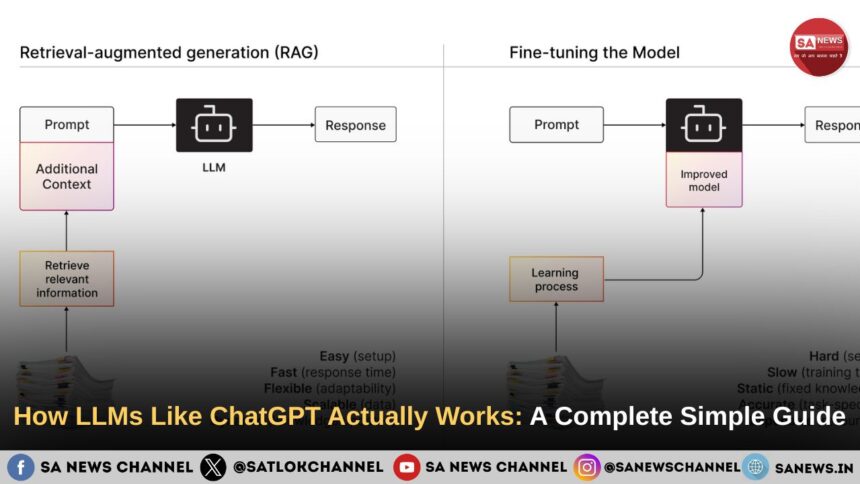
How LLM Works: Every week, more than 900 million people ask ChatGPT a question and get back an answer that reads like a real person wrote it. Almost none of them know what is actually happening in the two or three seconds before that answer shows up.
- Step 1: What ChatGPT Actually Is
- Step 2: Tokens, the Real Building Blocks of Text
- Step 3: Parameters, Explained With a Real Number
- Step 4: How Training Actually Happens
- Step 5: The Transformer, the Actual Engine Inside
- Step 6: How a Reply Gets Built, One Piece at a Time
- Step 7: Why Fluent Answers Are Not Always Correct Answers
- Step 8: Context Window, Another Key Term Worth Knowing
- ChatGPT’s Real Scale in 2026
- How This Should Change the Way You Use It
- The Human Question Behind the Machine
There is no brain inside. There is no understanding, not the way you and I understand things. What is actually there is a giant math machine that has learned to guess the next word really, really well. Once you see exactly how that guessing works, ChatGPT stops feeling like magic and starts making complete sense.
This guide will walk you through the whole thing, step by step, using real examples at every stage. No sentence will be left vague. Every big word will be explained the moment it shows up, using something you can picture in your head.
Step 1: What ChatGPT Actually Is
ChatGPT is built on something called an LLM, short for Large Language Model. Let us break that name apart.
“Language” means it works with words and sentences, not images or sound directly. “Model” just means a system that has been trained on data to do a job, in this case, the job of predicting text. “Large” means it was trained on a huge amount of writing and has an enormous number of internal settings, which we will explain properly in a minute.
Here is the simplest possible way to describe what it does: ChatGPT looks at the words you gave it, and then guesses, one word at a time, what word is most likely to come next. That is the entire job. Nothing more mysterious is happening. The magic is in how good that guess turns out to be, because of everything that happened during training.
Example: if you type “The capital of France is,” the model has seen this exact pattern so many times during training that it can guess “Paris” with very high confidence. If you type “I woke up and made a cup of,” it guesses something like “coffee” or “tea,” because those words showed up after that phrase millions of times in its training data.
Step 2: Tokens, the Real Building Blocks of Text
Here is something most explanations skip completely, and it is one of the most important ideas in this whole guide.
ChatGPT does not read your sentence letter by letter, the way your eyes move across a page. It also does not read it word by word. Instead, it breaks your sentence into pieces called tokens.
A token can be:
- A whole common word, like “dog” or “the”
- A piece of a longer or less common word, like “un,” “believ,” and “able” combining to form “unbelievable”
- Sometimes even just punctuation, like a comma or a period
Example: The word “strawberry” is likely broken into two tokens by the model, something like “straw” and “berry,” not into ten separate letters. This single fact, that the model works in these word-chunks called tokens instead of individual letters, explains a huge number of ChatGPT’s strange mistakes, which we will get to later in this guide.
Why does the model use tokens instead of full words? Because there are only about 50,000 to 100,000 common token chunks in English, but there are millions of possible words if you count every variation, tense, and spelling. Breaking words into smaller reusable chunks lets the model handle any word, even ones it has never seen before, by combining familiar pieces.
Step 3: Parameters, Explained With a Real Number
This is the part most articles get lazy about. Let us do it properly.
A parameter is a single adjustable number inside the model. Think of the model as an enormous machine full of knobs and dials, and each parameter is one of those dials. During training, the model turns these dials very slightly, over and over, billions of times, until turning them produces better guesses.
Here is a real, concrete number so this stops being abstract. GPT-3, an earlier model behind ChatGPT, had 175 billion parameters. GPT-4 is estimated to have around 1.7 to 1.8 trillion parameters, though OpenAI has not officially confirmed the exact figure.
What do these numbers actually mean in practice? Picture each parameter as controlling one tiny piece of judgment, like “how strongly should the word ‘bank’ lean toward meaning ‘a place with money’ versus ‘the side of a river,’ given the three words that came before it.” Multiply that kind of tiny decision by hundreds of billions, all working together at once, and you get a model that can handle grammar, tone, factual recall, and reasoning, all in a single pass.
Here is precisely how parameters change the output. More parameters generally mean:
- Finer distinctions between similar meanings. A small model might treat “happy” and “content” as almost identical. A model with far more parameters can capture the subtle difference, that “content” implies calm acceptance while “happy” implies active joy, because it has more dials available to represent that nuance.
- Longer chains of reasoning held together. With more parameters, the model can track more relationships across a longer passage, which is part of why bigger models handle multi-step math or logic problems more reliably.
- Better handling of rare topics. A smaller model might only have picked up a shallow pattern for niche subjects. A larger model, having more capacity, has room to store more detailed patterns about less common topics.
But more parameters is not automatically better in every way. A bigger model is also slower to run and far more expensive, since every single one of those billions of parameters has to be calculated for every single token it produces. This is exactly why companies also build smaller, faster versions like GPT-4o Mini, which use fewer parameters, around 8 billion, to answer quick questions cheaply and fast, trading away some depth for speed.
Step 4: How Training Actually Happens
Training happens in three clear stages. Each one shapes the model differently.
Stage one: pretraining. The model is shown a massive amount of text, an enormous slice of the internet, books, articles, and code. It plays one repetitive game: look at some text, cover up the next word, guess it, check the real answer, and adjust its parameters slightly if the guess was wrong. This single exercise, repeated an almost unimaginable number of times, is how the model learns grammar, facts, and reasoning patterns. Nobody wrote grammar rules into it directly. It picked up grammar the way a child does, purely through repeated exposure.
Stage two: supervised fine-tuning. Human writers create example conversations showing what a genuinely good, clear, helpful answer looks like. The model is trained specifically on these curated examples, which pushes it away from just mimicking random internet text and toward answering the way a helpful assistant actually should.
Stage three: reinforcement learning from human feedback, usually shortened to RLHF. Human reviewers are shown several different possible answers to the same question and rank them from best to worst. The model gets adjusted again based on these rankings, learning to produce more of what people actually rate highly.
Example showing why this matters: Without RLHF, if you asked the raw pretrained model “how do I make a bomb,” it might complete the sentence the way similar text on the internet often continues, which could be dangerous or unpredictable. RLHF is the stage where human feedback specifically trains the model to refuse harmful requests and to answer safely and helpfully instead. It is not a separate safety filter bolted on afterward. It is baked into the same parameters through this extra round of training.
Step 5: The Transformer, the Actual Engine Inside
Almost every model behind ChatGPT is built using an architecture called a transformer. This word gets thrown around constantly without explanation, so let us fix that.
Before transformers existed, older AI language models read text strictly in order, one word after another, like reading through a narrow flashlight beam. By the time these older models reached the end of a long sentence, they had often forgotten details from the beginning.
Transformers introduced a mechanism called attention. Instead of reading strictly in order, the model looks at every word in your entire message at the same time, and calculates how strongly each word should connect to every other word.
Concrete example: Take the sentence, “The trophy did not fit in the suitcase because it was too big.” Does “it” refer to the trophy or the suitcase? A human figures this out instantly using common sense about the physical world. The transformer figures it out mathematically, by calculating an “attention score” between “it” and every earlier word in the sentence, and finding that “it” connects most strongly to “trophy,” based on patterns learned from millions of similar sentences during training.
This single idea, attention, introduced in a research paper in 2017, is the actual reason chatbots went from producing choppy, forgetful text to writing long, coherent, connected paragraphs.
Read More : What is Machine Learning? Learn Everything With Easy Examples
Step 6: How a Reply Gets Built, One Piece at a Time
Now let us combine everything above into the exact sequence of events that happens the moment you send a message.
- Tokenizing: Your sentence gets broken into tokens, the word-chunks described earlier.
- Turning tokens into numbers: Each token gets converted into a long list of numbers, called a vector, that represents its meaning and its relationship to other words. Similar words end up with similar number patterns. For example, the vectors for “king” and “queen” end up mathematically close together, and close to “man” and “woman” too, in a way that actually captures the relationship between those words.
- Passing through attention layers: The model runs these vectors through many stacked layers of the attention mechanism described above, refining its understanding of how every word connects to every other word.
- Predicting the next token: After all this processing, the model produces a list of every possible next token, each with a probability score. “The sky is” might give “blue” a 70% chance, “clear” a 15% chance, “grey” an 8% chance, and thousands of other tokens much smaller chances.
- Picking a token: The model usually does not always pick the single highest-probability token every time. It samples somewhat randomly from the top choices, which is exactly why asking the same question twice can give you two slightly different, but both reasonable, answers.
- Repeating the whole process: That chosen token gets added to the sequence, and steps two through five repeat again to generate the next token, and the next, and the next, until the reply is finished.
This means a ChatGPT reply is never written as one complete thought. It is built one token at a time, hundreds of times per second, each new token depending on everything generated before it. That is also why longer replies appear to “type out” gradually on your screen. It genuinely is being created piece by piece in real time, not revealed from something already fully written.
Step 7: Why Fluent Answers Are Not Always Correct Answers
Because the model is built to predict likely text, not to check true facts, it can produce a completely wrong answer with the exact same confident tone as a correct one. This is called hallucination in AI, a polite term for the model simply making something up that sounds convincing.
Here are two real, easy to repeat examples that show this clearly.
Example one, the missing “x.” Ask ChatGPT which month’s spelling contains the letter “x.” It will often confidently name a month, even though no month, from January through December, actually contains an x anywhere in its spelling. Why? Because the model usually treats a word like “October” as one near-complete token, not as nine separate letters it is actively scanning one by one.
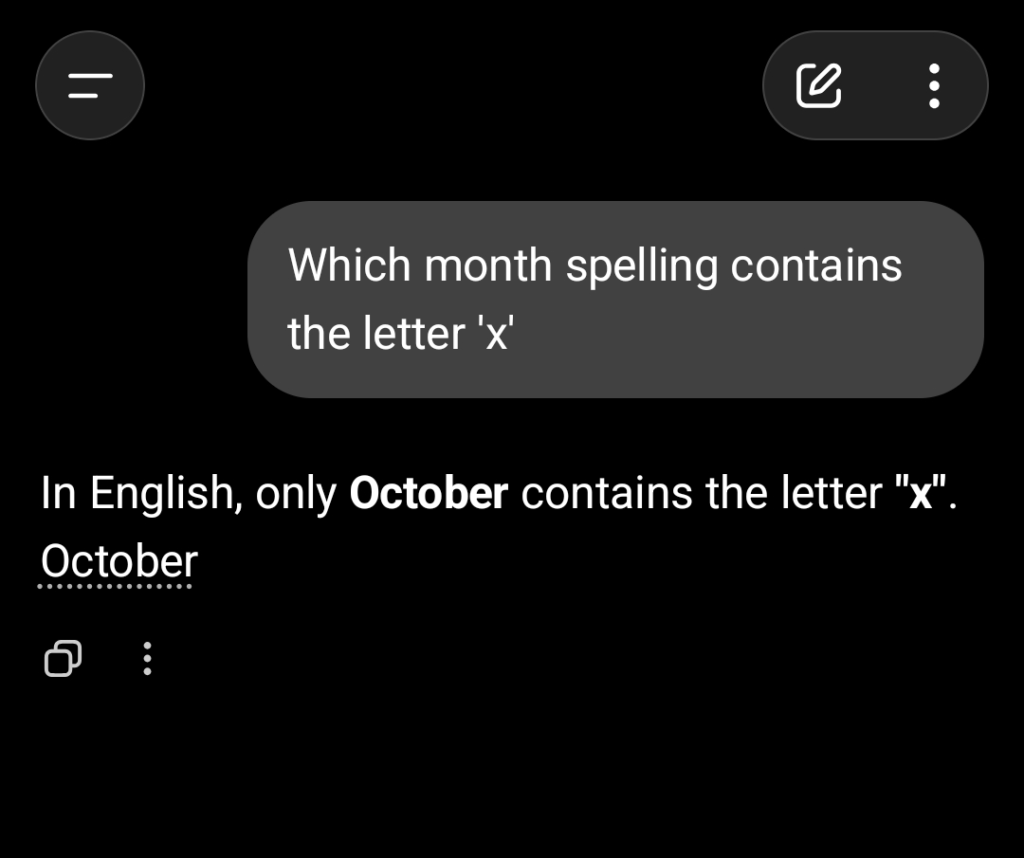
Asking about a specific letter buried inside a word asks it to check something at a level of detail, individual characters, that its whole system is not naturally built to track. So it falls back on a loose, half-remembered pattern from similar training examples and produces a guess instead of a genuine check.
Example two, the strawberry problem. Ask ChatGPT how many times the letter “r” appears in “strawberry.” Earlier versions frequently answered “2” instead of the correct “3.” The cause is the same tokenizing issue. If the model sees the word as two chunks, roughly “straw” and “berry,” rather than as ten individual letters s-t-r-a-w-b-e-r-r-y, it has to guess the letter count based on pattern memory rather than actually counting, and pattern memory is not reliable for something this exact.
Why can the same model still solve hard calculus? Because advanced math problems have appeared, worked out step by step, an enormous number of times across the model’s training data. The model has essentially seen the shape of solving these problems thousands of times, so predicting the correct next step feels natural to it. Counting individual letters inside a word almost never appears explicitly written out in training text, so the model has far less practice at that oddly specific skill, even though it has enormous practice at algebra. The model is not smarter at math and weaker at spelling. It relies on patterns for both. Math simply has far richer patterns available to learn from than letter-counting does.
Interestingly, once the strawberry mistake became widely known and joked about online, AI companies noticed and started deliberately including more character-level examples in later training rounds. Newer models have gotten noticeably better at this specific task, not because the model became magically smarter overall, but because it received more targeted practice at exactly this weak spot.
Step 8: Context Window, Another Key Term Worth Knowing
One more important idea: the context window. This is the total amount of text, measured in tokens, that the model can “see” and consider at once during a single conversation.
If a model has a context window of 128,000 tokens, roughly speaking that is around 90,000 to 100,000 English words it can keep in view at the same time. Anything beyond that limit gets pushed out of view, similar to how you might forget the exact wording of something said very early in a long conversation.
Example: If you paste a 300-page book into ChatGPT and ask a question about a detail from page 2, whether it can answer correctly depends heavily on whether that detail still fits inside the current context window, or whether it has already been pushed out by everything typed afterward.
ChatGPT’s Real Scale in 2026
All of this, tokens, parameters, attention, prediction, now runs at an enormous global scale.
| Metric | Figure (2026) |
| Weekly active users | Over 900 million |
| Daily prompts processed | Around 2.5 billion |
| GPT-3 parameter count | 175 billion |
| GPT-4 estimated parameter count | Around 1.7 to 1.8 trillion |
| Fortune 500 companies using it | 92% |
ChatGPT has over 800 million weekly active users as of February 2026, representing roughly 10% of the global adult population, an 8x increase from November 2023. The app crossed 1 billion global monthly active users in June 2026, becoming the fastest app in history to reach that milestone, faster than TikTok, Instagram, or Google Maps.
Every single one of those billions of daily replies, correct or flawed, runs through the exact same token-by-token, attention-based prediction process explained above.
Read More : GPT 5 and ChatGPT 5 Release Date and Full Update
How This Should Change the Way You Use It
Understanding the actual mechanism tells you exactly where to trust ChatGPT and where to slow down and check its work yourself.
- Lean on it for: drafting text, explaining concepts, brainstorming ideas, summarizing long documents, writing code following common patterns. These tasks reward broad pattern recognition, which is exactly what the model is built for.
- Double-check it for: exact counts, precise dates, rare statistics, and anything that needs character-by-character or fact-by-fact accuracy rather than a fluent-sounding pattern.
The same model that writes you a flawless, well-organized paragraph is, underneath, running the identical mechanism that might occasionally miscount a letter in the very next sentence. Both outcomes come from one single process: predicting the next most likely token, again and again, at incredible speed.
The Human Question Behind the Machine
Every single prediction an LLM makes is built entirely from human writing, human ideas, and human knowledge, absorbed from text and recombined at massive scale. In a real sense, ChatGPT is a reflection of humanity’s collective writing, not a mind of its own, and not a source of new truth beyond what humans have already written down somewhere.
That raises a quiet but important question underneath all this technical power. If a machine can now imitate our words this convincingly, what actually separates real human understanding from very advanced prediction? A machine can simulate a conversation, but it cannot simulate the search for meaning that sits underneath every honest question a person asks.
That search has occupied genuine seekers long before any of this technology existed. Those curious about that deeper layer of life, the part no algorithm can generate, may find it worth exploring “Gyan Ganga“ and “Way of Living“ by Saint Rampal Ji Maharaj, two works that turn attention away from artificial answers and toward real self-understanding.