Robotics has emerged as one of the most revolutionary technologies of the twenty-first century. From manufacturing industries and hospitals to agriculture, defense, education, and household applications, robots are transforming the way humans live and work. What was once considered science fiction has now become an integral part of modern society. The rapid advancements in artificial intelligence, machine learning, sensors, automation, and computing power have significantly accelerated the growth of robotics.
- What is Robotics?
- History and Evolution of Robotics:
- Types of Robots
- Role of Artificial Intelligence in Robotics:
- Robotics in Manufacturing:
- Robotics in Healthcare
- Robotics in Agriculture
- Robotics in Education
- Robotics and Smart Homes
- Robotics in Disaster Management
- India’s Progress in Robotics:
- Career Opportunities in Robotics:
- Skills Required for Robotics:
- Disadvantages of Robotics:
- Balancing Benefits and Challenges:
- Future of Robotics:
- Spiritual Perspective Inspired by the Teachings of Sant Rampal Ji Maharaj
- Final Thoughts:
- FAQs
Robotics is an interdisciplinary field that combines mechanical engineering, electronics, computer science, artificial intelligence, and control systems to design, construct, operate, and maintain robots. A robot is a programmable machine capable of carrying out tasks autonomously or semi-autonomously. These machines can perform repetitive, dangerous, or highly precise activities more efficiently than humans.
As countries across the world strive for technological leadership and economic growth, robotics is increasingly being recognized as a key driver of innovation, productivity, and sustainable development. The integration of robotics into various sectors promises improved efficiency, reduced operational costs, enhanced safety, and better quality of life.
What is Robotics?
Robotics is the branch of technology concerned with the conception, design, manufacture, and operation of robots. It also involves developing software systems that enable robots to perceive their environment, process information, make decisions, and execute actions.
A robot typically consists of the following components:
1. Mechanical Structure
The physical framework includes arms, wheels, legs, joints, and other moving parts that allow the robot to interact with its surroundings.
2. Sensors
Sensors help robots gather information from the environment.
Examples include:
- Cameras
- Temperature sensors
- Ultrasonic sensors
- Infrared sensors
- Pressure sensors
- GPS modules
3. Actuators
Actuators convert electrical signals into physical movement. Motors and hydraulic systems are common examples.
4. Controller
The controller acts as the brain of the robot. It processes information from sensors and sends commands to actuators.
5. Power Supply
Robots require energy sources such as batteries, fuel cells, or direct electrical connections.
6. Software
Programming enables robots to perform specific tasks, adapt to changing environments, and communicate with humans or other machines.
History and Evolution of Robotics:
The concept of automated machines dates back thousands of years. Ancient civilizations created mechanical devices that mimicked human movements. However, modern robotics began to develop during the twentieth century.
Early Developments:
In the 1920s, the term “robot” was introduced by Czech writer Karel Čapek in his play R.U.R. (Rossum’s Universal Robots). The word originated from the Czech term robota, meaning forced labor.
During the 1950s, inventor George Devol developed the first programmable industrial robot called Unimate. It was installed in an automobile manufacturing plant and marked the beginning of industrial robotics.
Growth in Industrial Applications
By the 1970s and 1980s, robots were widely used in automobile assembly lines for welding, painting, and material handling.
Intelligent Robotics Era
The development of artificial intelligence and machine learning in the twenty-first century enabled robots to learn from experience, recognize objects, understand speech, and make independent decisions.
Today, robots can assist surgeons, explore distant planets, deliver packages, and even provide companionship to elderly individuals.
Types of Robots
- Industrial Robots:
Industrial robots are commonly used in factories and manufacturing units. They perform repetitive tasks with high accuracy and speed.
Applications:
- Welding
- Painting
- Packaging
- Assembly
- Material handling
Advantages:
- Increased productivity
- Reduced human error
- Improved workplace safety
- Service Robots:
Service robots assist humans in performing daily activities.
Examples:
- Cleaning robots
- Delivery robots
- Hotel service robots
- Reception robots
- Medical Robots:
Medical robotics has revolutionized healthcare.
Examples:
- Robotic surgical systems
- Rehabilitation robots
- Prosthetic limbs
- Pharmacy automation systems
Benefits:
- Minimally invasive surgeries
- Faster recovery
- Reduced blood loss
- Enhanced surgical precision
- Agricultural Robots:
Agriculture is increasingly adopting robotics to improve productivity and address labor shortages.
Applications:
- Precision spraying
- Harvesting fruits
- Plant monitoring
- Weed removal
- Seed sowing
- Military Robots:
Defense forces use robots for hazardous missions.
Applications:
- Bomb disposal
- Surveillance
- Reconnaissance
- Unmanned combat vehicles
- Space Robots:
Space exploration relies heavily on robotic technology.
Examples:
- Planetary rovers
- Robotic arms
- Satellite servicing robots
These machines can operate in environments unsuitable for human survival.
- Humanoid Robots:
Humanoid robots resemble humans in appearance and movement.
Characteristics:
- Facial expressions
- Speech recognition
- Walking capability
- Human-like gestures
- Potential uses include customer service, education, healthcare, and entertainment.
Role of Artificial Intelligence in Robotics:
Artificial intelligence has become the backbone of modern robotics.
AI enables robots to:
- Understand spoken language
- Recognize faces
- Identify objects
- Navigate independently
- Learn from experience
- Predict outcomes
Machine learning algorithms allow robots to improve performance over time.
Computer vision technologies help robots analyze visual information from cameras and sensors.
Natural language processing enables communication between humans and robots.
The combination of AI and robotics is leading to the development of autonomous systems capable of functioning with minimal human intervention.
Robotics in Manufacturing:
Manufacturing industries are among the largest users of robotic technology.
Robots help companies achieve:
- Higher Productivity: Machines can work continuously without fatigue, significantly increasing production capacity.
- Better Quality: Robotic systems maintain consistent standards and reduce defects.
- Cost Reduction: Although initial investments are high, long-term savings can be substantial due to increased efficiency.
- Worker Safety: Robots perform dangerous tasks involving:
- Toxic chemicals
- Extreme temperatures
- Heavy lifting
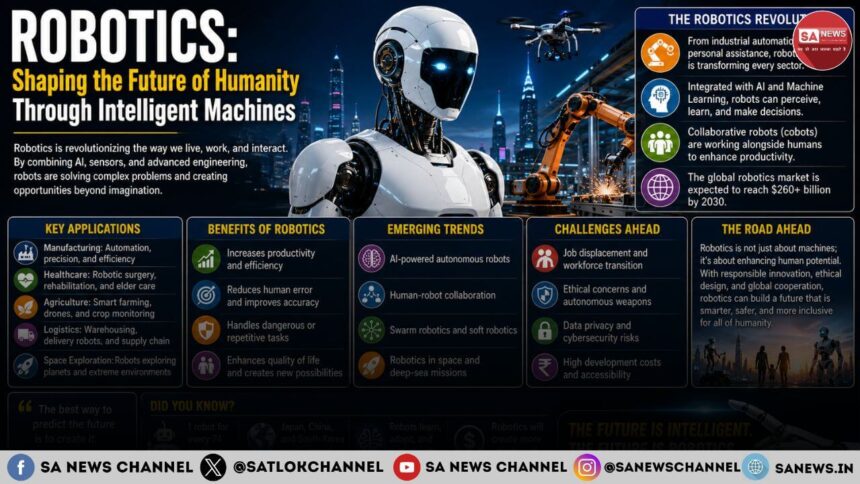
Countries such as Japan, South Korea, Germany, and China are global leaders in industrial robotics adoption.
Robotics in Healthcare
Healthcare robotics is one of the fastest-growing segments.
- Robotic Surgery: Surgeons use robotic systems to perform complex procedures with enhanced precision.
Benefits include:
- Smaller incisions
- Reduced pain
- Shorter hospital stays
- Lower infection risk
- Rehabilitation Robots: These robots assist patients recovering from strokes, injuries, or neurological disorders.
- Elderly Care Robots: Robots can remind patients to take medication, monitor vital signs, and provide companionship.
- Hospital Logistics: Autonomous robots transport medicines, laboratory samples, and medical supplies within hospitals.
Robotics in Agriculture
Agriculture faces challenges such as labor shortages, climate change, and rising production costs.
Robotic technologies can help farmers by improving resource utilization.
- Autonomous Tractors: Driverless tractors can plow, sow, and fertilize fields.
- Drones and Robotic Systems:Drone technology integrated with robotics assists in:
- Crop monitoring
- Disease detection
- Irrigation planning
- Fertilizer application
- Fruit Picking Robots: Robotic harvesters can identify ripe fruits and collect them without damaging crops.
- Weed Control Robots: These machines target weeds precisely, reducing herbicide usage.
The adoption of agricultural robotics can contribute to sustainable farming practices.
Robotics in Education
Educational institutions are increasingly incorporating robotics into curricula.
Benefits include:
- Practical Learning: Students gain hands-on experience in engineering and programming.
- Creativity Enhancement: Robotics projects encourage innovation and problem-solving skills.
- Teamwork Development: Students collaborate in designing and building robotic systems.
- Career Preparation: Exposure to robotics prepares learners for future technology-driven jobs.
Many schools organize robotics competitions to inspire young minds.
Robotics and Smart Homes
Smart home technologies increasingly rely on robotic systems.
Examples include:
- Vacuum cleaning robots
- Lawn mowing robots
- Window cleaning robots
- Security robots
Future home robots may assist with cooking, laundry, and childcare.
Voice assistants integrated with robotic platforms are making homes more convenient and efficient.
Robotics in Disaster Management
Natural disasters often expose rescue workers to dangerous conditions.
Robots can support emergency response efforts through:
- Search and Rescue: Robots equipped with cameras and sensors can locate trapped victims.
- Firefighting: Robotic systems can enter burning buildings where human firefighters cannot safely operate.
- Hazardous Material Handling: Robots manage chemical spills and radioactive environments.
- Damage Assessment: Aerial and ground robots provide real-time information to rescue teams.
- Robotics in Transportation: Autonomous transportation systems are rapidly developing.
Examples include:
- Self-driving cars
- Autonomous buses
- Delivery robots
- Warehouse automation vehicles
Benefits:
- Reduced traffic accidents
- Improved fuel efficiency
- Lower transportation costs
Challenges remain regarding safety regulations and public acceptance.
India’s Progress in Robotics:
India is gradually strengthening its robotics ecosystem.
Government initiatives promoting innovation include:
- Startup support programs
- Skill development missions
- Research grants
- Technology incubation centers
Indian universities and research institutions are conducting studies in:
- Artificial intelligence
- Autonomous navigation
- Human-robot interaction
- Medical robotics
Several Indian startups are developing robotic solutions for agriculture, healthcare, and logistics.
The demand for skilled robotics professionals is expected to increase significantly in the coming years.
Career Opportunities in Robotics:
Robotics offers exciting career prospects for students from engineering and science backgrounds.
Popular career options include:
1. Robotics Engineer: Designs and develops robotic systems.
2. Automation Engineer: Implements automated industrial processes.
3. Artificial Intelligence Engineer: Creates intelligent algorithms for robots.
4. Embedded Systems Engineer: Develops hardware-software interfaces.
5. Research Scientist: Conducts advanced studies in robotics technologies.
6. Data Scientist: Analyzes information generated by robotic systems.
7. Drone Specialist: Works with unmanned aerial vehicles and autonomous platforms.
Skills Required for Robotics:
Students interested in robotics should develop expertise in:
- Programming languages such as Python and C++
- Electronics
- Mechanical design
- Sensor technologies
- Artificial intelligence
- Machine learning
- Computer vision
- Mathematics
- Control systems
Practical experience through projects and internships is highly beneficial.
Disadvantages of Robotics:
Although robotics offers numerous advantages, it also presents several challenges and disadvantages that require careful consideration.
1. High Initial Investment: Installing robotic systems requires significant capital for purchasing equipment, software, infrastructure, and training employees. Small and medium-sized businesses may find it difficult to afford advanced robotics.
2. Job Displacement: One of the biggest concerns associated with robotics is the replacement of human labor in repetitive and routine jobs. Automation may reduce employment opportunities in sectors such as manufacturing, warehousing, and logistics, making reskilling and upskilling essential.
3. Maintenance and Technical Expertise: Robots require regular maintenance, software updates, and skilled technicians for repairs. Any technical failure can interrupt production and lead to financial losses.
4. Limited Decision-Making Ability: Even AI-powered robots cannot fully replicate human creativity, emotions, ethical judgment, and common sense. They may struggle in unexpected situations that require human intuition and experience.
5. Cybersecurity Risks: Modern robots are often connected to networks and cloud-based systems, making them vulnerable to hacking, malware, and cyberattacks. Unauthorized access can compromise sensitive data or disrupt operations.
6. Dependence on Electricity and Technology: Most robots rely on a continuous power supply and stable digital infrastructure. Power failures or system malfunctions can bring operations to a halt.
7. High Training Requirements: Employees need specialized training to operate, program, and maintain robotic systems. Organizations must invest time and resources in workforce development.
8. Ethical and Social Concerns: The increasing use of robots raises ethical questions about privacy, surveillance, accountability, and decision-making, especially in healthcare, defense, and law enforcement.
9. Lack of Human Touch: In sectors such as healthcare, education, and customer service, robots cannot fully replace empathy, compassion, emotional intelligence, and personal interaction that human beings provide.
10. Environmental Impact: The manufacturing and disposal of robotic components, batteries, and electronic equipment contribute to electronic waste (e-waste). Sustainable recycling and responsible disposal practices are essential to minimize environmental impact.
Balancing Benefits and Challenges:
Despite these disadvantages, robotics remains a transformative technology with immense potential. The key lies in adopting robotics responsibly, ensuring cybersecurity, promoting ethical AI practices, investing in worker reskilling, and using robots to complement human capabilities rather than replace them entirely. With proper planning and regulation, robotics can create safer workplaces, improve productivity, and contribute to sustainable economic growth while preserving the importance of human skills.
Future of Robotics:
The future of robotics appears highly promising.
Emerging trends include:
1. Collaborative Robots: These robots work safely alongside humans.
2. Swarm Robotics: Large groups of small robots cooperate to accomplish tasks.
3. Soft Robotics: Flexible materials enable robots to handle delicate objects.
4. Bio-inspired Robots: Designs inspired by animals improve mobility and adaptability.
5. Brain-Computer Interfaces: Humans can already control certain robotic systems through brain-computer interfaces in research and clinical applications, and broader adoption is expected in the future.
6. Quantum Robotics: Quantum robotics is an emerging research area that may eventually combine robotics with quantum computing and quantum sensing technologies.
Experts predict that robotics will become deeply integrated into everyday life over the next few decades.
Robots may assist teachers in classrooms, support elderly individuals at home, cultivate crops, construct buildings, explore oceans, and undertake missions to distant planets.
Spiritual Perspective Inspired by the Teachings of Sant Rampal Ji Maharaj
Followers of Sant Rampal Ji Maharaj believe that while robotics and artificial intelligence represent remarkable achievements of human intelligence, technology alone cannot provide lasting peace, freedom from suffering, or the ultimate purpose of life. According to their understanding of His teachings, scientific progress should be accompanied by spiritual wisdom, ethical values, compassion, and responsible conduct. They believe that true spiritual knowledge (Satgyan) helps individuals use technological advancements for the welfare of humanity rather than for destruction or selfish gain. From this perspective, robotics can improve human life when it is guided by morality, kindness, and a commitment to serving society. Those who wish to understand, according to these teachings, the real purpose of human life are encouraged to read the book “Gyan Ganga”, written by Sant Rampal Ji Maharaj.
Final Thoughts:
Robotics represents one of humanity’s most significant technological achievements. By combining engineering, artificial intelligence, and automation, robots are reshaping industries and improving countless aspects of daily life. Their applications in healthcare, agriculture, manufacturing, transportation, education, and disaster management demonstrate their immense potential.
While concerns regarding employment, ethics, and security must be addressed carefully, The benefits of robotics can outweigh the challenges when implemented responsibly. Governments, educational institutions, industries, and researchers should collaborate to ensure that robotic technologies are developed responsibly and inclusively.
As innovation continues to accelerate, robotics is expected to play a central role in building smarter economies, sustainable societies, and a better future for generations to come. Investing in robotics education, research, and skill development today will empower nations to thrive in an increasingly automated world.
FAQs
Q1. What is robotics?
Answer: Robotics is a branch of technology that involves the design, construction, programming, and operation of robots to perform tasks automatically or semi-automatically.
Q2. Where is robotics used?
Answer: Robotics is widely used in manufacturing, healthcare, agriculture, education, defense, logistics, construction, household services, and space exploration.
Q3. What are the main advantages of robotics?
Answer: Robotics improves productivity, accuracy, efficiency, workplace safety, and quality while reducing human error and operational costs.
Q4. What are the disadvantages of robotics?
Answer: Robotics has some drawbacks, including high installation costs, maintenance expenses, job displacement in repetitive roles, cybersecurity risks, and dependence on technology.
Q5. How is Artificial Intelligence used in robotics?
Answer: AI enables robots to learn from data, recognize objects, understand speech, make decisions, navigate independently, and perform complex tasks with minimal human intervention.
Q6. Is robotics a good career option?
Answer: Yes. Robotics offers excellent career opportunities in robotics engineering, automation, AI, embedded systems, machine learning, industrial automation, and research.
Q7. How is robotics helping agriculture?
Answer: Robotics helps farmers through autonomous tractors, precision spraying, robotic harvesting, weed control, crop monitoring, and efficient resource management.
Q8. What is the future of robotics?
Answer: The future of robotics includes collaborative robots (cobots), AI-powered autonomous systems, healthcare robots, smart manufacturing, space robotics, soft robotics, and human-robot collaboration across industries.