

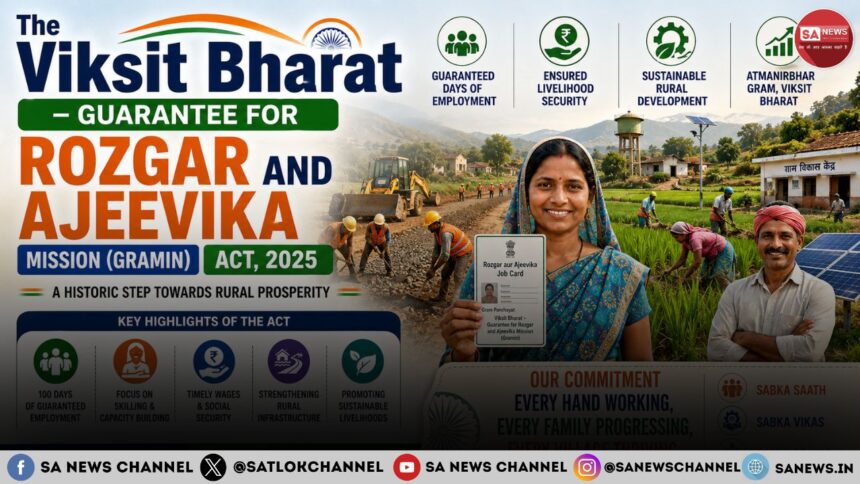
The Viksit Bharat – Guarantee for Rozgar and Ajeevika Mission (Gramin) Act, 2025, officially known as the VB-G RAM G Act, has come into effect across India on July 1, 2026. This landmark social welfare legislation marks a monumental shift in the structural governance of rural employment throughout the nation. By completely replacing the two-decade-old Mahatma Gandhi National Rural Employment Guarantee Act (MGNREGA) of 2005, the new law aims to align rural livelihood security with the central government’s long-term vision of an empowered, self-reliant nation under the Viksit Bharat @2047 initiative.
Key Features and Structural Shifts Under VB-G RAM G Act
The newly implemented Act brings a series of massive upgrades designed to optimize rural infrastructure creation and increase household incomes. The most significant shift is the expansion of the statutory employment guarantee. Eligible rural households are now legally entitled to 125 days of guaranteed wage employment in each financial year, a substantial increase from the previous 100-day limit under MGNREGA.
To maintain stability in the broader agricultural economy, the Act introduces a strategic 60-day state-notified pause during peak sowing and harvesting seasons. This ensures that local farmers have an adequate supply of agricultural labor when needed most, preventing artificial wage inflation and agricultural disruption.
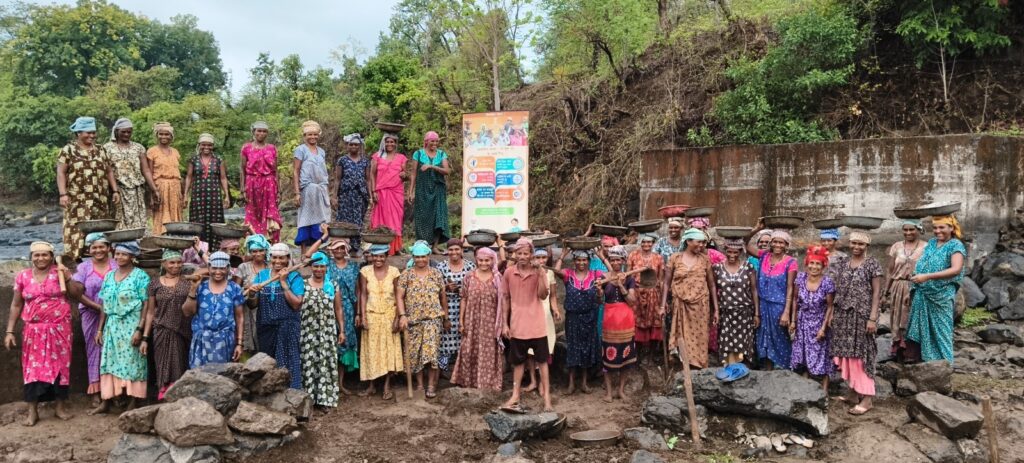
Another foundational structural change lies in the funding mechanism. Under the older MGNREGS framework, the Central Government absorbed 100% of the unskilled manual wage bill. The VB-G RAM G Act modifies this setup by shifting a portion of the financial responsibility onto state administrations.
| State/Region Classification | Centre-State Cost Sharing Ratio | Minimum Notified Base Wage |
| Standard States | 60:40 Ratio | Rs 300 per day |
| North Eastern and Himalayan States | 90:10 Ratio | Rs 300 per day |
| Union Territories (Without Legislature) | 100:0 Ratio (Fully Centrally Funded) | Rs 300 per day |
Also Read: International Day of Rural Women: Understand the Role of Rural Women to Attain Gender Equality
Revised Wage Rates and Financial Allocations
Coinciding with the national rollout on July 1, the Ministry of Rural Development notified heavily revised daily wage rates across all 34 states, Union Territories, and regional wage zones. A strict national floor wage of Rs 300 per day has been established, meaning no notified daily wage anywhere in the country can fall below this baseline. This structural correction has driven the national average notified wage up by more than 10%, shifting from Rs 298.8 per day to Rs 327.4 per day.
States that historically maintained lower wage limits are experiencing the most substantial percentage boosts. For example, Uttar Pradesh, Bihar, West Bengal, Jharkhand, and Assam are seeing direct wage increases ranging between 15% and 25%. On the higher end of the scale, Haryana maintains the highest standard daily wage rate at Rs 409, closely followed by Goa at Rs 406 and Kerala at Rs 401, while specific high-altitude Gram Panchayats in Sikkim will receive a specialized rate of Rs 450 per day. To ensure a seamless transition and prevent any disruptions in ongoing public works, the Centre has released an interim budgetary allocation of Rs 95,692.31 crore to the states.
Technological Integration and Governance
The implementation protocol places Gram Panchayats directly at the center of planning and execution through the formulation of localized Viksit Gram Panchayat Plans. To ensure complete transparency, the operational architecture incorporates advanced technology, including real-time GPS tracking, mobile-based monitoring, biometric authentication, and artificial intelligence to minimize irregularities and identity theft.
The transition guidelines clarify that all existing e-KYC verified job cards remain completely valid for accessing work until states progressively issue the new, multi-colored Gramin Rozgar Guarantee Cards. Special, distinctly colored cards are also being prioritized for vulnerable groups, including single women, individuals with disabilities, senior citizens, and transgender persons.
Also Read: International Day for the Eradication of Poverty 2025 (Hindi): संसार में दुख और गरीबी कैसे दूर होगी?
Raajneeti vs. Dharamneeti: The Reality of True Security
While the VB-G RAM G Act suggests that the old MGNREGA framework is finally operating at its absolute limits, such raajneetik (political) schemes remain a fragile, temporary fix for the struggles of the mortal world. In contrast, the dharamneeti championed by Sant Rampal Ji Maharaj is embodied in the Annapurna Muhim.
This Muhim provides free, lifetime rations to every needy person, entirely unconditional—requiring neither labor nor payment. Beyond basic sustenance, this Muhim empowers families by providing newly constructed homes, free medical care, and quality education for children, ensuring dignity for the soul.
While worldly schemes fluctuate with political tides, the Annapurna Muhim demonstrates that true security is found when one aligns with the Supreme Almighty, transcending the temporary nature of material survival to achieve lasting peace and eternal salvation.
Frequently Asked Questions on VB-G RAM G Act
Q1. What is the full form of the VB-G RAM G Act?
Ans: The full form is the Viksit Bharat – Guarantee for Rozgar and Ajeevika Mission (Gramin) Act, 2025.
Q2. How many days of employment are guaranteed under the new Act?
Ans: The Act guarantees up to 125 days of wage employment per financial year for eligible rural households.
Q3. Which previous social welfare legislation does this new Act replace?
Ans: It completely replaces the Mahatma Gandhi National Rural Employment Guarantee Act (MGNREGA) of 2005.
Q4. What is the newly established minimum national floor wage under this Act?
Ans: The minimum base wage rate has been strictly fixed at Rs 300 per day across the nation.
Q5. What happens if an eligible applicant is not provided work within the stipulated time?
Ans: The Act mandates that a daily unemployment allowance becomes payable by the respective state government if work is not provided within 15 days of demand.