


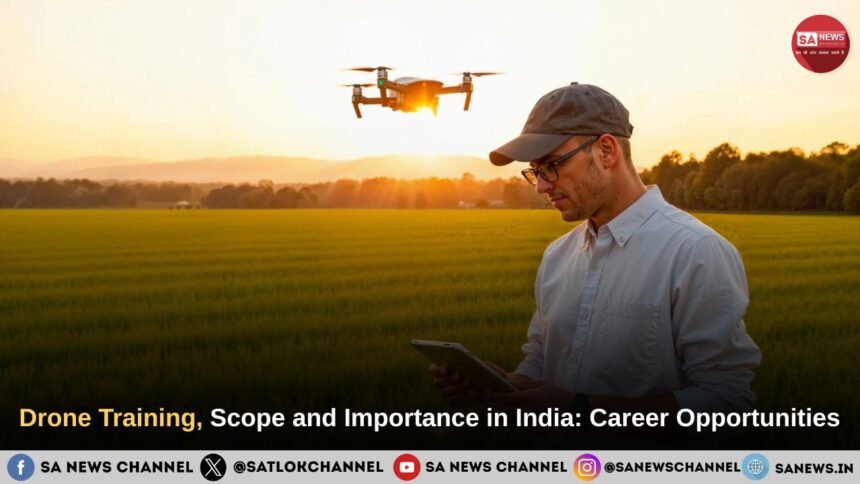
Drone Training: In recent years, drone technology has emerged as one of the most transformative innovations across the world. Drones, technically known as Unmanned Aerial Vehicles (UAVs), are aircraft that operate without an onboard human pilot and can be controlled remotely or fly autonomously through programmed flight plans. What was once considered a technology limited to military applications has now become an essential tool in agriculture, disaster management, infrastructure inspection, logistics, filmmaking, healthcare, environmental monitoring, and many other sectors.
- Understanding Drone Technology:
- Classification of drones:
- Importance of Drone Training:
- Components of a Drone Training Program:
- Theoretical Training
- Practical Training:
- Assessment
- Scope of Drone Technology in Agriculture:
- Precision Agriculture
- Pesticide Spraying
- Crop Health Assessment
- Scope in Surveying and Mapping:
- Disaster Management
- Infrastructure Inspection
- Healthcare Applications
- Environmental Conservation
- Wildlife Monitoring
- Forest Management
- Water Resource Assessment
- Pollution Monitoring
- Applications in Media and Entertainment
- Defense and Security Applications:
- Logistics and Delivery Services
- Career Opportunities in the Drone Sector:
- Drone Pilot
- Drone Maintenance Technician
- Data Analyst
- Agricultural Drone Operator
- Drone Instructor
- Research Scientist
- Entrepreneur
- Government Initiatives
- Challenges in Drone Adoption:
- High Initial Investment
- Limited Battery Life
- Regulatory Compliance
- Privacy Concerns
- Weather Dependence
- Lack of Skilled Personnel
- Future Prospects of Drone Technology:
- Drone Technology and Spiritual Knowledge: A Unique Perspective Inspired by Sant Rampal Ji Maharaj
- Final Thoughts
- FAQs
India is witnessing rapid growth in the drone ecosystem due to supportive government policies, technological advancements, and increasing demand for efficient and cost-effective solutions. Recognizing the immense potential of drones, educational institutions, research organizations, government departments, and private companies are conducting drone training programs to develop a skilled workforce capable of operating and maintaining these sophisticated machines.
Drone training plays a crucial role in ensuring the safe, legal, and effective use of drones. It equips individuals with technical knowledge, practical flying skills, and an understanding of regulations governing drone operations. As the drone industry continues to expand, trained drone pilots and technicians will be in high demand, creating new employment opportunities and contributing significantly to economic development.
This article discusses the importance of drone training, the scope of drone technology in various sectors, career opportunities, challenges, and the future prospects of drones in India.
Understanding Drone Technology:
A drone is an unmanned aircraft equipped with sensors, cameras, navigation systems, communication devices, and propulsion mechanisms. Depending on its purpose and design, drones can vary in size, range, payload capacity, and flight endurance.
Major components of a drone:
– Flight controller
– Motors and propellers
– Electronic Speed Controllers (ESCs)
– Battery system
– GPS module
– Remote controller
– Cameras and imaging sensors
– Communication systems
– Payload attachments
Classification of drones:
- Based on weight
– Nano drones
– Micro drones
– Small drones
– Medium drones
– Large drones
- Based on wing configuration:
1. Fixed-Wing Drones:
These resemble conventional airplanes and are suitable for long-distance surveys and mapping.
2. Multi-Rotor Drones:
These drones have multiple propellers and are widely used for photography, surveillance, and agricultural spraying.
3. Hybrid Drones:
Hybrid drones combine the advantages of fixed-wing and multi-rotor systems.
Importance of Drone Training:
Drone technology offers tremendous opportunities, but improper handling can lead to accidents, property damage, and violations of aviation regulations. Therefore, structured training programs are essential.
1. Ensuring Safe Operations
Training teaches operators how to fly drones safely, maintain control during emergencies, and minimize risks associated with adverse weather conditions, technical failures, and crowded environments.
2. Pilots learn:
Pre-flight inspection procedures
Battery management
Emergency landing techniques
Obstacle avoidance methods
Weather assessment
2. Knowledge of Regulations
Drone operations are regulated by aviation authorities to ensure public safety and national security.
Training programs provide information regarding:
– Drone registration procedures
– Permission requirements
– No-fly zones
– Height restrictions
– Privacy laws
– Airspace classifications
Understanding these regulations helps operators avoid legal complications.
3. Skill Development
Practical training improves the confidence and proficiency of drone pilots.
Trainees gain experience in:
– Manual flying
– Autonomous missions
– Camera operations
– Data collection
– Agricultural spraying
– Mapping and surveying
4. Increasing Employment Opportunities:
The drone sector is expected to generate thousands of jobs.
Training enables individuals to work as:
– Drone pilots
– Drone instructors
– Maintenance engineers
– Survey specialists
– Data analysts
– Agricultural service providers
5. Promoting Technological Innovation
Training encourages students and professionals to explore advanced technologies such as:
– Artificial Intelligence
– Machine Learning
– Geographic Information Systems
– Remote sensing
– Computer vision
These technologies enhance drone capabilities and open new possibilities.
Components of a Drone Training Program:
A comprehensive drone training course generally includes theoretical and practical sessions.
Theoretical Training
Topics covered include:
– Basics of aerodynamics
– Drone components
– Principles of flight
– Aviation terminology
– Airspace regulations
– Navigation systems
– Communication protocols
– Meteorology
– Safety procedures
– Practical Modules
Practical Training:
– Drone assembly
– Calibration
– Flight simulations
– Manual take-off and landing
– Waypoint missions
– Payload management
– Data acquisition
– Maintenance practices
Assessment
Participants are evaluated through:
– Written examinations
– Flight tests
– Project assignments
– Skill demonstrations
Successful candidates receive certification that enhances their professional credibility.
Scope of Drone Technology in Agriculture:
Agriculture is one of the sectors benefiting most from drone applications.
Crop Monitoring
Drones equipped with high-resolution cameras capture images of crop fields.
These images help farmers identify:
– Pest infestations
– Disease outbreaks
– Nutrient deficiencies
– Water stress
Timely detection allows corrective measures to be taken before significant losses occur.
Precision Agriculture
Precision farming aims to optimize inputs while maximizing productivity.
Drones facilitate:
– Variable rate fertilizer application
– Precision spraying
– Site-specific crop management
This reduces wastage and lowers production costs.
Pesticide Spraying
Drone spraying offers several advantages:
– Uniform distribution
– Reduced labor requirement
– Faster coverage
Lower exposure to hazardous chemicals
Farmers can spray large areas in a short period.
Crop Health Assessment
Multispectral sensors measure vegetation indices that indicate crop vigor.
Farmers can assess:
– Plant growth stages
– Nutritional status
– Yield potential
– Livestock Monitoring
Drones help monitor grazing animals and detect missing livestock.
They can also inspect fencing systems and water resources.
Scope in Surveying and Mapping:
Traditional land surveys are time-consuming and expensive.
Drone-based surveys provide:
– High accuracy
– Rapid data collection
– Detailed topographic maps
Applications include:
– Land records management
– Urban planning
– Road construction
– Mining operations
– Watershed development
– Photogrammetry software converts drone images into three-dimensional models.
Disaster Management
Natural disasters often damage transportation networks, making access difficult.
Drones assist authorities by providing real-time information.
Applications include:
Flood Monitoring
Drones identify flooded regions and stranded populations.
Earthquake Assessment
They inspect damaged buildings and infrastructure.
Forest Fire Detection
Thermal cameras detect hotspots and monitor fire spread.
Search and Rescue
Drones equipped with night vision cameras locate victims in remote areas.
Their rapid deployment capability improves emergency response.
Infrastructure Inspection
Inspection of bridges, power lines, and industrial facilities involves significant risk.
Drones provide safer alternatives.
They are used for inspecting:
Transmission towers
Wind turbines
Pipelines
Railways
Solar panels
Dams
High-definition imagery helps engineers detect defects and plan maintenance.
Healthcare Applications
Drone technology is revolutionizing healthcare delivery.
Applications include:
Transporting medicines
Delivering vaccines
Carrying blood samples
Supplying emergency equipment
Remote villages can receive essential medical supplies quickly.
During disease outbreaks, drones reduce human contact and support public health efforts.
Environmental Conservation
Drones contribute to environmental protection by monitoring ecosystems.
Wildlife Monitoring
Researchers track animal populations without disturbing habitats.
Forest Management
Drones estimate forest cover and identify illegal logging activities.
Water Resource Assessment
Reservoirs and rivers can be surveyed efficiently.
Pollution Monitoring
Sensors detect contaminants in air and water bodies.
Applications in Media and Entertainment
Drone photography has transformed visual storytelling.
Drones are extensively used for:
Film production
Sports coverage
Tourism promotion
Wedding videography
News reporting
Aerial footage enhances audience engagement.
Defense and Security Applications:
Defense agencies use drones for surveillance and reconnaissance.
Applications include:
Border monitoring
Intelligence gathering
Threat assessment
Disaster response support
Security agencies employ drones during public events for crowd management.
Logistics and Delivery Services
Several companies are experimenting with drone deliveries.
Benefits include:
Reduced transportation time
Lower fuel consumption
Improved accessibility
Faster emergency deliveries
In the future, drones may become common in e-commerce and food delivery services.
Career Opportunities in the Drone Sector:
The expanding drone ecosystem offers diverse career options.
Drone Pilot
Certified pilots operate drones for commercial purposes.
Drone Maintenance Technician
Technicians inspect and repair drone systems.
Data Analyst
Professionals process drone-generated data.
Agricultural Drone Operator
Operators provide spraying and monitoring services to farmers.
Drone Instructor
Experienced pilots train new candidates.
Research Scientist
Scientists develop innovative drone technologies.
Entrepreneur
Individuals can establish businesses related to:
Drone rental services
Agricultural spraying
Surveying
Photography
Mapping solutions
Government Initiatives
The Government of India has introduced several initiatives to promote drone adoption.
Major initiatives include:
Drone Rules 2021
Digital Sky Platform
Drone Training Organisations
PLI Scheme
Drone Didi Programme
SVAMITVA Scheme
Startup Support
Skill Development Programs
Under the SVAMITVA Scheme, drones have been used to survey lakhs of villages and prepare crores of property cards, while the Drone Didi initiative is helping women self-help groups adopt drone-based agricultural services.
Challenges in Drone Adoption:
Despite numerous benefits, certain challenges remain.
High Initial Investment
Advanced drones and sensors can be expensive.
Limited Battery Life
Most drones have restricted flight durations.
Regulatory Compliance
Operators must stay updated regarding evolving regulations.
Privacy Concerns
Unauthorized surveillance may violate individual privacy.
Weather Dependence
Strong winds and rainfall affect drone performance.
Lack of Skilled Personnel
There is still a shortage of certified drone pilots and technicians.
Future Prospects of Drone Technology:
The future of drones appears highly promising.
Emerging trends include:
Artificial Intelligence-powered autonomous drones
Swarm technology
Drone taxis
Advanced collision avoidance systems
Longer-lasting batteries
Integration with 5G networks
Smart city applications
Experts believe drones will become an integral part of daily life, much like smartphones and computers today.
Drone Technology and Spiritual Knowledge: A Unique Perspective Inspired by Sant Rampal Ji Maharaj
Drone technology demonstrates how advanced science enables humans to monitor, protect, and manage resources from a higher perspective with precision and efficiency. Similarly, followers of Sant Rampal Ji Maharaj believe that true spiritual knowledge (Satgyan) provides a higher understanding of life, helping individuals overcome ignorance, live ethically, and progress toward spiritual well-being. According to his followers, Sant Rampal Ji Maharaj is imparting authentic spiritual knowledge based on the teachings of holy scriptures.
Just as drones are effective only when guided by accurate systems and proper direction, they believe that human life reaches its true purpose when guided by genuine spiritual wisdom. In this way, drone technology symbolizes the importance of guidance and vision, while spiritual knowledge emphasizes inner awareness, moral values, and righteous living, demonstrating how both science and spirituality can contribute to the welfare of humanity in their respective domains. Readers interested in learning more about these beliefs may explore Gyan Ganga, written by Sant Rampal Ji Maharaj, which his followers present as a source of spiritual teachings based on holy scriptures.
Final Thoughts
Drone technology has evolved into a powerful tool capable of transforming multiple sectors of the economy. From precision agriculture and disaster management to healthcare, infrastructure inspection, and environmental conservation, drones are improving efficiency, reducing costs, and enhancing decision-making processes.
However, the successful adoption of drone technology depends largely on proper training and skill development. Drone training programs equip individuals with technical expertise, operational competence, and regulatory awareness necessary for safe and productive drone usage.
As India moves toward becoming a global drone hub, investments in training, research, and innovation will play a crucial role in realizing the full potential of this technology. With increasing government support, expanding industrial applications, and rising employment opportunities, drones are expected to become one of the most influential technologies shaping the future.
FAQs
1. What is drone training?
Drone training is a structured program that teaches participants how to safely operate, maintain, and manage drones while understanding aviation regulations and practical applications.
2. Who can join a drone training course?
Students, farmers, engineers, entrepreneurs, government employees, and professionals from various sectors can enroll in drone training programs.
3. How are drones useful in agriculture?
Drones help farmers in crop monitoring, pesticide spraying, nutrient management, disease detection, precision farming, and livestock monitoring.
4. What career opportunities are available after drone training?
Certified individuals can work as drone pilots, agricultural drone operators, survey specialists, maintenance technicians, instructors, data analysts, or start their own drone-based businesses.
5. What are the major challenges in drone adoption?
Some challenges include high initial investment, limited battery life, regulatory compliance, privacy concerns, weather dependency, and a shortage of skilled professionals.
6. What is the future scope of drone technology in India?
The future scope is vast, with emerging applications in smart cities, autonomous delivery systems, AI-powered drones, swarm technology, healthcare logistics, and precision agriculture.
7. Why is drone training important?
Drone training ensures safe operations, improves technical skills, increases employment opportunities, and helps operators comply with aviation laws and regulations.
8. Can drones replace traditional farming methods?
Drones cannot completely replace traditional farming methods, but they significantly enhance efficiency, reduce labor costs, and support data-driven decision-making in modern agriculture.