

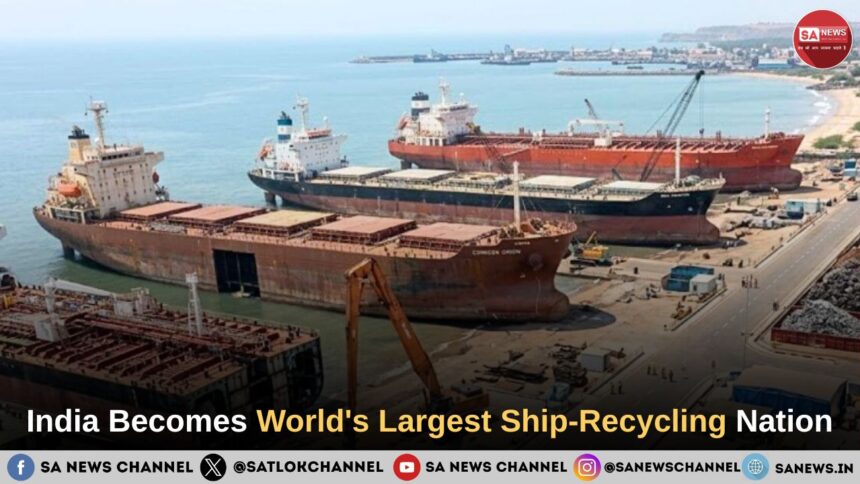
In a monumental achievement for the nation’s blue economy, India officially emerged as the world’s largest ship-recycling nation in 2025, capturing a dominant 35.4% share of the global market. According to the landmark report released by the United Nations Conference on Trade and Development (UNCTAD), India overtook its regional and global competitors by recycling an extraordinary 2.99 million Gross Tons (GT) of shipping volume.
This staggering figure represents a massive 60% year-on-year growth compared to the 1.86 million GT recorded in 2024. With this surge, the Ministry of Ports, Shipping and Waterways (MoPSW) has successfully accomplished the central objective of the Maritime India Vision (MIV) 2030 five years ahead of its original schedule, cementing India’s position as a premier global hub for responsible, circular manufacturing and green industrial recycling.
Deciphering the UNCTAD Data: The Growth Surge
The latest UNCTAD figures showcase a profound structural shift in global ship-breaking dynamics. Historically a highly fragmented market with frequent shifts between South Asian nations, 2025 saw India consolidate a commanding lead.
The industry’s expansion is fundamentally linked to a tightening global shipping pool and an aging mercantile fleet. According to forecasts from the Baltic and International Maritime Council (BIMCO), more than 16,000 vessels are slated for decommissioning over the next decade. Backed by its massive 35.4% global market share, India’s modernized facilities are technically positioned to process between 500 to 600 large vessels annually, converting millions of tons of marine scrap into high-grade reusable structural steel.
Also Read: World Environment Day: जानिए पर्यावरण का महत्व, इतिहास, थीम और धरती को बचाने के आसान उपाय
The Blueprint of Success: Key Government Policy Initiatives
India’s rapid climb to the absolute top of the global ship-recycling ladder is not a matter of chance. It is the direct result of targeted regulatory updates, fiscal incentives, and massive investments in infrastructure compliance.
Global Compliance via the Hong Kong Convention (HKC)
The foundational turning point for the industry was the enactment of the Recycling of Ships Act, 2019, which structurally aligned the domestic dismantling ecosystem with the Hong Kong International Convention for the Safe and Environmentally Sound Recycling of Ships (HKC). Backed by government financial assistance totaling ₹53.5 crore, a remarkable 115 Indian ship-recycling yards successfully upgraded their operational models to achieve full HKC compliance. This has opened the doors to premium European and international ship owners who mandate strict environmental and worker safety standards.
The Innovative Ship-Breaking Credit Note Scheme
To incentivize dual growth in both recycling and active domestic shipbuilding, the MoPSW introduced a highly effective economic multiplier: the Ship-breaking Credit Note Scheme.
- The Benefit: Under this initiative, ship owners are issued a financial credit note equivalent to 40% of the scrap value of their recycled vessel.
- The Utility: This credit can be directly utilized to offset up to 5% of the total cost of constructing a brand-new vessel at any certified Indian shipyard, creating a highly sustainable, self-contained maritime loop.
| Metric / Operational Factor | 2024 Performance | 2025 Performance (UNCTAD Report) | Year-on-Year Growth (%) | MIV 2030 Target Status |
| Global Market Share (%) | 30.1% | 35.4% | +17.6% Growth | Achieved (5 Years Early) |
| Recycled Tonnage (Gross Tons) | 1.86 Million GT | 2.99 Million GT | +59.7% Growth | Achieved (5 Years Early) |
| HKC-Compliant Indian Yards | 90 Facilities | 115 Facilities | +27.7% Compliance | Continuously Upgrading |
| Projected Annual Vessel Capacity | ~350 Vessels | 500–600 Vessels | Scaled Base Capacity | Positioning for Future Demand |
Future Expansion: Transforming Alang into a 9-Million LDT Powerhouse
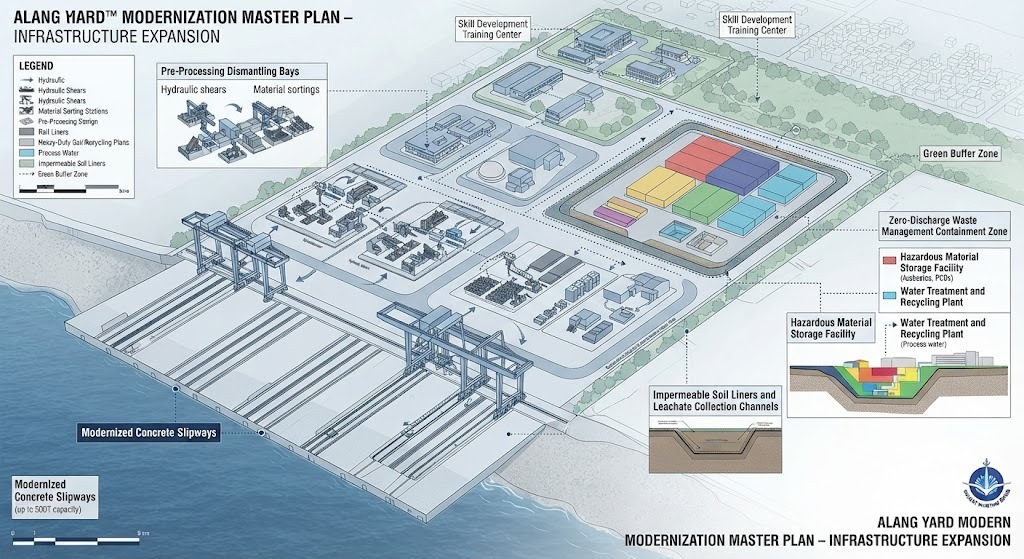
With leadership firmly established, the Government of India and the State Government of Gujarat have already deployed a comprehensive infrastructure master plan to safeguard this dominance. Central to this strategy is the massive physical expansion of the Alang Ship Recycling Yard in Gujarat.
Also Read: Maritime Crisis: Hantavirus Outbreak Kills 3 on Atlantic Cruise Ship
The master plan aims to nearly double the country’s existing capacity to an unprecedented 9 million Light Displacement Tons (LDT). Concurrently, Indian maritime authorities are actively pursuing the structural inclusion of domestic yards under the strict European Union Ship Recycling Regulations (EUSRR), which would solidify absolute dominance over western maritime retirement contracts.
Deconstructing the Wealth of the World: A Spiritual Lesson in Impermanence
All materialistic things, earthly titles, and worldly possessions are strictly temporary and destined to perish with time. True, permanent wealth is not found in financial or worldly success, but in the spiritual naam (true holy word) and the ultimate moksha (salvation) attained through it. Sant Rampal Ji Maharaj is the complete saint authorized to grant this true, scripture-certified naam, guiding souls away from transient illusions toward eternal peace. To understand this deep spiritual truth and the true way of worship, you can order the book Gyan Ganga for free by clicking this link.
Frequently Asked Questions (FAQs) on Ship-Recycling
Q1. Which international organization recognized India as the world’s top ship-recycling nation?
Ans: India’s top ranking was officially published and validated by the United Nations Conference on Trade and Development (UNCTAD) in its specialized global maritime tracking data.
Q2. What was India’s total global market share in ship recycling in 2025?
Ans: India captured a dominant 35.4% of the global ship-recycling market in 2025, rising significantly from the 30.1% market share recorded in 2024.
Q3. What is the total volume of ship tonnage recycled by India in 2025?
Ans: India processed an exceptional 2.99 million Gross Tons (GT) of shipping volume in 2025, which marks a near 60% growth compared to the previous year.
Q4. What is the significance of the Hong Kong Convention (HKC) in this achievement?
Ans: The HKC sets strict international benchmarks for safe and environmentally sound ship recycling. By upgrading 115 domestic yards to meet these global standards, India successfully attracted high-value international ship owners who mandate green recycling practices.
Q5. How does the Ship-breaking Credit Note Scheme benefit ship owners?
Ans: The scheme grants ship owners a credit note worth 40% of the scrap value of their recycled vessel. This credit can then be used to pay for up to 5% of the cost of building a new vessel at an Indian shipyard, promoting domestic manufacturing.