

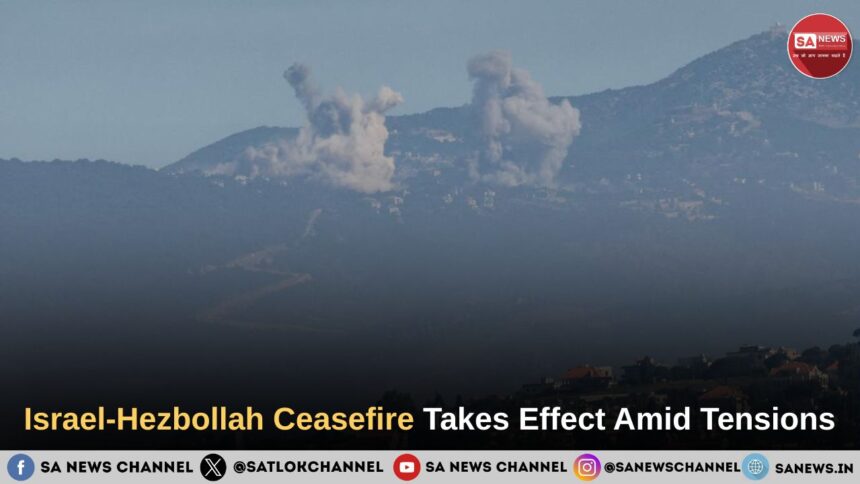
A significant diplomatic development has emerged in the Middle East, with a ceasefire between Israel and Hezbollah confirmed. According to a senior US official, both sides agreed to halt hostilities beginning at 4:00 p.m. local time (1300 GMT) on Friday, June 19.
The agreement was brokered with the assistance of US and Qatari mediators, while Iran was also involved in the negotiations, underscoring the broader regional dimensions of the conflict. The ceasefire is being viewed as a crucial step toward preventing a wider escalation at a time of heightened tensions across the Middle East.
Morning Clashes Prompt Urgent Diplomatic Efforts
The ceasefire came after a fresh outbreak of violence earlier on Friday that raised fears of a broader confrontation.
Reports indicated that Israeli strikes in southern Lebanon killed dozens of people, while Hezbollah attacks resulted in the deaths of Israeli soldiers. The exchanges of fire marked one of the most serious flare-ups in recent weeks and threatened to derail ongoing diplomatic initiatives aimed at stabilising the region.
The rapid escalation reportedly intensified international efforts to secure an immediate halt to hostilities, ultimately leading to the ceasefire agreement announced later in the day.
US, Qatar, and Iran Play Key Roles in Negotiations
Diplomatic sources said the ceasefire was achieved through intensive behind-the-scenes negotiations involving multiple regional and international actors.
A senior US official confirmed that Israel and Hezbollah had accepted the truce following mediation efforts led by Washington and Doha. Iran’s involvement was also considered significant, given its influence on regional dynamics and its connections to ongoing diplomatic discussions.
Although reports initially noted that neither Israel nor Hezbollah had publicly confirmed the agreement across all media outlets, US officials stated that the ceasefire was in effect and expected both sides to adhere to its terms.
Linked to Broader 2026 Regional Tensions
The latest ceasefire is not an isolated development. It is closely connected to the wider geopolitical tensions that have shaped the Middle East throughout 2026.
Analysts describe the agreement as a renewal or reinforcement of earlier ceasefire frameworks established during April and June 2026. The conflict has also been linked to broader regional instability associated with the ongoing Iran war and efforts to revive US-Iran negotiations.
Recent fighting had briefly jeopardised diplomatic engagement between Washington and Tehran, leading to the postponement of scheduled talks. Observers believe the ceasefire could help create conditions for renewed diplomacy and reduce the risk of further regional escalation.
International Media Widely Reports the Agreement
The ceasefire was extensively reported by major international news organisations, including BBC, CNN, Reuters, Associated Press (AP), Deutsche Welle (DW), and other global outlets.
These organisations cited US, regional, and diplomatic sources in confirming the agreement. The widespread coverage reflects the international significance of the ceasefire and its potential implications for security and stability across the Middle East.
Governments and diplomatic observers worldwide are closely monitoring developments to assess whether the agreement can hold and contribute to a broader de-escalation of tensions.
Concerns Emerge Over Possible Violations
Despite the announcement, questions remain about the durability of the ceasefire.
Shortly after reports of the agreement emerged, some social media accounts referenced explosions and possible ceasefire violations in southern Lebanon. While these reports were not immediately verified, they highlighted the fragile nature of the truce and the challenges associated with implementing such agreements in an active conflict zone.
Security analysts cautioned that the coming hours and days would be critical in determining whether both parties remain committed to the ceasefire.
What Comes Next?
The ceasefire offers a potential opportunity to reduce violence and reopen diplomatic channels, but experts warn that lasting peace will require far more than a temporary halt in fighting.
Regional and international stakeholders, including the United States, Qatar, Iran, Israel, and Hezbollah, will face the challenge of ensuring compliance with the agreement while pursuing broader political and security arrangements.
Given the complex nature of Middle Eastern geopolitics, observers stress that sustainable stability will depend on continued diplomacy, confidence-building measures, and renewed engagement among all relevant parties.
For now, the ceasefire that took effect at 4:00 p.m. local time (1300 GMT) on June 19, 2026, represents an important step toward containing violence and preventing a wider regional conflict. The international community will be watching closely to see whether the agreement can endure and pave the way for further diplomatic progress.