


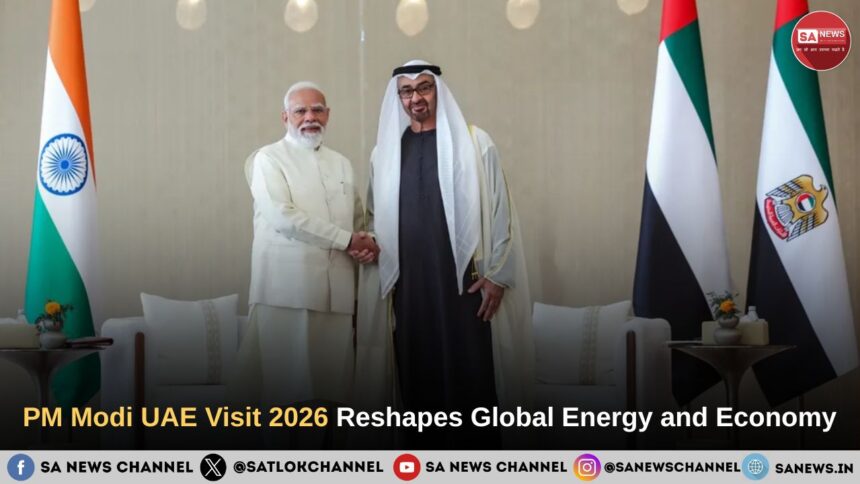
PM Modi visit UAE: Prime Minister Narendra Modi concluded a brief but highly productive visit to the United Arab Emirates on Friday, marking a monumental opening leg of his five-nation tour. The high-stakes visit significantly fortified the India-UAE Comprehensive Strategic Partnership against a backdrop of heightened geopolitical uncertainty in West Asia. Through a series of landmark agreements, New Delhi and Abu Dhabi have aggressively expanded their collaboration across energy security, advanced technology, defense industrialization, and multi-billion-dollar capital investments.
A Ceremonial Welcome and Deepening Brotherly Ties
Demonstrating the exceptional personal chemistry and deep institutional trust between the two leaderships, UAE President Sheikh Mohamed bin Zayed Al Nahyan extended a special gesture by personally receiving Prime Minister Modi at the Abu Dhabi airport. The Prime Minister was accorded a ceremonial guard of honor, while his aircraft was escorted by UAE military jets upon entering the nation’s airspace.
Shortly after their delegation-level talks, Prime Minister Modi took to the social media platform X to express his gratitude, describing the UAE as his “second home.” In the wake of recent regional stability challenges and drone attacks in the Gulf, PM Modi strongly condemned the targeting of the UAE, emphasizing that India stands “shoulder-to-shoulder” with Abu Dhabi. The Prime Minister praised the UAE’s restraint and reiterated India’s readiness to extend all possible support to restore regional peace.
$5 Billion Investment Influx into Infrastructure and Banking
Economic ties between the two nations reached an unprecedented milestone as the UAE announced fresh investment commitments totaling 5 billion dollars (approximately ₹42,000 crore) into the Indian economy. This capital injection showcases the Gulf nation’s unwavering confidence in India’s growth trajectory.
According to Indian diplomatic officials, the investment package is highly diversified:
- Banking Sector: A significant chunk of 3 billion dollars will be invested by the UAE’s Emirates NBD bank directly into the Indian banking infrastructure, marking a historic first for UAE-India financial collaboration.
- Infrastructure Growth: The Abu Dhabi Investment Authority (ADIA) committed 1 billion dollars to be channeled into priority infrastructure sectors in tandem with the National Investment and Infrastructure Fund (NIIF).
- Financial Liquidity: The International Holding Company (IHC) will inject an additional 1 billion dollars into Samman Capital to boost domestic credit and housing finance.
Transforming Energy Security and Strategic Reserves
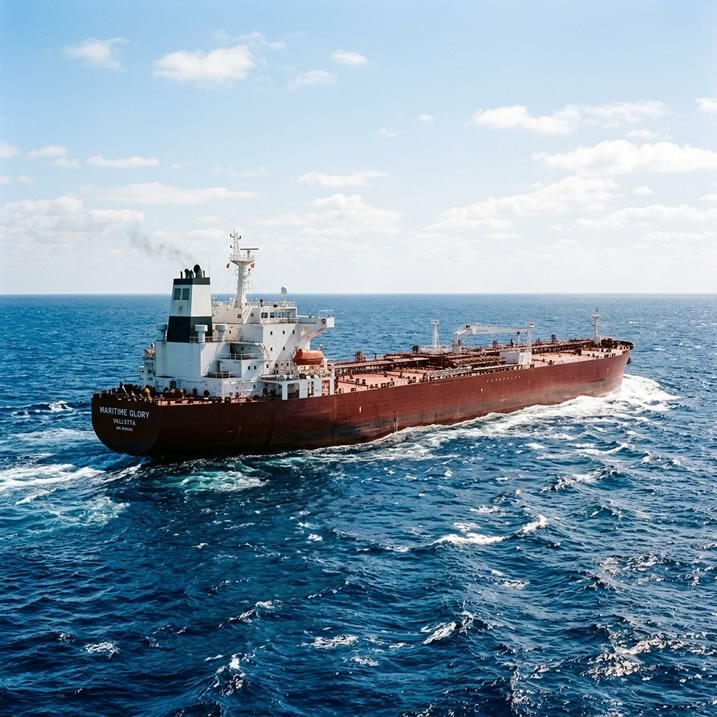
With global energy markets facing volatility, energy security emerged as the operational anchor of the bilateral talks. The primary breakthrough came via an agreement between Indian Strategic Petroleum Reserves Limited and the Abu Dhabi National Oil Company (ADNOC). Under this framework, the UAE will exponentially scale up its crude storage participation in India’s underground strategic reserves from its current levels to a massive 30 million barrels.
Going beyond traditional crude oil, the two countries agreed to cooperate on building strategic storage reserves for liquefied natural gas (LNG) and liquefied petroleum gas (LPG). A long-term contract signed between Indian Oil Corporation (IOCL) and ADNOC secures prioritized LPG supply to India, a critical buffer considering the UAE currently fulfills nearly 40% of India’s domestic cooking gas requirements. Both leaders strongly underscored the necessity of keeping the critical Strait of Hormuz free, open, and safe for global energy transit.
Advancing AI, Defence, and Maritime Infrastructure
The visit also witnessed a major technological leap with the signing of a term sheet to establish a cutting-edge 8-exaflop supercomputer facility in India. This rare international collaboration places India and the UAE at the forefront of global artificial intelligence infrastructure and advanced data processing.
In parallel, military ties shifted from standard joint exercises to a robust Agreement on Framework for the Strategic Defence Partnership. This framework shifts focus toward joint defense industrial collaboration, technology transfers, cyber defense, and co-production. Furthermore, to optimize bilateral maritime logistics, an MoU was signed to set up a dedicated Ship Repair Cluster at Vadinar in Gujarat, expanding India’s coastal ecosystem alongside a newly operationalized virtual trade corridor connecting the customs and port authorities of both nations.
Context of the Five-Nation Tour
The highly successful UAE stopover serves as the springboard for Prime Minister Modi’s broader six-day international diplomatic push spanning May 15 to May 20, 2026. Following his departure from Abu Dhabi, the Prime Minister arrived in the Netherlands to advance high-tech semiconductor manufacturing and clean energy cooperation.
From Amsterdam, PM Modi is scheduled to travel to Sweden and Norway—where he will attend the 3rd India-Nordic Summit in Oslo to build resilient technology supply chains following the recently finalized India-EFTA and India-EU Free Trade agreements. The Prime Minister will conclude his global tour in Italy to solidify bilateral strategic roadmaps with Rome.
FAQs: PM Modi Visit to the UAE
What are the major outcomes of PM Modi’s 2026 visit to the UAE?
The visit resulted in a 5 billion dollar investment commitment from the UAE, a massive expansion of strategic petroleum reserves to 30 million barrels, a long-term LPG supply contract, a Strategic Defence Partnership framework, and an agreement to build an 8-exaflop AI supercomputer facility in India.
Where will the UAE’s 5 billion dollar investment in India be utilized?
The funding is split into three main sectors: 3 billion dollars from Emirates NBD into the Indian banking sector, 1 billion dollars from ADIA into priority infrastructure via the NIIF, and 1 billion dollars from the International Holding Company into Samman Capital.
How does this visit strengthen India’s energy security?
By increasing the UAE’s crude oil storage in Indian strategic reserves to 30 million barrels and initiating strategic gas, LNG, and LPG storage partnerships, India creates a vital buffer against global supply chain disruptions.
What is the significance of the Vadinar agreement signed during the visit?
An MoU was signed to establish a Ship Repair Cluster at Vadinar in Gujarat. This will expand India’s maritime infrastructure, boost local ship maintenance capabilities, and integrate with a virtual trade corridor to reduce logistical transit times between India and the UAE.
How did the West Asia conflict impact the discussions?
Given ongoing regional tensions, PM Modi strongly condemned attacks on the UAE and stated that India stands “shoulder-to-shoulder” with the nation. Both leaders emphasized the critical importance of keeping vital maritime trade routes, specifically the Strait of Hormuz, free and secure.