


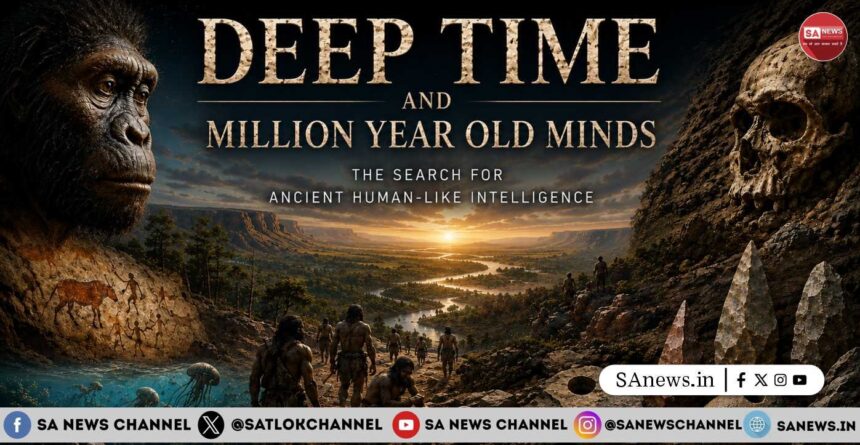
For a long time, scientists believed that human exceptionalism our advanced intelligence, complex tools, and organized societies belonged only to *Homo sapiens*. Traditional history tells us these traits appeared near the end of the Pleistocene epoch, only about 300,000 years ago. However, new discoveries demand a massive shift in how we understand the past.
- The Immense Gulf of Deep Time
- The Fast Decay of Our World
- The Lithic Bias and Taphonomy
- How Intelligence Evolves
- The Deep Roots of Our Family Tree
- Ancient Engineers and Weapon Makers
- The Power of Fire and Society
- Sailing the Open Oceans
- Art, Symbols, and the Ancient Mind
- We Are More Ancient Than We Think
- Did Ancient Humans Pray To God?
- FAQs
When we carefully look at the geological record, ancient environments, and new archaeological sites, a different story emerges. Recent advances in imaging technology, AI-assisted analysis, and neuroarchaeology have provided new insights into ancient human behavior. Evidence suggests that some ancient hominin species displayed far more sophisticated behavior and cognitive abilities than once believed. These ancient populations used sophisticated tools, may have crossed open waters, and likely lived in socially coordinated groups.
This article explores the timeline of advanced intelligence on Earth. We will first look at the massive scale of geologic time and why the Earth hides its past. Then, we will explore the signs of ancient minds, from complex wooden tools and the mastery of fire to the earliest sea voyages and the dawn of symbolic art.
The Immense Gulf of Deep Time
To understand the chance of advanced intelligence living a million years ago, we must first face the limits of the geological record. Scientists use the idea of “deep time” to describe the billions of years of Earth’s history. This scale is so vast that human minds struggle to picture it. Because the Earth is dynamic, its active crust and living ecosystems constantly recycle, bury, and destroy physical evidence.
In the past, people heavily restricted their estimates of the Earth’s age. In 1664, an Irish archbishop named James Ussher claimed the Earth began in 4004 BC. He believed the planet was only about six thousand years old. It was not until the late 1700s that Scottish scientists like James Hutton realized the Earth’s rock layers proved the planet was unimaginably older. Today, we know the Earth is about 4.5 billion years old.
To picture this, imagine a long piece of string where one inch equals one year. The entire recorded history of humanity would take up just 1.6 miles of string. The total age of the Earth, however, would require a string 72,600 miles long enough to wrap around the globe nearly three times.
The Fast Decay of Our World
If a human-like intelligence built homes and cities a million years ago, why do we not see them? We can answer this by looking at how quickly our own modern world decays. Without humans constantly repairing things, our buildings fall apart incredibly fast.
Water quickly ruins roofs and rusts steel. Fungus and bacteria eat away at wood. Within just 500 years, a modern neighborhood would collapse entirely, and forests would reclaim the land. The only things that might survive from an average house are plastics, aluminum parts, and stainless steel pots.
Massive engineering projects face the same fate. Without constant pumping, underground subways would flood almost immediately. Without daily dredging, dirt and jungle plants would swallow the Panama Canal. If our modern world can vanish in just a few thousand years, the chance of an ancient building surviving for a million years is almost zero.
The Lithic Bias and Taphonomy
The fact that we do not find ancient cities does not mean ancient people lacked intelligence. It is simply the result of natural decay, a process scientists call taphonomy. Taphonomy studies how things decay and fossilize. For an object to survive millions of years, it must land in a perfect, oxygen-free environment that protects it from bacteria, water, and crushing rocks.
This creates a severe “lithic bias” , a bias toward stone. Stone tools and mineralized bones are the only things tough enough to survive the crushing pressure of deep time. Meanwhile, organic tools made of wood, plant fibers, and animal skins rot away. Because we only find the simple stone tools that survived, we assume ancient people only had simple technology. If an ancient group built a highly advanced society using mostly wood and natural materials, almost all evidence of their brilliance would disappear.
How Intelligence Evolves
To believe that non-sapiens species had human-like minds, we must understand how intelligence grows. High intelligence did not march in a straight line directly to *Homo sapiens*. Instead, complex brains evolve independently across many different animal groups when they face intense pressure to survive.
Scientists see incredible problem-solving skills in octopuses, dolphins, elephants, and even crows and parrots. These animals share common pressures: they navigate complex social groups, hunt for hard-to-find food, and spend a long time raising their young. Crows, for example, have brains the size of walnuts and lack a mammalian cortex. Yet, they remember the past, solve puzzles together, and invent new tools. This proves that high intelligence does not require a human brain shape.
Brains and Stone Handaxes
Paleoanthropologists debate whether early humans grew large brains to handle complex social politics or to map out complex environments for food. Most likely, ancient humans needed their brains for both. They had to survive rapidly changing climates by inventing new ways to find food and teaching those methods to their children.
We can actually see this ancient intelligence at work today through neuroarchaeology. Scientists use brain scanners on modern people as they recreate ancient stone tools. When people make simple “Oldowan” tools which are just broken rocks with sharp edges dating back 2.6 million years they only use the visual and motor parts of their brains.
However, making an “Acheulean” handaxe is entirely different. Ancient *Homo erectus* began making these beautiful, symmetrical stone tools about 1.8 million years ago. Brain scans show that making these axes requires the brain’s higher-order networks. The toolmaker must hold an abstract, invisible blueprint of the axe in their mind while striking the rock perfectly dozens of times. This suggests that Homo erectus possessed advanced planning and cognitive abilities.
The Deep Roots of Our Family Tree
The Earth a million years ago did not hold just one primitive ape-man species waiting to turn into us. It held a diverse array of highly intelligent human branches. Homo erectus was the first to achieve modern human body proportions, but they were not alone.
In 1990, scientists found a crushed skull in China called “Yunxian 2.” It dates back roughly one million years. Recently, researchers used high-resolution CT scans and supercomputers to digitally piece the crushed skull back together. The results completely shocked the scientific world.
The Yunxian 2 skull shared features with a group called Homo longi (Dragon Man), which scientists closely link to the Denisovans. Denisovans were an archaic human population with sophisticated adaptive abilities who lived across Asia. The Yunxian 2 discovery proves that the Denisovan family tree stretches deep into the Pleistocene epoch.
Genetic data tells us that the ancestors of modern humans, Neanderthals, and Denisovans separated from each other roughly 1.32 to 1.38 million years ago. A million years ago, these different human branches were already traveling the world, adapting to distinct environments, and solving complex problems with unique evolutionary brilliance.
| Human Branch | When They Emerged | Famous Fossils | Where They Lived |
|---|---|---|---|
| Neanderthals (Homo neanderthalensis) | ~430,000 – 40,000 years ago | Shanidar | Europe, Western Asia |
| Homo sapiens | ~300,000 years ago – Present | Omo Kibish | Africa, later worldwide |
| Denisovans / Homo longi (debated classification) | ~300,000 – 50,000 years ago (approx.) | Harbin Skull, Denisova Cave remains | East Asia, Siberia |
| Homo erectus | ~1.9 million – 110,000 years ago | Turkana Boy | Africa, Asia |
Ancient Engineers and Weapon Makers
The brilliant minds of these ancient populations physically show up in the things they built. They did not just break rocks; they engineered advanced materials.
At Olduvai Gorge in Tanzania, scientists found an ancient “factory” dating back 1.5 million years. Alongside thousands of stone tools, early humans systematically manufactured bone tools. They took massive elephant and hippo bones and shaped them using the exact same complicated methods they used for stone. This shows they could take an abstract idea tool making and transfer it to a completely new material.
At Kalambo Falls in Zambia, scientists found a wooden structure perfectly preserved in wet mud. Dating back 476,000 years, it consists of massive wooden logs deeply carved to lock together perfectly. These ancient engineers actively changed their environment to build a raised platform or foundation.
Perhaps most amazing are the Schöningen spears found in Germany, dating back roughly 300,000 years. Ancient hunters carved ten complete wooden spears from spruce and pine. They were not just sharp sticks. The hunters perfectly engineered the spears so the center of gravity sat near the front, making them fly exactly like modern Olympic javelins. Trapping and killing fast wild horses with these spears required intense planning, silent communication, and extreme teamwork.
The Power of Fire and Society
While tools show mechanical skill, mastering fire changed human biology forever. Proving ancient humans used fire is hard because wind and water easily wash away ash. However, using artificial intelligence to study the atomic structure of ancient flint tools, scientists discovered that early humans in Israel controlled fire between 800,000 and 1,000,000 years ago. In Africa, baked red clay shows fire use stretching back 1.5 million years.
Fire changed everything. Cooking food softens tough plants and unlocks massive amounts of energy. The “Cooking Hypothesis” argues that this extra energy allowed early humans to shrink their digestive tracts and grow massive, energy-hungry brains.
Fire also built society. It kept predators away at night and forced people to gather around a central location. Sitting around the hearth led to deep social bonding, shared knowledge, and compassion. We know these ancient people cared for each other. In the Republic of Georgia, scientists found a 1.77-million-year-old skull of an elderly *Homo erectus* who had lost all his teeth long before he died. He only survived because his community actively mashed his food and protected him.
Sailing the Open Oceans
Perhaps the most shocking evidence of ancient intelligence comes from islands. Crossing deep, open oceans requires massive planning and cooperation.
On the Greek island of Crete, archaeologists found ancient handaxes dating back over 130,000 years. Because deep water surrounds Crete, reaching it required sailing across miles of treacherous open sea. Similarly, ancient humans crossed the terrifying ocean currents of the “Wallace Line” in Indonesia to reach the island of Flores roughly one million years ago.
Many researchers believe at least some of these crossings required planning and cooperation. Experts agree that to build rafts and organize a deep-sea journey, these ancient humans had to possess a complex proto-language. They needed to talk about islands they could barely see, share engineering knowledge to build boats, and work together in life-or-death situations.
Art, Symbols, and the Ancient Mind
The final proof of advanced intelligence is abstract art the ability to give a physical object a deeper, symbolic meaning.
In Blombos Cave in South Africa, humans carved geometric patterns into rock 73,000 years ago and wore snail shells as jewelry. In Indonesia, humans painted cave pigs 45,500 years ago. Neanderthals carved beautiful patterns into giant deer bones in Germany.

Today, a massive debate rages about a small-brained human ancestor called Homo naledi, who lived roughly 300,000 years ago. Scientists found their bodies deep inside the Rising Star cave system in South Africa. Researchers argue that *Homo naledi* purposefully carried their dead deep into pitch-black caves to bury them, carving abstract art into the walls nearby. If true, this shatters the idea that you need a massive brain to understand death and create sacred art. While scientists still debate this exact discovery, it proves that the urge to create art and find meaning is incredibly ancient.
We Are More Ancient Than We Think
When we step back and look at the whole picture, the growing body of evidence suggests ancient hominins were more cognitively capable than previously assumed. The Earth hosted highly intelligent, capable minds long before *Homo sapiens* arrived.
The fact that we do not see ancient skyscrapers does not mean ancient people were simple. Deep time simply erases organic architecture. Through the mass production of bone tools, the engineering of wooden weapons, the mastery of fire, and the crossing of deep oceans, ancient humans proved their brilliance.
They thought, planned, engineered, and cared for one another. Acknowledging their intelligence rewrites our history. It gives us a humbling lens to view our own place in the world, reminding us that we are not the first advanced minds to walk and shape the Earth.
Did Ancient Humans Pray To God?
According to the spiritual teachings of Saint Rampal Ji, human existence in the earlier eras, or Yugas, was incredibly peaceful and prosperous, closely resembling heaven on Earth. During those golden times, humanity universally followed the true Sanatan Dharam. However, because their lives were so comfortable and free from deep suffering, these ancient populations were rarely interested in achieving true, ultimate salvation; they were simply content with their worldly and heavenly joys.
In contrast, today’s challenging era offers a unique and powerful spiritual opportunity. Complete salvation is now highly attainable because the profound, once-hidden knowledge of Supreme God Kabir has been openly revealed, providing humanity with the exact path to achieve eternal liberation from the cycle of birth and death.
To learn why Saint Rampal Ji is the True Guru and if the answers he has provided are full and final. Head on towards jagatgururampalji.org or access literature such as “Gyan Ganga” and “Jeene Ki Raah” to examine the proofs directly,by free ordering or downloading these books for free.
FAQs
1: Why haven’t we found ancient cities from a million years ago?
A: The Earth’s dynamic geology and natural decay completely erase physical infrastructure over the vast span of deep time.
2: How do scientists look for ancient advanced civilizations if buildings decay?
A: The Silurian Hypothesis suggests looking for permanent chemical, radioactive, or isotopic signatures baked into ancient rock layers.
3: Is there proof that ancient human species could sail across oceans?
A: Yes, the discovery of ancient stone tools on deep-water islands like Crete proves early hominins successfully navigated treacherous open seas.
4: What major discovery allowed ancient human brains to grow so large?
A: The mastery of controlled fire allowed early humans to cook food. One major theory is that cooking food provided additional energy that supported brain expansion. .
5: Were modern humans the first to create art and use symbols?
A: No, emerging evidence suggests that much older species, such as Neanderthals and potentially Homo naledi, also created symbolic art and rituals.