

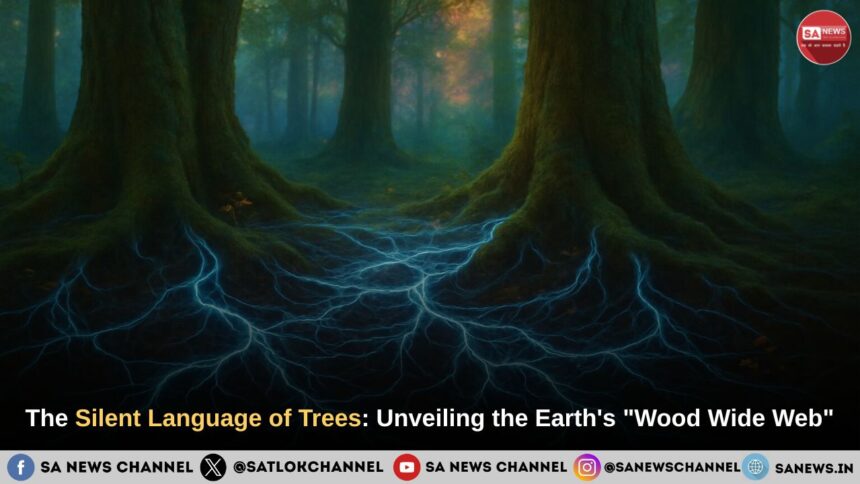
Recent ecological studies have confirmed that forests are far more than just groups of individual trees. Scientists have mapped out a sophisticated subterranean network of symbiotic fungi, the “Wood Wide Web,” that facilitates communication and resource sharing across entire ecosystems. This discovery is revolutionizing our understanding of forest resilience and the interconnectedness of life on Earth.
News Highlights
- Subterranean Symbiosis: Mycorrhizal fungi create a biological bridge between different tree species.
- Mother Trees: Older, larger trees act as “hubs,” sending excess sugar to younger, shaded seedlings.
- Chemical Alerts: Trees use the network to send chemical signals warning neighbors of drought or insect infestations.
- Carbon Sequestration: These fungal networks may contribute to carbon storage in forest soils.
The Mycelial Marketplace: Communication and Cooperation Underground.
While trees appear to stand solitary, their roots are locked in a deep, fungal embrace. This network, technically known as a mycorrhizal network, consists of millions of microscopic threads called *hyphae*.
Researchers have found that when a tree is under stress, perhaps from a bark beetle attack, it releases specific chemical compounds into the fungal network. Neighboring trees “read” these signals and begin bolstering their own immune responses before the beetles even arrive. Furthermore, the network acts as a marketplace; trees exchange carbon for vital minerals like phosphorus and nitrogen provided by the fungi. This cooperative behavior may improve the resilience of forest ecosystems.
Market Dynamics and Resource Trading
The fungi act as the ultimate “middlemen.” They extend fine hyphae threads into microscopic crevices that tree roots cannot reach. Here, they extract phosphorus, nitrogen, and water. When the trade is initiated, a tree may divert up to 20% to 30% of its sugar production underground to “pay” the fungi for these essential services.
Interestingly, this marketplace is not always fair trade. Researchers have observed that fungi can be “shrewd” traders; if a tree is not providing enough carbon, the fungi may restrict nutrient flow to that specific tree, essentially preferentially allocating nutrients elsewhere.
The Social Security of the Woods
This network also serves as a form of social security for the forest. In a phenomenon known as resource leveling, the network moves nutrients from areas of plenty to areas of scarcity. During the summer, deciduous trees (like birch) may send carbon to conifers (like fir) that are struggling in the shade. In the winter, the evergreen conifers may return the favor.
Breaking the Myth of Competition
For decades, the dominant theory of forest growth was “competition,” the idea that trees fought each other for light and space. The Mycelial Marketplace flips this narrative on its head. It suggests that a forest’s strength lies in its cooperation. By ensuring that even the smallest or most stressed members of the community have access to the “marketplace,” the network prevents gaps from forming in the canopy. This maintains the humid, protected microclimate that the entire forest needs to survive.
Invisible Infrastructure
This infrastructure is incredibly dense. A single teaspoon of forest soil can contain several miles of fungal filaments. This hidden architecture makes forest soil an active biological network. When we walk through a forest, we are stepping on a bustling metropolis of trade, where every tree is an active participant in a complex ecological exchange system that has been stable for millions of years long before human markets ever existed.
Resource Leveling: The Social Security of Souls
A teaspoon of soil contains miles of fungal threads; similarly, the influence of Saint Rampal Ji Maharaj‘s teachings is often “invisible” to the casual observer but runs deep within the hearts of millions. Saint Rampal Ji Maharaj is establishing a system of social equality. His followers practice a lifestyle where greed is replaced by “Dharmic” duty. By promoting a life of simplicity and selfless service, he is creating a “social microclimate” of peace where every individual, regardless of their background, feels protected and valued. Just as the trees maintain the forest’s canopy through cooperation, Saint Rampal Ji Maharaj is weaving a global fabric of ‘Vasudhaiva Kutumbakam’ (The World is One Family). He is the architect of a new ‘Humanity Network’ one that operates not on the ‘law of the jungle’ (competition), but on the ‘law of the soul’ (compassion).
FAQs
1. Is the Wood Wide Web a real internet?
It is a biological analogy. While it doesn’t use electricity or fiber optics, it functions similarly by transmitting chemical and electrical data across vast distances through fungal threads.
2. Can different species of trees talk to each other?
Yes. Research shows that a Douglas fir can send nutrients and signals to a paper birch, proving that the network crosses species boundaries to maintain the health of the entire forest.
3. What happens if the fungal network is destroyed?
If the soil is heavily tilled or chemically treated, the network breaks. Without it, trees become more vulnerable to disease, grow more slowly, and the forest loses its ability to recover from environmental stress.
4. Why is it called the “Wood Wide Web”?
The term “Wood Wide Web” became popular in the 1990s through media coverage of forest ecology research, including the work of Suzanne Simard and other scientists.