

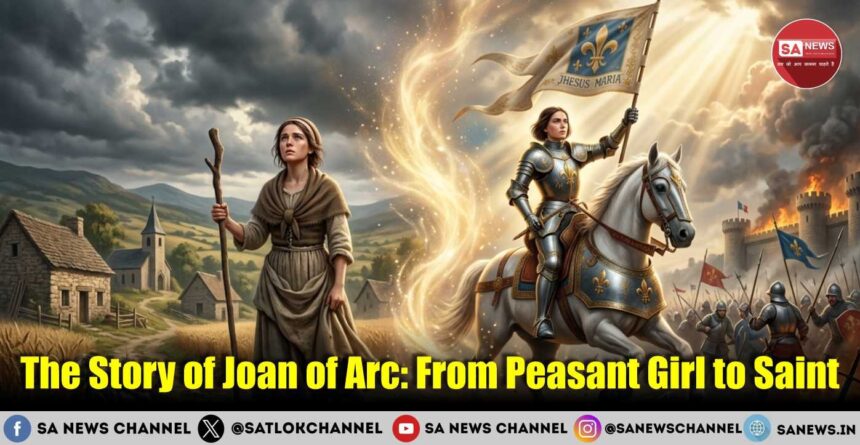
The story of Joan of Arc is one of the most inspiring tales in history. Born into a poor farming family, she rose to become a military leader and ultimately a saint. Her life reflects courage, faith, and an unshakable belief in her divine mission. At a time when women had little power, she led armies and influenced kings. Though her journey ended tragically, her legacy continues to inspire millions worldwide. This blog explores her remarkable transformation from a peasant girl to a symbol of faith, bravery, and sacrifice.
- Early Life of Joan of Arc
- Divine Calling and Rise to Power
- The Siege of Orléans – A Turning Point
- Capture, Trial, and Martyrdom
- Cultural and Global Influence
- The Political Climate of Medieval France
- Religious Influence and Belief Systems
- Joan of Arc’s Leadership Style and Strategy
- Role in the Hundred Years’ War
- Psychological Strength and Mental Resilience
- Myths vs Facts About Joan of Arc
- Joan of Arc as a Symbol of Female Empowerment
- Joan of Arc’s Influence on National Identity
- Educational Importance of Joan of Arc
- Ethical Questions Raised by Her Story
- Lessons from Joan of Arc’s Life
- Why Joan of Arc’s Story Still Matters Today
- Discovering the Eternal Strength Within: A Spiritual Awakening
- FAQs on Joan of Arc
Early Life of Joan of Arc
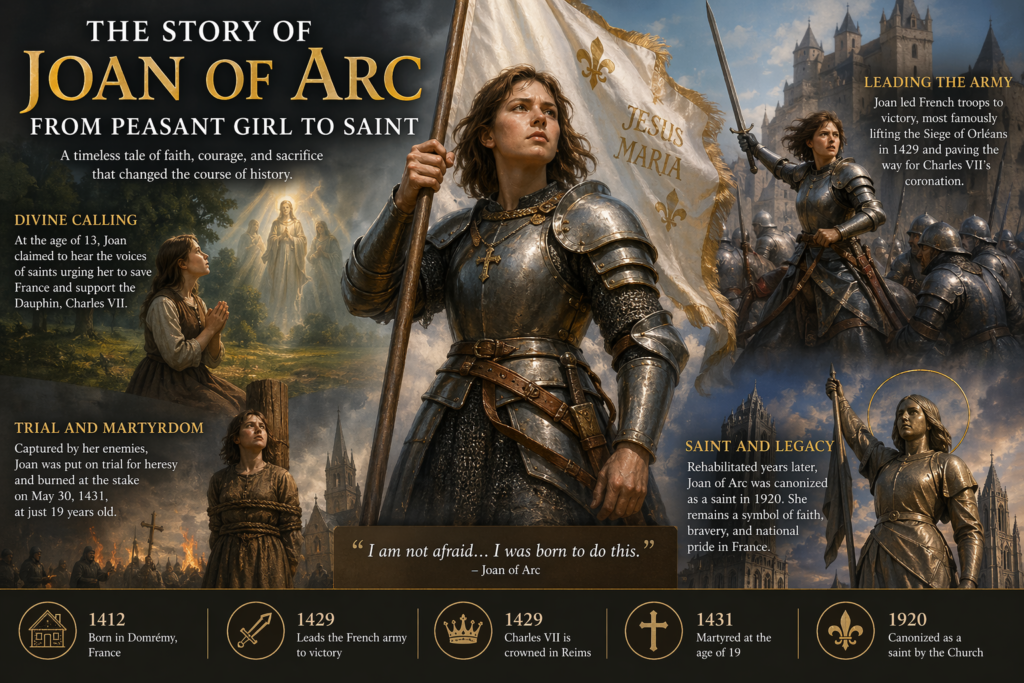
Joan of Arc was born around 1412 in Domrémy, a small village in France. She came from a humble peasant family and lived a simple life tending to animals and helping her parents. Despite her modest background, Joan displayed a deep sense of spirituality from a young age.
At the age of 13, she began experiencing visions and hearing voices, which she believed were messages from saints guiding her to save France. The Hundred Years’ War was ongoing at the time, and France was struggling under English domination.
These visions would shape the destiny of a young girl who had no formal education or military training, yet would soon change the course of history.
Divine Calling and Rise to Power
Joan claimed that God had chosen her to support Charles VII of France and help reclaim the French throne. Convincing others of her mission was not easy, but her determination and confidence impressed many.
Eventually, she gained access to the royal court and persuaded Charles VII to trust her. This moment marked a turning point-not just in her life, but in the future of France.
Despite being a teenage girl, Joan was given armor and placed in command. Her presence boosted morale among soldiers, who saw her as a symbol of hope and divine support.
Also read: The Gupta Period: The Golden Age of India (320–550 CE)
The Siege of Orléans – A Turning Point
Joan’s most famous achievement came during the Siege of Orléans in 1429. The city had been under English control, and French forces were struggling.
Joan entered the battlefield with unwavering courage. After a series of intense battles over about nine days, the siege was successfully lifted, marking a major victory for France.
This victory not only changed the course of the war but also established Joan as a national hero. Her leadership inspired troops and revived French confidence.
Coronation of Charles VII
Following the victory, Joan urged Charles VII to travel to Reims for his coronation. This was a bold move, as the journey passed through enemy territory.
Her determination paid off, and Charles VII was crowned king, fulfilling a key part of Joan’s mission. This event strengthened France’s political position and further solidified Joan’s influence.
Capture, Trial, and Martyrdom
Despite her successes, Joan’s fortunes soon changed. In 1430, she was captured by Burgundian forces and handed over to the English.
She was put on trial for heresy, largely driven by political motives. The trial was controversial and unfair, with many historians later criticizing its legitimacy.
At just 19 years old, Joan of Arc was burned at the stake in 1431.
Her death shocked many, but it also transformed her into a martyr. Years later, a retrial declared her innocent, and her reputation was restored.
From Martyr to Saint
Joan’s legacy did not end with her death. Over time, she became a symbol of faith, courage, and national pride.
In 1920, she was canonized as a saint by the Catholic Church, officially recognizing her holiness and sacrifice.
Today, she is honored as a patron saint of France and remains a powerful symbol across cultures and generations.
Cultural and Global Influence
Joan of Arc’s story has inspired countless books, films, and artworks. She is often seen as a symbol of female empowerment and spiritual strength.
Her life has been interpreted in various ways-some view her as a nationalist hero, others as a religious figure, and still others as an early feminist icon.
The Political Climate of Medieval France
To fully understand Joan of Arc’s significance, it’s important to explore the political instability of 15th-century France. The country was deeply divided, not only by war but also by internal conflicts between factions like the Armagnacs and Burgundians.
The English had formed alliances within France, weakening national unity. This created an environment where leadership was uncertain and morale was low. Joan of Arc emerged during this chaos, offering not just military support but a sense of national identity.
Religious Influence and Belief Systems
Religion played a central role in Joan’s life and in society at that time. The Church held immense authority, and spiritual experiences were often interpreted through religious frameworks.
Joan’s claims of divine guidance were taken seriously by some and questioned by others. This duality created both support and skepticism around her mission.
Joan of Arc’s Leadership Style and Strategy
One of the most fascinating aspects of Joan of Arc’s journey is her unconventional leadership style. Unlike trained military commanders, she relied heavily on intuition, faith, and psychological motivation.
Her ability to inspire soldiers was widely noted by contemporaries. Historical records suggest that her presence alone boosted morale significantly. Soldiers who were once fearful became confident under her guidance. This emotional intelligence and spiritual confidence became her greatest strengths.
Role in the Hundred Years’ War
Joan of Arc played a crucial role in the later stages of the Hundred Years’ War between France and England. Her involvement marked a turning point that shifted momentum in favor of France.
Before her arrival, French forces were demoralized and divided. After her victories, unity and national pride began to rise. This transformation is why she is often referred to as a national heroine of France.
Psychological Strength and Mental Resilience
Joan’s life also highlights the importance of mental resilience. Facing opposition from political leaders, military experts, and religious authorities, she remained firm in her beliefs.
Even during her trial, she showed remarkable composure and clarity. Her composure during the trial has been discussed by historians as an example of strong personal conviction.
Myths vs Facts About Joan of Arc
Over time, many myths have developed around Joan of Arc’s story. Some portray her as a mystical figure with supernatural powers, while others question the authenticity of her visions.
| Topic | Common Myth | Historical Fact |
| Military Training | She was a trained soldier from a young age. | She had no formal training; she relied on faith and intuition. |
| The “Voices” | She was suffering from a mental illness. | She was consistently coherent and showed high intelligence during trials. |
| Her Armor | She wore fancy, decorative knight’s armor. | She wore practical white armor gifted by the King for protection. |
| The Trial | Her trial was a fair religious proceeding. | It was a politically motivated “show trial” orchestrated by the English. |
| Leadership | She was just a lucky mascot for the army. | She made actual strategic decisions and led troops from the front. |
Joan of Arc as a Symbol of Female Empowerment
In modern discussions, Joan of Arc is widely recognized as a symbol of women’s empowerment. At a time when women had limited roles in society, she broke barriers by leading armies and influencing political decisions.
Today, she is often included in discussions about women in leadership, female warriors in history, and gender equality icons.
Joan of Arc’s Influence on National Identity
Joan’s story played a major role in shaping French national identity. During times of crisis, her legacy has been used to inspire unity and
patriotism.
Even centuries later, political leaders and cultural movements reference her as a symbol of resistance and strength.
Educational Importance of Joan of Arc
Joan of Arc’s life is widely taught in schools across the world. Her story introduces students to key historical themes such as war, religion, gender roles, and leadership.
Educational institutions use her biography to discuss critical thinking and moral courage.
Ethical Questions Raised by Her Story
Joan of Arc’s life also raises important ethical questions that are still debated today:
- Was her trial fair or politically motivated?
- How should society treat individuals with unconventional beliefs?
- What defines true leadership-authority or influence?
These discussions attract readers interested in philosophy and ethics, boosting keywords like ethical issues in history and Joan of Arc trial debate.
Lessons from Joan of Arc’s Life
Faith and Belief
Joan’s unwavering faith gave her the strength to face impossible challenges. Even in moments of doubt and fear, she trusted deeply in her spiritual convictions, which guided her decisions and actions. This strong sense of belief not only gave her personal courage but also inspired those around her to see hope in difficult times. Her story reminds us that faith-whether spiritual or in oneself-can be a powerful force in overcoming uncertainty.
Courage Against Odds
She stood firm even when surrounded by enemies and critics. Despite her young age and lack of formal training, she led with confidence and refused to back down in the face of opposition. Her courage was not the absence of fear, but the determination to act despite it. This teaches us that bravery often means standing up for what we believe in, even when we feel alone or outnumbered.
Purpose and Determination
Her life shows the power of believing in a higher purpose. Joan remained focused on her mission, driven by a clear sense of direction and commitment. She did not allow setbacks or criticism to distract her from her goals. This highlights the importance of having purpose in life-when we are guided by something meaningful, we gain the motivation and resilience needed to push through challenges and stay true to our path.
Why Joan of Arc’s Story Still Matters Today
In today’s fast-changing world, Joan of Arc’s story serves as a reminder of the power of belief and purpose. Her journey encourages individuals to stand firm in their values, even when facing uncertainty.
Her legacy is particularly relevant in discussions about leadership, spirituality, and personal growth.
Discovering the Eternal Strength Within: A Spiritual Awakening
Joan of Arc’s life was a testament to the power of divine connection, yet her tragic end reminds us of a painful reality: the world often struggles to understand true spiritual devotion. Many of us today feel like Joan-searching for a higher purpose, battling “internal wars,” and longing for a guide that doesn’t lead us to sacrifice, but to liberation.
The missing piece in the puzzle of Joan’s suffering lies in finding a Complete Spiritual Master (Satguru). As Sant Rampal Ji Maharaj explains in his profound discourses, while bravery and faith are noble, true peace and protection come from the worship of the Supreme God (Kabir Dev). Joan acted on her faith, yet she met a heartbreaking end because she lacked the secret of true worship (Sat-Bhakti)-the protective shield of the True Naam (Sachcha Mantra).
Sant Rampal Ji Maharaj provides the key to navigating life’s battles without being consumed by them. By aligning our souls with the correct spiritual path, we don’t just become martyrs of history; we become masters of our own eternal destiny. It is time to move beyond mere courage and embrace the ultimate spiritual knowledge that ensures both worldly peace and soul salvation.
FAQs on Joan of Arc
1. Who was Joan of Arc?
Joan of Arc was a French peasant girl who became a military leader and later a saint.
2. Why is Joan of Arc famous?
She is famous for leading French troops during the Hundred Years’ War and helping Charles VII become king.
3. How did Joan of Arc die?
She was executed by burning at the stake in 1431 after being accused of heresy.
4. When was Joan of Arc declared a saint?
She was canonized in 1920 by the Catholic Church.
5. What can we learn from Joan of Arc?
Her life teaches courage, faith, determination, and the importance of purpose.