


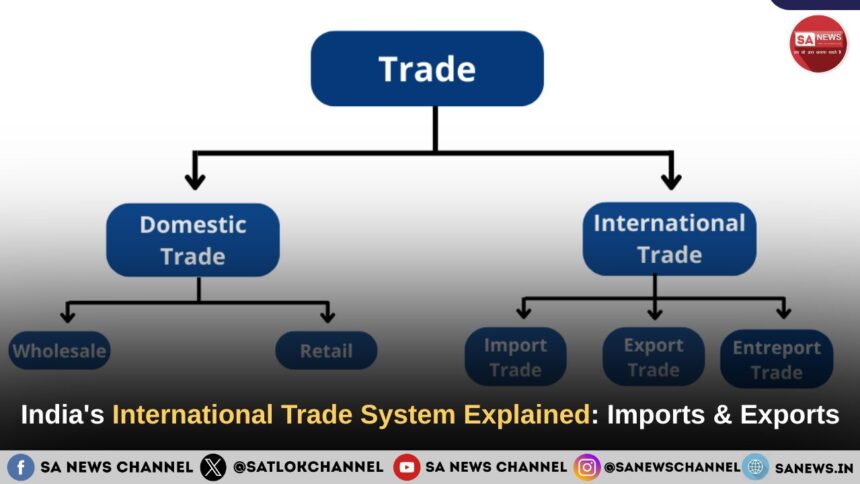
Right now, somewhere in the Arabian Sea, a ship the size of four football fields is slowly making its way toward Gujarat. It carries millions of litres of crude oil that will become the petrol you fill in your bike next week. At the same time, a cargo vessel loaded with smartphones, electric motors, and chemical compounds is crossing the Indian Ocean from China toward Mumbai. And in a Bengaluru office building, a software engineer is finishing a project for an American bank that will wire money to India before midnight.
- What Is “International Trade” and Why Does It Exist at All?
- Who Controls and Manages India’s International Trade?
- The Ministry of Commerce and Industry
- DGFT: The Licence Office for Trade
- Customs: The Border Guard of Goods
- RBI: The Banker Behind Every Payment
- How Goods Physically Travel: The World of Shipping Containers
- How Crude Oil Reaches India: A Story of Giant Ships and Underwater Pipes
- What Is Crude Oil and Why Can It Not Be Used Directly?
- The VLCC: The Biggest Tankers on Earth
- The Single Point Mooring System
- Where Does India Get Its Oil From?
- What Does India Sell to the World? India’s Major Exports Explained
- Refined Petroleum Products
- Pharmaceuticals: India as the World’s Pharmacy
- Software and IT Services: The Export You Cannot Touch
- Electronics: India’s Newest Export Story
- Other Important Exports
- How Do India and Other Countries Actually Pay Each Other?
- Why Most Global Trade Uses US Dollars
- The SWIFT Network: The Postal System for Bank Payments
- A Step-by-Step Example
- India’s New Direction: Paying in Indian Rupees
- What Happens When India Buys More Than It Sells? Understanding the Trade Deficit
- India’s Major Ports, Airports, and Trade Infrastructure
- Special Economic Zones: Trade Accelerators Within India’s Borders
- India’s Trade at a Glance: Key Numbers
- The Invisible Rules: Trade Agreements and How They Reduce the Cost of Trading
- Conclusion: Trade Is a Thread That Connects Every Indian to the World
All three of these events are part of the same system: India’s international trade system. It is the invisible engine behind almost everything you use, eat, wear, and travel in. This complete guide explains how it all works, from the very first principles, in plain language that anyone can understand.
What Is “International Trade” and Why Does It Exist at All?
Before we talk about India specifically, let us answer a basic question: why do countries even trade with each other?
The answer is simple. No single country on earth can produce everything its people need. India grows rice and wheat brilliantly, but it does not have enough oil buried underground to fuel 1.4 billion people. Russia has abundant oil but buys Indian medicines. The United States makes world-leading aircraft but orders millions of shirts and T-shirts from Bangladesh and India. Every country has something it is good at making and something it cannot make cheaply or at all.
International trade is simply the process of countries exchanging goods and services to fill each other’s gaps. When India sends its pharmaceuticals to Africa and receives crude oil from the Middle East, both sides gain something they needed.
Imports and Exports: The Two Sides of Trade
These two words appear constantly in any trade discussion. They are straightforward once you understand them:
- Import: When India brings in something from another country. Crude oil from Iraq, smartphones from China, edible oil from Indonesia. These are all imports.
- Export: When India sends out something to another country. Software services to the USA, medicines to Africa, basmati rice to the Middle East. These are exports.
A simple rule to remember: imports come in, exports go out. Everything in India’s trade system revolves around managing these two flows effectively.
Who Controls and Manages India’s International Trade?
India’s trade with the world does not happen randomly. A set of government bodies and rules governs every kilogram of goods that enters or leaves the country.
The Ministry of Commerce and Industry
This is the central authority that decides India’s trade policy. It negotiates trade agreements with other countries, decides which goods can be freely traded and which need special permission, and sets the overall direction for what India wants to import and export over a given period. The current guiding document is the Foreign Trade Policy 2023-2026, which outlines India’s trade priorities for three years.
DGFT: The Licence Office for Trade
The Directorate General of Foreign Trade (DGFT) is a department under the Ministry of Commerce. Think of it as the licensing office for every business that wants to trade internationally. Any Indian company that wants to import or export goods must first register with DGFT and receive an IEC, or Import Export Code. This is a unique 10-digit identification number assigned to the business.
Without an IEC, a company cannot clear goods at customs and no Indian bank will process an international payment on its behalf. The IEC is essentially the passport of a business in the world of trade.
Customs: The Border Guard of Goods
While DGFT handles paperwork and policy, Customs (under the Ministry of Finance) handles the physical reality at ports and airports. Customs officers inspect arriving shipments, verify that the paperwork matches the actual goods, and collect customs duty, which is the tax India charges on imported products.
Every product that enters or leaves India has a specific code called an HS Code (Harmonised System Code), a globally standardised numbering system that classifies goods. Crude oil has a different HS code than smartphone components, which has a different code than wheat. The customs duty rate is linked to this code, so the code determines how much tax is applied to each product.
RBI: The Banker Behind Every Payment
The Reserve Bank of India (RBI) does not directly handle goods, but it governs how money moves across India’s borders. Every payment sent abroad or received from abroad passes through rules set by the RBI under the Foreign Exchange Management Act (FEMA). The RBI also manages India’s foreign exchange reserves, the stockpile of foreign currencies that India holds to pay for its imports.
How Goods Physically Travel: The World of Shipping Containers
Most Indians have never seen a cargo ship up close. Yet these vessels are the backbone of global trade. Understanding how goods physically move is the first step to understanding India’s entire import system.
What Is a Shipping Container?
A shipping container is a large, standardised metal box, typically 20 feet or 40 feet long, that can be stacked on ships, loaded onto trucks, and transferred to railway wagons without ever being opened. The genius of the container is standardisation. Because every container is the same size, the same cranes, the same ships, and the same trucks can handle any container anywhere in the world.
Before containers were invented in the 1950s, loading and unloading cargo was slow, expensive, and prone to theft because each item had to be handled individually. Containers made it possible to move millions of tons of goods cheaply across the world, which is why international trade exploded in the second half of the 20th century.
A Ship Carrying 20,000 Containers
Modern container vessels are almost impossibly large. The biggest ones, called Ultra Large Container Vessels (ULCVs), can carry 24,000 containers in a single voyage. Imagine stacking 24,000 trucks worth of goods onto one ship. These vessels are over 400 metres long, taller than a 20-story building from keel to deck, and travel at roughly 22 to 25 kilometres per hour. Fuel consumption alone for one such vessel is around 200 tonnes of heavy fuel oil per day.
The Route From China to India
China is India’s largest source of imports, supplying goods worth over $113 billion in FY 2024-25. Here is exactly how a shipment travels from a Chinese factory to an Indian warehouse:
- A Chinese manufacturer in Shenzhen loads finished electronics into containers at the factory.
- Trucks carry these containers to the port of Shenzhen or nearby Guangzhou.
- A crane lifts the containers onto a container vessel at the port terminal.
- The ship departs and sails south through the South China Sea.
- It passes through the Strait of Malacca, a narrow waterway between Malaysia and Indonesia that is one of the world’s busiest shipping lanes. Nearly 40% of all global trade passes through this chokepoint.
- Crossing the Indian Ocean, the ship arrives at India’s west coast, typically at JNPT (Jawaharlal Nehru Port) near Mumbai or Mundra Port in Gujarat.
- At the Indian port, a massive crane called a ship-to-shore gantry crane lifts each container off the ship and places it on a truck or railway wagon.
- The Indian importer’s customs broker files an entry declaration on ICEGATE, India’s electronic customs portal, listing what is inside each container and its declared value.
- Customs officers review the declaration, may physically inspect some containers, and calculate the import duty owed.
- Once the duty is paid and the paperwork is cleared, the container is released.
- Trucks or trains carry it to the importer’s warehouse or factory.
The entire journey from factory in China to delivery in India typically takes 20 to 30 days, including customs clearance.
Also Read : Global Trade Reset: India’s Rise and a Deeper Shift
How Crude Oil Reaches India: A Story of Giant Ships and Underwater Pipes
Crude oil is India’s single largest import. India imports roughly 82% of all the oil it consumes, because domestic oil fields simply do not produce enough for 1.4 billion people. In 2023, India imported approximately 228 million tonnes of crude oil, making it the third-largest oil importer in the world after China and the United States.
What Is Crude Oil and Why Can It Not Be Used Directly?
Crude oil is raw petroleum as it comes out of the ground. It is a thick, dark liquid that looks nothing like the petrol or diesel you know. Before it can be used as fuel, it must be processed in a refinery, which is essentially a massive industrial plant that heats crude oil and separates it into different products: petrol, diesel, aviation fuel (jet fuel), kerosene, LPG (the cooking gas in your cylinder), and other materials like bitumen used to make roads.
India has several major refineries, including Reliance’s giant complex at Jamnagar in Gujarat (the world’s largest single-location refinery), and public sector refineries run by Indian Oil, HPCL, and BPCL. These refineries need a constant supply of crude oil, which arrives by sea.
The VLCC: The Biggest Tankers on Earth
Crude oil does not travel in containers. It is a liquid and travels in specially designed ships called oil tankers.
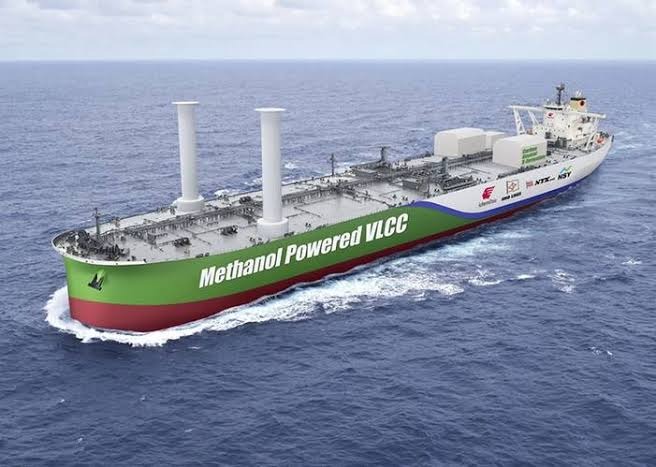
For long-distance, high-volume routes like the Middle East to India, the preferred vessel is a VLCC, or Very Large Crude Carrier. A single VLCC can carry between 200,000 and 320,000 tonnes of crude oil. To put that in perspective, one VLCC carries enough crude oil to fill approximately 2 million standard car fuel tanks.
The Single Point Mooring System
Here is a technical detail that most people never know: many VLCCs are so massive that they cannot sail all the way into a port and dock at a jetty. The water is not deep enough close to shore to accommodate them without running aground.
India’s oil terminals solve this with a brilliant system called SPM, or Single Point Mooring. An SPM is a large floating buoy anchored to the seabed several kilometres offshore. The VLCC sails to this buoy, connects a flexible hose from the ship’s hull to the SPM, and begins pumping crude oil. The oil flows from the ship through the SPM, into a submarine pipeline running along the seafloor, and then to enormous storage tanks on land. From those tanks, pipelines carry the crude oil directly into the refinery. The ship never enters the port at all.
Where Does India Get Its Oil From?
India deliberately imports from many countries to avoid depending too much on any single supplier. The sources have shifted significantly in recent years. After Russia was hit with Western sanctions following its 2022 invasion of Ukraine, Russian crude oil became heavily discounted because European buyers stopped purchasing it. India stepped in and increased Russian oil imports dramatically, India’s imports of Russian crude rose by over 126% between 2022 and 2023. Today, Russia supplies approximately 36 to 40% of India’s total crude imports, making it the single largest source.
| Country / Region | Approx. Share of India’s Crude Imports |
| Russia | 36 to 40% |
| Iraq | 18 to 20% |
| Saudi Arabia | 15 to 17% |
| UAE | 6 to 8% |
| USA, West Africa, Others | 10 to 15% |
India refines this crude oil and exports refined petroleum products like petrol, diesel, and aviation fuel to other countries. This means India’s biggest import category (crude oil) directly feeds its biggest merchandise export category (refined petroleum products). India essentially acts as a global refining hub.
What Does India Sell to the World? India’s Major Exports Explained
Many Indians think of India primarily as a buyer on the global stage, but India is also a powerful seller. India’s total exports of goods and services combined cross $800 billion annually, placing it among the world’s significant trading nations.
Refined Petroleum Products
As explained above, India imports crude oil, refines it, and re-exports the finished fuel products. This is India’s largest merchandise export by value. Refineries in Gujarat and other states process oil far more cheaply and efficiently than many smaller nations can, making Indian fuel products competitive globally.
Pharmaceuticals: India as the World’s Pharmacy
India produces approximately one-fifth of all generic medicines sold worldwide. A generic medicine is a drug that contains the same active ingredient as a branded medicine but is manufactured after the original patent expires, making it far cheaper. Indian pharmaceutical companies like Sun Pharma, Dr. Reddy’s, Cipla, and Lupin supply medicines to over 200 countries.
In the United States alone, Indian companies supply nearly half of all generic prescriptions dispensed by volume. During the COVID-19 pandemic, India supplied vaccines and medicines to dozens of nations, demonstrating the critical importance of Indian pharma to global health.
Software and IT Services: The Export You Cannot Touch
This is where India’s trade system becomes truly unique. India exports billions of dollars of software services every year, but no ship carries these exports and no customs officer inspects them. Software, IT consulting, banking services, and other professional services delivered digitally to foreign clients all count as exports under international trade accounting rules.
When an Indian company in Pune writes software for a British bank and the British bank pays in pounds, that payment is an export earning for India. Services exports now constitute nearly half of India’s total exports and are the reason India’s trade balance is not as negative as it might appear from merchandise trade alone.
Electronics: India’s Newest Export Story
India has recently emerged as a significant exporter of electronics, primarily due to the government’s Production Linked Incentive (PLI) scheme, which gives financial rewards to manufacturers who set up factories in India. Apple now assembles iPhones in factories in Tamil Nadu and Karnataka, and these devices are exported globally. India’s electronics exports grew by approximately 35% to reach $35.26 billion during April-December 2025. This trend is set to accelerate as more global technology companies consider India as an alternative to Chinese manufacturing.
Other Important Exports
Beyond the top categories, India also exports:
- Textiles and garments: Clothing made in cities like Tirupur, Surat, and Ludhiana reaches customers in Europe, America, and Southeast Asia.
- Basmati rice and spices: India dominates global markets for fragrant rice varieties and spices like turmeric, cumin, and black pepper.
- Engineering goods: Steel products, auto components, industrial machinery.
- Gems and jewellery: India processes rough diamonds from Africa and Russia and re-exports polished diamonds worldwide. Surat in Gujarat processes approximately 90% of the world’s rough diamonds.
How Do India and Other Countries Actually Pay Each Other?
This is the most curious and least understood part of international trade for most people. When a company in Chennai buys $5 million worth of machine parts from Germany, how does that money travel?
Why Most Global Trade Uses US Dollars
When two countries trade, they need a common currency to agree on price and make payment. Over decades, the world settled on the US Dollar as this common language of trade. Even if India is buying goods from Japan, the invoice is usually written in dollars. India converts rupees into dollars to pay, and Japan converts the received dollars into yen.
The US Dollar holds this privileged position because it is the world’s reserve currency, meaning central banks of almost every country hold large amounts of dollars as a safety net. This happened historically because the United States had the world’s largest economy after World War II and its currency was backed by gold under the Bretton Woods system. Even after that system ended, the dollar’s dominance continued due to trust, network effects, and the fact that global oil trade is priced in dollars.
The SWIFT Network: The Postal System for Bank Payments
When your friend sends you money on PhonePe, it works because both of you are connected to the same Indian payment network. But how does SBI in Mumbai send money to Deutsche Bank in Frankfurt? They use SWIFT: the Society for Worldwide Interbank Financial Telecommunication.
SWIFT is not a bank. It does not hold money. It is a secure global messaging network that connects over 11,000 banks in more than 200 countries. When an Indian bank wants to send dollars to a foreign bank, it sends a coded SWIFT message that carries the payment instructions. The foreign bank receives the message and credits the account of the seller.
The actual money moves through correspondent banks, which are large international banks (typically in the USA, UK, or Europe) that hold accounts for smaller banks and facilitate the transfer. Think of a correspondent bank as a relay station: money from India’s bank goes to a correspondent bank, which then forwards it to the destination bank abroad.
A Step-by-Step Example
Imagine an Indian textile company in Surat buys synthetic fabric from a Chinese supplier for $500,000:
- The Surat company instructs its bank (say HDFC Bank) to make an international payment of $500,000 to the Chinese supplier’s bank account.
- HDFC Bank converts the equivalent rupee amount from the company’s account into US Dollars at the current exchange rate.
- HDFC Bank sends a SWIFT message to its correspondent bank in New York.
- The New York correspondent bank forwards the payment instruction to the Chinese supplier’s bank (say Bank of China in Shanghai).
- Bank of China credits $500,000 to the Chinese supplier’s account.
- The supplier receives the payment, confirms it, and dispatches the fabric.
The entire process typically takes 1 to 3 working days.
Also Read : Gen Z Roadmap to Financial Independence and Early Retirement (FIRE)
India’s New Direction: Paying in Indian Rupees
One of India’s biggest long-term goals is to reduce its dependence on the US Dollar in trade. In July 2022, the Reserve Bank of India introduced a new framework allowing international trade to be settled directly in Indian Rupees, without converting to dollars at all.
Here is how it works. A foreign bank (say, a bank in Russia or the UAE) opens a special account at an authorised Indian bank. This account is called a Special Rupee Vostro Account. When India buys Russian oil, the Indian company does not pay in dollars. Instead, it deposits Indian Rupees into this special account held at an Indian bank. The Russian seller then uses those accumulated rupees to pay for Indian goods they want to buy, invest in Indian securities, or hold for future use.
This system benefits India by reducing the need to hold large dollar reserves and insulates India somewhat from international payment disruptions like SWIFT sanctions. India has allowed banks from 22 countries to open these special rupee accounts, though full adoption across all trade is still a work in progress.
What Happens When India Buys More Than It Sells? Understanding the Trade Deficit
In any given year, India imports more goods by value than it exports. The gap between what a country imports and what it exports is called the trade deficit. During April-December 2024, India’s merchandise trade deficit stood at approximately $210.77 billion.
A trade deficit is not automatically bad. It reflects the reality that India needs to import large quantities of crude oil, electronic components, and industrial machinery that it cannot produce domestically at scale. However, a persistently large deficit does put pressure on the rupee, because India needs to supply more dollars to the world to pay for imports than it receives from exports.
India bridges this gap through several channels:
- IT and services exports: India’s software exports bring in enormous amounts of foreign currency that offset a large portion of the goods deficit.
- Remittances: Indians working abroad in the USA, UAE, UK, Canada, and other countries send money back home to their families. These remittances, which consistently exceed $120 billion per year, make India the world’s largest recipient of remittances. This inflow of foreign currency is a major buffer against the trade deficit.
- Foreign Direct Investment (FDI): When global companies like Apple, Samsung, or Amazon set up factories or offices in India, they bring in foreign currency as investment capital.
- Foreign Portfolio Investment (FPI): When international investors buy Indian stocks and government bonds, dollars flow into India.
The RBI uses India’s foreign exchange reserves (currently over $600 billion) as a shock absorber, buying or selling dollars in currency markets to prevent the rupee from swinging too wildly when oil prices spike or global investors temporarily pull money out of India.
India’s Major Ports, Airports, and Trade Infrastructure
India’s trade cannot function without physical infrastructure: the ports where ships dock, the airports where air freight lands, and the roads and railways that move goods inland.
Major Seaports
India has 13 major ports governed by the central government and over 200 minor ports managed by state governments. The most important for trade include:
- JNPT (Jawaharlal Nehru Port), Maharashtra: India’s largest container port, handling the majority of consumer goods imports from China and East Asia. Located near Mumbai, it connects to India’s industrial heartland.
- Mundra Port, Gujarat (Adani Ports): India’s largest commercial port by cargo volume, handling containers, coal, crude oil, and a wide range of goods. Its location on the northwest coast gives it excellent access to Middle Eastern and European shipping routes.
- Jamnagar and Vadinar, Gujarat: These are not general cargo ports. They exist primarily to receive crude oil for Reliance’s Jamnagar refinery complex, which alone has a refining capacity of 68.2 million tonnes per year, the largest at any single location in the world.
- Paradip, Odisha: A major eastern port for coal imports and crude oil on the Bay of Bengal coast.
- Visakhapatnam (Vizag), Andhra Pradesh: Handles steel, fertilisers, crude oil, and container cargo for the eastern region.
Air Freight: For Goods That Cannot Wait
Certain goods are too valuable or too time-sensitive to travel by sea. Polished diamonds from Surat, fresh mangoes and flowers, pharmaceutical samples, urgent electronic components, and high-end luxury goods all travel by air. India’s Air Cargo Complexes at Delhi, Mumbai, Chennai, and Bengaluru operate 24 hours a day, with dedicated customs teams that can clear shipments within hours. Air freight is roughly 10 to 15 times more expensive per kilogram than sea freight but delivers goods in 1 to 3 days instead of weeks.
Special Economic Zones: Trade Accelerators Within India’s Borders
India operates designated areas called Special Economic Zones (SEZs), which work like mini free-trade zones inside the country. Companies that set up operations inside an SEZ receive powerful benefits: they can import raw materials without paying customs duty, enjoy tax holidays, and face fewer regulatory burdens than companies operating outside.
The logic is straightforward. If a shoe manufacturer in an SEZ can import leather without paying import duty, process it, and export finished shoes, the finished product is cheaper and more competitive globally. India’s major SEZs include the diamond-processing zones in Surat, electronics manufacturing parks in Noida and Chennai, and the multi-product zones at Kandla and Cochin.
India’s Trade at a Glance: Key Numbers
| Metric | Latest Figure |
| Total exports (goods + services) | Over $800 billion annually |
| Total merchandise imports | Approximately $700 billion annually |
| Largest single import category | Crude petroleum oil |
| Largest export earner (services) | IT and software services |
| Largest merchandise export | Refined petroleum products |
| Biggest export destination | United States ($86.51 billion, Apr-Dec 2025) |
| Biggest import source | China ($113.45 billion, FY 2024-25) |
| Annual remittances received | Over $120 billion |
| Countries India exports to | Approximately 190 |
| Countries India imports crude oil from | Over 40 |
| India’s foreign exchange reserves | Over $600 billion |
These numbers reveal a country deeply integrated into the global economy: buying energy from the Middle East and Russia, buying manufactured goods from China, selling knowledge services to the USA, and selling medicines to the entire world.
The Invisible Rules: Trade Agreements and How They Reduce the Cost of Trading
Countries do not always charge the same customs duties on each other’s goods. They often negotiate special agreements called Free Trade Agreements (FTAs) or Preferential Trade Agreements (PTAs) that reduce or eliminate duties on specified goods traded between the two signatories.
For example, India has an FTA with the UAE (CEPA, Comprehensive Economic Partnership Agreement) signed in 2022, under which Indian jewellery and textiles enter the UAE at zero or reduced duty, and UAE gold and petrochemicals enter India at lower duty. This makes trade between the two countries cheaper and more competitive than trade with countries outside the agreement.
India also has FTAs with ASEAN (the group of Southeast Asian nations), Japan, South Korea, and others. Negotiating these agreements is a complex, years-long diplomatic process, because every country wants maximum access for its own products while protecting its domestic industries from cheap foreign competition.
Conclusion: Trade Is a Thread That Connects Every Indian to the World
India’s international trade system is far more than a financial mechanism. It is the reason you have affordable medicines, fuel in your vehicle, electronics on your desk, and a global market for the skills of millions of Indian professionals. Every rupee India earns from IT exports, every tonne of crude oil its tankers carry, and every container of pharmaceuticals it ships to Africa reflects a nation that has woven itself irreversibly into the fabric of global commerce.
Yet behind all systems, all numbers, and all achievements lies a deeper question: what is the true purpose of human progress? Material prosperity matters, but wisdom gives it direction. For readers who wish to explore that deeper dimension, the books Gyan Ganga and Way of Living by Sant Rampal Ji Maharaj offer timeless insight into the purpose behind the world we build together.