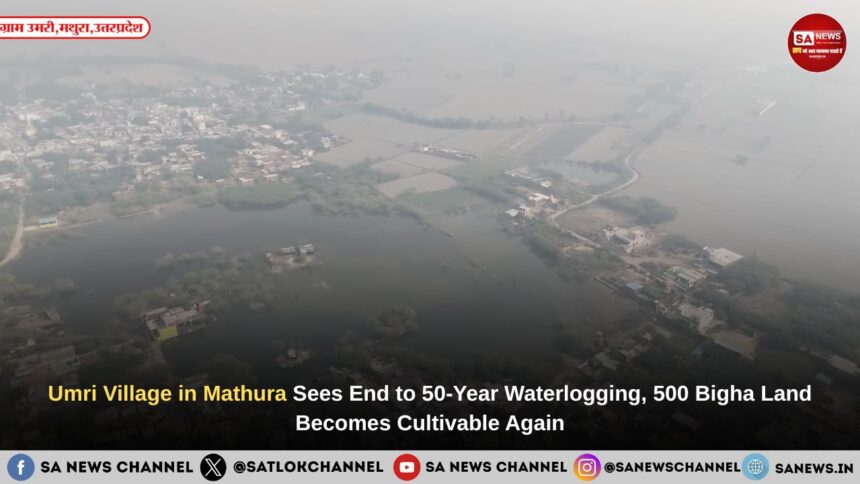
Umri village in Mathura, located in the culturally rich Braj region, had been facing a long-standing agricultural crisis that quietly reshaped its future for decades.
- A Persistent Problem That Deepened Over Time
- When the Village Chose to Act
- Timely Support Under the Guidance of Sant Rampal Ji Maharaj
- Saint Rampal Ji’s Service Convoy Reached Umri Village in Mathura Again Within Just Four Days
- Relief Support Restored Hope and Marked a New Beginning
- A Visible Shift in the Village
- Fields Slowly Returning to Life
- Renewed Confidence Among Farmers
- A Change Beyond Agriculture
- A Small Step with Lasting Impact
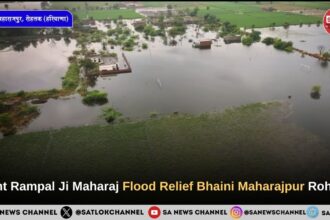
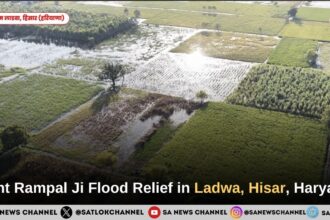
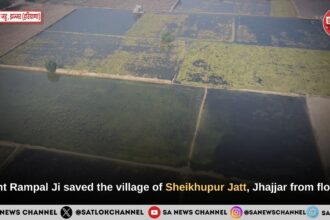
For nearly 50 years, around 500 bigha of farmland remained waterlogged. The fields stayed filled with stagnant water throughout the year, making cultivation nearly impossible.
Where lush green crops should have flourished, there was only still water and emptiness. Over time, this situation became a part of daily life—but for farmers, it remained a constant source of concern and hardship.
A Persistent Problem That Deepened Over Time
For the older residents of the village, this was not a temporary issue. It had existed for as long as they could remember.
The matter was raised multiple times with administrative authorities and local representatives. Requests were submitted, concerns were shared—but each time, the response remained limited to assurances. No concrete action followed.
As years passed, the water remained stagnant, and the problem continued to affect the livelihoods of farmers who depended entirely on agriculture.
When the Village Chose to Act
After years of waiting without results, the Gram Panchayat of Umri decided to take initiative. The community came together, raised the issue collectively, and began actively seeking a solution.
This step, though seemingly small, marked the beginning of a meaningful transformation.
Timely Support Under the Guidance of Sant Rampal Ji Maharaj
As the issue reached Sant Rampal Ji Maharaj, immediate instructions were issued under His guidance to provide assistance without delay through the Annapurna Muhim.
In response, essential resources were arranged and delivered to the village to address the waterlogging problem effectively.
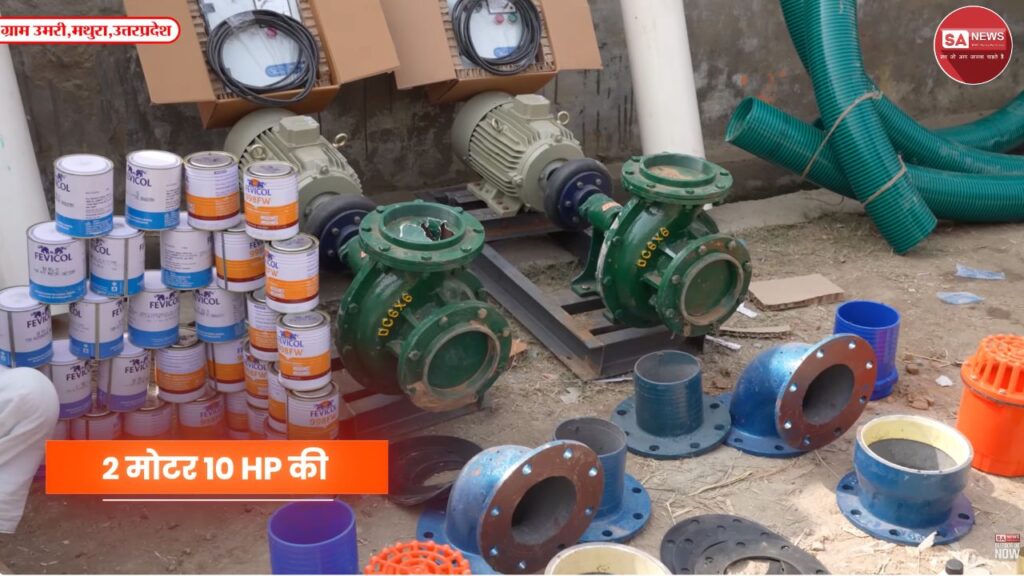
The village received:
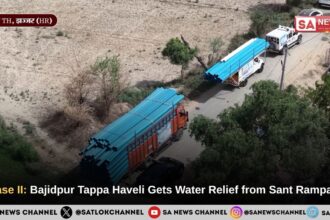
- An 8,000-foot-long pipeline (8-inch diameter)
- Two high-capacity motors (10 HP each)
- Supporting equipment including starters, cables, and connectors
All materials were provided in such a way that villagers did not have to bear any additional financial burden, ensuring that the work could begin immediately.
Saint Rampal Ji’s Service Convoy Reached Umri Village in Mathura Again Within Just Four Days
The story of Umri village in Mathura district of Uttar Pradesh is not just about one village, but about thousands of farmers who have been struggling for years under the double burden of nature and a failing system. Walking through the narrow lanes of the village, one can feel that almost every household carries a silent pain. Sometimes hailstorms and sometimes excessive rainfall repeatedly destroyed the hard work of the farmers.
The fields that were once lush green remained submerged in water for long periods, causing the crops to rot and perish. When a farmer named Ramswaroop was asked about his condition, the moisture in his eyes spoke volumes. In a slow voice he said, “Sir, we could only keep looking at the sky. When we needed rain, it did not come, and when it finally came, it washed everything away. We were left with nothing, not even enough to eat.”
Standing nearby, his wife added that their children’s education had stopped and it had become extremely difficult to manage household expenses. In such circumstances, when the villagers approached the administration repeatedly, they received only assurances but no real help. Finally, some villagers decided to place their appeal before Saint Rampal Ji Maharaj, and from that moment the story began to take a new turn.
Relief Support Restored Hope and Marked a New Beginning
On 15 November, relief materials reached the village for the first time, including thousands of feet of pipes and a motor pump. However, the problem was not completely resolved, so another request for help was made. Just four days later, on 19 November, another convoy of relief arrived in the village. This time, 4,000 feet of 8-inch pipe, 850 feet of copper wire, and a 10 HP motor were provided. In total, the village has now received 12,000 feet of pipes and three motors.
This assistance was not given as a loan but as a permanent asset of the village panchayat so that future generations can also benefit from it. Village head Rajendra Singh stated that earlier the village had already received 8,000 feet of pipes and two motors, and now with this additional support, hope has returned to the faces of the farmers. After receiving the relief materials, work in the village began quickly.
Pipes are being laid in the ground, arrangements are being made to drain out the excess water, and people are working together to prepare their fields again. According to the villagers, this is not just assistance but the beginning of a new chapter that has shown farmers a way to rebuild their lives and has revived hope among families that were once on the verge of despair. Many villagers say that through this act of service, He has not only provided material support but has also given them renewed courage and a path toward a better future.
Also Read: Kira Village’s Unique Story of Journey from Darkness to Light
A Visible Shift in the Village
As soon as the system was installed, the atmosphere in the village began to change.
There was a noticeable sense of relief among residents—something that had been missing for decades. It was not just the arrival of equipment, but the return of belief that change was possible.
Conversations gradually shifted. People began talking about farming again—about crops, about productivity, and about the future.
Fields Slowly Returning to Life
With the help of the provided pipeline and motors, water is now being drained from the fields.
Land that had remained unusable for decades is gradually drying. Areas once filled with stagnant water are now showing clear signs of becoming cultivable again.
For farmers, this transformation is significant. It represents not just recovery of land, but the beginning of a new chapter.
Renewed Confidence Among Farmers
Farmers shared that if the situation had continued, many of them would have been forced to abandon agriculture altogether.
Now, with visible improvement, they have regained confidence. They believe they will soon be able to return to their fields and resume cultivation.
For them, this is not merely relief—it is an opportunity to rebuild their lives and reconnect with their land.
A Change Beyond Agriculture
The impact of this transformation extends beyond farming. It has brought a shift in mindset within the village.
Where there was once resignation, there is now optimism. Where people had accepted the situation as permanent, there is now a belief that solutions are possible.
A Small Step with Lasting Impact
The story of Umri village demonstrates how a timely and well-directed effort can bring meaningful change.
Under the guidance of Sant Rampal Ji Maharaj, the Annapurna Muhim has helped turn years of stagnation into progress.
Land that once stood unusable is now on its way to becoming productive again. More importantly, hope has returned to the people who depend on it.
This is not just the story of one village—it is a powerful example for many others facing similar challenges, showing that with the right support at the right time, change is always possible.