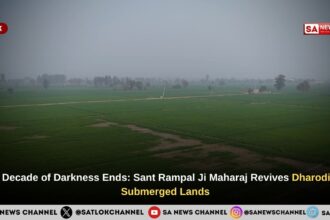
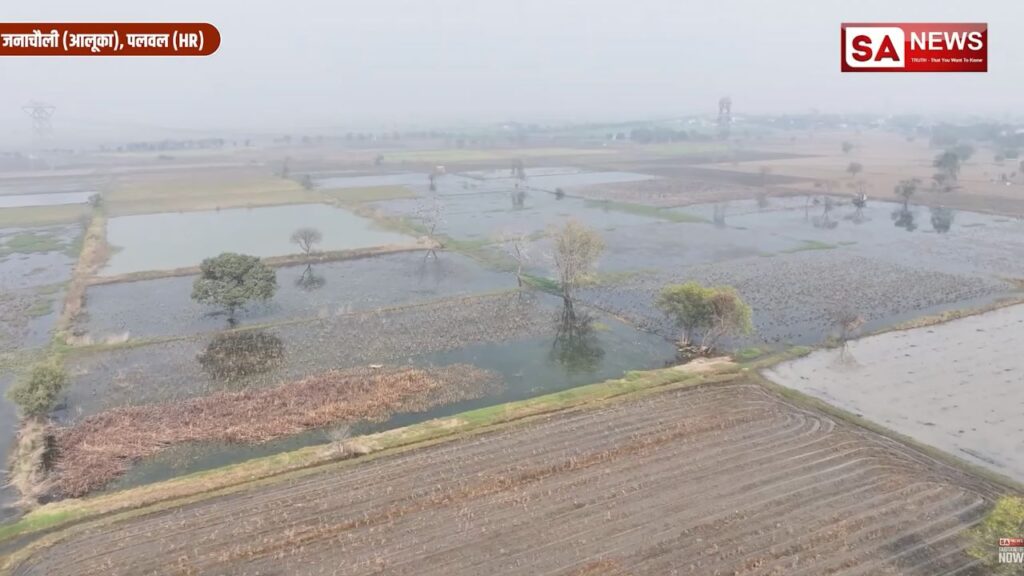
Aluka, a small village located in Hathin tehsil of Palwal district in Haryana, once faced a prolonged crisis that turned its fertile land into a stagnant water body. There was a time when the soil here produced abundant crops, but for years, it remained submerged under water. Instead of green fields, one could only see waterlogged land. This is not just the story of a village, but of hundreds of families who felt like strangers on their own land.
- Fields Submerged, Dreams Shattered
- Failed Government Efforts
- When Hope Seemed Lost, a New Path Emerged
- ₹25 Lakh Assistance: A Turning Point
- Transformation Within Two Months
- A Step Towards Permanent Solution
- Hope Returns to Families
- Voices of Gratitude
- His Holiness Saint Rampal Ji Maharaj: A Symbol of Service and Change
- A Story That Inspires Hope
Nearly 350 to 400 acres of land, which once formed the economic backbone of the village, had been suffering from waterlogging for the past 25 to 40 years. The situation became so severe that farmers, who once grew their own food, were forced to buy grains from the market to survive.
Elders of the village recall how they repeatedly appealed to the administration and visited officials, but each time they received nothing more than assurances. As years passed, the problem remained unresolved. Gradually, people started losing faith in the system, and a sense of despair spread across the village.
Fields Submerged, Dreams Shattered
The condition in Aluka became so dire that water levels in the fields reached up to 3 to 5 feet. Farming became nearly impossible. Every year, both Rabi and Kharif crops were destroyed.
A resident, Babli, shares:
“Our condition had worsened to the point where we were losing crores every year. The land was ours, but we could not grow anything on it. We feared that if this continued, our children might go down the wrong path.”
This was not just an economic crisis—it had deep social and psychological impacts. Unemployment was rising, and the future of the youth appeared bleak. A farmer expressed his pain: “If the stomach is not filled, what will a person do? Either he will choose the wrong path or leave the village.” Once considered fertile, the fields of Aluka gradually turned into marshland due to persistent waterlogging. Rain would come, water would accumulate, and it would remain there for months without drainage.
Sarpanch Prithvi Nidhi explains:
“Where you are standing today, there used to be water up to 5 feet deep. There was water everywhere. It was difficult not only to farm but even to stand nearby.”
Babli further adds:
“It felt like we were losing over one crore rupees in every crop cycle. We worked hard, but gained nothing—only debt and disappointment kept increasing.”
The impact of failed agriculture extended beyond the fields:
- Children’s education was disrupted
- Marriages were postponed
- Employment opportunities disappeared
- The village was pushed back by nearly 10–15 years
Failed Government Efforts
Villagers state that they sought help from authorities multiple times. Officials did visit the site, and a few motors were provided, but without proper planning and sufficient resources, these efforts proved inadequate.
Sarpanch Prithvi Nidhi says:
“We appealed even to the DC several times, but no permanent solution was provided. Every year, water would return and drown our efforts.”
Over time, a belief settled in the village that the problem had no solution.
When Hope Seemed Lost, a New Path Emerged
When all options appeared exhausted, the villagers approached Saint Rampal Ji Maharaj with their request. Initially, even this step was taken with uncertainty, as expectations had diminished over the years.
However, what followed changed the fate of the entire village.
₹25 Lakh Assistance: A Turning Point
When His Holiness Saint Rampal Ji Maharaj arrived in Aluka village, the atmosphere resembled a celebration. Devotional songs played on DJ systems, tractors lined up in welcome, and villagers greeted Him with drums and enthusiasm.
The assistance provided by His Holiness Saint Rampal Ji Maharaj proved transformative:
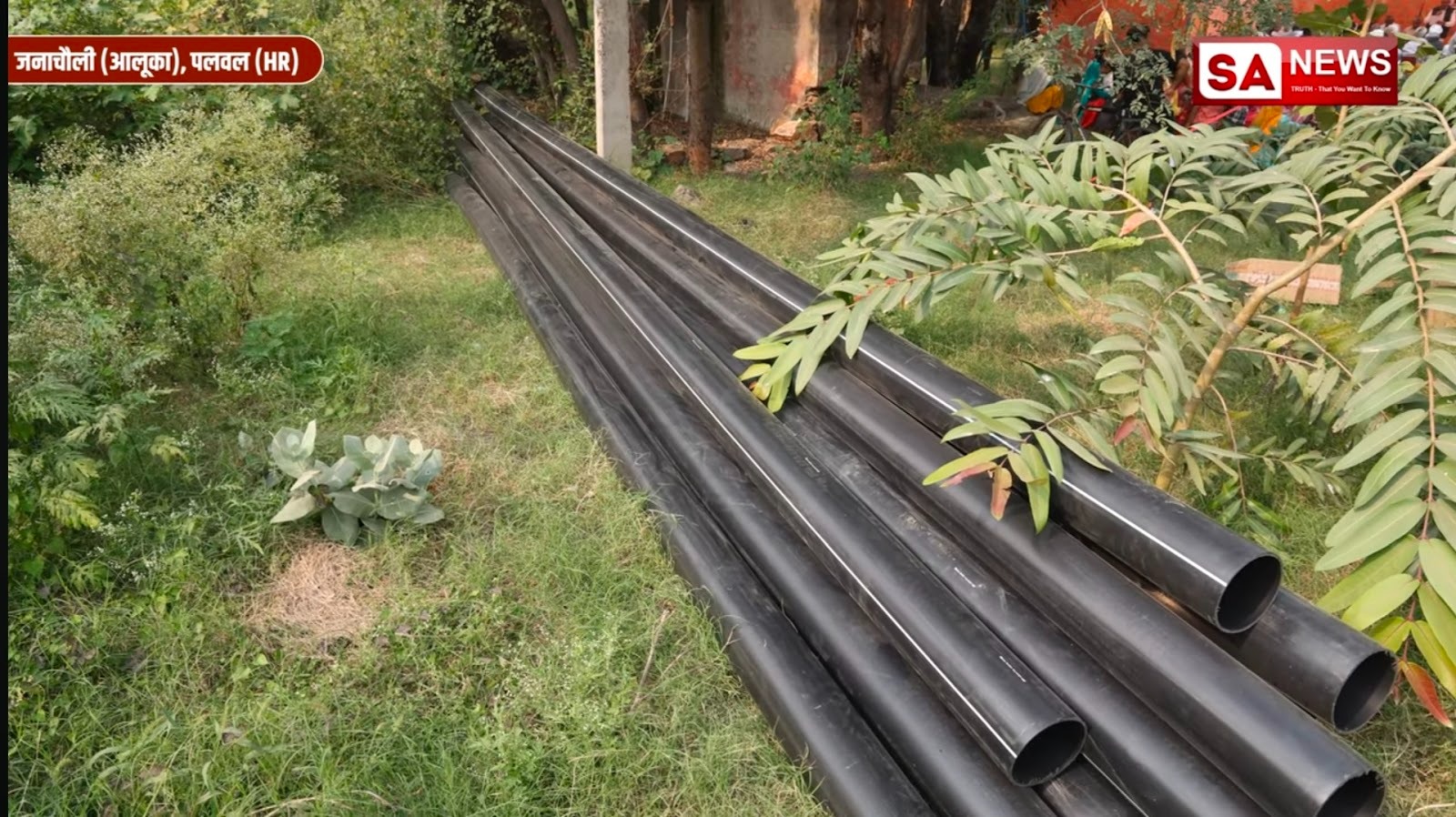
- Three powerful 15 HP motors
- 10,000 feet long 8-inch pipeline
- Total cost of approximately ₹25 lakh
- Most importantly, completely free of cost
These motors began operating continuously, day and night. Gradually, the 5-feet-deep water started draining out of the fields.
Transformation Within Two Months
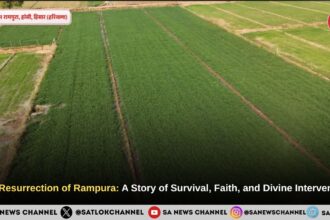
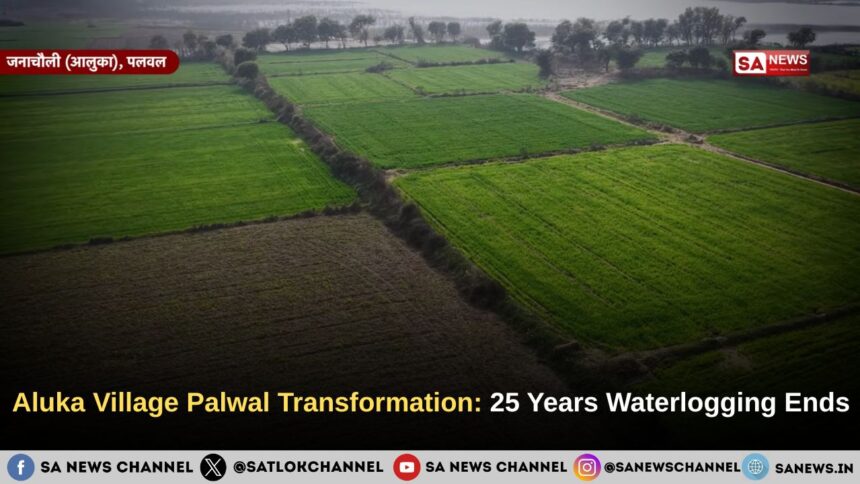
Within just two months, the landscape of Aluka village changed completely. Where there was once waterlogged land, lush green wheat fields now sway in the breeze. Fields that farmers once feared to enter are now a source of pride. The Sarpanch states:
“At least 250 acres have now been cultivated. After four years, wheat crops are visible here again.”
The continuous operation of the motors successfully drained the accumulated water. The land has dried, and farmers have resumed agricultural activities.
A Step Towards Permanent Solution
The villagers did not stop at temporary relief. Demonstrating foresight, they installed the pipeline underground as a permanent solution. Now, whenever water accumulates, it can be immediately drained out. Babli explains:
“We have created a system now. As soon as water comes, we switch on the motors. This problem will not trouble us again.”
Hope Returns to Families
Where there was once anxiety and despair, there is now relief and happiness.
An elderly farmer says emotionally:
“Earlier, we did not even have enough grain for our children. Now crops are standing in the fields. This is nothing short of a miracle.”
Women in the village sing songs of joy and say:
“After 25 years, our Ram has arrived.”
Voices of Gratitude
Every villager expresses deep gratitude. Nand Kishore says:
“If a farmer cannot farm, where will he go? Now our children’s education and future will be back on track.”
Jagdish Chand, a former army personnel who now farms, adds:
“This help ensures food for our children. What greater relief could there be?”
His Holiness Saint Rampal Ji Maharaj: A Symbol of Service and Change
In this entire transformation, the role of His Holiness Saint Rampal Ji Maharaj goes beyond that of a helper. He acted as a guide and protector. Without any personal interest and without waiting for lengthy administrative processes, He directly reached those who needed help the most.
His initiative demonstrates that true service is timely and selfless. For the people of Aluka, He is not just a saint, but a source of hope. His compassion and social service have shown that even the most complex problems can be resolved with the right intent.
A Story That Inspires Hope
The story of Aluka village teaches a clear lesson: no matter how severe the challenge, change is possible when the right effort is made at the right time.
Today, the village is not only filled with greenery but also with renewed hope, faith, and a fresh beginning. This is not just the revival of fields, but the restoration of life itself.
Throughout this journey, one name consistently emerges—His Holiness Saint Rampal Ji Maharaj. For the villagers, He became a pillar of support in times of crisis. Where systems failed, His compassion and service transformed an entire village.
His initiative sends a broader message: a true saint possesses the power to change adverse circumstances, make barren land fertile, and transform lives through blessings and guidance.