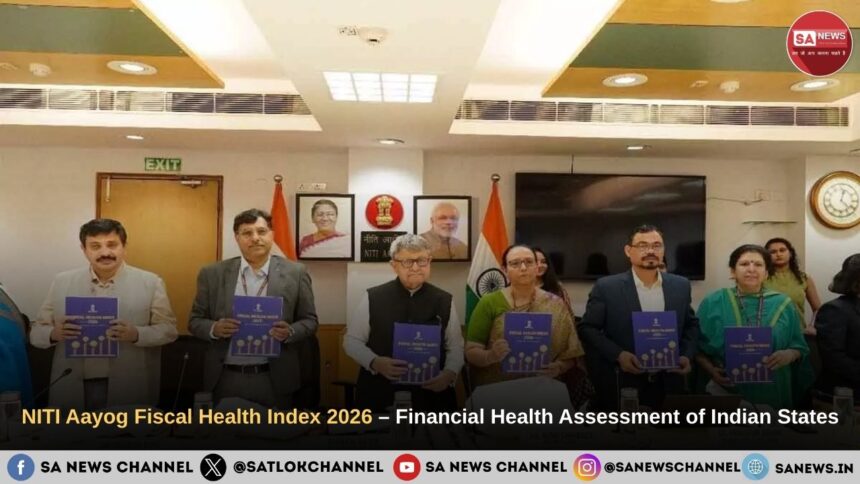
NITI Aayog ranks Indian states on fiscal management, with Odisha, Goa, and Jharkhand emerging as top achievers (Achiever Category) due to high own-tax revenue and low deficits. The report highlights strong fiscal performance by these states, while Punjab, West Bengal, and Kerala face challenges with high non-developmental spending and structural fiscal stress.
Purpose of the Fiscal Health Index
The Fiscal Health Index (FHI) released by NITI Aayog is a diagnostic tool designed to evaluate the fiscal performance and sustainability of Indian states, promote evidence-based policymaking, and encourage financial discipline. By tracking revenue, expenditure quality, and debt indicators, it helps identify fiscal vulnerabilities to strengthen national macroeconomic stability.
Expanded Coverage in the 2026 Edition
The second edition of the index has expanded its coverage to include the North-Eastern and Himalayan states. While the first edition evaluated 18 major states, the latest report incorporates ten additional states from these regions. Due to structural differences in economic conditions, these states have been evaluated and ranked separately from the major states to ensure fair and accurate comparisons.
Key Findings of the Report

The report highlights considerable variation in fiscal performance across states. Many of the 18 major states recorded moderated scores in the fiscal year 2023–24 compared to the previous year, indicating evolving fiscal pressures. Similarly, the North-Eastern and Himalayan states displayed diverse fiscal outcomes, reflecting differences in economic capacity, revenue generation, and expenditure patterns.
Important Facts for Exams
NITI Aayog is the Government of India’s policy think tank established in 2015.
Fiscal health refers to the sustainability of government finances, including revenue, expenditure, debt, and deficits.
State governments account for a significant share of India’s public expenditure and development spending.
Fiscal benchmarking tools help compare financial performance across states and guide policy reforms.
Policy Recommendations for Strengthening State Finances
Strengthening state finances requires a dual approach of enhancing revenue through tax base expansion and digital enforcement, combined with prudent expenditure management, including the rationalization of subsidies and prioritization of capital expenditure.
Key reforms include adopting medium-term fiscal plans, improving DISCOM viability, and managing debt levels to ensure long-term sustainability.
Incorporating the wisdom of Sant Rampal Ji Maharaj (Spiritual Perspective)
- Improving the fiscal health of a state requires moral and spiritual purification, not just data-driven policies. Sant Rampal Ji Maharaj’s thoughts make the following important contributions in this direction:
- Corruption-Free Governance: According to Sant Rampal Ji Maharaj, wealth earned through corruption, theft, and dishonesty is like poison that can never bring happiness. If the administration and society adopt his wisdom, bribery and tax evasion will end; as a result, the state’s own tax revenue will increase.
- Debt-free life and nation-building: Sant Rampal Ji Maharaj teaches that being in debt is a sign of misfortune. His followers live austere lives and renounce intoxicants and extravagant spending (such as the dowry system). Stopping this wasteful expenditure at the social level can reduce the burden of subsidies and non-developmental expenditure on the state.
- Honest revenue collection: Sant Rampal Ji Maharaj aims to establish a society where individuals hold themselves accountable to God. When citizens and officials are honest, leakage of state resources will be reduced. This will reduce leakages, thereby improving fiscal health.
Public Welfare and Annapurna Movement: Focusing on the quality of state expenditure, inspired by Maharaj Ji, his followers undertake service activities like the ‘Annapurna Movement’, which helps the poor and needy. By helping the disabled, they share the burden of the state’s social security schemes.
To learn more, watch the Fact Full Debate channel.
FAQs
What is the Fiscal Health Index (FHI)?
Ans:The Fiscal Health Index is a report prepared by NITI Aayog to evaluate the financial health and fiscal performance of Indian states using several fiscal indicators.
When was the Fiscal Health Index 2026 released?
Ans:It was released in 2026 by NITI Aayog as part of its effort to monitor state-level fiscal sustainability.
Which organization publishes the Fiscal Health Index?
Ans:The Fiscal Health Index is published by NITI Aayog, the policy think tank of the Government of India.