

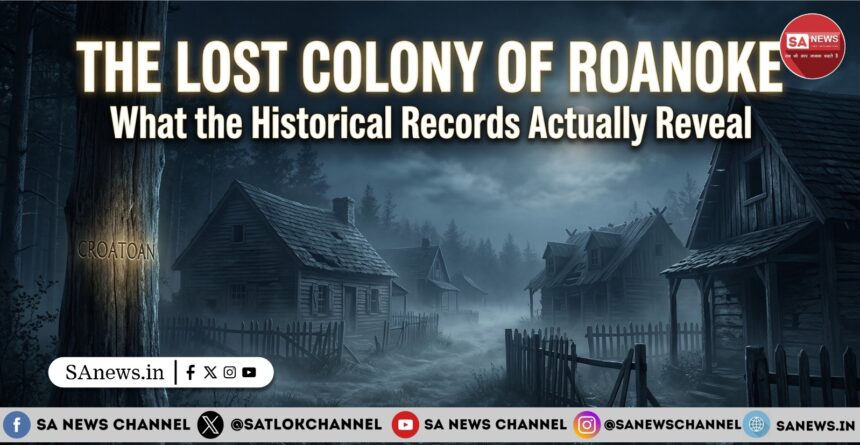
The Lost Colony of Roanoke: Imagine leaving your family on a distant island, promising to return soon with supplies, only to come back years later and find that they have vanished without a trace. This was the fate that awaited John White when he returned in 1590 to the English settlement on Roanoke Island after a three-year absence. The houses stood empty, the settlers had disappeared, and the only clue left behind was a single word carved into wood. Known today as the Roanoke Colony disappearance, this event remains one of the most enduring mysteries in early American history.
- A Brief Timeline of the Roanoke Colony
- 1584 – Exploration of the Carolina Coast
- 1585 – First English Settlement Attempt
- 1586 – The First Colony Is Abandoned
- 1587 – Arrival of the ‘Lost Colony’ Settlers
- 1587 – John White Sails Back to England
- 1588 – War Delays White’s Return
- 1590 – The Colony Has Disappeared
- A Return to Silence
- Roanoke: The Colony That Was Meant to Last
- Why John White Could Not Return
- The Only Clue: ‘CROATOAN’
- Early Colonial Accounts and Rumours
- How Historians Interpret the Evidence
- Archaeology and Modern Investigations
- The Hidden Fort on the Map
- Archaeological Work by the First Colony Foundation
- Discoveries of Early English Artefacts
- The Silence of the Record: Uncovering the Disappearance of Civilisations
- Why Civilisations Disappear: Sant Rampal Ji Maharaj Reveals the Hidden Force Behind Humanity’s Misery
- FAQs: The Mystery of the Roanoke Colony
While countless theories have emerged over the centuries, the historical record itself tells a quieter and more complex story. For more than four centuries, historians and researchers have tried to answer one enduring question: what happened to the settlers of Roanoke? Let us explore.
A Brief Timeline of the Roanoke Colony
Before moving into the mysterious case of the disappearance of the Roanoke Colony, let us briefly glance through the sequence of events that occured:
1584 – Exploration of the Carolina Coast
An expedition sponsored by Walter Raleigh surveys the coastline of present-day North Carolina and identifies Roanoke Island as a promising site for an English settlement.
1585 – First English Settlement Attempt
England establishes a small military outpost on Roanoke Island. However, the colony faces severe shortages of supplies and strained relations with nearby indigenous communities.
1586 – The First Colony Is Abandoned
The settlers leave the island and return to England with Francis Drake, temporarily ending the first attempt at colonisation.
1587 – Arrival of the ‘Lost Colony’ Settlers
A new group of settlers led by John White arrives with the intention of establishing a permanent English community. During this year Virginia Dare was born on the island.
1587 – John White Sails Back to England
Facing shortages of food and supplies, White returns to England to organise a relief expedition for the colony.
1588 – War Delays White’s Return
England prepares to defend itself against the Spanish Armada, preventing White from returning to the colony immediately.
1590 – The Colony Has Disappeared
White finally returns to Roanoke Island and finds the settlement deserted. The only trace left behind was the word ‘CROATOAN’ carved in, hinting at Croatoan Island.
A Return to Silence
In August 1590, after a difficult journey across the Atlantic, John White finally reached the shores of Roanoke Island. Three years earlier, he had departed for England with the hope of securing supplies and support for the struggling settlement of hundred and fifteen fellow countrymen he had left behind. Among the colonists waiting for his return were his own daughter and granddaughter (Eleanor Dare and Virginia Dare) making the journey back not only a mission of duty but also one of deep personal longing.
However, what White discovered upon his return was not the thriving colony he had hoped to see.
- The settlement stood eerily silent.
- The houses appeared to have been carefully dismantled, the fortifications were gone and there was no sign of the men, women or children who had once lived there.
- No bodies, no signs of battle and no clear evidence of catastrophe remained, only an unsettling emptiness.
Yet the abandoned settlement was not entirely without a clue. A lone word, ‘CROATOAN’, was inscribed on a wooden post. The meaning of that word and what it revealed about the fate of the missing colonists, would become one of the central questions surrounding the Roanoke Colony disappearance, a mystery that historians continue to debate more than four centuries later.
To understand how an entire settlement could disappear so completely, it is necessary to return to the beginning of the colony itself and the ambitions that first brought English families to Roanoke Island.
Roanoke: The Colony That Was Meant to Last
The settlement that John White returned to in 1590 had not been intended as a temporary outpost. It was part of a larger vision promoted by the English courtier and explorer Sir Walter Raleigh, who sought to establish England’s first permanent colony in the lands across the Atlantic. Backed by royal approval and driven by the promise of trade, exploration and influence in the New World, Raleigh organised expeditions to the region along the coast of present-day North Carolina.
By 1587, a new group of settlers set sail for Roanoke Island. Unlike earlier expeditions that consisted largely of soldiers and explorers, this group included entire families – men, women and children, who hoped to build a stable community far from England. Their arrival marked a significant shift in England’s colonial ambitions. The goal was no longer merely exploration but the establishment of a lasting settlement.
It is important here to also recall the geopolitical situation in the world. It was a time when European countries like England, Spain, Portugal, etc. were also conquesting land and making colonies to establish their dominance in the world and further their trade interests.
Soon after the colonists arrived, a symbolic moment reinforced these hopes for permanence. In August 1587, Virginia Dare was born on Roanoke Island, becoming the first English child known to have been born in the New World. Her birth seemed to signal the beginning of a new chapter for England across the Atlantic – a future in which families might build new lives on distant shores.
However, the fragile colony faced immediate challenges, such as shortages of supplies and uncertain relations with neighbouring indigenous communities. In response to these difficulties, the settlers urged White to return to England to obtain much-needed assistance. Reluctantly, he agreed, leaving the colony behind with the promise that he would return as soon as possible.
Why John White Could Not Return
When John White left the settlers on Roanoke Island in 1587, the plan was simple. He would travel back to England, gather supplies and return as quickly as possible. The colonists depended on this promise, as the young settlement faced shortages of food, tools and other essential resources needed for survival in an unfamiliar land.
However, events unfolding in Europe soon made White’s return far more difficult than anyone had anticipated. At the time, England was locked in a growing conflict with Spain, one of the most powerful empires of the era. In 1588, tensions escalated dramatically when Spain launched the Spanish Armada, a massive naval campaign intended to invade England and challenge its rising influence.
The threat of invasion forced England to prioritise its defence. Ships that might otherwise have sailed across the Atlantic were instead requisitioned for military use. Under these circumstances, organising a voyage back to the distant colony became nearly impossible. White spent months and eventually, years, attempting to secure passage back to Roanoke, but the ongoing war and the shortage of ships repeatedly delayed his plans.
As a result, the settlers who had expected White’s quick return were left isolated far longer than anyone had intended. By the time he finally managed to sail back across the Atlantic in 1590, the colony had been without outside support for three years – a long and uncertain period for a small and vulnerable community on the edge of an unfamiliar continent.
The Only Clue: ‘CROATOAN’
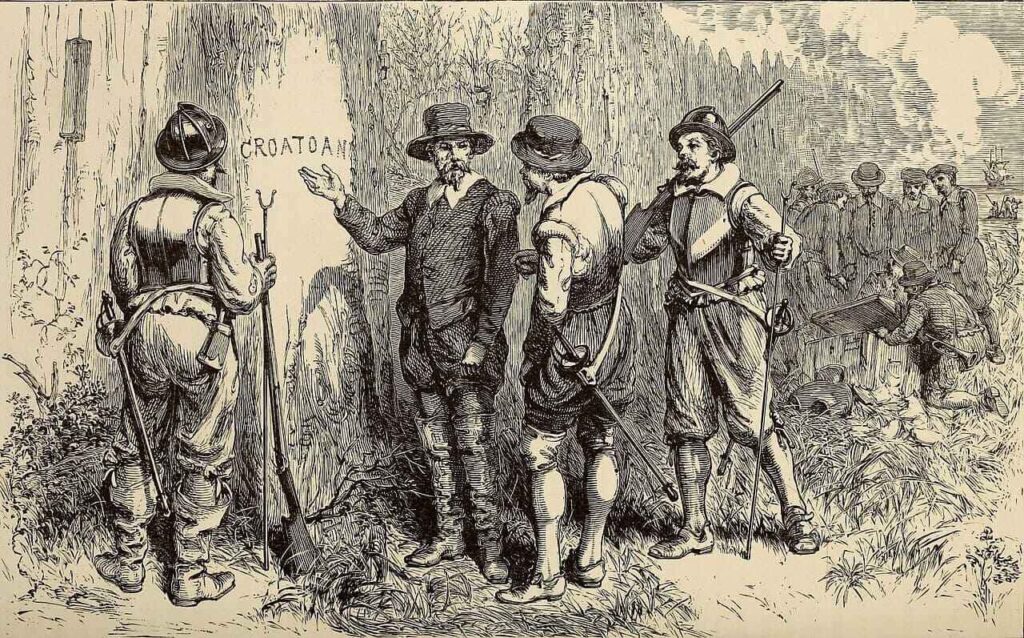
When John White finally returned to the abandoned settlement on Roanoke Island in 1590, the absence of the colonists was deeply troubling. However, the deserted colony did not appear to have been left in haste or under violent circumstances. The houses had been carefully dismantled, suggesting that the settlers may have deliberately relocated rather than fled suddenly.
Amid the silence of the abandoned settlement, White discovered the only clear clue left behind by the missing colonists. The wooden post bore a solitary word, ‘CROATOAN’, a name he knew all too well. Before leaving the colony in 1587, White had agreed with the settlers that if they were forced to move to another location, they would carve the name of their destination so he could follow their trail.

Title: John White at the ‘Croatoan’ inscription
According to this arrangement, if the colonists had been compelled to leave under threat or danger, they would also carve a Maltese cross alongside the message as a distress signal. When White examined the carving, however, he found no such symbol. The absence of the cross suggested that the settlers may have relocated willingly rather than under immediate attack.
Also Read: The Black Death in 14th Century Europe: How History’s Deadliest Plague Killed 50 Million People
The word ‘Croatoan’ itself referred to Croatoan Island, an island located south of Roanoke that was home to a Native American community known to have friendly relations with the English settlers. White believed this might indicate where the colonists had gone and he hoped to sail there to continue his search. Unfortunately, severe storms and dangerous sea conditions prevented the expedition from reaching the island.
As a result, the message carved into wood remained the only tangible clue left by the missing settlers. From that moment onward, the story of the Roanoke Colony disappearance moved from the realm of documented events into the uncertain territory of interpretation, where historians continue to debate what ultimately became of the colony.
Early Colonial Accounts and Rumours
Although the immediate trail of the Roanoke settlers seemed to end with the carving of ‘CROATOAN’, later English colonists in North America recorded intriguing reports that hinted at possible encounters between the missing settlers and indigenous communities. These accounts, written years after the disappearance, provide fragmentary clues that have continued to influence historical interpretations.
One of the most frequently cited sources comes from William Strachey, who arrived in Virginia in the early seventeenth century. In his writings about the region, Strachey recorded stories told by indigenous groups suggesting that some Europeans had once lived among them. According to these reports, certain tribes claimed to have encountered or even killed people who were believed to be survivors from an earlier English settlement.
Similar observations appear in the accounts of John Smith, one of the leaders of the colony at Jamestown. Smith wrote that some indigenous communities possessed objects of European origin, including iron tools that were not commonly produced by local societies at the time. Such items raised the possibility that contact may have occurred between Native groups and the settlers who had once lived on Roanoke Island.
These scattered reports do not provide definitive answers about the fate of the colony, but they suggest that the disappearance of the settlers may not have been a sudden or mysterious vanishing. Instead, some historians believe the colonists may have moved inland or integrated with Indigenous communities, leaving behind traces that later observers only partially understood.
However, the reliability of these accounts remains uncertain. Much of the information recorded by early writers was based on second-hand stories, collected years after the events themselves. As a result, these narratives offer tantalising hints rather than conclusive evidence, adding another layer of complexity to the enduring mystery of the Roanoke Colony disappearance.
How Historians Interpret the Evidence
Because the available historical evidence is limited, historians have proposed several interpretations of what may have happened to the missing settlers. Two notable perspectives come from Lee Miller and James Horn, whose conclusions illustrate how the same pieces of evidence can lead to contrasting historical narratives.
Lee Miller argues that the fate of the colonists may have been far more violent than the traditional narrative suggests. Drawing on early colonial accounts, particularly those recorded by William Strachey, Miller proposes that some of the settlers may have been killed during conflicts between indigenous groups. Strachey’s writings describe reports that certain tribes had destroyed people believed to be English settlers living among neighbouring communities. Miller interprets these accounts as possible evidence that the Roanoke colonists initially integrated with local groups but later became victims of intertribal warfare. In this view, the disappearance was not a peaceful relocation but a tragic episode shaped by the unstable political landscape of the region.
By contrast, historian James Horn presents a more cautious interpretation grounded primarily in the known agreements made by the colonists themselves. Horn emphasises the significance of the message carved at the abandoned settlement and the earlier understanding between John White and the settlers that they would indicate their destination if they relocated. The word ‘CROATOAN’, therefore, may represent exactly what it appears to be – a deliberate signal that the colonists had moved toward Croatoan Island, where they had established friendly relations with a local Indigenous community. According to Horn, the settlers may have gradually merged with these communities, leaving few identifiable traces in the historical record.
Although just two references, given the limited scope of this article, these differing interpretations demonstrate the central challenge historians face when studying Roanoke. With only a handful of contemporary documents and scattered later reports, scholars must piece together a narrative from incomplete evidence. As a result, the mystery of the lost colony has become not only a historical puzzle but also a reminder of how history itself is shaped by the ways in which evidence is interpreted and is not necessarily correct always.
Archaeology and Modern Investigations
More than four centuries after the disappearance of the settlers, historians and archaeologists continue to search for evidence that might explain the fate of the Roanoke Colony disappearance. Modern investigations combine historical documents with archaeological research, and several discoveries have opened new possibilities about what may have happened to the colonists.
The Hidden Fort on the Map
One of the most intriguing clues comes from a map created by John White during the early English explorations of the region. This map, known as the ‘La Virginea Pars’, shows the coastline of what is now North Carolina.
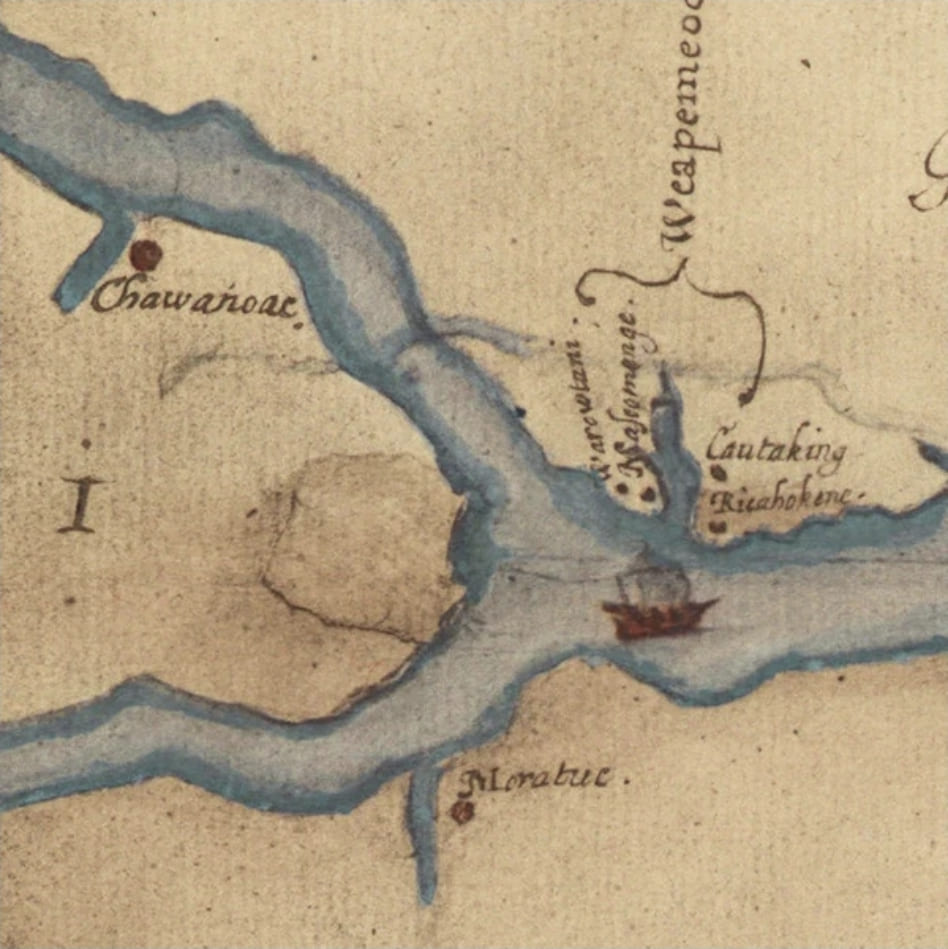
Title: Section of the ‘La Virginea Pars’ map
Centuries after the map was produced, researchers noticed a small patch of paper covering part of its surface. When the patch was examined more closely, a faint symbol resembling the outline of a fort appeared beneath it.
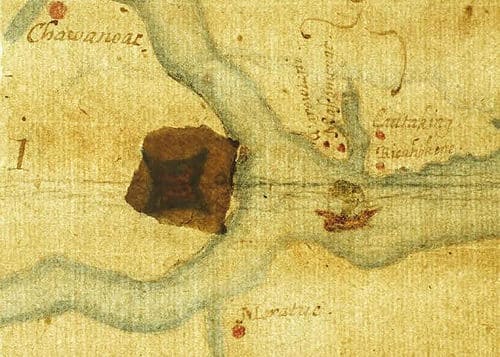
Symbol beneath the patch
Some historians believe this may indicate that White marked a possible inland relocation site for the settlers. If this interpretation is correct, the colonists may have planned to move away from the vulnerable coastal settlement toward a more secure inland location.
Archaeological Work by the First Colony Foundation
The discovery of the hidden map symbol prompted further investigations by the First Colony Foundation, a group dedicated to researching the history of England’s earliest American settlements.
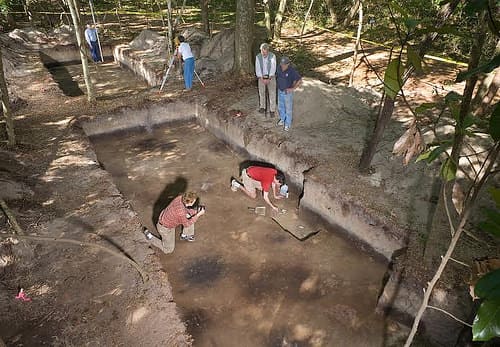
Archaeologists associated with the foundation have carried out excavations at locations inland from Roanoke Island that correspond with the suspected fort site. Their work aims to determine whether the missing settlers may have attempted to establish a new community after leaving the original colony.
Although the investigations are ongoing, the excavations have produced several artefacts such as copper plates, fragments of ceramic dating back to the 16th century, Venetian beads, etc., that appear to date from the late sixteenth century.
Discoveries of Early English Artefacts
Among the most significant discoveries are fragments of English pottery and other small objects associated with early colonial life. These artefacts were found at inland sites rather than on the island itself, suggesting that at least some settlers may have travelled into the interior.
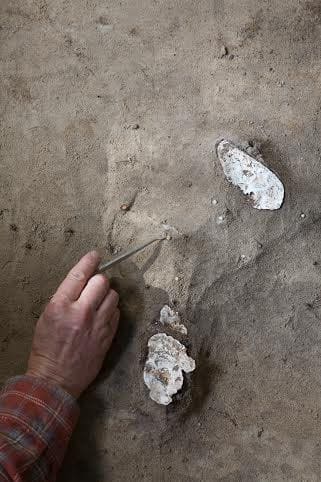
Title: Excavation of Venetian beads
While the evidence is still limited, these discoveries provide a possible explanation for the disappearance of the Roanoke colonists. Instead of vanishing entirely, they may have relocated and gradually integrated into the surrounding landscape and communities.
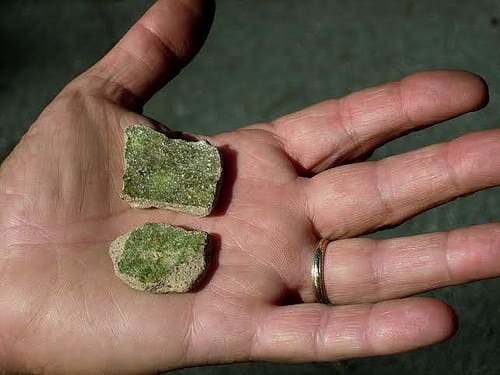
Title: Pottery remains from the late 16th century
Yet even with these archaeological clues, the mystery remains unresolved. Each new discovery brings historians closer to understanding what might have happened, but the full story of Roanoke continues to elude definitive explanation.
The Silence of the Record: Uncovering the Disappearance of Civilisations
More than four centuries after John White stood before the deserted settlement on Roanoke Island, the fate of the colonists remains suspended between record and interpretation. The surviving documents tell us only a small part of the story – a struggling settlement, a delayed return and a single carved word pointing toward Croatoan Island.
Everything beyond that point, whether theories of political intrigue, accounts preserved by later writers like William Strachey, or modern historical interpretations offered by scholars such as Lee Miller and James Horn, represents our attempts to fill the silence left by the historical record.
It is crucial to recognise that the mystery surrounding vanished colonies is not just the silence of historical records. History itself shows that entire civilisations have disappeared, with or without documentation. The question is not whether records exist, but why they vanished. Doesn’t the sudden disappearance of entire civilisations strike you as suspicious? Can human life be so easily erased?
A striking analogy comes from the teachings of Jagatguru Tatvdarshi Sant Rampal Ji Maharaj: He explains that the entire lineage of Lord Krishna was annihilated by a curse from Rishi Durvasa. Pause for a moment and think – if even the lineage of a deity could be wiped out so completely, what chance do ordinary humans have? Who, then, is truly behind such catastrophic events? Can it all be dismissed as mere fate or is there a deeper, more sinister force at work?
Why Civilisations Disappear: Sant Rampal Ji Maharaj Reveals the Hidden Force Behind Humanity’s Misery
Sant Rampal Ji Maharaj exposes a harsh truth. We are mere puppets in the hands of Kaal Brahm, known as Satan in the Western world. Every conflict, every suffering that plagues the world feeds him, keeping souls trapped in misery. But why? What does Kaal Brahm truly gain from our pain?
This is where hope shines through the darkness. Sant Rampal Ji Maharaj divulges, this period within the Kalyug is the golden period for true worship that can lead to complete salvation. Only the authentic devotion to Supreme God Kabir, the Creator, imparted by a Tatvdarshi Sant, can grant complete salvation. Through such worship, the soul can finally break free from the vicious cycle of life and death under Kaal’s dominion over 21 universes.
However, Kaal’s cunning interest is in distraction. He keeps us endlessly busy in conflict, fear and trivial pursuits, leaving no room for the soul to even glimpse the real God. This is why we obsess over lesser mysteries, like missing historical records, while the greater truths, such as the disappearance of entire civilisations, remain ignored. Wake up before the puppeteer tightens his strings further.
The time to awaken to the grand conspiracy against humanity is NOW. Human life is not meant for endless struggle or confusion, it exists for the true worship of our Father, Supreme God Kabir, leading the soul to salvation and its return to Satlok (the eternal, singular realm of immortality).
But this liberation is only possible through worship imparted by a True Saint (Tatvdarshi Sant). In today’s era, that Saint is Sant Rampal Ji Maharaj, whom even Nostradamus foretold as the Great Chyren.
With the world teetering on the brink of a third world war, there has never been a more critical moment to uncover the true story of our origin and reclaim our rightful place in Satlok, the original civilisation of eternal peace.
To know more, visit:
Website: www.jagatgururampalji.org
YouTube: Sant Rampal Ji Maharaj
Facebook: Spiritual Leader Saint Rampal Ji
‘X’ handle: @SaintRampalJiM
FAQs: The Mystery of the Roanoke Colony
Q1) What really happened to the settlers of the Roanoke Colony?
Answer: The Roanoke settlers vanished mysteriously, with theories ranging from assimilation with local tribes to deadly hardships.
Q2) Why did the Roanoke Colony disappear without a trace?
Answer: The colony disappeared without a trace due to possible famine, disease, or conflict with Indigenous peoples.
Q3) What does the historical evidence reveal about the Roanoke mystery?
Answer: Historical evidence offers clues but no definite answers, keeping the Roanoke disappearance an enduring mystery.