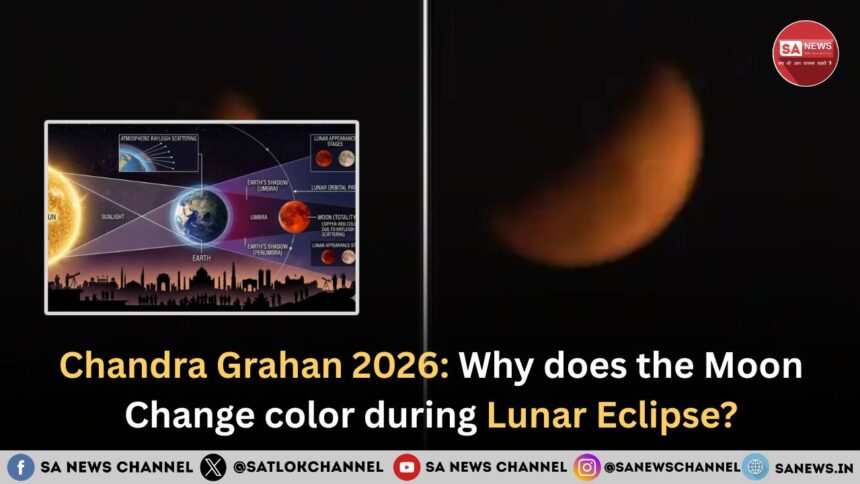
A total lunar eclipse (Chandra Grahan) on March 3, 2026, will turn the Moon red—often called a “Blood Moon”—because Earth blocks direct sunlight and instead filters it through our atmosphere. This process scatters blue light away, allowing only red/orange wavelengths to bend around Earth and light up the Moon, acting like all sunsets on Earth hitting the Moon at once.
Key Details for 2026:
- Date: March 3, 2026.
- Cause: The Earth moves directly between the Sun and the Moon, casting its dark shadow (umbra) on the Moon.
- Why Red? Earth’s atmosphere scatters blue light and bends (refracts) red light, causing it to glow, rather than turn completely black.
- Visibility: Visible over the Americas, Australia, New Zealand, and East Asia.
- Duration: The peak phase is expected around 4:50 a.m. ET (March 3) or 6:33 PM–6:40 PM IST.
What is a lunar eclipse?
When the Earth comes between the Sun and the Moon during a lunar eclipse, the Earth’s shadow falls on the Moon.
This condition occurs only on a full moon.
The general sequence is:
Sun → Earth → Moon
Why does the Moon turn red?
Now the real question—when the Earth’s shadow falls on the Moon, why doesn’t it turn completely black? Why does it appear red?
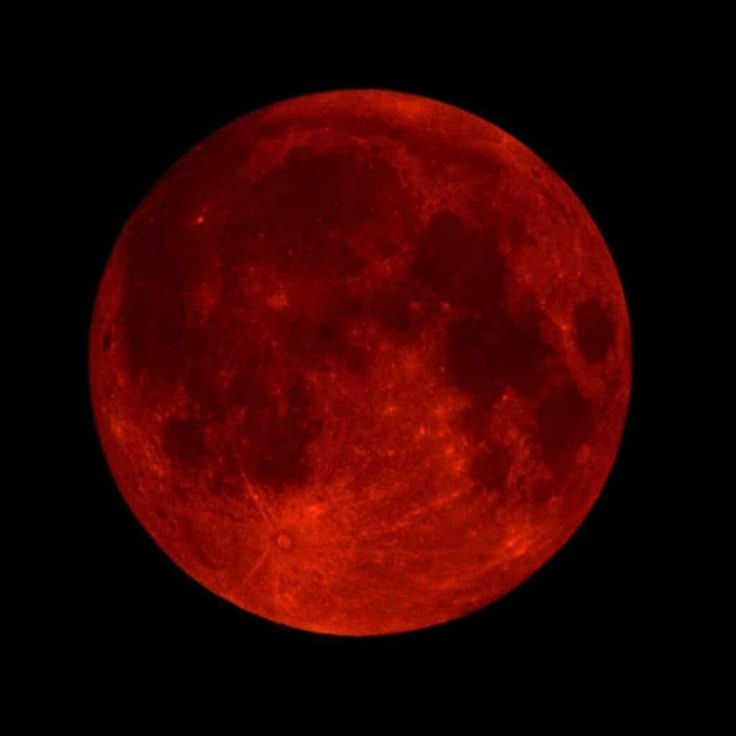
The reason for this is the Earth’s atmosphere.
- Sunlight has many colors (the colors of the rainbow).
- When this light passes through Earth’s atmosphere, it:
- Blue light is scattered more (which is why the sky appears blue).
- Red and orange light are scattered less.
- During a lunar eclipse:
- The Earth blocks direct light from reaching the Moon.
- This red light gives the moon a red or coppery color.
Why is it called a “Blood Moon”?
When the entire Moon passes into Earth’s deep shadow (umbra), it is called a total lunar eclipse.During this time, the Moon may appear dark red. That is why it is commonly called “Blood Moon”.
Is the color the same every time?
No.
The moon’s color depends on:Dust and pollution in Earth’s atmosphere Volcanic eruptions (if recent) Weather conditions
Sometimes the moon appears pale red, sometimes dark brown or orange.Just as the sun appears red at sunrise and sunset, the moon appears red during a lunar eclipse.
Spiritual Viewpoint of Sant Rampal Ji Maharaj
It is said in the discourses of Sant Rampal Ji Maharaj that:
- An eclipse is a natural (astronomical) phenomenon.
- It is not correct to associate it with any inauspicious event or fear.
- Only devotion to God and true knowledge can make a person’s life safe and successful.
- By taking initiation from a true Satguru and doing devotion, a person can attain liberation from the cycle of birth and death.
According to him, instead of being afraid or adopting superstition during the eclipse, it is more beneficial to remember God and do true devotion.
FAQs :Chandra Grahan 2026: Why Does the Moon Turn Red During a Lunar Eclipse?
When does a lunar eclipse occur?
Ans: A lunar eclipse occurs only on a full moon day.
What is a lunar eclipse?
Ans: When the Earth comes between the Sun and the Moon and its shadow falls on the Moon, it is called a lunar eclipse.
What is a “blood moon”?
Ans: When the moon appears deep red during a total lunar eclipse, it is commonly referred to as a “blood moon.”
Is a lunar eclipse inauspicious?
Ans: Scientifically, it is a natural astronomical event; there is nothing inauspicious about it.